
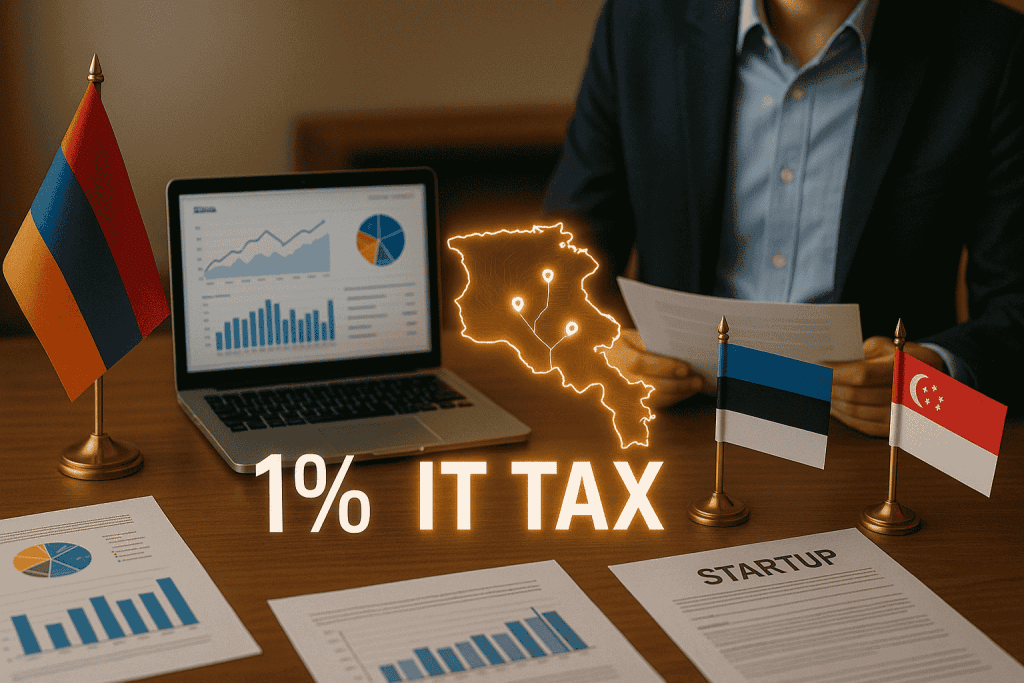
Discover how Armenia's revolutionary tax framework is creating one of the world's most attractive environments for tech startups, digital nomads, and IT companies.
Explore Armenia's Tax GuideThe Global Search for Tax Efficiency
In today's digital economy, tech entrepreneurs face a crucial decision that can significantly impact their bottom line: where to establish their business. With remote work and digital services becoming the norm, tech founders have unprecedented freedom to choose jurisdictions that offer the most favorable tax environments.
Estonia has long been celebrated for its e-Residency program and innovative tax approach. Singapore has established itself as a global business hub with attractive incentives. But a new player has emerged with what might be the most compelling offer yet: Armenia's 1% IT tax rate.
This comprehensive analysis compares the tax systems of these three countries specifically for tech entrepreneurs, examining how each jurisdiction handles:
Corporate Income Tax
How profits are taxed in each country
Dividend Taxation
Rules for extracting profits from your business
Compliance Burden
Administrative requirements and complexities
By the end of this analysis, you'll understand why Armenia's approach to tech business taxation is creating a significant competitive advantage for early-stage tech companies and digital entrepreneurs.
Armenia's Revolutionary 1% IT Tax Framework
Beginning January 2025, Armenia has introduced a groundbreaking tax framework specifically designed for technology companies and IT professionals. The centerpiece of this initiative is a 1% turnover tax rate that replaces both standard profit tax (18%) and VAT (20%).
Key Features:
- Ultra-low 1% turnover tax on gross revenue (compared to 18% profit tax)
- Revenue-based taxation rather than profit-based, simplifying accounting
- Valid through 2031, providing long-term planning stability
- No need for complex expense tracking for tax purposes
- Quarterly filing requirements rather than monthly
- 200% salary deduction for technical staff (for companies on general tax system)
Qualification Requirements:
- Annual revenue must not exceed AMD 115 million (approximately $300,000)
- At least 90% of revenue must come from qualifying high-tech activities
- Registration in Armenia's state registry for high-tech businesses is mandatory
This targeted approach makes Armenia particularly attractive for early-stage startups, freelance developers, and tech consultancies with relatively high profit margins.
Estonia's E-Residency and Tax Deferral System
Estonia has pioneered digital governance and attracted global entrepreneurs with its innovative e-Residency program. The Estonian tax system is built around a unique approach to corporate taxation that has made it popular among digital entrepreneurs.
Key Features:
- 0% tax on reinvested profits - only distributed profits are taxed
- Standard 22% tax on distributed profits (calculated as 22/78 of net payment)
- E-Residency program allowing non-residents to establish and manage Estonian companies
- Fully digital tax filing and compliance systems
- Simplified accounting for small businesses
- Access to EU markets and banking
Important Considerations:
- E-Residency is not tax residency - companies may still face taxation in their operational jurisdictions
- Corporate tax rate increased from 20% to 22% as of January 2025
- Companies must establish substance if they wish to access certain benefits
- Banking can be challenging for companies without genuine Estonian operations
- May still require VAT registration (20% Estonian VAT)
Estonia's system excels for companies that reinvest profits for growth, but becomes less advantageous when owners need to extract profits regularly.
Singapore's Corporate Tax Incentives
Singapore has established itself as a premier global business hub with a strong reputation for stability, legal certainty, and favorable tax policies. For tech companies, Singapore offers a competitive tax environment bolstered by numerous incentives.
Key Features:
- Flat 17% corporate tax rate on profits
- Tax exemption scheme for new startups:
- 75% exemption on first S$100,000 of chargeable income
- 50% exemption on next S$100,000 of chargeable income
- Applicable for first 3 consecutive years of operation
- 200% tax deduction on qualifying R&D expenditures
- Extensive double taxation treaties with over 80 countries
- No capital gains tax
- Access to ASEAN market and regional trade agreements
Important Considerations:
- Relatively high cost of living and operations
- Requires substantial substance for tax benefits
- Complex compliance requirements compared to Armenia and Estonia
- Significant minimum capital requirements for certain benefits
- May need to demonstrate job creation for Singaporeans
Singapore offers a solid tax package for companies with substantial operations, though the overall cost structure may be prohibitive for early-stage startups.
Head-to-Head Comparison
| Feature | Armenia | Estonia | Singapore |
|---|---|---|---|
| Standard Tax Rate | 1% on turnover | 0% on retained profits 22% on distributed profits |
17% on profits |
| Tax Base | Gross Revenue | Distributed Profits | Net Profits |
| Dividend Taxation | Included in 1% turnover tax No additional tax |
22% corporate tax No additional personal tax |
0% withholding tax for individuals |
| VAT/GST | Not required under turnover tax system |
20% (€40,000 threshold) | 8% (S$1M threshold) |
| Accounting Complexity | Very Simple Revenue tracking only |
Moderate | Complex |
| Filing Frequency | Quarterly | Monthly + Annual | Annual + Estimated |
| Special Incentives | 200% salary deduction for tech staff |
Digital business infrastructure |
R&D incentives IP development box |
| International Recognition | Growing | Strong | Excellent |
| Key Limitations | Revenue cap of ~$300,000 |
Substance requirements for tax benefits |
High operational costs Complex compliance |
| Best For | Early-stage startups Freelancers High-margin tech |
Growth-focused companies Reinvesting profits Digital businesses |
Established companies Regional headquarters IP-focused businesses |
Effective Tax Rate Comparison
The following table demonstrates the effective tax burden for a tech company with $200,000 annual revenue and 40% profit margin across all three jurisdictions:
| Metric | Armenia | Estonia | Singapore |
|---|---|---|---|
| Annual Revenue | $200,000 | $200,000 | $200,000 |
| Profit (40%) | $80,000 | $80,000 | $80,000 |
| Distributed Profit (50%) | $40,000 | $40,000 | $40,000 |
| Tax Calculation | 1% of $200,000 | 22% of $40,000 | 17% of $80,000 (with partial exemption) |
| Total Tax | $2,000 | $8,800 | ~$8,500 |
| Effective Tax Rate (% of Revenue) |
1.0% | 4.4% | 4.25% |
| Effective Tax Rate (% of Profit) |
2.5% | 11.0% | 10.6% |
As the comparison demonstrates, Armenia's 1% turnover tax creates a dramatically lower tax burden for qualifying tech businesses compared to both Estonia and Singapore.
Practical Examples: The Tax Impact in Action
Let's explore how Armenia's 1% turnover tax model works in real-world scenarios for different types of tech businesses.
Example 1: Software Development Startup
Company Profile:
- Annual Revenue: $250,000
- 6 developers on team
- Profit Margin: 30%
Standard Taxation:
$75,000 profit × 18% =
$13,500 tax
Armenia 1% Tax:
$250,000 × 1% =
$2,500 tax
Annual Savings: $11,000
This example is for illustrative purposes based on typical market conditions.
Example 2: Digital Product Company
Company Profile:
- Annual Revenue: $280,000
- 5 developers on team
- Profit Margin: 40%
Standard Taxation:
$112,000 profit × 18% =
$20,160 tax
Armenia 1% Tax:
$280,000 × 1% =
$2,800 tax
Annual Savings: $17,360
This example is for illustrative purposes based on typical market conditions.
Example 3: Strategic Growth Planning
A growing tech company can strategically manage growth to maximize tax benefits:
Years 1-2: Turnover Tax Phase
- Maintain revenue under threshold
- Benefit from 1% turnover tax
- Reinvest tax savings in R&D
- Build tech infrastructure
Year 3: Preparation Phase
- Plan transition to general taxation
- Implement accounting systems
- Structure for 200% salary deduction
- Train staff on compliance
Year 4+: Growth Phase
- Transition to general taxation
- Utilize 200% R&D salary deduction
- Expand market reach
- Consider structure optimization
This strategic growth scenario illustrates how companies can plan their development phases to maximize available tax benefits while scaling operations.
Why Armenia's 1% IT Tax Rate Wins
For Early-Stage Startups
- Maximum Cash Preservation - Critical for bootstrap operations
- Simplicity - Focus on building product, not compliance
- Predicable Tax Planning - Fixed percentage of revenue
- Lower Entry Barriers - Minimal initial capital requirements
- Easier Fundraising - Better economics attract investors
For Tech Freelancers
- Minimized Tax Burden - Keep more of what you earn
- Simplified Accounting - Track revenue, not expenses
- Quarterly Filings - Less administrative overhead
- No VAT Complications - Included in the turnover tax
- Legitimately Global - Work from anywhere with legal structure
Competitive Advantage in Numbers
90%+
Potential tax savings compared to standard corporate tax rates in most countries
7 Years
Of tax certainty through 2031, allowing for stable business planning
2-3 Days
To register a company and begin operations with expert guidance
Frequently Asked Questions
1. Can foreign entrepreneurs qualify for Armenia's 1% IT tax rate?
2. What happens when my company exceeds the revenue threshold?
3. How does Armenia's 1% tax compare to Estonia's 0% tax on reinvested profits?
4. What types of tech activities qualify for the 1% rate?
5. Do I need to live in Armenia to benefit from the tax incentives?
6. How does banking work for an Armenian tech company?
7. Is Armenia's 1% IT tax program likely to remain stable?
Making Your Decision: Which Tax System Is Right for You?
After comparing Armenia, Estonia, and Singapore's tax systems for tech entrepreneurs, it's clear that each jurisdiction offers distinct advantages for different business profiles and growth stages.
Choose Armenia If:
- You're an early-stage startup or freelancer
- Your annual revenue is under $300,000
- You operate with high profit margins
- You want maximum tax efficiency and simplicity
- You regularly distribute profits to owners
Choose Estonia If:
- You reinvest all profits for long-term growth
- You need EU market presence
- You value digital governance infrastructure
- You don't plan to distribute profits for years
- You need EU banking access
Choose Singapore If:
- You're an established company with substance
- You need access to Asian markets
- You require extensive treaty protection
- You have significant IP development
- You value maximum business credibility
For tech entrepreneurs focused on maximizing early-stage growth and profitability, Armenia's 1% IT tax rate stands out as the clear winner, offering unprecedented tax efficiency combined with operational simplicity.
Ready to Leverage Armenia's 1% IT Tax Advantage?
Discover how tech companies worldwide are strategically reducing their tax burden by up to 90% while maintaining full legal compliance.
Download Your Free Guide Now