
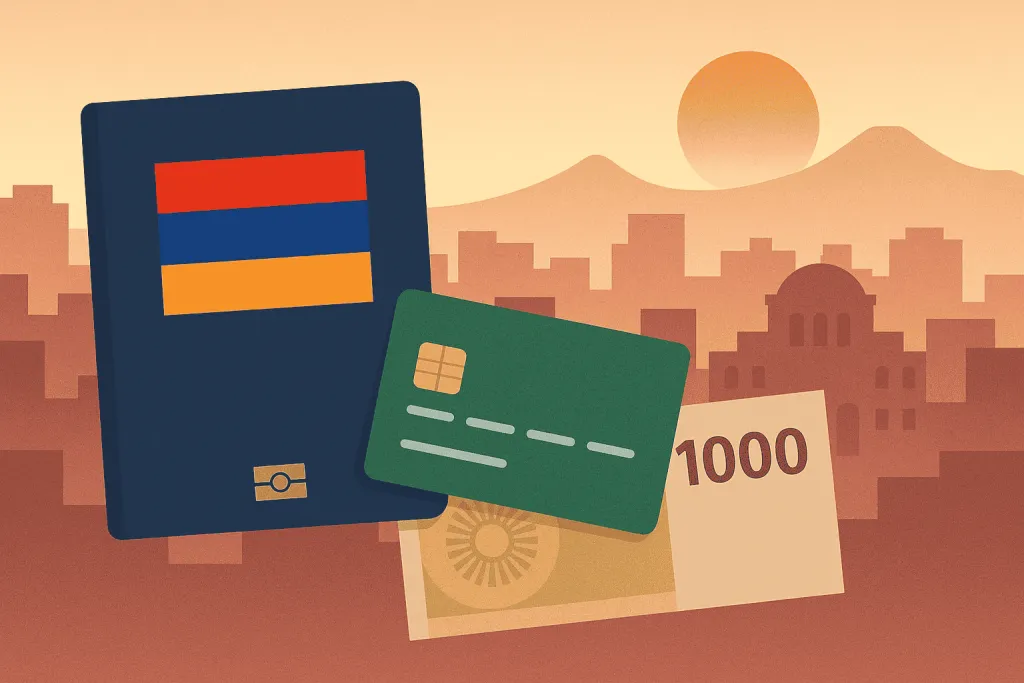
A comprehensive guide to navigating the Armenian banking system, understanding documentation requirements, and choosing the right financial institution for your specific needs in 2025.
Introduction to Banking in Armenia
Armenia has emerged as an attractive destination for foreign entrepreneurs, digital nomads, and expats looking for both business opportunities and lifestyle benefits. The country's banking sector has undergone significant transformation in recent years, developing into a robust financial ecosystem that caters to both locals and foreigners.
With 18 commercial banks operating in the country as of 2025, Armenia offers a competitive banking environment with innovative services, attractive interest rates, and increasingly foreigner-friendly policies.
Did you know?
According to recent statistics, Armenia's banking sector has seen a 61% increase in profitability in 2024 compared to the previous year, and the combined assets of Armenian banks are nearly equivalent to the country's GDP.
Key Benefits for Foreigners in 2025
Understanding the Armenian Banking System
The banking system is the dominant component of Armenia's financial market, accounting for approximately 83.5% of the country's financial system assets. All banks in Armenia are licensed and regulated by the Central Bank of Armenia, providing a secure environment for your finances.
Key Features of Armenian Banking
Market Structure
The five largest banks (Ameriabank, Ardshinbank, ACBA Bank, AMIO Bank, and Inecobank) hold approximately 64% of the total loan portfolio, creating healthy competition that drives innovation and service improvements.
Regulatory Environment
Armenia's banking sector follows international standards. The Central Bank of Armenia implements robust regulations to ensure stability and protect consumers, with special attention to anti-money laundering protocols.
Deposit Insurance
Bank deposits in Armenia are protected by the Deposit Guarantee Fund. For deposits in AMD, the guarantee covers up to 16 million AMD, while for foreign currency deposits, the coverage is up to 7 million AMD.
International Recognition
Fitch has affirmed Armenia's B+ rating and Moody's has affirmed it at B1, reflecting confidence in the country's financial system. Several Armenian banks have received positive ratings from international agencies.
Banking System Stability
Types of Bank Accounts Available for Foreigners
Armenian banks offer various account types to meet different needs. Understanding these options will help you choose the most suitable account for your specific situation, whether you're an entrepreneur, digital nomad, or long-term expat.
Current (Checking) Accounts
Basic accounts for everyday transactions, bill payments, and regular access to funds.
- Available in multiple currencies (AMD, USD, EUR, RUB, etc.)
- Usually free or low-cost to open for residents
- May have small opening fees for non-residents (5,000-15,000 AMD)
- Typically includes debit card access
Savings Accounts
Interest-bearing accounts designed for saving funds with limited transactions.
- Higher interest rates than current accounts
- Opening fees range from 2,000-20,000 AMD for non-residents
- May have minimum balance requirements
- Interest paid varies by currency (highest for AMD)
Business Accounts
Specifically designed for company operations, with enhanced transaction capabilities.
- Required for legally registered businesses
- Supports business operations and tax payments
- Often comes with business online banking access
- May have higher fees but more services
Specialized Accounts
Special-purpose accounts for specific needs:
- Escrow Accounts: For secure transaction settlements
- Metal Accounts: For investing in precious metals
- Joint Accounts: Shared access for multiple individuals
- Term Deposits: Fixed-term savings with higher interest
Resident vs. Non-Resident Accounts
Understanding the distinction between resident and non-resident accounts is crucial for foreigners:
| Feature | Resident Account | Non-Resident Account |
|---|---|---|
| Documentation Required | Passport + social card/ID card | Passport + additional documents |
| Opening Fee (typical) | Free or minimal (0-2,000 AMD) | Higher (10,000-20,000 AMD) |
| Maintenance Fee | Often free | May have monthly fees (1,000-3,000 AMD) |
| Due Diligence | Standard | Enhanced |
| Remote Opening Options | Widely available | Limited but improving |
Note: Requirements and fees may vary between banks. Non-residents from certain countries may face stricter requirements due to international compliance protocols.
Step-by-Step Account Opening Process
Opening a bank account in Armenia as a foreigner requires following specific procedures and preparing the right documentation. This process can be completed in-person or, increasingly, through remote channels.
In-Person Application Process
Step 1: Prepare Required Documentation
Gather all necessary documents before visiting the bank:
- Valid passport (with at least 6 months validity)
- Proof of address (utility bills, rental agreement, or hotel address for temporary visitors)
- Residency card (if available, some banks may require this)
- Social Services Number (not mandatory but recommended, costs 1,000 AMD and takes about 15 minutes to obtain)
- Source of income documentation (employment contracts, business ownership proof, etc.)
- Purpose of account (personal statement explaining why you need an Armenian bank account)
Step 2: Select a Bank and Visit a Branch
Research and choose a bank that best meets your needs, then visit a branch with your documentation. Major banks like Ameriabank, Evocabank, and ID Bank have English-speaking staff at many locations.
When visiting the bank:
- Ask for an English-speaking representative if needed
- Be prepared to explain your residence status and financial needs
- Some branches in Yerevan's city center are more accustomed to serving foreigners
Step 3: Complete Application Forms
Fill out the account opening forms provided by the bank. These typically include:
- Personal information form
- Tax residency declaration
- FATCA form (for US citizens)
- Beneficial owner declaration (for business accounts)
- Service agreement
Most banks have forms available in English, but translation assistance may be provided if needed.
Step 4: KYC Interview and Verification
Bank staff will conduct a "Know Your Customer" (KYC) interview to understand your banking needs and verify your information. Be prepared to answer questions about:
- Purpose of the account
- Expected transaction volumes and types
- Source of funds
- Your activities in Armenia
- Connections to politically exposed persons (if any)
Step 5: Account Activation and Card Issuance
After approval, which can take from 30 minutes to several days for non-residents:
- Pay any applicable account opening fees
- Receive your account details and online banking credentials
- Order a debit card (can be issued immediately at some banks or within 3-5 business days)
- Make an initial deposit if required
Important Consideration for Specific Nationalities
Armenian banks have specific requirements for citizens of certain countries:
- Russian citizens need to provide proof of residence in Armenia (property ownership or rental agreement) and proof of income source.
- Iranian citizens typically need a Residency Card and may face restrictions on account currencies (some banks only offer AMD accounts).
- Citizens from FATF high-risk countries (Iran, North Korea) face enhanced due diligence procedures.
Obtaining a Social Services Number
While not always mandatory, having a Social Services Number (SSN) simplifies the banking process:
- Visit any branch of the RA Migration and Citizenship Service
- Present your passport
- Pay a fee of approximately 1,000 AMD
- The process takes about 1 day to complete
Top Banks Comparison for Foreigners
Not all Armenian banks are equally accommodating to foreign clients. Here's a comparison of the top banks for expatriates and foreign entrepreneurs in Armenia:
Ameriabank
Armenia's largest bank
Foreign-Friendly Features
- Full English-language service
- Multi-currency accounts
- Remote account opening available
- International wire transfers
- Robust mobile banking app
Account Opening Fees
Free for basic accounts, up to 10,000 AMD for premium services
Monthly Maintenance
0-5,000 AMD depending on account type
Best For
Business owners, high-net-worth individuals, those needing comprehensive banking services
Evocabank
Armenia's leading digital bank
Foreign-Friendly Features
- Award-winning digital services
- English mobile interface
- Fast remote account opening
- Modern payment solutions
- Competitive foreign exchange rates
Account Opening Fees
Free for online application, up to 5,000 AMD in-branch
Monthly Maintenance
Free for standard accounts
Best For
Digital nomads, tech-savvy users, those preferring remote banking
IDBank
Known for high deposit rates
Foreign-Friendly Features
- High interest rates (up to 9.05%)
- Simplified documentation for foreigners
- Non-resident remote account opening
- English-speaking staff
- Competitive fees for international transfers
Account Opening Fees
3,000 AMD standard fee
Monthly Maintenance
Free for most account types
Best For
Savers, investors, those seeking high deposit returns
ACBA Bank
Strong regional presence
Foreign-Friendly Features
- Good coverage outside Yerevan
- Business banking expertise
- Agricultural sector focus
- Fee-free ATM network
- Modern digital services
Account Opening Fees
Free for residents, 5,000-10,000 AMD for non-residents
Monthly Maintenance
1,000-3,000 AMD depending on services
Best For
Business owners outside Yerevan, agricultural entrepreneurs
Inecobank
Strong in SME banking
Foreign-Friendly Features
- Specialized business solutions
- User-friendly mobile app
- Free current accounts
- Competitive loan products
- English-language support
Account Opening Fees
Free with online registration
Monthly Maintenance
From free to 1,500 AMD
Best For
Small and medium business owners, entrepreneurs
Ardshinbank
Highest profit-generator
Foreign-Friendly Features
- Extensive ATM network
- Fee-free withdrawals
- Strong in mortgage lending
- Good regional coverage
- Competitive interest rates
Account Opening Fees
Free for basic accounts, premium services have fees
Monthly Maintenance
0-2,000 AMD depending on account type
Best For
Property investors, those needing wide ATM access
Digital Banking Options
Armenia's banking sector has embraced digital transformation, making it increasingly convenient for foreigners to manage their finances remotely. Here's what you need to know about digital banking options in Armenia in 2025:
Mobile Banking Apps
Most major Armenian banks offer feature-rich mobile applications with capabilities essential for foreigners:
- Multi-language interfaces - Most banking apps offer English, Russian, and Armenian interfaces. Ameriabank and Evocabank provide the most comprehensive English-language mobile experiences.
- Remote account management - View balances, transaction history, and account details without visiting a branch.
- International transfers - Initiate and track cross-border transfers with competitive fees.
- Currency conversion - Exchange between multiple currencies at competitive rates directly in the app.
- Card management - Block/unblock cards, set spending limits, and enable/disable international transactions.
- Bill payments - Pay utilities and other local services through integrated payment systems.
Online Banking Platforms
Web-based banking platforms offer more comprehensive features than mobile apps, particularly useful for business customers:
- Enhanced security features - Multi-factor authentication and advanced encryption protect your finances.
- Detailed statements - Generate and download comprehensive transaction reports and statements.
- Business tools - Batch transactions, payroll processing, and multiple user access for business accounts.
- Document submission - Upload and manage documentation requirements digitally.
- Investment management - Access to deposit products, bonds, and other investment opportunities.
- Customer support - Integrated messaging systems to communicate with bank representatives in English.
Leading Digital Banking Solutions for Foreigners
Evoca Digital
Evocabank's digital platform offers:
- Fully digital onboarding process
- Complete mobile banking functionality
- Instant P2P transfers
- Virtual card issuance
- Biometric authentication
Ameria Online/Mobile
Ameriabank's digital services feature:
- Comprehensive English interface
- Advanced business tools
- Investment portfolio management
- International transfer tracking
- Remote document submission
InecoMobile
Inecobank's mobile solution provides:
- Simple, intuitive interface
- Biometric login options
- QR code payments
- Fee-free internal transfers
- Regular feature updates
Digital Banking Security Tips for Foreigners
- Use secure networks - Avoid conducting banking transactions over public Wi-Fi networks.
- Enable notifications - Set up transaction alerts to monitor account activity in real-time.
- Update regularly - Keep your banking apps updated to benefit from the latest security enhancements.
- Use biometric authentication - Enable fingerprint or face recognition for added security.
- Monitor statements - Regularly review your transaction history and report any suspicious activity immediately.
- Use strong passwords - Create complex, unique passwords for your banking accounts.
Digital Banking Trend in Armenia
Armenia has been advancing a comprehensive digital ID scheme as part of its open data vision, which is streamlining banking processes and enabling more sophisticated digital banking services. This development is particularly beneficial for foreign users who can increasingly manage their accounts entirely through digital channels.
Banking Fees and Costs
Understanding the fee structure of Armenian banks is crucial for managing your finances effectively. Here's a comprehensive breakdown of typical fees you might encounter as a foreign account holder in Armenia:
Account Opening and Maintenance Fees
| Fee Type | For Residents | For Non-Residents | Notes |
|---|---|---|---|
| Checking Account Opening | Free | 10,000-15,000 AMD | Some banks offer free opening for premium clients |
| Savings Account Opening | Free-2,000 AMD | 2,000-20,000 AMD | Higher interest rates offset these fees |
| Business Account Opening | 0-5,000 AMD | 15,000-25,000 AMD | Additional verification fees may apply |
| Monthly Maintenance (Personal) | 0-1,000 AMD | 0-3,000 AMD | Often waived with minimum balances |
| Monthly Maintenance (Business) | 2,000-5,000 AMD | 5,000-25,000 AMD | Higher for foreign-owned companies |
| Online/Mobile Banking | Free-500 AMD | Free-1,000 AMD | Most banks offer free digital banking |
Note: Remote account opening is often free or discounted compared to in-branch services.
Card Issuance and Usage Fees
| Fee Type | Typical Range | Notes |
|---|---|---|
| Debit Card Issuance | Free-5,000 AMD | Standard cards often free, premium cards have fees |
| Card Annual Fee | 0-10,000 AMD | Varies by card tier and bank |
| ATM Withdrawals (Same Bank) | Free | Almost all banks offer free withdrawals at their ATMs |
| ATM Withdrawals (Other Banks) | 0.5-1.5% (min. 1,000 AMD) | Some premium accounts offer free withdrawals at all ATMs |
| International ATM Withdrawals | 1.5-3% (min. 1,500 AMD) | Additional fees may be charged by the ATM operator |
| Card Replacement | 2,000-5,000 AMD | Expedited replacement may cost more |
Transfer and Transaction Fees
| Fee Type | Typical Range | Notes |
|---|---|---|
| Domestic Transfers (Same Bank) | Free | Transfers between accounts at the same bank |
| Domestic Transfers (Different Bank) | 200-500 AMD | Lower fees via digital channels |
| International Transfers (Outgoing) | 0.1-1% (min. 5,000-7,000 AMD) | Varies by destination, currency, and amount |
| International Transfers (Incoming) | 0-0.2% (max. 20,000 AMD) | Some banks offer free incoming transfers |
| Currency Conversion | 0-2% spread from market rate | Digital conversion often has better rates |
| Cash Deposits | Free-0.3% | Higher fees for large cash deposits |
| Cash Withdrawals (Branch) | 0-0.5% | Some accounts have withdrawal limits |
Business-Specific Fees
| Fee Type | Typical Range | Notes |
|---|---|---|
| Business Payment Processing | 1-3% | For merchant services and payment acceptance |
| Payroll Processing | 0-200 AMD per transaction | Batch transfers often have discounted rates |
| Business Online Banking | 0-5,000 AMD monthly | Premium features may have additional costs |
| Check Services | 1,000-2,000 AMD per check | Not commonly used in Armenia |
| Statement Certification | 1,000-5,000 AMD | For official documents needed for legal purposes |
| Account Closure | Free | Most banks don't charge for account closure |
Money-Saving Tips for Foreign Account Holders
- Compare fee structures across multiple banks before selecting one
- Consider online-only account options which often have lower fees
- Maintain minimum balances to waive monthly maintenance fees
- Use digital channels for transfers to reduce transaction costs
- Consider multi-currency accounts to reduce conversion fees
- Ask about special packages for expatriates or entrepreneurs
Practical Examples
To illustrate how different types of foreign entrepreneurs and expats might approach banking in Armenia, here are some practical case studies based on common scenarios:
Case Study 1: International Business Owner
Maria is an entrepreneur from Spain who has established an IT services company in Armenia to take advantage of the growing tech ecosystem. She needs comprehensive business banking services for her 10-person team.
Banking Needs:
- Business account with multiple user access
- Payroll processing for employees
- Regular international transactions
- Business advisory services
- Potential credit facilities in the future
Optimal Solution:
Ameriabank's Business Package
Maria visited Ameriabank's main branch in Yerevan with her company registration documents. She selected this bank because:
- Their business banking platform supports multiple user roles and permissions
- They offer dedicated business account managers who speak English
- Their payroll system is integrated with accounting software
- They provide preferential rates for business clients with regular international transactions
- The bank has experience working with foreign-owned IT companies
Result:
Maria's business account was approved within a week after enhanced due diligence. She now manages her company finances through Ameriabank's business online platform, where she can authorize payments, manage employee access, and generate financial reports. The bank also helped her establish relationships with local accounting services familiar with international business requirements.
Case Study 2: Expatriate Family
The Johnsons are an American family who have moved to Armenia for a three-year diplomatic assignment. They need comprehensive personal banking services including accounts for daily expenses, savings, and education funds for their children.
Banking Needs:
- Joint and individual accounts
- High-yield savings options
- Regular transfers from their U.S. accounts
- Multiple cards for family members
- Investment opportunities
Optimal Solution:
ID Bank's Premium Family Package
The Johnson family decided on ID Bank after comparing several options. Their decision was based on:
- The bank's high deposit interest rates (up to 9.05% for AMD deposits)
- A comprehensive package that includes multiple linked accounts
- Experience working with diplomatic families
- The ability to open education savings accounts for their children
- Premium debit cards with travel benefits and insurance
Result:
The family now maintains a multi-currency structure with their daily expenses in AMD, while keeping USD and EUR accounts for savings and international purchases. They have set up recurring transfers from their U.S. bank and use ID Bank's mobile app to monitor all accounts. Mrs. Johnson particularly appreciates the high interest rates on their AMD savings, which are substantially higher than what they could earn in the United States.
Case Study 3: Real Estate Investor
Mikhail is a Russian entrepreneur investing in Armenian real estate. He needs banking services for property purchases, rental income management, and potential mortgage financing.
Banking Needs:
- Secure large transfers for property purchases
- Escrow services for real estate transactions
- Rental income collection
- Potential mortgage financing
- Compliance with regulations for Russian citizens
Optimal Solution:
Ardshinbank's Real Estate Investment Package
Mikhail visited multiple banks before selecting Ardshinbank. Key factors in his decision included:
- The bank's strong reputation in mortgage lending
- Professional escrow services for secure property transactions
- Experience working with Russian investors and understanding of documentation requirements
- Services for managing rental properties and income collection
- Network of branches throughout Armenia for managing properties in different regions
Result:
After providing documentation proving his residence in Armenia (rental agreement) and source of funds, Mikhail successfully opened both personal and business accounts. He now uses Ardshinbank's services for all his real estate transactions, including secure escrow accounts for property purchases and a system for collecting rental payments from tenants. The bank also provided mortgage financing for his latest investment property at competitive rates.
Common Challenges and Solutions
Foreign entrepreneurs and expats often face specific challenges when opening and managing bank accounts in Armenia. Here are the most common issues and practical solutions to help you navigate these obstacles:
Language Barriers
Challenge:
Not all bank staff speak English fluently, and documentation may be primarily in Armenian or Russian, making it difficult to understand terms and conditions.
Solutions:
- Select banks known for their English-language services (Ameriabank, Evocabank, ID Bank)
- Request English versions of all important documents
- Use digital banking interfaces that offer English options
- Schedule appointments in advance and request an English-speaking representative
- Consider bringing a trusted translator for important meetings
Proof of Address Requirements
Challenge:
Providing acceptable proof of address can be difficult for recent arrivals without utility bills or formal rental agreements.
Solutions:
- Use hotel address documentation for temporary visitors
- Get a formal rental agreement (even for short-term stays)
- Request a letter from your employer or host confirming your address
- Some banks will accept foreign utility bills as secondary address proof
- Register with local authorities to obtain official address documentation
Enhanced Due Diligence
Challenge:
Foreign clients, especially from certain countries or with complex business structures, face increased scrutiny under KYC and AML procedures.
Solutions:
- Prepare comprehensive documentation about your source of funds
- Provide clear explanation of business activities and purpose of the account
- Be transparent about international connections and operations
- Consider using legal experts familiar with Armenian banking compliance
- Allow extra time for account approval if you're from a high-risk jurisdiction
International Transfer Complications
Challenge:
International transfers may face delays, high fees, or additional verification requirements, especially for large amounts or certain countries.
Solutions:
- Inform your bank in advance about incoming large transfers
- Ensure sending banks include complete reference information
- Compare transfer fees across banks before selecting one
- Consider digital payment alternatives for smaller amounts
- Maintain documentation explaining the purpose of significant transfers
Business Account Requirements
Challenge:
Opening business accounts often requires extensive documentation about company structure, ownership, and activities that may differ from standards in your home country.
Solutions:
- Work with a local business registration specialist or lawyer
- Prepare detailed documentation about your ultimate beneficial owners
- Have your corporate documents properly translated and notarized
- Be prepared to provide financial statements or business plans
- Consider banks with dedicated departments for foreign businesses
Digital Banking Access Issues
Challenge:
Some digital banking features may have geographical restrictions or require local phone numbers, creating access problems when traveling internationally.
Solutions:
- Obtain a local SIM card for banking authentication purposes
- Set up multiple authentication methods when available
- Test digital banking access before international travel
- Inform your bank about your travel plans
- Use VPN services cautiously (some banks block access via VPNs)
Special Considerations for US Citizens
US citizens face unique challenges due to FATCA (Foreign Account Tax Compliance Act) requirements:
- You will need to complete W-9 forms when opening accounts
- Armenian banks will report your account information to the IRS
- You must report foreign bank accounts on your US tax returns if they exceed certain thresholds
- Consider consulting with a tax advisor familiar with expatriate taxation issues
Frequently Asked Questions
Yes, non-residents can open bank accounts in Armenia with minimal documentation. Most banks require only a valid passport, and some may ask for proof of address. The process is straightforward, and many banks even offer remote account opening for non-residents. However, non-residents may face enhanced due diligence procedures and might be subject to higher fees compared to residents.
Evocabank is widely recognized as Armenia's leading digital bank, having won the "Best Digital Bank in Armenia" and "Best Mobile Banking in Armenia" awards for 2025. Ameriabank also offers excellent digital services and has been recognized for its digital solutions. Both provide comprehensive mobile apps and online banking platforms with English interfaces, making them particularly suitable for foreign users.
Evocabank tends to be preferred by individual users and digital nomads, while Ameriabank's digital platform has more robust features for business users.
As of 2025, Armenian banks offer some of the highest deposit rates globally:
- AMD (Armenian Dram) deposits typically yield 7-9% annually
- USD deposits offer 3-4% annual interest
- EUR deposits provide 1-2% annual interest
These rates vary by bank and term length, with longer-term deposits generally offering higher returns. ID Bank currently offers some of the highest rates, with up to 9.05% on AMD deposits.
Yes, bank deposits in Armenia are protected by the Deposit Guarantee Fund. The insurance coverage limits are:
- For deposits in AMD: up to 16 million AMD (approximately $40,000)
- For foreign currency deposits: up to 7 million AMD (approximately $17,500)
This system ensures a basic level of security for depositors in case of bank failures. All commercial banks operating in Armenia participate in this deposit insurance program.
To open a business account in Armenia, you typically need:
- Certificate of Incorporation/Registration
- Company charter or Articles of Association
- Tax registration certificate
- Passport copies of all directors and significant shareholders (usually those owning 5% or more)
- Proof of company's legal address
- Beneficial ownership declaration
- Business activity description
For foreign companies, these documents should be properly translated and notarized/apostilled. The bank may request additional documentation depending on your business type and structure.
Yes, all major Armenian banks support SWIFT international wire transfers. Fees typically range from 0.1% to 1% of the transfer amount, with minimum charges of 5,000-7,000 AMD. Transfer completion times vary from 1-3 business days depending on the destination country and intermediary banks involved.
Most banks offer preferential rates for digital transfers initiated through online banking platforms. Some banks also support alternative international transfer methods such as card-to-card transfers and specialized payment systems.
Most major Armenian banks, including Ameriabank, Evocabank, HSBC Armenia, ID Bank, and ACBA Bank, offer services in English. This includes English-speaking staff, English documentation, and English interfaces for their digital banking platforms.
Ameriabank and Evocabank are particularly noted for their comprehensive multilingual service. In branches located in Yerevan's center and business districts, finding English-speaking staff is usually not a problem. For more specialized services or at branches in smaller cities, it's advisable to schedule appointments and request English-speaking assistance in advance.
Minimum deposit requirements vary by bank and account type:
- Basic current accounts typically require minimal or no initial deposits (0-10,000 AMD)
- Savings accounts may require minimum deposits of 50,000-100,000 AMD
- Business accounts often have higher minimum requirements, starting from 25,000 AMD
- Premium or specialized accounts may have significant minimum balance requirements
Most banks offer account options with no minimum deposit requirements for standard services, but maintaining certain balances may help waive monthly maintenance fees.
The timeframe for opening a bank account in Armenia varies:
- For residents: Usually 30 minutes to 2 business days
- For non-residents: From 1-10 business days, depending on nationality and documentation
- For business accounts: 3-14 business days, with foreign-owned businesses taking longer
Remote account opening typically takes longer than in-person applications. Citizens from countries with enhanced due diligence requirements (like Iran or certain high-risk jurisdictions) may experience additional delays as banks conduct more thorough verification processes.
Yes, you can continue to manage your Armenian bank account remotely after leaving the country. Most Armenian banks offer comprehensive online and mobile banking platforms that allow full account management from anywhere in the world. You can perform transactions, check balances, receive statements, and manage cards.
However, there are a few considerations:
- Some banks may require local phone numbers for two-factor authentication
- Certain features might have geographical restrictions for security reasons
- Physical cards may have expiration dates requiring in-person renewal
- Some banks might have inactivity fees if the account is not used for a prolonged period
It's advisable to inform your bank about your travel plans and ensure you have multiple ways to access your account remotely.
Ready to Open Your Armenian Bank Account?
Now that you understand the process, requirements, and options for banking in Armenia, you're well-equipped to make an informed decision. Whether you're an entrepreneur establishing a business, a digital nomad seeking a temporary financial hub, or an expat settling for the long term, Armenia's banking system offers solutions to meet your needs.
Remember to compare offerings from different banks, prepare your documentation thoroughly, and consider both in-person and remote account opening options based on your circumstances.
With high interest rates, growing digital capabilities, and increasingly foreigner-friendly services, Armenian banks provide attractive opportunities for managing your finances in this dynamic Caucasus nation.
At a glance
- Armenia has 17 commercial banks supervised by the Central Bank. Foreign entrepreneurs and expats can open personal or corporate accounts at any of them.
- The first account must be opened in person at a branch — video or remote KYC is not accepted for the initial visit.
- You will need a passport, a PSN (Public Service Number from the Migration and Citizenship Service), proof of address, and a tax-residency self-certification.
- AMD term deposits currently yield 7 – 10.5% (short-term) and up to 10.75% (long-term). The CBA refinancing rate is 6.5%.
- Armenia commenced CRS/AEOI automatic exchange in September 2025 with 21 partner jurisdictions. Your account may be reported to your home country.
Last updated June 2026
Opening a bank account in Armenia is a practical first step for foreign entrepreneurs and expats who are relocating, investing, or doing business in the country. The banking sector is stable and well-capitalized, digital banking is mature, and compliance requirements are standardized. Recent regulatory changes — including CRS reporting and new crypto licensing rules — mean you should prepare a proper document set and expect tax-residency disclosures at account opening.
For a complete overview of banking services, see our banking services guide. If you are planning a move, coordinate banking with your residency permit, business registration, and tax setup so everything proceeds smoothly.
Why open a bank account in Armenia — 2026 market snapshot
Armenia’s banking sector has 17 commercial banks supervised by the Central Bank of Armenia (CBA), following the completion of the HSBC Armenia acquisition by Ardshinbank in early 2025. The sector remains profitable and well-capitalized — in 2024, aggregate net profit reached approximately AMD 363 billion, up 61% year-on-year.
AMD deposit rates remain attractive by global standards. As of early 2026, major banks offer 7 – 9.5% on short-term AMD deposits (up to 12 months) and 8 – 10.75% on longer terms. Smaller banks offer up to 10.5%. USD deposits yield 4.25 – 5.75%, while EUR deposits sit around 2 – 2.5%. The CBA refinancing rate stands at 6.5%, reduced from 6.75% in December 2025.
The regulatory landscape has shifted significantly. Armenia commenced participation in the OECD’s Common Reporting Standard (CRS) with its first automatic exchange of financial account information in September 2025, sharing data with 21 partner jurisdictions. Banks now collect tax-residency and tax-ID details from all foreign clients at account opening. New crypto-asset regulations also came into force in early 2026.
For entrepreneurs setting up a company or local presence, Armenia offers a well-regulated banking environment, robust digital channels, and standardized requirements. Coordinate your banking with business registration and tax planning from the start.
Who can open an account — eligibility for foreigners
Both residents and non-residents can open personal bank accounts in Armenia. There is no legal requirement for a residence permit to open an account — any foreigner physically present in the country can apply. However, banks apply enhanced KYC/AML procedures for foreign clients and may exercise discretion on a case-by-case basis.
The first account opening must be completed in person at a bank branch. Video KYC or fully remote onboarding is not accepted for the initial identity verification under current Armenian banking regulations. After the first visit, you can manage your account entirely through digital channels.
Nationality restrictions: There is no universal list of prohibited nationalities. However, banks apply enhanced due diligence for clients from high-risk jurisdictions under FATF guidelines. US citizens are not prohibited but must provide FATCA documentation (W-9 form). Clients from sanctioned countries may face additional scrutiny or refusal at the bank’s discretion.
If you plan to live in Armenia long-term, obtaining a residence permit and a local PSN in advance simplifies the banking process and subsequent tax compliance.
How to get a PSN (Public Service Number)
A PSN (Public Service Number), sometimes called a “social card” or Armenian tax number, is generally required by banks when opening an account. It links your account to local tax records and is used for CRS/FATCA reporting.
The PSN is issued by the Migration and Citizenship Service (not the police). Any foreigner physically present in Armenia can obtain one, regardless of residence permit status. The process takes approximately 15 minutes and costs AMD 1,000 (~$2.50). You will need your passport.
Some banks accept a “declaration of absence” instead of an actual PSN card if you do not yet have one, but this varies by bank. We recommend obtaining your PSN before visiting a bank branch to avoid delays.
Step-by-step — opening a personal bank account in branch
Here is the practical process for opening a personal account as a foreigner in Armenia. Expect the process to take 1 – 2 weeks from your first branch visit to a fully active account.
1. Obtain your PSN. Visit the Migration and Citizenship Service with your passport. This takes about 15 minutes and costs AMD 1,000 (~$2.50).
2. Choose a bank. Consider English-language support, mobile app quality, and the services you need (international transfers, multi-currency accounts, card products). Ameriabank, Evocabank, and IDBank are popular choices among foreigners.
3. Prepare your documents. Bring your passport (original), PSN or social card, proof of local address (rental agreement or similar), and your foreign tax-ID number for the CRS/FATCA self-certification form.
4. Visit the branch in person. The first account opening must be face-to-face. Complete the bank’s application, KYC questionnaire, and tax-residency self-certification. The bank may also request documentation of your source of funds.
5. Receive your account and activate digital access. Once approved, set up e-banking and mobile app access. After the initial in-person verification, all routine operations can be handled digitally.
Document checklist — personal account
| Document | Notes |
|---|---|
| Passport (original) | Required for identity verification. Some banks may request a notarized Armenian translation. |
| PSN / social card | Armenian tax number from Migration and Citizenship Service. Some banks accept a declaration of absence. |
| Proof of local address | Rental agreement, utility bill, or other bank-acceptable evidence. Foreign address may substitute for non-residents. |
| Tax-residency self-certification | CRS/FATCA form with your foreign tax-ID number. US citizens must provide W-9. |
| Source of funds documentation | May be requested depending on the bank and account type. Employment contract, business registration, or bank statements. |
Opening a corporate bank account
Corporate accounts follow a similar KYC process but require additional company documentation: the company charter, state registration certificate, tax registration certificate, and beneficial ownership information. The timeline is typically 4 – 14 business days for foreign-owned companies, as banks conduct enhanced due diligence on the corporate structure and beneficial owners.
An important distinction: corporate deposits are not covered by Armenia’s Deposit Guarantee Fund. Only individual and individual entrepreneur (IE) deposits are insured. Factor this into your cash management strategy.
Coordinate your corporate account opening with business registration to avoid delays. Beneficial ownership must be declared within 40 days of company registration.
Digital banking — top mobile apps for foreigners
Once your account is opened in person, Armenian banks provide robust digital channels for day-to-day operations. Here are the top choices for English-speaking foreigners:
Ameriabank — Named Best Digital Bank in Armenia by Euromoney (2023). Full English UI with SWIFT transfers, FX conversion, card management, and ArCa integration. The most flexible option for non-residents handling international transactions.
Evocabank — Armenia’s first digital bank with a mobile-first platform. Supports ArCa Pay instant transfers and provides 24/7 English-language customer support. A strong choice for tech-savvy users.
Idram + IDBank — A super-app combining an e-wallet with full banking. Offers QR payments, Alipay+ integration, and is the strongest option for domestic QR-based payments. English UI consistency varies.
Several banks launched new digital features in late 2025 and early 2026: AMIO Bank introduced mobile-first deposit opening with preferential rates, Converse Bank added mobile corporate bond purchases, and Ardshinbank rolled out a digital mortgage refinancing workflow. The CBA has also joined the Global Financial Innovation Network (GFIN) and is developing an open banking framework.
International transfers and payment platforms
SWIFT transfers are available at all major Armenian banks. Fees are typically 0.2 – 0.4% of the transfer amount plus minimum/maximum caps set by each bank. Processing takes 1 – 3 business days for USD and EUR, and up to 5 days for more complex routing. There are no systematic correspondent banking issues documented for Armenia as of mid-2026.
Stripe is not available in Armenia as of mid-2026. Businesses that need Stripe can access it indirectly through Stripe Atlas (US entity formation) or Stripe Express, but native Armenian Stripe accounts are not supported.
Payoneer works in Armenia. EasyPay is a local Payoneer for Banks partner, and Easywallet offers native Payoneer integration. PayPal is available for receiving global payments, though direct withdrawal to an Armenian bank account may have limitations.
Typical fees: Account maintenance is generally free or low (a few USD per month) for basic accounts. Card issuance (Visa, Mastercard, ArCa) costs approximately $3 – $10 one-time, with modest or waived annual fees for basic cards. SWIFT incoming transfers are often free or carry a low flat fee.
Deposit rates and deposit insurance
Armenia offers some of the highest deposit yields in the region. As of early 2026, the market-level ranges are:
| Currency | Short-term (up to 12 months) | Long-term (12+ months) |
|---|---|---|
| AMD | 7 – 10.5% | 8 – 10.75% |
| USD | 4.25 – 5% | 5 – 5.75% |
| EUR | 2 – 2.5% | 2 – 2.5% |
The CBA refinancing rate is 6.5% (reduced from 6.75% in December 2025). Larger banks (Ameriabank, Evocabank, ACBA, Inecobank, Ardshinbank, IDBank) generally offer 7 – 9.5% on AMD, while smaller institutions like AMIO, Byblos, and Converse may offer up to 10.5%.
Non-residents pay a 10% withholding tax on interest income from Armenian deposits. This should be factored into your net yield calculations and may be creditable against home-country taxes under applicable tax treaties. See our tax guide for details.
Deposit insurance: Armenia’s Deposit Guarantee Fund covers individual and individual entrepreneur (IE) deposits up to AMD 16 million (~$40,500) for AMD deposits and AMD 7 million (~$17,700) for foreign-currency deposits, per depositor per bank. Corporate deposits are not covered.
Tax reporting — CRS, AEOI, and FATCA
Armenia signed the CRS Multilateral Competent Authority Agreement on January 12, 2024, with a reporting period starting from January 1, 2024. The first automatic exchange of non-resident financial account information took place in September 2025 with 21 partner jurisdictions, as confirmed by the OECD (April 2026). Armenia plans to expand its exchange network in coming years.
For pre-existing accounts (opened before January 1, 2024), reporting is triggered when balances or flows exceed AMD 250,000 (~$630). Banks have been actively collecting and updating tax-residency details from foreign clients since the CRS framework took effect.
Armenia is not a secrecy jurisdiction. If you are a tax resident of a CRS partner country, your Armenian account information — balances, interest, and identifying data — will be shared with your home tax authority.
FATCA: Armenia has a Model II Intergovernmental Agreement (IGA) with the United States, signed in February 2018. US citizens and green card holders must provide W-9 or W-8BEN forms when opening accounts, and are subject to FBAR filing obligations if aggregate foreign account balances exceed $10,000 at any point during the year.
Ensure your self-certifications are accurate, keep your tax-ID numbers current, and coordinate with your advisors on cross-border reporting. Our taxes in Armenia overview covers residency rules, withholding, and filing obligations.
Crypto business banking
Since January 31, 2026, crypto-asset service providers (CASPs) must hold a CBA license to operate in Armenia (CBA Regulation 7/01). Existing operators have a transitional period until January 31, 2027, to obtain licensing. Unlicensed crypto businesses face significant difficulty opening or maintaining bank accounts.
Banks apply enhanced scrutiny to accounts linked to cryptocurrency activity. If your business involves crypto, prepare for additional due diligence questions about the nature and volume of your operations, and ensure you have — or are in the process of obtaining — the required CBA license.
Frequently asked questions
Can I open an Armenian bank account remotely?
Do I need a residence permit to open a bank account?
Where do I get a PSN (Public Service Number)?
Will my Armenian bank account be reported under CRS?
What deposit interest rates can I expect?
Is Stripe available in Armenia?
Opening a bank account in Armenia is straightforward if you prepare your documents in advance, plan for an in-person branch visit, and are ready for the CRS/FATCA tax-reporting requirements. With 17 well-regulated banks, competitive deposit rates, and mature digital platforms, Armenia offers a practical banking base for entrepreneurs and expats from around the world.
For tailored help with banking, account opening, or coordinating your banking with residency, company setup, or tax planning, contact our team.
