
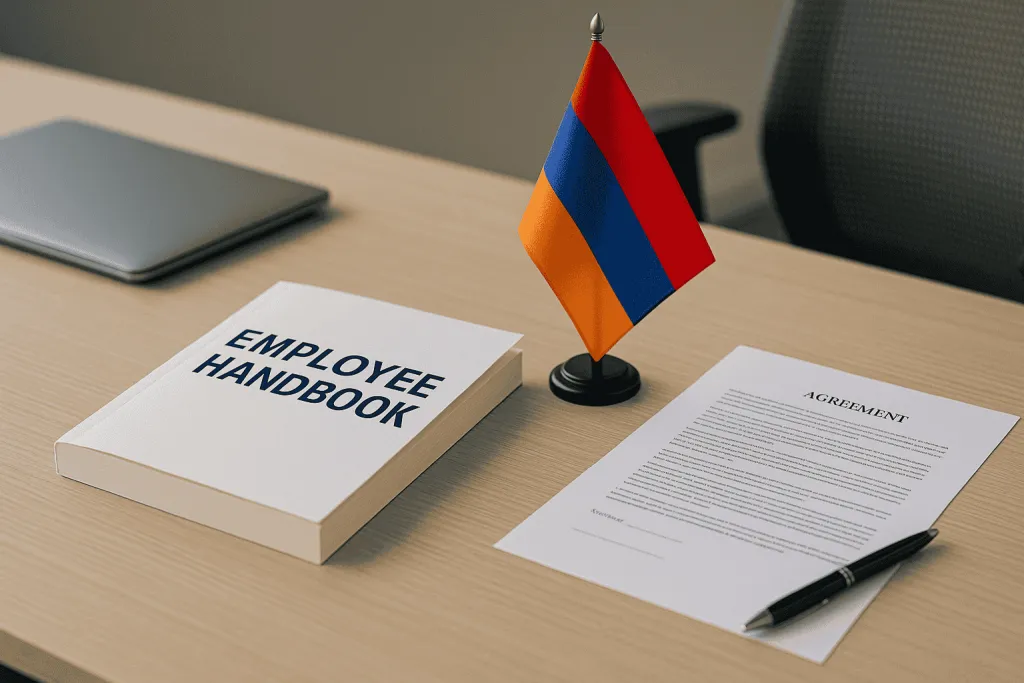
Creating a compliant employee handbook is essential for businesses operating in Armenia, as it serves as a crucial tool for establishing clear workplace policies, communicating legal obligations, and fostering a positive work environment. A well-crafted handbook not only protects your business legally but also helps employees understand their rights and responsibilities under Armenian labor law.
This comprehensive guide will walk you through the step-by-step process of developing a legally compliant employee handbook specifically tailored to Armenia's labor regulations, including practical examples and addressing common scenarios that employers face in the Armenian business landscape.
Understanding Armenia's Legal Framework
Before drafting your employee handbook, it's crucial to understand the legal framework that governs employment relationships in Armenia:
- Labor Code of the Republic of Armenia - Adopted in 2004, this is the foundational legal document that regulates employment relationships in Armenia. It contains 24 chapters and 266 articles addressing various aspects of employment at both collective and individual levels.
- The Constitution of the Republic of Armenia - Contains fundamental provisions related to labor rights.
- Law on Protection of Personal Data - Regulates how employers must handle employee data.
- International treaties - Armenia has ratified various international labor conventions that influence domestic labor practices.
The Armenian labor legislation is built on several key principles, including freedom of work, prohibition of forced labor, legal equality of parties, right to fair working conditions, equality of rights and opportunities, and right to fair remuneration.
Benefits of a Well-Structured Employee Handbook
A properly designed employee handbook offers numerous advantages for both employers and employees in Armenia:
Legal Protection
Helps ensure compliance with Armenia's labor regulations and minimizes legal risks.
Clear Communication
Establishes transparent workplace policies and procedures.
Consistent Management
Provides managers with guidance on handling various employment situations.
Employee Onboarding
Facilitates the integration of new hires into the organization.
Dispute Prevention
Reduces misunderstandings by clarifying expectations and procedures.
Step-by-Step Guide to Creating a Compliant Employee Handbook
1 Gather Essential Legal Information
Begin by collecting all relevant legal materials, including:
- The latest version of the Labor Code of Armenia
- Relevant amendments to labor legislation
- Industry-specific regulations (if applicable)
- International treaties that Armenia has ratified
Practical Example: A tech company in Yerevan must consider not only general labor laws but also specific regulations related to IT professionals, intellectual property, and data protection when preparing their handbook.
2 Define the Handbook's Scope and Structure
Outline the sections that will comprise your handbook based on legal requirements and company needs:
- Introduction and company information
- Employment relationship basics
- Working hours and compensation
- Leave policies and benefits
- Health and safety regulations
- Code of conduct and disciplinary procedures
- Anti-discrimination and equal opportunity policies
- Data protection and privacy
- Dispute resolution procedures
- Termination policies
Practical Example: An international company with offices in Armenia might structure its handbook to address both global corporate policies and specific Armenian legal requirements, clearly delineating which policies apply universally and which are country-specific.
3 Draft Essential Employment Policies
3.1 Employment Contract Information
The handbook should clarify the types of employment contracts used by your organization and their key components, in accordance with Articles 84-96 of the Labor Code:
- Indefinite-term contracts (standard)
- Fixed-term contracts (for specific circumstances)
- Probationary periods (maximum 3 months)
- Contract modification procedures
Practical Example: "At [Company Name], new employees typically begin with a three-month probationary period. During this time, either party may terminate the employment relationship with a three-day written notice. After successful completion of the probation period, employees transition to a standard indefinite-term contract."
3.2 Working Hours and Overtime
Clearly outline working hours policies in compliance with Articles 139-149 of the Labor Code:
- Standard working hours (not exceeding 40 hours per week, 8 hours per day)
- Flexible work arrangements (if offered)
- Overtime regulations (maximum 4 hours per day, 120 hours per year)
- Overtime compensation (at least 1.5 times the regular rate)
- Record-keeping requirements for working time
Practical Example: "Standard work hours are Monday through Friday, 9:00 AM to 6:00 PM with a one-hour lunch break. Any work exceeding 8 hours per day or 40 hours per week is considered overtime and must be pre-approved by management. Overtime is compensated at 1.5 times the employee's regular hourly rate and tracked in the company's time management system."
3.3 Compensation and Benefits
Detail your compensation structure and benefits in accordance with Armenian law:
- Salary payment schedule (at least monthly by the 15th of the following month)
- Minimum wage compliance (currently AMD 75,000 per month)
- Bonuses and incentives
- Social security contributions
- Pension contributions (10% of basic income)
- Additional company benefits
Practical Example: "Salaries are paid monthly via bank transfer on the 10th of each month. All employees participate in the mandatory pension system, with contributions processed according to Armenian law: 5% from employees earning less than AMD 500,000, and 10% minus AMD 25,000 for those earning more."
4 Develop Leave and Time-Off Policies
Elaborate on various types of leave entitlements in accordance with Articles 158-185 of the Labor Code:
4.1 Annual Leave
- Minimum 28 calendar days of annual leave
- Extended leave of 35 days for specific employee categories
- Leave accrual and calculation methods
- Procedures for requesting and approving leave
- Rules regarding carrying forward unused leave
4.2 Maternity and Parental Leave
- 140 days of maternity leave (70 days before and 70 days after childbirth)
- 155 days for complicated pregnancies
- 180 days for multiple births
- Childcare leave until the child reaches 3 years
- Procedures for requesting and documenting family leaves
4.3 Sick Leave and Other Special Leaves
- Sick leave entitlements and documentation requirements
- Educational leave provisions
- Bereavement leave (minimum 3 days)
- Marriage leave (3 days)
- Leave for fulfilling state/public duties
Practical Example: "Employees must submit annual leave requests at least two weeks in advance through our HR portal. Approval is based on business needs and is typically granted on a first-come, first-served basis. During peak business periods (December-January), leave requests may be limited to ensure operational continuity."
5 Establish Health and Safety Policies
Develop comprehensive health and safety policies in accordance with Chapter 23 (Articles 242-262) of the Labor Code:
- General workplace safety requirements
- Emergency procedures and evacuation plans
- Accident reporting protocols
- Special provisions for hazardous work environments
- Regular medical examinations (mandatory for employees under 18)
- Training requirements
Practical Example: "All workplace accidents, regardless of severity, must be reported to the designated safety officer within 24 hours. First aid kits are located on each floor near the elevators. Annual safety training is mandatory for all employees and will be conducted each March."
6 Implement Anti-Discrimination and Equal Opportunity Policies
Based on Article 3 of the Labor Code, craft clear policies promoting workplace equality:
- Prohibited grounds of discrimination (gender, race, nationality, language, religion, social status, etc.)
- Equal employment opportunity principles
- Anti-harassment provisions
- Reporting procedures for discrimination cases
- Investigation protocols
Practical Example: "Our company is committed to providing equal employment opportunities to all individuals regardless of their gender, race, nationality, religion, or any other protected characteristic. Any employee who experiences or witnesses discrimination should report it immediately to their manager or HR department. All reports will be investigated promptly and confidentially."
7 Address Data Protection and Employee Privacy
Incorporate data protection provisions in line with Armenian personal data protection laws:
- Types of employee data collected and processed
- Purpose and legal basis for data processing
- Data security measures
- Employee rights regarding their personal data
- Restrictions on accessing personal information
- Third-party data sharing policies and consent requirements
Practical Example: "Employee personal data is collected solely for employment-related purposes such as payroll, benefits administration, and legal compliance. The company will not disclose employee personal data to third parties without written consent, except where required by law. Employees have the right to access their personal information and request corrections if needed."
8 Develop Code of Conduct and Disciplinary Procedures
Create clear guidelines for workplace behavior and disciplinary actions:
- Expected standards of conduct
- Prohibited behaviors
- Progressive disciplinary measures (verbal warning, written warning, suspension, termination)
- Investigation procedures
- Appeal process
Practical Example: "Progressive discipline typically follows these steps: (1) verbal warning, (2) written warning, (3) final written warning or suspension, and (4) termination. However, the company reserves the right to bypass steps depending on the severity of the misconduct. All disciplinary actions will be documented and maintained in the employee's personnel file."
9 Establish Dispute Resolution Procedures
Define mechanisms for resolving workplace conflicts:
- Internal grievance procedures
- Mediation options
- Escalation pathways
- Reference to external resolution mechanisms (courts, arbitration)
Practical Example: "Employees are encouraged to first discuss concerns with their immediate supervisor. If the matter remains unresolved, employees may submit a formal written grievance to the HR department, which will investigate and respond within 10 business days. If still unresolved, employees may request review by senior management."
10 Outline Termination Policies
Detail termination procedures in accordance with Chapter 15 of the Labor Code:
- Grounds for termination (mutual agreement, contract expiration, employer initiative, employee initiative)
- Notice period requirements (varies from 3 days to 2 months depending on circumstances)
- Severance pay provisions (minimum 2 weeks' salary)
- Final payment procedures
- Return of company property
- Exit interview process
Practical Example: "When an employee resigns, they must provide a written resignation letter with at least 14 days' notice. The HR department will schedule an exit interview and provide information about final pay, benefits continuation, and the return of company property. Final salary payment will include any accrued but unused annual leave."
11 Review for Legal Compliance
Before finalizing your handbook:
- Have it reviewed by a legal expert familiar with Armenian labor law
- Ensure compliance with latest amendments to the Labor Code
- Check consistency with your existing employment contracts
- Verify alignment with any applicable collective agreements
Practical Example: "Following recent amendments to the Labor Code regarding remote work arrangements, our company's legal team updated the handbook to include specific provisions on home office safety requirements, equipment provisions, and monitoring procedures for remote employees."
12 Implement and Communicate
Once your handbook is complete:
- Translate it into Armenian and any other relevant languages
- Distribute it to all employees (digital and/or physical copies)
- Obtain signed acknowledgments from employees
- Provide training on key policies
- Make it easily accessible (intranet, HR portal, etc.)
Practical Example: "During the annual company meeting, HR introduced the updated employee handbook, highlighting key changes and new policies. All employees received digital copies and were required to sign an electronic acknowledgment form confirming they had read and understood the handbook."
13 Regular Review and Updates
Establish a process for keeping your handbook current:
- Schedule annual reviews
- Monitor changes in labor legislation
- Update policies to reflect organizational changes
- Communicate significant updates to employees
Practical Example: "Our HR department conducts quarterly reviews of labor law changes and updates the handbook accordingly. Major revisions are communicated to all employees via email, with training sessions organized for significant policy changes."
Addressing Common Scenarios in Armenian Workplaces
Scenario 1: Remote Work Arrangements
With the increasing trend toward remote work, especially in Armenia's growing tech sector, your handbook should address:
- Eligibility criteria for remote work
- Equipment and technology requirements
- Working hours and availability expectations
- Performance measurement criteria
- Data security protocols for remote workers
Solution: "Our company permits eligible employees to work remotely up to 3 days per week, subject to manager approval. Remote workers must be available during core hours (11 AM to 4 PM), maintain secure connections using company-provided VPN, and attend weekly team meetings via video conference."
Scenario 2: Managing Overtime in Project-Based Work
For industries like IT, consulting, or creative services:
- Clear definition of what constitutes overtime
- Pre-approval requirements
- Compensation or time-off options
- Recording procedures
- Measures to prevent excessive overtime
Solution: "During project deadlines, overtime may be necessary but must be approved in advance. Employees can choose between monetary compensation at 1.5x their hourly rate or equivalent time off within 30 days. No employee will be required to work more than 12 hours per day or 48 hours per week, in accordance with Armenian labor law."
Scenario 3: Handling Extended Leaves of Absence
For managing situations where employees need extended time away:
- Documentation requirements
- Communication expectations during leave
- Job protection provisions
- Return-to-work procedures
Solution: "Employees requiring extended leave must provide appropriate documentation and develop a transition plan with their manager. The company will maintain the employee's position for up to three months, depending on circumstances. Two weeks before returning, employees should contact HR to coordinate their reintegration."
Scenario 4: Language Requirements and Company Communications
In multinational companies operating in Armenia:
- Official language(s) for company communications
- Translation requirements for important documents
- Language proficiency expectations
- Language training opportunities
Solution: "While Armenian is the primary workplace language, important company announcements and policy documents will be provided in both Armenian and English. Language training is available for employees who need to improve their proficiency in either language."
Practical Tips for an Effective Employee Handbook
- Use clear, simple language - Avoid legal jargon and complex terminology. Your handbook should be understandable to all employees.
- Include concrete examples - Illustrate policies with relevant examples to enhance understanding.
- Be comprehensive yet concise - Cover all necessary legal aspects without creating an overwhelming document.
- Include disclaimers - Clarify that the handbook does not constitute an employment contract and that policies may be updated.
- Consider cultural context - Ensure the handbook respects Armenian cultural norms and practices.
- Make it visually appealing - Use formatting, color coding, and visual elements to improve readability.
- Create a table of contents and index - Help employees quickly locate specific policies.
- Add a glossary - Define industry-specific or legal terms used throughout the handbook.
Frequently Asked Questions
Is an employee handbook legally required in Armenia?
While not explicitly required by law, having an employee handbook is highly recommended as it helps demonstrate compliance with Armenia's labor regulations. Certain internal policies related to workplace rules and safety must be documented, and a handbook is an effective way to fulfill these requirements.
What language should the employee handbook be in?
The handbook should be available in Armenian, as this is the official language of the country. If you have international employees, providing translations in relevant languages (e.g., English, Russian) is advisable to ensure all employees can understand the policies.
How often should we update our employee handbook?
Your handbook should be reviewed at least annually to ensure compliance with changing labor regulations. Additionally, updates should be made whenever significant changes occur in company policies or when amendments to the Labor Code affect your workplace practices.
Can we include policies that exceed minimum legal requirements?
Yes, employers are free to offer more favorable conditions than those mandated by law. For example, you can provide more annual leave days than the legal minimum or implement more generous parental leave policies.
How should we handle employee acknowledgment of the handbook?
Have employees sign an acknowledgment form confirming they have received, read, and understood the handbook. This documentation can be important in potential disputes. For digital handbooks, electronic acknowledgments are acceptable.
What are the consequences of non-compliance with labor regulations?
Non-compliance can result in administrative penalties, compensation claims from employees, damaged reputation, and potential legal disputes. In serious cases, employers may face fines and be required to remedy violations.
Conclusion
Creating a compliant employee handbook for your organization in Armenia requires careful attention to the country's labor laws and a thoughtful approach to policy development. By following the step-by-step guide outlined in this article, you can develop a comprehensive handbook that not only ensures legal compliance but also serves as an effective communication tool and valuable resource for both management and employees.
Remember that your handbook should be a living document that evolves with changing legal requirements and organizational needs. Regular reviews and updates, coupled with clear communication about policy changes, will help maintain the handbook's relevance and effectiveness in your Armenian workplace.
Investing time and resources in developing a thorough employee handbook will pay dividends in terms of improved employee relations, reduced legal risks, and a more harmonious workplace culture aligned with both Armenian labor standards and your organizational values.
