
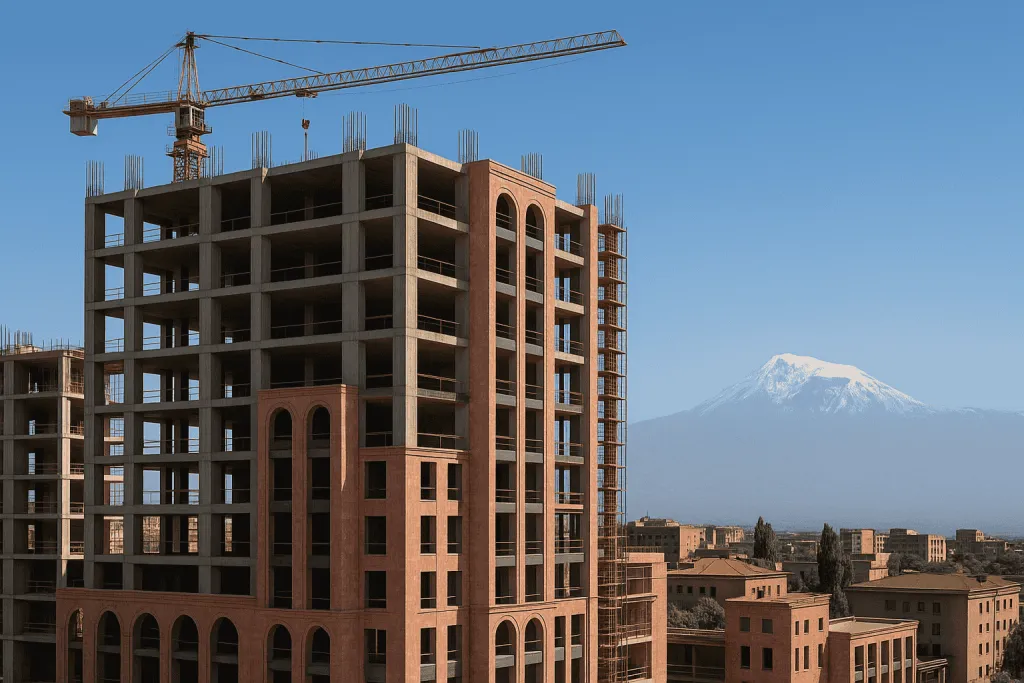
Armenia's real estate construction sector has emerged as a vital economic driver, contributing over 21% to the country's GDP. This comprehensive guide navigates the complexities of developing construction projects in this historically and architecturally rich nation.

The Cafesjian Center for the Arts in Yerevan showcases Armenia's blend of modern and traditional architectural elements
Armenia's construction landscape presents unique opportunities and challenges. From the iconic pink tuff stone buildings of Yerevan to the contemporary structures reshaping the skyline, the country embraces both its architectural heritage and modern development trends. Recent data shows the real estate market achieving a record-breaking total of 247,926 transactions in 2024, indicating robust growth across both Yerevan and provincial regions.
This guide provides a methodical approach to navigating construction projects in Armenia, examining each phase from initial concept to final occupancy. We explore the regulatory framework, architectural considerations specific to Armenia's context, material choices, and key procedures required for successful project delivery.
Current State of Armenia's Construction Market
The construction sector, alongside related industries, has emerged as a central economic pillar in Armenia, contributing over 21% to the country's GDP. According to the Armenian Builders' Association, construction alone accounts for 15.2% of GDP, with this figure rising to 21-22% when including auxiliary industries.
Key Market Indicators:
- Record 247,926 real estate transactions in 2024
- 12% growth in Yerevan's real estate transactions
- 13% growth in provincial real estate activity
- Construction sector contributing 15.2% to Armenia's GDP
- Gegharkunik Province leading regional growth at 15%
The market has experienced notable transformation since 2020, when an economic decline of 7.4% was registered, including a 6.6% drop in construction. Current growth is attributed to several factors:
- Rising income levels among locals
- Favorable tax incentives
- Increased interest from the Armenian diaspora
- Investment from Russian nationals and other foreign investors
- Government initiatives to streamline transaction processes
However, industry experts highlight several challenges that may affect future development:
- Rising utility connection fees
- Delays in government and municipal approval processes
- Regulatory instability affecting investment appeal
- Increasing construction costs due to both global material prices and higher local fees
For example, permit fees for constructing a 14-story building in Yerevan's Arabkir district can reach 50-60 million drams (approximately $125,000-$150,000), significantly impacting project economics.
Planning Phase: Foundations for Success
Effective planning forms the cornerstone of successful construction projects in Armenia. This critical phase involves comprehensive market research, site selection, and financial analysis.
Market Research and Feasibility
Before committing to a construction project in Armenia, conduct thorough market analysis focused on:
- Location analysis: Evaluate areas with growth potential. Currently, Yerevan shows 12% transaction growth, while provinces like Gegharkunik (15%) and Lori (14%) demonstrate even higher growth trajectories.
- Demand assessment: Analyze the target market segment (residential, commercial, mixed-use) and potential buyer/tenant profiles.
- Pricing trends: Research current and projected pricing in your target area.
- Competition analysis: Identify existing and planned developments that may compete with your project.
Financial Planning
Develop comprehensive financial models that account for Armenia's specific construction environment:
- Land acquisition costs: Prices vary significantly by location, with central Yerevan commanding premium rates.
- Construction costs: Budget approximately $500-800 per square meter for standard construction, with premium projects ranging from $1,000-2,000 per square meter.
- Permit and connection fees: These have increased substantially and may constitute 5-10% of total project costs.
- Taxation: Property tax rates, income tax on profits, and VAT implications.
- Financing options: Local banks typically offer construction loans at 9-12% interest rates, while international financing may provide more favorable terms.
Practical Example: Residential Complex Planning
For a mid-size residential complex (10,000 m²) in Yerevan's Arabkir district:
- Land acquisition: $1-2 million (depending on exact location)
- Construction costs: $6-8 million
- Permits and fees: $250,000-400,000
- Professional services (architecture, engineering): $400,000-600,000
- Contingency (10%): $800,000-1.1 million
- Total project budget: $8.45-12.1 million
- Expected selling price: $1,800-2,500 per m²
- Potential revenue: $18-25 million
- Projected ROI: 40-55% (before taxes, over 2-3 years)
Legal Due Diligence
Before purchasing land or commencing design, conduct thorough legal verification:
- Verify clear title through the State Cadastre
- Check for encumbrances, easements, or restrictions
- Review applicable zoning regulations and density requirements
- Investigate any historical or cultural preservation requirements
- Assess access to infrastructure and utilities
Engaging a local legal specialist with expertise in Armenian real estate law is highly recommended, as laws governing property rights have undergone several changes in recent years.
Regulatory Framework and Permitting Process
Navigating Armenia's regulatory landscape requires understanding multiple layers of approval processes. The construction permit system has been gradually modernizing, with increasing digitalization expected by 2025.
Building Regulations
Construction in Armenia is governed by several regulatory frameworks:
- Republic of Armenia Building Code (RABC 20.04) of 2020
- Law of the Republic of Armenia "About town planning"
- Technical regulations for safety, energy efficiency, and seismic design
- Local zoning and municipal development plans
Construction Permit Process
The construction permit process in Armenia follows a sequential procedure with several distinct stages:
Main Stages of the Construction Permit Process:
- Architectural-Planning Assignment (APA): Submit application to the architectural department of the relevant municipality with information on the project purpose, building type, and proposed location. This establishes the technical conditions for building design and use of engineering infrastructure.
- Technical Conditions Approvals: Obtain individual approvals from utility providers:
- Water and sewage approval (Yerevan Water and Sewage Company)
- Telecommunications approval (ArmenTel)
- Electricity approval (ArmElNet)
- Ecological Expertise: For projects larger than 1,000 m², submit to ecological expertise by the Ministry of Ecology.
- Architectural Plan Review: Hire a licensed expert to conduct expertise approval of architectural drawings.
- Construction Permit Application: Submit approved architectural drawings to the municipality for final construction permit.
- Construction Process and Inspections: Notify State Inspection of Urban Development before beginning construction. Expect multiple inspections during construction.
- Final Inspections and Occupancy Permit: Request final municipal inspection upon completion and obtain an occupancy permit.
- Property Registration: Register the completed building with the Cadastre.
Important Timing Considerations:
Based on documented processes in Yerevan, developers should plan for the following timeframes:
- Architectural-Planning Assignment: 38 days
- Technical conditions from water authority: 20 days
- Technical conditions from telecommunications: 7 days
- Technical conditions from electricity provider: 17 days
- Ecological expertise approval: 30 days
- Construction permit issuance: 22 days
- Utility connections: 8-10 days each
- Final inspection and occupancy permit: 28 days
- Property registration: 2-7 days
Total process can take 6-9 months for standard projects, not including construction time.
Fees and Costs
Budget for the following regulatory and administrative costs:
- Ecological expertise fee: AMD 25,000
- Architectural expertise fee: AMD 25,000+
- Construction permit fee: AMD 70,000-963,340 (varies by project size and location)
- Infrastructure use fee and earth excavation/rubbish fee (for Yerevan): AMD 960 per m² + AMD 300 per truck
- Utility connection fees (electricity, water, telecommunications): AMD 2,600-24,000+ per connection
- Property registration: AMD 99,397+ (varies by property size)
Note that actual costs may vary based on project specifics and current fee schedules, which are subject to periodic updates.
Architectural Design and Materials: Honoring Armenia's Heritage
Armenia possesses a rich architectural heritage spanning millennia, from ancient pagan temples to medieval churches and Soviet-era structures. Modern construction often incorporates elements of this legacy while implementing contemporary techniques.
Architectural Considerations
When designing buildings in Armenia, consider the following architectural aspects:
- Contextual harmony: Respect the surrounding urban fabric, particularly in historically significant areas.
- Climate adaptation: Armenia experiences hot summers and cold winters, requiring robust thermal insulation and appropriate solar orientation.
- Seismic design: Armenia is in a seismically active region, necessitating earthquake-resistant construction techniques.
- Cultural elements: Consider incorporating traditional Armenian architectural motifs, proportions, or materials as appropriate.
- Sustainability: Increasing focus on energy efficiency and sustainable design practices.
Traditional Armenian Materials
Armenia's distinctive architecture is defined by its use of local stone, particularly tuff and basalt:

The Garni Temple showcases Armenia's ancient stone architecture
Armenian Tuff Varieties:
Tuff is a volcanic rock formed from ash and mineral deposits, available in 28 natural shades including:
- Ani Tuff: Light shades, the lightest variety
- Artik Tuff (Pink Tuff): A blend of pink, lilac, and violet hues
- Yerevan Tuff: Rich shades of black, brown, and red
- Byurakan Tuff: Notable for its stone inclusions, minerals, and colorful spots
- Felsite Tuff: A unique variant with distinctive features
Properties of Tuff:
- Natural porosity providing thermal insulation
- Excellent soundproofing capabilities
- Water resistance (varies by type)
- Durability in Armenia's climate extremes (-40°C to +40°C)
- Aesthetic versatility through varied natural colors
Basalt, another common Armenian building material, is formed by cooling lava and offers exceptional strength and durability. It's particularly valued for foundations, retaining walls, and decorative elements.
Contemporary Materials and Techniques
Modern construction in Armenia increasingly incorporates:
- Reinforced concrete frames for seismic resistance
- Glass curtain walls for commercial structures
- Energy-efficient windows and insulation materials
- Traditional stone as decorative cladding rather than structural elements
- Composite materials that mimic natural stone but offer improved performance
Sustainable Building Practices
Green building is gaining traction in Armenia, though the market remains nascent:
- Armenia's Nationally Determined Contributions (NDCs) identify urban development, including buildings and construction, as one of six sectors for climate mitigation
- The greatest opportunity lies in retrofits rather than new construction, with building stock growing at less than 1% CAGR through 2025
- International Finance Corporation (IFC) initiatives have supported green residential financing since 2012
- Energy-efficient technologies are increasingly being adopted, particularly for heating and cooling systems
Practical Example: Modern Tuff Application
A contemporary residential development in Yerevan's Kentron district successfully integrated traditional materials with modern construction:
- Reinforced concrete structural frame designed to seismic standards
- Pink Artik tuff cladding on the facade, cut with precision machinery
- Double-glazed, energy-efficient windows
- Rooftop solar panels providing supplementary power
- Modern HVAC systems with heat recovery
- Rainwater collection system for landscape irrigation
This approach balanced traditional aesthetics with contemporary performance, achieving both cultural sensitivity and modern efficiency.
Construction Phase: Building in Armenia
Managing construction effectively in Armenia requires navigating local contractor relationships, material supply chains, and regulatory oversight.
Contractor Selection
When selecting contractors for Armenian construction projects, consider:
- Licensing verification: Ensure contractors hold valid construction licenses from the Ministry of Urban Development.
- Experience with similar projects: Look for demonstrated expertise, particularly with your building type and scale.
- Financial stability: Verify the contractor's financial health to ensure project completion.
- Local knowledge: Prioritize contractors with established relationships with local authorities and suppliers.
- Reference projects: Visit completed buildings and speak with previous clients.
The construction market includes both large firms capable of handling complex projects and smaller specialized contractors. For international developers, partnering with established local firms is advisable to navigate regulatory relationships.
Materials Sourcing and Management
Armenia's construction materials market presents both opportunities and challenges:
- Local stone: Armenia produces exceptional tuff and basalt, with quarries primarily near Artik and Gyumri.
- Concrete and aggregates: Locally produced with good availability.
- Imported materials: Many finishing materials, specialized components, and high-end fixtures are imported, primarily through Georgia.
- Supply chain considerations: Armenia is landlocked, so imported materials face additional logistics costs and potential delays.
- Seasonal factors: Harsh winters can affect construction schedules and material deliveries, particularly in mountain regions.
Material Procurement Strategy:
Develop a procurement strategy that accounts for Armenia's specific conditions:
- Order imported materials with 2-3 months lead time
- Source local materials early and reserve production capacity
- Maintain buffer stocks of critical materials
- Consider warehousing arrangements for staged deliveries
- Verify quality through independent testing
Construction Management and Quality Control
Effective project management in Armenia requires:
- Technical supervision: By law, construction projects must have licensed technical supervision experts who oversee quality and compliance.
- Regular inspections: Expect inspections from both municipal authorities and the State Inspection of Urban Development.
- Quality assurance: Implement rigorous quality control systems, particularly for structural elements and building envelope components.
- Documentation: Maintain comprehensive records of approvals, changes, inspections, and compliance certificates.
- Risk management: Develop contingency plans for common challenges such as weather delays, material shortages, or labor issues.
Practical Example: Construction Timeline for a Mid-Size Residential Building
Based on industry standards in Armenia, a typical 10-story residential building of 5,000 m² might follow this timeline:
- Site preparation and excavation: 1-2 months
- Foundations: 2-3 months
- Structural frame: 6-8 months
- Building envelope (exterior walls and roof): 3-4 months
- MEP systems: 4-5 months (overlapping with envelope)
- Interior finishes: 4-6 months
- External works and landscaping: 2-3 months
- Testing and commissioning: 1-2 months
Total construction duration: 18-24 months, with potential seasonal adjustments (slower progress during winter months).
Project Completion and Handover
The final phase of any construction project in Armenia involves navigating inspection processes, obtaining the necessary occupancy approvals, and completing formal registration procedures.
Final Inspections
Before a building can be occupied, it must undergo several inspections:
- Completion certificate: A joint agreement between investor and builder confirming construction completion according to approved plans.
- Municipal inspection: Application must be made to the municipality for final inspection.
- State Inspection: The State Inspection of Urban Development under the Ministry of Urban Development must also conduct an independent inspection.
- Utility inspections: Each utility provider (water, electricity, gas) will conduct inspections to verify proper installation.
Occupancy Permit
After successful inspections, an occupancy permit is issued by the Mayor's Office. This document:
- Certifies the building is safe for occupation
- Confirms compliance with approved plans and building codes
- Authorizes connection to municipal services
- Serves as a prerequisite for property registration
The process typically takes about 28 days from application to issuance, though timelines can vary based on inspection findings and municipal workloads.
Cadastral Registration
The final step in formalizing a new construction project is registration with the State Cadastre. This process involves:
- Documentation submission: Including land title, allocation permit, building permit, construction plans, and occupancy permit.
- Site inspection: Cadastral representatives will visit the site to verify measurements and property boundaries.
- Registration fees: Payment of prescribed fees based on property size and value.
- Certificate issuance: Upon approval, formal property registration certificates are issued.
Registration Fee Structure:
- Registration fee: AMD 10,000
- Building metering: AMD 20 per square meter (fast track - 2 days)
- Building sketch: AMD 1,000 per page
- Stamp duty: AMD 1,000
The State Cadastre offers fast-track options whereby transactions can be completed in 2, 4, or 7 days for different fee structures.
Marketing and Sales
For commercial developments, the final phase includes marketing and sales activities:
- Market positioning: Based on current demand trends and competitive landscape.
- Sales strategies: Many developers in Armenia pre-sell units during construction, with staged payment plans.
- Documentation: Prepare comprehensive sales packages including floor plans, specifications, and legal documentation.
- Customer support: Establish procedures for handling customer queries, inspections, and issue resolution.
Practical Example: Post-Completion Timeline
For a typical residential development, plan for the following post-construction activities:
- Pre-completion quality inspection: 2-3 weeks before construction completion
- Defect rectification: 2-4 weeks
- Utility final connections: 1-2 weeks
- Municipal inspection application: 1 day
- Inspection and approval process: 4-5 weeks
- Occupancy permit issuance: 1 week
- Cadastral registration application: 1 day
- Cadastral inspection and registration: 1-2 weeks
- Unit handover to buyers: 2-4 weeks (staged)
Total post-completion process: 12-16 weeks
Case Studies: Successful Projects in Armenia
Residential Development: Northern Avenue, Yerevan
Northern Avenue represents one of Armenia's most ambitious urban renewal projects, transforming a central corridor in Yerevan into a modern mixed-use district.
- Project scope: Multiple high-end residential buildings with ground-floor commercial spaces
- Architectural approach: Contemporary design with traditional Armenian elements
- Materials: Modern construction methods with tuff stone facades
- Challenges addressed: Complex urban integration, high-end market positioning, preservation of architectural character
- Success factors: Strategic location, quality construction, effective positioning for international buyers
Commercial Project: Tumo Center for Creative Technologies, Gyumri
This innovative adaptive reuse project transformed a historic textile factory into a state-of-the-art educational facility.
- Project scope: Renovation of industrial building into educational technology center
- Architectural approach: Preservation of historic structure with modern interventions
- Materials: Restored original stone with contemporary additions
- Challenges addressed: Historic preservation requirements, technical infrastructure integration, seismic upgrades
- Success factors: Respect for heritage, innovative programming, community engagement
Mixed-Use Development: Cascade Hills, Yerevan
This hillside development near the iconic Cascade complex demonstrates effective terrain adaptation and luxury positioning.
- Project scope: Terraced residential development with boutique hotel component
- Architectural approach: Modern interpretation of terraced Armenian settlements
- Materials: Reinforced concrete structure with natural stone cladding
- Challenges addressed: Steep terrain, premium market positioning, view preservation
- Success factors: Unique location, distinctive architecture, quality amenities
Frequently Asked Questions
Foreign developers typically face challenges related to regulatory navigation, language barriers, establishing reliable local partnerships, and understanding market dynamics. Specific hurdles include the complex permitting process, utilities connection procedures, and adapting to local construction practices. Engaging local legal and technical consultants with experience in supporting international investors is highly recommended.
The complete permitting process from initial application to construction approval typically takes 4-6 months for standard projects. This includes approximately 38 days for the Architectural-Planning Assignment, 20-30 days for technical conditions from utilities, 30 days for ecological expertise, and 22 days for the construction permit issuance. Complex projects or those in sensitive locations may require additional time for approvals.
Construction costs vary significantly based on building type, location, and quality level. As of 2024, standard residential construction costs range from $500-800 per square meter, mid-range quality from $800-1,200 per square meter, and premium developments from $1,200-2,000+ per square meter. Commercial construction typically commands a 20-30% premium over residential costs due to more complex systems and finishes.
Armenia has a relatively open policy toward foreign real estate ownership. Foreign individuals and companies can purchase and own most types of real estate, including land, with few restrictions. However, agricultural land has some ownership limitations. Foreign investors receive the same property rights protections as local owners under Armenian law. Property transactions and registrations follow the same procedures regardless of nationality.
Sustainable building practices are gaining traction in Armenia, though the green building market remains nascent. Current trends include improved thermal insulation, energy-efficient HVAC systems, and the incorporation of solar energy. Traditional materials like tuff naturally provide good thermal properties. International certification systems like EDGE (Excellence in Design for Greater Efficiencies) are beginning to appear in the market, with IFC supporting green financing initiatives. The greatest opportunity for sustainable building lies in retrofitting existing structures rather than new construction.
Armenia experiences distinct seasons with hot summers and cold winters. Construction activity typically peaks from April through November, with reduced productivity during winter months, especially in higher elevation areas. Concrete pouring and exterior finishes may need to be scheduled during warmer months. Many developers adjust their construction schedules to focus on interior work during winter. Project timelines should include contingency for weather-related delays, particularly for projects with significant exterior components.
Financing options include local commercial bank loans (typically at 9-12% interest rates), international development finance institutions like the IFC and EBRD (offering more favorable terms for qualifying projects), equity partnerships with local investors, and pre-sales financing (particularly common in residential development). Some specialized financing exists for energy-efficient or green buildings. The Armenian government occasionally offers incentives for specific development types or locations, particularly those contributing to economic development goals.
Conclusion: Building Armenia's Future
Armenia's construction sector continues to demonstrate resilience and growth, serving as a critical economic driver while preserving the country's rich architectural heritage. For developers navigating this market, success hinges on understanding the unique regulatory landscape, appreciating the cultural and material context, and establishing strong local partnerships.
The challenges of operating in Armenia—from complex permitting processes to material sourcing considerations—are balanced by significant opportunities. The country's steady market growth, increasing foreign investment interest, and gradual regulatory improvements create a favorable environment for thoughtfully planned development projects.
As Armenia continues its economic transformation, construction projects that honor traditional architectural elements while implementing modern techniques and sustainability practices will likely find the most enduring success. By approaching development with both technical expertise and cultural sensitivity, investors can contribute meaningfully to Armenia's built environment while achieving their financial objectives.
The future of Armenian construction lies in this balanced approach—respecting the past while building for tomorrow, preserving the iconic pink tuff facades of Yerevan while creating spaces that meet contemporary needs and aspirations.
