
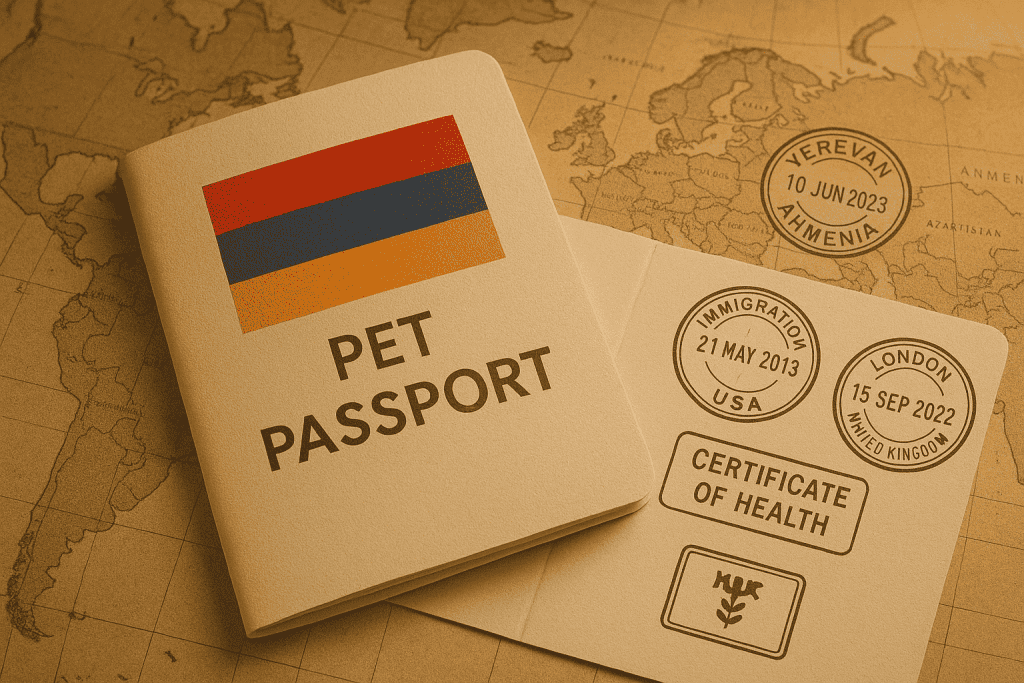
A comprehensive guide to successfully relocating your beloved pets to Armenia, covering all legal requirements, documentation, and practical considerations for a smooth transition.
No Quarantine Required
When all regulations are properly met, your pets can enter Armenia without quarantine.
Vaccinations Essential
Current rabies vaccination and other required immunizations are mandatory.
Documentation Critical
Health certificates must be completed within 5 days of travel.
Understanding Armenia's Pet Import Requirements
What Constitutes a "Pet Passport"
A pet passport for Armenia is a collection of documents that fulfill the country's import requirements. This should not be confused with an official EU Pet Passport. Your pet's documentation package must include:
- Proof of current rabies vaccination
- Export health certificate from licensed veterinarian
- Import permit (for more than 2 pets)
Eligible Animals
✓ Allowed
- • Domestic dogs and cats
- • Assistance and service animals
- • Other pets (birds, rabbits, reptiles) with additional requirements
✗ Restricted
- • Wolf hybrids (unless 5th generation removed)
- • Savannah and Bengal cats (unless 5th generation removed)
Step-by-Step Import Process
Pet Microchipping (Recommended)
While not mandatory, microchipping is strongly recommended for pet identification and documentation purposes.
Requirements:
- • Non-encrypted, 15-digit microchip
- • ISO 11784 or 11785 Annex A compliant
- • Implanted by licensed veterinarian
- • Registered in manufacturer database
Vaccination Requirements
All pets must have current vaccinations, with specific requirements for dogs and cats.
Dogs Must Have:
- • Rabies (21 days to 11 months before travel)
- • Canine distemper
- • Canine hepatitis
- • Canine leptospirosis
- • Canine parvovirus
Cats Must Have:
- • Rabies (21 days to 11 months before travel)
- • Feline viral rhinotracheitis
- • Feline panleukopenia
- • Feline leukemia
- • Dermatophytoses screening
Parasite Treatment (Recommended)
While not mandatory, treating for internal and external parasites is recommended for public health and pet safety.
Consult with your veterinarian about treatments for Echinococcus multilocularis, fleas, and ticks based on your country's disease status.
Health Certificate (Mandatory)
A licensed veterinarian must complete a health certificate within 5 days of travel.
Critical Requirements:
- • Must be completed within 5 days of travel
- • Must indicate pet is clinically healthy
- • Must be signed and stamped by government veterinarian
- • Must include rabies vaccination proof
Import Permit (If Needed)
Import permits are only required for specific situations.
No Permit Needed:
1-2 pets traveling with their owner
Permit Required:
- • More than 2 pets per person
- • Unaccompanied shipments
- • Commercial imports
Practical Examples and Scenarios
Example 1: Tech Entrepreneur Relocating with Two Cats
*This is a theoretical example for illustration purposes only
Sarah, a software entrepreneur, is relocating from Germany to establish her startup in Yerevan. She has two domestic cats, Luna and Max, both 3 years old.
Her checklist included:
- • Microchipped both cats with ISO-compliant chips
- • Updated rabies vaccinations (ensuring 21+ days before travel)
- • Completed feline-specific vaccinations
- • Obtained health certificates 3 days before departure
- • No import permit needed (only 2 pets)
- • Arranged direct flight to Zvartnots Airport
Example 2: Family with Service Dog
*This is a theoretical example for illustration purposes only
The Johnson family is relocating from the United States with their certified service dog, Rex, who assists their child with mobility issues.
Special considerations:
- • Service animals follow same health requirements
- • USDA-accredited veterinarian completed health certificate
- • All canine vaccinations up to date
- • Microchip implanted before rabies vaccination
- • Traveled in cabin with proper documentation
Example 3: Researcher with Exotic Pet Bird
*This is a theoretical example for illustration purposes only
Dr. Martinez, a wildlife researcher, needs to bring his pet macaw, Azul, from Brazil to Armenia for a research position.
Additional requirements for birds:
- • CITES permit required for macaw
- • Vaccinations for avian influenza, salmonellosis
- • Individual marking (leg band) prior to isolation
- • 5-day health examination
- • Coordination with Armenian Environmental Protection Agency
Transportation and Logistics
Airline Transportation
Entry Requirements:
- • Must enter through Zvartnots International Airport
- • Direct flights or short layovers in rabies-controlled countries
- • IATA-compliant carriers required
Transport Options:
- • In-cabin (small pets under weight limits)
- • Checked baggage (medium-sized pets)
- • Air cargo (large pets or multiple animals)
Professional Pet Relocation Services
Services Typically Include:
- • Documentation assistance
- • Veterinary coordination
- • Airport handling
- • Door-to-door transportation
- • Customs clearance
When to Consider Professional Help:
- • Multiple pets
- • Large or exotic animals
- • Complex routing
- • Time constraints
- • First-time international pet travel
Costs and Budgeting Considerations
Veterinary Costs
- • Microchipping: $50-100
- • Vaccinations: $100-200
- • Health certificate: $150-300
- • Parasite treatment: $50-150
- • Veterinary consultation: $100-200
*Theoretical cost estimates for budgeting purposes
Transportation Costs
- • Airline pet fees: $200-1,500
- • IATA-compliant carrier: $100-300
- • Pet relocation service: $1,000-3,000
- • Airport handling: $100-200
- • Insurance: $50-150
*Costs vary by airline, route, and pet size
Additional Costs
- • Import permit (if required): $50-200
- • CITES permit: $100-500
- • Customs fees: Varies by value
- • Overnight accommodations: $100-200
- • Emergency veterinary care: $200-500
*Some costs may not apply to all situations
Common Challenges and Solutions
Challenge: Timing of Vaccinations
Many pet owners struggle with the timing requirements for rabies vaccination (21 days minimum but not more than 11 months).
Solution:
Plan your relocation timeline around vaccination schedules. If your pet's rabies vaccination is expiring, coordinate the renewal with your planned travel date to maximize the validity period.
Challenge: Health Certificate Timing
The 5-day window for health certificate completion can be stressful, especially with last-minute travel changes.
Solution:
Schedule your veterinary appointment strategically, allowing buffer time for potential delays. Have all other documentation ready so only the health certificate needs last-minute completion.
Challenge: Airline Restrictions
Different airlines have varying pet policies, and some routes may not allow pets during certain seasons.
Solution:
Research airline pet policies early and book pet space in advance. Consider alternative airlines or routes if your preferred option has restrictions during your travel dates.
Challenge: Return Travel Planning
Armenia is classified as a high-risk rabies country, making return travel to some countries more complex.
Solution:
Before relocating, research the requirements for returning to your home country. Some destinations may require rabies titer tests or additional quarantine periods for pets coming from Armenia.
Recommended Timeline and Preparation
Initial Planning Phase
- • Research Armenia pet import requirements
- • Identify licensed veterinarian in your area
- • Review your pet's current vaccination status
- • Research airline pet policies
- • Consider professional pet relocation services
Documentation and Health Preparation
- • Microchip your pet (if not already done)
- • Update all required vaccinations
- • Purchase IATA-compliant travel carrier
- • Book airline space for your pet
- • Apply for import permit (if needed)
Final Preparations
- • Acclimate your pet to travel carrier
- • Arrange pet-friendly accommodations
- • Confirm all documentation is complete
- • Review import requirements one final time
- • Prepare for health certificate appointment
Final Week Before Travel
- • Schedule health certificate appointment (within 5 days)
- • Complete final veterinary examination
- • Obtain government endorsement of health certificate
- • Prepare pet for travel (fasting, etc.)
- • Review travel day procedures
Special Considerations for International Residents and Entrepreneurs
For Digital Nomads and Remote Workers
Consider:
- • Visa requirements for extended stays
- • Pet-friendly accommodation options
- • Local veterinary services in Armenia
- • Emergency pet care availability
- • Climate adaptation for your pet
Armenia-Specific Benefits:
- • Growing expat community
- • Developing pet services infrastructure
- • Moderate cost of living
- • Strong tech ecosystem
For Business Entrepreneurs
Business Considerations:
- • Tax implications of pet relocation expenses
- • Business insurance coverage for pets
- • Office pet policies if applicable
- • Networking opportunities in expat communities
Long-term Planning:
- • Return travel requirements for home country
- • Succession planning for pet care
- • Building local veterinary relationships
- • Understanding Armenian pet ownership laws
Frequently Asked Questions
Is quarantine required for pets entering Armenia?
No, there is no quarantine requirement for pets entering Armenia if all import regulations are properly met. However, pets that don't conform to regulations may be subject to quarantine, returned to origin, or in extreme cases, euthanized.
Do I need an import permit for my pet?
Import permits are not required for importing 1-2 dogs or cats traveling with their owners. However, permits are required for more than 2 pets per person, unaccompanied shipments, or commercial imports.
Is microchipping mandatory?
While microchipping is not required by Armenian law, it is strongly recommended for identification purposes and may be required by your airline or for return travel to your home country.
Can I bring my pet in the airplane cabin?
Yes, small pets can travel in the cabin if they meet airline size and weight restrictions. Pets must travel in IATA-compliant carriers and comply with airline policies.
What if my pet's rabies vaccination expires during the process?
The rabies vaccination must be current (not expired) at the time of travel. If it expires during your planning process, you'll need to get a new vaccination and wait 21 days before travel.
Are there any banned dog breeds in Armenia?
Armenia does not publish an official list of banned dog breeds. However, pet owners are responsible for their pet's behavior and must comply with local regulations.
What should I do if my pet gets sick during travel?
Contact your airline immediately and have your pet examined by a veterinarian. If your pet is not in apparent good health upon arrival, additional veterinary examination may be required at your expense.
How do I find a veterinarian in Armenia?
Research veterinary clinics in your destination city before arrival. Many larger cities have English-speaking veterinarians. Consider joining expat communities online for recommendations.
What happens if I need to return to my home country?
Armenia is classified as a high-risk rabies country by many nations. Your pet may need additional documentation, rabies titer tests, or quarantine periods for return travel. Research requirements before relocating.
Can I bring exotic pets like reptiles or birds?
Yes, but additional requirements apply. Birds need specific vaccinations and may require CITES permits. Reptiles, amphibians, and other pets have their own requirements. Contact Armenian authorities for specific guidance.
Useful Resources and Contacts
Armenian Government Resources
Ministry of Agriculture
Responsible for import permits and agricultural regulations
Environmental Protection Agency
Handles CITES permits for exotic animals
Zvartnots International Airport
Official port of entry for pets arriving by air
Professional Services
Pet Relocation Companies
Specialized services for international pet transportation
USDA-Accredited Veterinarians
Required for health certificate completion from the US
Armenian Veterinary Clinics
Local veterinary services for ongoing pet care
Final Tips for Success
Start Early
Begin planning 8-12 weeks before your intended travel date to allow for all requirements and potential delays.
Double-Check Everything
Verify all documentation, timing, and requirements multiple times before travel. Small errors can cause major delays.
Seek Professional Help
Consider professional pet relocation services for complex situations or if you're unsure about any requirements.
Successfully Relocating Your Beloved Pets
Moving to Armenia with your pets requires careful planning and attention to detail, but with proper preparation, you can ensure a smooth transition for your beloved companions. The key is to start early, understand all requirements, and seek professional help when needed. Remember that Armenia's pet import regulations are designed to protect both your pet and the local animal population. By following these guidelines and preparing thoroughly, you'll be well on your way to starting your new life in Armenia with your cherished pets by your side.
At a glance
- Up to 5 personal pet dogs or cats may enter Armenia per traveler with no quarantine if documentation is in order.
- An import permit may be required when bringing more than 2 pets per person — confirm with the Armenian Food Safety Service before travel.
- Microchipping is strongly recommended but not a legal entry requirement. Once in Armenia, dogs must be identified by microchip or tattoo by 4 months of age under domestic law.
- Rabies vaccination is required from 3 months of age. All pets need an official veterinary health certificate issued within 5 days of departure.
- Rodents and primates are currently banned from import and transit due to public health restrictions.
- Wolf hybrids, Savannah cats and Bengal cats cannot be imported unless they are at least 5th generation from pedigree.
Last updated June 2026
Moving to Armenia for work or investment is exciting — don’t let pet import rules become a surprise at the border. This guide covers the latest official requirements so international residents and entrepreneurs can bring their pets to Armenia smoothly and legally.
Planning a wider relocation? Explore our resources on residence permits, visas, digital nomad visas and business registration.
Eligible pets and species restrictions
Armenia permits personal pet dogs and cats when the owner meets health and documentation requirements. Up to five personal pets per traveler can enter without quarantine, according to USDA APHIS guidance for pet travel to Armenia.
There is a public health restriction in force: since 21 August 2024, the import and transit of all rodents and primates is prohibited due to monkeypox-related measures imposed by the Armenian Food Safety Service. If you own a hamster, gerbil, rat, mouse or any primate species, you cannot currently bring these animals into or through Armenia. This ban remains in effect until the WHO clarifies the outbreak situation in the Eurasian Economic Union.
Breed restrictions
Armenia does not maintain a formal banned-breeds list. However, wolf hybrids, Savannah cats and Bengal cats cannot be imported unless they are at least 5th generation removed from their wild ancestor pedigree. CITES rules apply separately for exotic species listed under the convention. If you plan to bring an unusual breed, confirm eligibility with the Food Safety Service before travel.
Import permits, pet limits and government authorization
Understanding pet limits and when a permit is necessary will help you plan correctly — especially if you are relocating with several animals or coordinating family travel.
| Pets per traveler | Permit needed? | Notes |
|---|---|---|
| 1–2 dogs or cats | Typically no | Standard entry when health and vaccination rules are met. |
| 3–5 dogs or cats | May be required | An import permit from the Ministry of Agriculture (valid for one month) may be required. Confirm with authorities before travel. |
| More than 5 | Not permitted as personal pets | Personal imports are capped at five. Commercial import rules apply beyond this. |
Personal pet entries are capped at five animals per traveler, and there is no mandatory quarantine for compliant entries. Some guidance indicates an official import permit is required when bringing more than two pets per person — always verify with Armenia’s Food Safety Service before booking travel.
Tip for business travelers: If you and family members are relocating together, consider splitting pets across passengers to stay within the per-person limits. For wider relocation planning, see our guides to Armenian residency permits and visa options.
Microchipping, tattoos and identification
Microchipping your pet before travel is strongly recommended but is not a legal requirement for entry into Armenia. An ISO 11784/11785-compliant microchip ensures your pet’s veterinary documents can be matched at the border and simplifies local registration after arrival.
Once you are living in Armenia, domestic law requires dogs to be identified by a microchip or tattoo by the age of four months under the Law on Veterinary Medicine. This links each animal to a unique identification number for tracking and registration purposes.
Cats are not explicitly referenced in the dog identification provisions. However, microchipping cats before travel is strongly advisable so the details on the health certificate match your pet at inspection.
Vaccinations, rabies rules and health certificates
All imported pets must be accompanied by an official veterinary health certificate issued by the competent authority or an authorized veterinarian in the country of origin. The certificate must be issued within 5 days of your departure date.
Required vaccinations for dogs
- Rabies (minimum 21 days before travel, maximum 11 months prior)
- Canine distemper virus (CDV)
- Parvovirus
- Infectious hepatitis (adenovirus)
- Leptospirosis
Required vaccinations for cats
- Rabies (minimum 21 days before travel, maximum 11 months prior)
- Feline panleukopenia (FPV)
- Feline viral rhinotracheitis (FHV-1)
- Feline calicivirus
Feline leukemia vaccination is not required for entry.
Rabies vaccination timing
The minimum age for rabies vaccination is 3 months (12 weeks). The vaccination must be given at least 21 days before your departure and no more than 11 months prior. A rabies titer test is not required for entry into Armenia.
Unvaccinated puppies and kittens under 3 months may be permitted to enter with a specific health certificate, but they still require identification documentation. Confirm the exact requirements with the Food Safety Service and your airline before departure.
Accepted certificates
USDA-endorsed health certificates (for U.S. travelers) and EU pet passports are accepted. The certificate must be issued or endorsed by the government veterinary authority of your departure country.
Pre-travel checklist
- Microchip your pet (ISO 11784/11785 — strongly recommended for entry, legally required for dogs in Armenia)
- Complete all required vaccinations including rabies (at least 21 days before travel)
- Obtain an official veterinary health certificate within 5 days of departure
- If bringing more than 2 pets, confirm whether an import permit is required
- Check airline pet policies for crate standards, weight limits and booking deadlines
- Carry all original vaccination records and certificates during travel
Border entry and what to expect
On arrival, present your pets along with the veterinary health certificate, vaccination records and any import permit to border veterinary control. Compliant entries are typically released without quarantine after a document check and inspection.
Make sure your documents match your pet’s identity — the microchip or tattoo number should appear on all certificates. Mismatches will cause delays.
Airline rules may be stricter than national regulations. Carrier limits per passenger, crate standards and heat or cold embargoes vary between airlines. Verify policies with your airline well before departure and align your paperwork timing with flight dates.
Prohibited species reminder: Rodents and primates cannot be imported or transited via Armenia until further notice. These animals will be refused entry at the border.
Return travel from Armenia
If you plan to travel from Armenia to the EU with your pet, be aware of additional requirements. Armenia is classified as an unlisted (high-risk) country under EU pet travel regulations. This means:
- A rabies antibody titer test is required — blood must be drawn at least 30 days after vaccination
- There is a mandatory 3-month waiting period from the date of the blood draw before your pet can enter the EU
- You will need an EU-format health certificate from an authorized veterinarian
Armenia is also classified as rabies-affected by U.S. and UK authorities. Plan your return journey well in advance and factor in the titer test waiting period. For travelers returning to the U.S., check current CDC requirements for pet dogs entering the United States.
Considering a broader move?
We support turnkey relocation and expansion to Armenia — company setup, bank and tax registrations, and property due diligence. Explore our guides on taxes in Armenia, real estate, employer of record services and opening a bank account.
Frequently asked questions
How many pets can I bring to Armenia?
Is quarantine required on arrival?
Do I need an import permit for three or more pets?
Are rodents or primates allowed?
Do pets need a microchip to enter Armenia?
Can I take my pet from Armenia to the EU?
Conclusion
Bringing your pets to Armenia is straightforward when you plan ahead: confirm the number of pets, obtain a health certificate within 5 days of departure, ensure rabies vaccination timing is correct and verify any permit needs. Note the breed restrictions on wolf hybrids and certain hybrid cats, and remember that rodents and primates are currently prohibited. If you are relocating for business or residency and need end-to-end support, contact us for tailored guidance.
