
Natural disasters are on the rise globally, displacing millions each year. For expats from high-risk areas, having a “Plan B” residence in the best country can provide peace of mind. This comprehensive analysis compares the best countries to obtain a residence permit as a fallback if natural disasters threaten your home country.
Key Factors for a Climate-Resilient Expat Haven
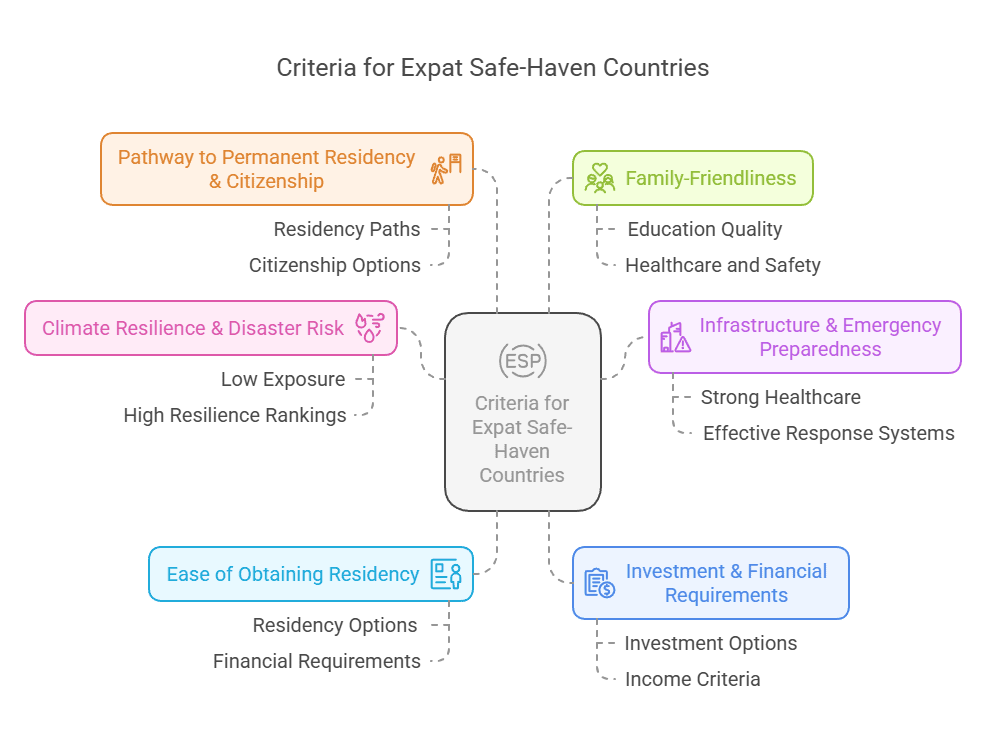
When evaluating safe haven countries, we considered several critical factors:
Climate Resilience & Disaster Risk: Locations with low exposure to major natural disaster risks (e.g. outside hurricane belts, away from seismic zones) and strong climate adaptation measures. These are often countries that rank highly on risk indices (WorldRiskIndex, ND-GAIN) for minimal natural hazard impact and high coping capacity.
Infrastructure & Emergency Preparedness: Robust infrastructure (transport, utilities, healthcare) that can withstand shocks, plus well-developed disaster response systems. Countries with high infrastructure quality (like Singapore, ranked #1 globally) and established emergency protocols ensure stability during crises.
Ease of Obtaining Residency: Accessible visa pathways for expats, including temporary and permanent residence permits. This includes investment visas, digital nomad or remote work visas, retirement visas, and skilled worker programs. We compare financial costs, processing times, and requirements.
Investment & Financial Requirements: The capital or income needed for residency. This ranges from “golden visa” programs requiring real estate or business investments (e.g. €280k in Portugal’s interior), to proof of funds or income for passive income visas, to minimal requirements for countries welcoming immigrants.
Pathway to Permanent Residency/Citizenship: Whether temporary residents can become permanent residents or citizens, and how long it takes. We note if dual citizenship is allowed, and typical timelines (e.g. five years of residency for citizenship in some countries).
Family-Friendliness: Considerations for individuals vs. families, such as safety, education, healthcare, language, and overall quality of life for dependents.
Comparative Overview of Top Safe-Haven Countries
The following tables summarize key comparisons among the selected countries for climate safety and residency options:
Climate Resilience and Infrastructure
Country | Natural Disaster Risk & Climate Resilience | Infrastructure & Emergency Preparedness |
|---|---|---|
Singapore | Very low risk (no recorded quakes or hurricanes); sheltered location | Excellent – world’s best infrastructure; advanced disaster systems |
Malaysia | Very low risk (rare disasters; outside typhoon zone) | Good – modern infrastructure in cities; improving disaster response |
Germany | Low risk (no major disasters; rare flooding) | Excellent – robust infrastructure; high emergency preparedness |
Portugal | Low–moderate risk (occasional wildfires or mild quakes) | Strong – solid infrastructure; active climate adaptation plans |
Malta | Very low risk (no significant history of disasters) | Good – reliable infrastructure; insular emergency plans in place |
Canada | Low risk (few extreme events; regional wildfires) | High – advanced infrastructure; strong disaster management capacity |
Uruguay | Low risk (no earthquakes or hurricanes) | Good – high-quality infrastructure for LATAM; stable utilities |
Panama | Low risk (hurricane-free; infrequent mild quakes) | Moderate – modern city infrastructure; improving preparedness |
UAE (Dubai) | Very low risk (no cyclones/tsunamis; minor seismic risk) | Excellent – cutting-edge infrastructure; proactive adaptation plans |
Qatar | Very low risk (no cyclones; minimal seismic activity) | Excellent – modern infrastructure; high investment in resilience |
Among European countries, Germany and Portugal stand out for their robust infrastructure and climate resilience.
Residency Pathways and Requirements

Country | Residency Visa Options | Typical Investment/Income | Path to PR/Citizenship |
|---|---|---|---|
Singapore | Employment Pass (work visa); Investor visa (GIP) | Job offer (high skill) or $1,8 million invest | PR after ~2–3 years work; Citizenship ~10 years (no dual) |
Malaysia | MM2H 10-year visa; Digital Nomad Pass | ~$226k fixed deposit + $9k/mo income (MM2H); ~$5k/yr income (nomad) | No automatic PR; long-term renewables; Citizenship tough (dual not allowed) |
Germany | EU Blue Card (work); Job-Seeker Visa; Freelancer | Job offer (salary €56k+ for Blue Card) | PR after 33 months (Blue Card) ; Citizenship ~8 years (dual now allowed) |
Portugal | D7 (passive income); Golden Visa (investor) | ~€1k/mo income or €280k–€500k investment | PR after 5 years; Citizenship eligible at 5 years (basic language test) |
Malta | MPRP (Permanent Residence by Investment); Citizenship by Investment | ~€100k total govt fees + property rent/purchase | PR granted on approval; Citizenship after ~1–3 years (with ~€750k donation) |
Canada | Express Entry (skilled PR); Start-up Visa; Study-to-PR | Varies (points-based; e.g. degree, job experience) | PR on arrival (for approved applicants); Citizenship after 3 years residence |
Uruguay | Temporary residency (easy process); Path to PR | Show any legit income or invest (no min) | PR in ~2 years; Citizenship after 3 years (married) or 5 years (single),(dual allowed) |
Panama | Friendly Nations Visa; Pensionado (retiree) | ~$200k investment (FNV) or $1k/mo pension | PR after 2 years; Citizenship after 5 years (Spanish basic required) |
UAE | 10-year Golden Visa; 5-year Green; Remote Work | AED 2M property (~$545k) or high salary job | No permanent PR (visas renewable long-term); Citizenship extremely rare (case-by-case) |
Qatar | Investor Residence (property ownership) | QAR 730k (~$200k) property for residency ; QAR 3.65M (~$1m) for PR | Permanent Residency available for large investors; Citizenship very rare (dual not allowed) |
For expats wishing to relocate to a foreign country, understanding the legal pathways and requirements is crucial.
Singapore – High-Tech Haven with Minimal Disaster Risk
Climate Resilience
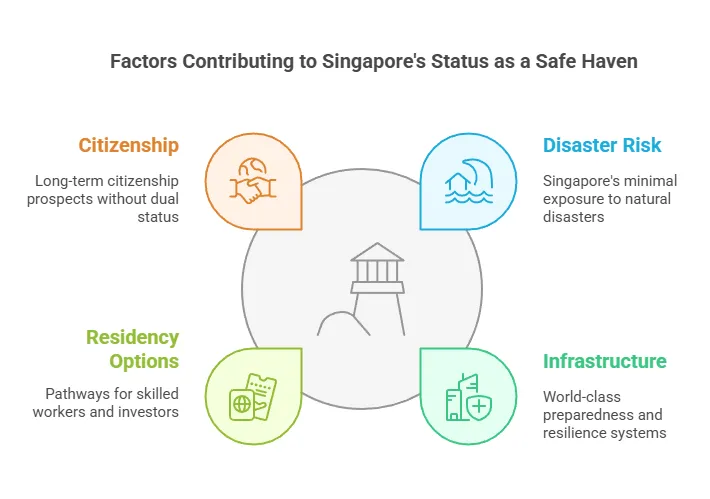
Singapore is one of the safest places globally in terms of natural disasters. Thanks to its location outside major seismic zones and tropical cyclone paths, Singapore has no recorded earthquakes and is shielded from tsunamis by neighboring landmasses. This city-state’s WorldRiskIndex score is extremely low (around 0.81% risk) – reflecting virtually no risk of hurricanes, earthquakes, or tsunamis. The climate is tropical but stable, with no extreme weather events apart from occasional heavy rains. Singapore also ranks among the top countries in climate change readiness, tying for 4th place globally in the ND-GAIN resilience index.
Infrastructure & Preparedness
Singapore boasts world-class infrastructure – in fact, it was rated the country with the best infrastructure in the world in 2023. The island’s urban planning and building standards are cutting-edge, ensuring resilience (e.g. drainage systems to prevent floods). Emergency preparedness is deeply ingrained: the government operates an island-wide Public Warning System (with sirens) and conducts the Community Emergency Preparedness Programme (CEPP) to train residents in disaster response. With a strong economy and governance, Singapore can quickly mobilize resources in any crisis. Healthcare and utilities are highly reliable, adding to its stability.
Residency Pathways
Obtaining residency in Singapore is possible via a few routes. The most common is through employment – a skilled expat can get an Employment Pass (work visa) if they have a job offer with a sufficient salary. Singapore actively attracts global talent, but standards are high (e.g. tech professionals, finance, researchers). After working a few years, one can apply for Permanent Resident (PR) status, which grants long-term stay and benefits. Another route is the Global Investor Programme (GIP) for high-net-worth individuals: investing $1.8 million in a Singapore business or fund can qualify an expat and family for PR eligibility. Singapore does not offer a “golden visa” for passive real estate investment alone – investment must contribute to the economy.
For retirees or remote workers, Singapore currently has no specific retiree visa or digital nomad visa; however, entrepreneurs may use the EntrePass to start a business. Overall, getting PR in Singapore is competitive but achievable for those with professional skills or substantial capital.
Investment & Financial Requirements
The investor PR route requires a multi-million dollar commitment, making it suitable only for wealthy expats. For others, the cost of residency is essentially the cost of living until one qualifies for PR. There is no minimum salary mandated for PR applications, but a well-paying job (e.g. the Employment Pass typically requires a monthly salary of $3,000+ for older applicants) is needed initially. Singapore’s cost of living is high (especially housing), so financial preparedness is important for expats planning a “Plan B” here.
Pathway to Citizenship
Singapore’s PR can lead to citizenship, typically after 10+ years of residence. However, Singapore is cautious in granting citizenship – applicants must show integration and commitment. Importantly, dual citizenship is not allowed in Singapore; one would have to renounce their original citizenship to become Singaporean. Many expats choose to remain PR long-term without converting to citizenship. PR confers most benefits (like buying property under certain conditions, Central Provident Fund participation, etc.) and is indefinite as long as renewal conditions (residence or ties to Singapore) are met.
Malaysia – Affordable Second Home in a Safe Climate
Climate Resilience
Malaysia, Singapore’s neighbor, similarly enjoys a geographically safe location with minimal natural disaster risks. It lies just outside the Pacific typhoon belt and far from any major tectonic plate boundaries. This means Malaysia rarely experiences major natural disasters – no significant earthquakes (any tremors are usually from distant quakes), and it is largely free from typhoons that hit the Philippines or Vietnam. According to the World Risk Index, Malaysia’s disaster risk is extremely low (around 0.83%, ranking among the safest countries). The country can have heavy monsoon rains and occasional flooding (especially in some coastal and low-lying areas during the Northeast Monsoon), but these events, while disruptive, are typically localized and managed with national disaster response. Overall, Malaysia’s climate is tropical and humid, but extreme weather events are rare.
Infrastructure & Preparedness
Malaysia has a mix of highly developed infrastructure in its major cities and more basic facilities in some rural areas. In hubs like Kuala Lumpur, Penang, and Johor, infrastructure is modern – good highways, airports, telecommunications, and healthcare facilities. Malaysia’s emergency preparedness has been improving; the government’s National Disaster Management Agency (NADMA) coordinates response to floods and storms. While the country may not have Singapore’s ultra-high-tech systems, it has shown the ability to handle disasters like flooding through evacuation plans and relief efforts. Notably, Malaysia’s widespread use of English and generally efficient governance in urban centers aid in crisis communication. For expats, the quality of private healthcare and services in Malaysia is a big plus (many foreigners travel to Malaysia for medical care). The nation’s electrical grid and water supply are stable in cities, and building standards are sufficient for the hazards they face (e.g. structures aren’t typically earthquake-hardened like in Japan, but Malaysia doesn’t need that level of seismic engineering).
Residency Pathways
Malaysia has been a popular “Plan B” country for expats due to its Malaysia My Second Home (MM2H) program. MM2H is essentially a long-term social visit pass (10-year renewable visa) for foreign retirees or individuals with adequate financial means. Historically, MM2H was very accessible (requiring proof of moderate income and fixed deposit in a Malaysian bank). In 2021, the program’s terms changed: now applicants must show roughly 9,000 monthly income and around $200k–300k in liquid assets, plus place a fixed deposit of $200,000 in Malaysia. These higher requirements have made MM2H more exclusive, but Malaysia introduced a regional variant (Sabah and Sarawak states offer slightly lower thresholds for their own MM2H programs).
For those who don’t meet MM2H requirements, Malaysia launched a “Premium Visa Programme” in 2022 for high-net-worth individuals (requiring roughly $1 million in assets and high income) and also a Digital Nomad Pass (De Rantau) aimed at remote IT/tech workers with lower income requirements (around US$24,000 annual income). The digital nomad visa grants a 1-year stay (extendable) and is quite straightforward, making Malaysia attractive to online professionals.
Other pathways include employment visas – if you get a job with a Malaysian company, you can receive an Employment Pass (usually 1-5 years, tied to the employer). There’s also an Entrepreneur visa option for those starting businesses, and a TalentCorp facilitation for certain high-skilled expats.
Investment & Financial Requirements
The MM2H program now demands significant funds (roughly US$300k+ in assets and deposits), which may be feasible for those selling property in a Western country to fund their stay, but it’s out of reach for some middle-class expats. On the other hand, the cost of living in Malaysia is much lower than in places like Singapore or Canada. Many expats find they can live comfortably on a modest budget in Malaysia – an important factor for a family or retiree’s fallback plan. The digital nomad visa’s financial requirement (around $2,000 per month income) is very reasonable and one of the lower bars globally for such visas, reflecting Malaysia’s effort to attract foreign professionals to boost its digital economy.
Pathway to Permanent Residency and Citizenship
Malaysia does not provide an automatic conversion from MM2H or other temporary passes to permanent residency. Permanent Residency in Malaysia is notoriously difficult – it’s usually given on a very selective basis (e.g. experts, spouses of citizens after long years, etc.). Most expats live on renewable passes for many years. Citizenship in Malaysia is also quite difficult for foreigners, typically requiring long-term residence and Malay language proficiency, and Malaysia does not allow dual citizenship (one would have to renounce their original citizenship, which many are unwilling to do). Therefore, most “Plan B” seekers view Malaysia as a long-term but temporary refuge – they can renew their 5 or 10-year visas indefinitely, which for practical purposes is almost as good as PR, but they usually won’t become Malaysian citizens.
Germany – Stable European Hub with Strong Infrastructure
Climate Resilience
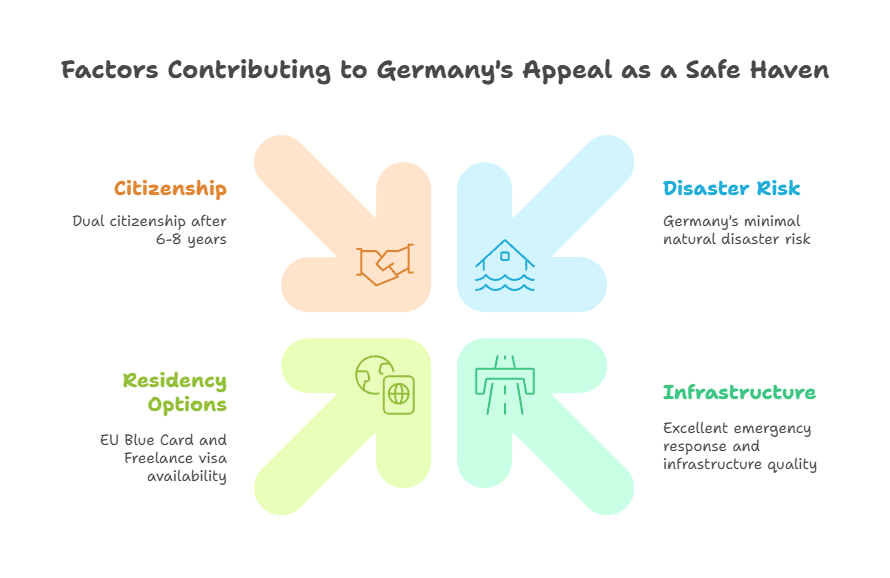
Germany is a prime example of a country with relatively minimal natural disaster risk. Located in Central Europe, Germany is free from extreme weather common elsewhere – no hurricanes, no monsoons, and it’s far from major earthquake fault lines. The country occasionally experiences moderate flooding (as seen in 2021 when severe rains caused floods in parts of Western Germany) and strong storms, but these events, while damaging locally, are rare on a catastrophic scale. Germany’s overall climate risk is low; it consistently ranks among the top in climate resilience indices (it’s tied for 8th least vulnerable country globally in one climate vulnerability ranking). Winters and summers have become slightly more extreme in recent years (heatwaves or heavy snow), but Germany has robust systems to handle such occurrences. There are no active volcanoes or significant wildfires to worry about in this region. In summary, aside from periodic floods or windstorms, an expat in Germany faces little threat from nature compared to many other countries. Compared to other European countries, Germany's climate resilience is notably high.
Infrastructure & Emergency Preparedness
Germany is renowned for its top-tier infrastructure and efficiency. The country’s transport network (Autobahn highways, railways, airports) and utilities are highly developed. Germany’s building codes are strict and enforce high standards, which means structures can generally withstand strong winds or heavy snow. The country’s emergency services (fire, medical, technical relief teams) are well-equipped and coordinate under a solid disaster management framework. For example, Germany’s Federal Office of Civil Protection and Disaster Assistance (BBK) oversees national preparedness, including warning systems (like mobile alerts, sirens) and community disaster education. Notably, Germany ranks #11 globally for disaster preparedness according to one index, reflecting its ability to cope with and adapt to hazards. The healthcare system is one of the best in the world, ensuring medical response in emergencies is readily available. Even during Europe’s occasional extreme weather incidents (such as heatwaves), Germany has mitigation plans (cooling centers, public advisories, etc.). For an expat, this means living in a country where roads, power, water, and internet are reliably maintained with redundancies, and any crisis (natural or man-made) is met with a prompt, organized response.
Ease of Obtaining Residency
Germany offers several accessible pathways for non-EU expats to obtain residence, especially for skilled professionals and entrepreneurs:
EU Blue Card: This is a popular option for university-educated professionals who find a job in Germany with a certain minimum salary (currently about €56,400, or around €43,800 for shortage occupations like IT or engineering). The Blue Card is a residency and work permit for professionals from outside the EU. Germany, as part of the EU, issues the Blue Card for up to 4 years, and it’s transferable within EU countries. Blue Card holders can become permanent residents in as little as 21 to 33 months (21 months if you reach B1 German language level).
Job Seeker Visa: Recognizing its need for skilled migrants, Germany allows foreign nationals with in-demand qualifications to come to Germany for up to 6 months on a job-seeker residence visa. You must show proof of funds and qualifications. If you secure a job in that time, you can convert to a work permit.
Freelance/Self-Employment Visa: Certain professionals (artists, language teachers, IT consultants, etc. in Berlin and other cities) can get a freelancer visa. Also, entrepreneurs who want to start a business can get a self-employment residence permit, provided the business plan is convincing and capital is sufficient. Some expats have used this to open consultancies, restaurants, or startups.
Student to Work Path: Many expats first come to Germany as students (Germany has many English-taught master’s programs, free or low tuition), then stay for work. A graduate from a German university gets an 18-month job search permit, and if hired, can transition to an EU Blue Card or work visa.
There isn’t an official “golden visa” for passive investors in Germany like in Portugal or Spain; investment in a business is possible but must generate local economic benefit.
Investment/Financial Requirements
For most of the above pathways, financial requirements are moderate. The job seeker visa might require showing around €5,000–€7,000 in savings for 6 months. The Blue Card simply requires a qualifying job salary (the employer basically sponsors by offering you the contract). The freelance visa requires demonstrating you have clients or income prospects in Germany and enough savings to live initially. Compared to many countries, Germany does not demand a large sum of money up front for residency (unless you’re doing an entrepreneurial investment, where you’d likely need to invest on the order of €50k+ to satisfy local authorities that your business is viable, though no fixed minimum is set by law).
One expected cost is health insurance – Germany mandates all residents have health coverage, which can be pricey for older expats or freelancers (but excellent coverage). As for living costs, Germany is cheaper than Switzerland or Norway but more expensive than Malaysia or Panama. Still, many find the cost of living reasonable given the high salaries and public services.
Path to Permanent Residency & Citizenship
Germany is quite welcoming in transitioning expats to long-term status:
After 4 years on a standard work residence permit (or as little as 33 months on a Blue Card, or 21 months with good German proficiency), one can get a Niederlassungserlaubnis, which is a permanent settlement permit (PR). This gives indefinite right to live and work in Germany.
Citizenship in Germany typically requires 8 years of legal residence, integration into society (including B1 level German language and passing a citizenship test on culture and laws), and no serious criminal record. However, there are some reductions: for example, 7 years if you complete an integration course, or 6 years in special integration cases (exceptional contributions or very high proficiency in German). Spouses of German citizens can apply after 3 years of marriage (with 2 years residence in Germany).
Importantly, as of recent reforms, Germany is moving to allow dual citizenship for non-EU nationals. In the past, Germany usually required renouncing your old citizenship unless you were an EU or Swiss citizen. But a draft law in 2023 signaled that foreigners will be able to naturalize without giving up their original passport in many cases, aligning with more liberal European norms. This is a significant draw – it means an expat can become German without losing their birth citizenship, making Germany even more attractive as a permanent plan B.
Portugal – Expat Favorite with Mild Climate and Golden Visa
Climate Resilience
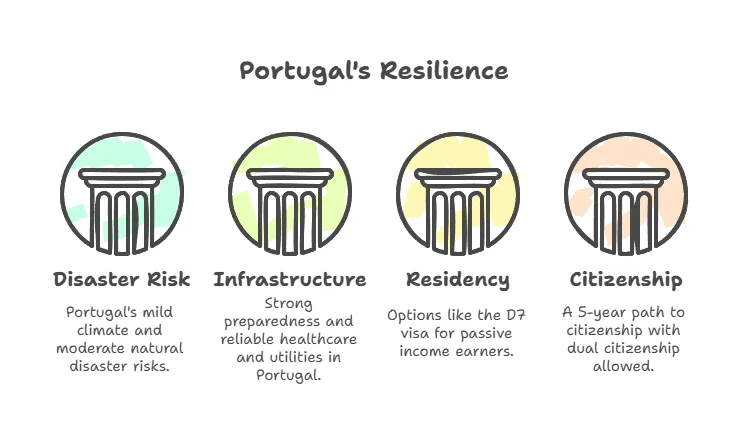
Portugal offers a mild climate and a relatively low incidence of natural disaster risks. In Western Europe, Portugal lies outside any major earthquake zones (though historically Lisbon experienced a massive earthquake in 1755, quakes of that magnitude are extraordinarily rare). Today, minor tremors happen but are infrequent. Portugal does not face tropical cyclones, and while Atlantic storms can bring heavy rain, true hurricanes diminish before reaching these latitudes. The country’s main natural challenges are wildfires in hot dry summers (especially in the interior and central regions) and occasional flooding during winter storms. Wildfires have affected parts of Portugal in recent years, but the government has improved forest management and firefighting capacity. Coastal areas could see some impact from rising sea levels or coastal erosion over the long term, but nothing acute. Overall, Portugal’s World Risk Index is moderate, and it was one of the first countries to develop a national climate adaptation plan in Europe (back in 2006). That plan has been updated to incorporate latest climate data, meaning Portugal is actively working to mitigate future risks. For an expat considering a fallback, Portugal strikes a good balance: it’s largely free from catastrophic natural events – no hurricanes, no tornadoes, no severe winter storms – just the need to be mindful of brushfires in rural zones and flash floods in limited areas.
Infrastructure & Emergency Preparedness
Portugal has solid infrastructure befitting a developed EU country. Roads, bridges, and buildings are built to European standards (which include seismic considerations in the south and islands). The power grid and water supply are reliable. After some tragic wildfire seasons (2017), Portugal invested heavily in emergency preparedness – improving early warning systems (like SMS alerts for weather/fire), creating firebreaks, and purchasing firefighting equipment. The medical emergency response is robust; Portugal’s healthcare system is accessible and of good quality, which is reassuring if an expat ever faces a health emergency during a disaster. Additionally, being part of the European Union’s civil protection mechanism, Portugal can receive support from other EU countries if a major disaster strikes (e.g., neighboring Spain and others often send firefighting aircraft to help with big fires, and vice versa). The country’s size is small enough that national resources can be quickly concentrated on a problem area.
In terms of climate adaptation, cities like Lisbon and Porto have developed plans to handle heatwaves (cooling centers, public health outreach) and floods (pumping stations and improved drainage). The Azores and Madeira (autonomous regions) have their own local preparedness for the storms and earthquakes that occasionally affect those islands. For most expats living on mainland Portugal, however, severe disruptions are uncommon.
Ease of Obtaining Residency
Portugal has become famous as one of the most expat-friendly immigration systems in the world, offering multiple pathways that are relatively straightforward:
Golden Visa (Residence by Investment): Launched in 2012, Portugal’s Golden Visa is a residency-by-investment program that attracted thousands of expats. The options include investing €500k in a Portuguese venture capital fund or creating jobs via business. The Golden Visa grants a temporary residence permit that only requires an average of 7 days per year stay – ideal as a “backup”, since you don’t have to live full-time to keep it. Portugal announced in 2023 that it plans to phase out the Golden Visa for property purchases to cool the housing market, but other investment routes or a modified scheme might remain. (This is something to check on current status.)
D7 Passive Income Visa: For many expats, the D7 visa is even more attractive because it doesn’t require buying property. It’s aimed at retirees or anyone with a steady passive income (from pensions, rentals, dividends, remote work, etc.). The requirement is roughly adult applicants must show an income of at least Portugal’s minimum wage (about €760 per month in 2023) – and more for dependents (typically 50% of that for a spouse, 30% for each child). With a D7, you get a temporary residence valid for 2 years, then renewable for 3 years.
Digital Nomad Visa: In late 2022, Portugal introduced a specific Digital Nomad Visa for remote workers, requiring about €2,820 per month income (four times the minimum wage) and proof of remote employment. This addresses those who previously used the D7 (which was technically for passive income, not active remote work income).
Employment or Study: Of course, one can also get residency by being employed by a Portuguese company or by enrolling as a student in a Portuguese university. But given the other visas, many expats don’t need to go this route.
Investment Requirements
If choosing the Golden Visa, be prepared with capital: €280k–€500k for various investment categories (e.g., €500k into funds/business or €250k for science research, etc.). The D7, by contrast, doesn’t require a lump sum investment, but you should have enough savings to sustain yourself and an income of maybe ~€1,000+ a month (for a couple, roughly €1,500). Additionally, Portugal’s cost of living is one of the lowest in Western Europe. Many retirees find that with $2,000 a month they can live quite comfortably, especially outside Lisbon.
Path to PR and Citizenship
One of Portugal’s biggest draws is the short timeline to full citizenship. Portugal grants a permanent residency or citizenship option after 5 years of legal residency. In fact, Portugal has one of Europe’s quickest routes to citizenship: after 5 years (and fulfilling minimal stay requirements), you can apply for naturalization. You’ll need to pass a basic A2-level Portuguese language exam and show integration (no serious tax or criminal issues), but the process is straightforward and successful for most. Portugal allows dual citizenship, so you don’t have to renounce your original nationality.
This means someone who starts with a Golden Visa or D7 in 2024 could be a Portuguese (EU) passport holder by 2029, which is incredibly appealing. An EU passport then grants the right to live anywhere in the EU. Even if you don’t seek citizenship, you can get a permanent residence permit after 5 years, which doesn’t expire (but you must still renew the card every 5 years for biometric updates).
Malta – Island Fortress of Safety with Investment Residency
Climate Resilience
Malta, a small island nation in the Mediterranean, is often cited as one of the world’s safest countries regarding natural disaster risks. Its geographic position and size mean Malta is spared from many large-scale calamities. There are no rivers (hence no floodplains), no proximity to hurricane zones (tropical cyclones do not form in the Mediterranean), and while Malta is in a seismically quiet region, it can occasionally feel distant earthquakes from Sicily or Greece – but these tremors have historically caused little to no damage. The country’s seismic history is very sparse. Malta’s risk of tsunamis is extremely low as well; it’s partially shielded by Sicily and North Africa from open-ocean seismic waves. The World Risk Index ranks Malta in the top 10 safest nations, and indeed Malta has recorded fewer than a dozen significant natural events in the past century – an enviable statistic.
One natural challenge Malta faces is related to climate change: being a low-lying island, heatwaves and drought can occur. However, Malta has robust desalination plants and water infrastructure, meaning even droughts have minimal impact on residents’ daily life (no water shortages in taps). Occasional strong Mediterranean storms can bring high winds and heavy rainfall, causing short-term flooding in some streets, but the scale is limited and the government responds quickly (with improved drainage and infrastructure projects in recent years). Overall, an expat in Malta can be confident that large natural disasters are virtually unheard of here.
Infrastructure & Emergency Preparedness
Malta’s infrastructure is modern, reflecting its status as an EU member and high-income economy. Roads and buildings are generally well-built (though some colonial-era buildings exist, new construction adheres to EU standards). The country invests in sturdy coastal protections and well-maintained harbors – important for an island that relies on sea transportation. Malta’s small size (just 316 km² and under 600,000 people) allows for centralized and efficient emergency services. If an incident occurs anywhere on the island, help can arrive within minutes from other areas. The Civil Protection Department of Malta runs disaster preparedness drills for scenarios like oil spills, building collapses, or floods. They also operate an SMS alert system for weather warnings.
Healthcare infrastructure in Malta is excellent – it has one of the best healthcare systems in Europe, which is a crucial aspect of disaster resilience. There’s high hospital bed availability per capita and well-trained staff. The island’s electricity and water supply systems have redundancies (for instance, multiple desalination plants and a power interconnection with Sicily for backup). Malta also has a strong community spirit; local councils and volunteers are often mobilized in any emergency.
Ease of Obtaining Residency
Despite (or because of) its small size, Malta has been very welcoming to expats through investment residency programs. Key pathways include:
Malta Permanent Residence Programme (MPRP): This is essentially Malta’s “golden visa.” Under the MPRP, non-EU nationals can obtain permanent residency (yes, direct PR status, not just temporary) by making a combination of investments and contributions. The typical requirements as of 2023: a contribution to the government fund (~€68,000 if buying property, or ~€98,000 if renting), plus a property purchase of at least €300,000 (or rental of at least €10,000 per year), and a donation of €2,000 to a Maltese NGO. Applicants also must show at least €500,000 in assets (of which €150,000 liquid). These numbers may adjust slightly year to year, but that’s the general ballpark. Once approved, you and your family get Maltese permanent residency for life (with a residence card renewed every five years). You only need to visit Malta once a year or so, thus it can serve purely as a fallback if you want.
Malta Citizenship by Naturalization for Exceptional Services (CES): Commonly referred to as the Maltese citizenship by investment program. Malta is one of the few EU countries where you can effectively buy citizenship, though it’s not cheap or instant. The current scheme requires first obtaining a residency status in Malta, then after 1 to 3 years (depending on the contribution amount) applying for citizenship. The contributions are substantial: about €750,000 donation for a fast-track 1-year route (or ~€600,000 for the 3-year route), plus purchasing or renting property (minimum €700,000 purchase or €16,000/yr rent for 5 years) and a €10,000 charity donation. This program is capped to a limited number of applicants per year and involves strict due diligence. For those who can afford it, the reward is a Maltese passport which means EU citizenship, one of the strongest passports globally.
Ordinary Residence and Work Permits: Separately, one can also move to Malta via a job offer (Malta has many iGaming, finance, and IT companies needing foreign talent) or as an EU citizen (who have free movement). For non-EU expats without huge capital, a work permit or even a self-employment visa (if you set up a business and employ at least a few locals) could be options. Malta also introduced a Nomad Residence Permit in 2021 for non-EU remote workers earning at least €2,700/month, allowing a 1-year stay (renewable up to 3 years).
Investment/Financial Requirements
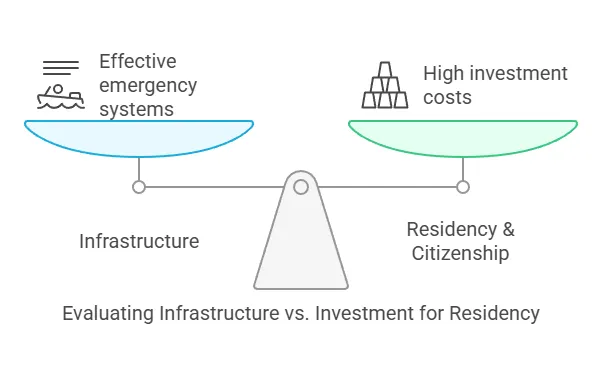
As outlined, the financial bar for Malta’s investment programs is high. The Permanent Residence route will cost roughly around €100k in non-recoverable expenses (government fees and donations) plus either tying up a few hundred thousand in property or paying rent for 5 years. The Citizenship route runs into seven figures. These are aimed at wealthy individuals seeking a secure base or EU access.
However, for those who do use these routes, Malta’s tax system can be a sweetener: Malta has favorable tax schemes for new residents, like a remittance basis of taxation (foreign income not remitted to Malta isn’t taxed locally, under certain conditions), and no property tax or council tax annually.
Day-to-day cost of living in Malta is moderate – cheaper than big EU cities, though a bit higher than Portugal or Eastern Europe. If you rent instead of buy, note that rents in popular areas (St. Julian’s, Sliema) can be significant. But one can live further out in Gozo (the second island) or the south for less.
Path to PR/Citizenship
The beauty of Malta’s MPRP is that permanent residency is granted from the start, with no renewal needed beyond a routine card update. This PR allows you to live in Malta indefinitely. However, it does not lead to citizenship automatically. If one’s goal is citizenship, they’d have to go via the “Exceptional Services” route as described (or live in Malta long-term for many years, but standard naturalization in Malta requires 5+ years of physical residence and is at the government’s discretion; not an assured path).
Malta allows dual citizenship, so an expat who does naturalize as Maltese can keep their original passport (subject to their home country’s rules).
United Arab Emirates (Dubai/Abu Dhabi) – High-End Resilience in the Desert

Climate Resilience
The United Arab Emirates (UAE) is located in the Arabian Peninsula, a region largely free from many traditional natural disaster risks. The UAE’s landscape is mostly desert and low-lying coast, and it sits in a relatively stable tectonic zone – large earthquakes are virtually unheard of locally (tremors from distant quakes in Iran or Pakistan are occasionally felt, but they’re minor). The country is completely outside the cyclone/hurricane belts; tropical cyclones from the Arabian Sea typically hit Oman or Yemen and fizzle out before reaching the UAE. Tsunamis are extremely unlikely in the Persian Gulf due to its narrow and shallow nature, and the UAE’s Persian Gulf location is sheltered by the Arabian landmass, meaning no exposure to open-ocean storms. There is also no risk of tornados or volcanic activity.
The main natural threat the UAE faces is from weather extremes like intense heat, occasional sand/dust storms, and infrequent heavy rain leading to flash floods in wadis (dry riverbeds) or urban areas. For example, in some years the UAE sees sudden downpours that can flood roads. But these events are not on the scale of disasters seen elsewhere and the government responds with infrastructure (like stormwater drainage projects in cities) and technology (cloud seeding has even been used to manage rainfall). The extreme heat (50°C in summer) is more of a climate comfort issue than a “disaster,” though it’s something expats must consider health-wise.
Notably, the UAE ranks relatively high on climate resilience indexes for a developing country – it has the wealth and foresight to adapt. The government released a National Climate Change Plan and emirates like Dubai have comprehensive adaptation strategies, including infrastructure to protect against sea level rise and heat.
Infrastructure & Emergency Preparedness
The UAE is globally renowned for its ultramodern infrastructure. Cities like Dubai and Abu Dhabi feature skyscrapers built to rigorous engineering standards, roads that are wide and new, and extensive investment in utilities. The UAE’s infrastructure was ranked among the best in the Middle East; for instance, the UAE often scores high in infrastructure indices for quality of roads, airports, and urban development.
Emergency services in the UAE are top-notch and well-funded. Civil defense units (firefighters, etc.) are equipped with the latest technology – Dubai even has experiments with jetpack responders for skyscraper fires. The country’s wealth means that in a crisis (say an unusual flooding event or a building collapse), response is rapid and resources (helicopters, military, etc.) can be deployed quickly. The UAE also places emphasis on smart technology for emergencies: residents get SMS alerts for weather or safety issues, and there’s a unified government app for emergencies.
One thing the UAE has done is enforce strict building codes after learning from experiences elsewhere. For example, after some buildings had facade fires, they updated regulations on cladding. For flood prevention, projects in Fujairah and other emirates are building dams and drainage. And because of heat, all public and many private spaces are climate-controlled (malls, offices, even bus stops in some areas are air-conditioned). In terms of health infrastructure, the UAE’s hospitals are world-class (medical tourism is common here). Power and water supply have redundancy (multiple desalination plants, backup grids). Even during regional events like the COVID-19 pandemic or a rare cyclone that hit the coast of Oman, the UAE has been a refuge of stability.
Ease of Obtaining Residency
Traditionally, the Gulf countries had strict sponsorship systems for expats. The UAE has dramatically liberalized its visa system in recent years, making it easier to obtain long-term residency without a local employer sponsor:
Golden Visa (10-year): Introduced to attract talent and investment, the UAE’s Golden Visa offers a 10-year residency for certain categories: investors (e.g. invest ~AED 2 million in property or business), highly skilled professionals in fields like science and technology (with salary above ~AED 30,000 and certain qualifications), exceptional talents and researchers, and also outstanding students. This visa is renewable and does not require a local sponsor, and the holder can sponsor family members.
Green Visa (5-year): A 5-year residency for skilled workers (with a job contract but no sponsor needed), freelancers (with proof of income ~AED 360k over last 2 years) or investors in commercial activities. It’s part of the new visa rules from late 2022.
Remote Work Visa: A relatively new 1-year visa that allows foreign professionals to live in the UAE while working remotely for employers overseas. One needs to show about $5,000 monthly income and proof of employment. It’s essentially a digital nomad visa for Dubai (and now available in other emirates too), and can be renewed.
Property Investor Visa: Separate from the Golden Visa, Dubai and other emirates long had 2-3 year residence visas if you purchase property above a certain value (e.g. about AED 1 million in Dubai). These are renewable as long as you hold the property. Now with Golden Visas, the threshold is higher but duration is longer.
Employment Visa: Of course, you can still get a normal work visa if you have a job in the UAE. Employers sponsor you for usually 2-3 years. The job market in the UAE is broad – many expats move for jobs in finance, IT, construction, tourism, teaching, etc. The UAE is unique that expats form ~85-90% of the population, so the bureaucracy for work permits is very streamlined.
Business setup (Investor) Visa: Setting up a company in one of UAE’s Free Zones or mainland can also grant a visa (as you become the company’s owner-employee). Free zones like DMCC, DIFC, etc., offer packages where if you register a company (with fees around $5k-$15k per year), you can get residence visas for yourself and staff. This has been a popular way for entrepreneurs and even freelancers to base in the UAE.
Investment/Financial Requirements
The range is broad:
For a 10-year Golden Visa via real estate, one needs about AED 2 million ($545k) investment in property. For the 5-year visa, about AED 1 million ($272k) property purchase sufficed under older rules.
For skilled/talent Golden Visas, it’s more about salary or achievements (e.g. a doctor, a PhD in AI, etc., might qualify automatically).
The remote work visa requires proving income (~$5k monthly) but no big investment.
Starting a company could require a few thousand dollars in fees and some capital depending on the business.
If going the traditional job route, basically the requirement is just getting hired (some sectors might require degrees).
One should note living in the UAE, especially Dubai or Abu Dhabi, can be expensive: housing, schooling, and healthcare (if not covered by employer) are significant costs. However, there’s no income tax on individuals, which can offset the expenses.
Path to Permanent Residency/Citizenship
Historically, the concept of permanent residency or citizenship in the UAE was nearly impossible for expats. The recent long visas (5- and 10-year) are de facto permanent residency as long as renewed, but they are technically not “permanent residence permits” like other countries have. They are however much more secure than the old 2-year work visas – you don’t have to worry about annual sponsorship.
As for citizenship, the UAE has started to very selectively grant citizenship to extraordinary talent (artists, scientists, investors) as of 2021. This is rare and at the discretion of rulers. For the vast majority, UAE citizenship isn’t on the table – plus one would likely have to renounce other citizenship since the UAE disallows dual citizenship except by special exemption.
So, if your goal is a passport, the UAE won’t be that path (at least not in the foreseeable future). But if your goal is a stable long-term residency, the UAE now provides that via the Golden and Green visas. You can indefinitely renew a 10-year visa, effectively staying as long as you want.
Qatar – Climate-Safe Gulf Oasis with New Residency Options
Climate Resilience
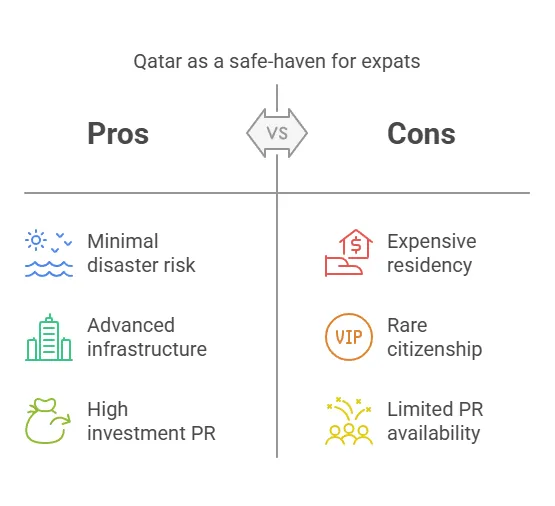
Qatar shares many geographic advantages with its neighbor, the UAE, in that it is largely free from natural disaster risks. This small peninsular nation in the Persian Gulf is not in a cyclone pathway, so it avoids the hurricanes and tropical storms that plague other regions. Earthquake risk is negligible – Qatar lies in the stable Arabian tectonic plate with minimal seismic activity. Historical records show virtually no significant earthquakes in Qatar. Like Bahrain (which is nearby and has similar geography), Qatar is shielded by the Arabian Peninsula from open ocean threats. The WorldRiskIndex lists Qatar among the least disaster-prone countries (it had a very low risk score around 1.15%, indicating very low exposure).
The main environmental challenges in Qatar are extreme heat (summers regularly over 45°C) and occasional heavy rain causing brief flooding. In 2022, for example, Doha saw unusually heavy rains that caused some street flooding, but the government addressed it quickly with drainage efforts and infrastructure improvements. Dust and sandstorms can occur when winds pick up desert dust, but these are common manageable events (you stay indoors or wear masks if needed). Qatar’s flat terrain means no landslides or avalanches; no forests means wildfires are not an issue. Overall, Qatar can confidently claim to be nearly disaster-proof – no quakes, no volcanoes, no cyclones – just a hot, arid climate which it manages with technology (e.g., widespread air conditioning and desalination).
Infrastructure & Preparedness
Fueled by its vast natural gas wealth, Qatar has invested massively in infrastructure, especially ahead of hosting the FIFA World Cup 2022. The country now has state-of-the-art stadiums, roads, a new metro system in Doha, and an expanded international airport. Its electrical grid and water supply (all desalinated) are highly reliable. Qatar’s emergency services and civil defense are well-organized; during the World Cup, for instance, they demonstrated capacity to handle large-scale events and emergencies (including health and crowd management). Hospitals in Qatar are world-class (the Hamad Medical Corporation network, plus new facilities like Sidra Medicine), ensuring medical preparedness for any incident.
The Qatari government has also undertaken significant climate adaptation initiatives. For example, Qatar has built parks and green spaces in Doha to combat the urban heat island effect and has been investing in drainage systems after earlier flood episodes. It is exploring cloud seeding for rainfall and researching cooling technologies for public spaces (like air-conditioned outdoor areas—one World Cup stadium was even cooled).
Emergency alerts and communications in Qatar are efficient, often delivered via phone alerts (in multiple languages if needed, given the expat population). The country’s small size (about 2.8 million people, majority in the Doha metro) means in a crisis, resources can be mobilized quickly nationwide. For example, when there were rare events like a warehouse fire or flooding, authorities responded promptly and usually prevented any casualties.
Ease of Obtaining Residency
Historically, like other Gulf states, Qatar had residency primarily through employment, and very limited options otherwise. However, Qatar has recently opened up more to investors and property buyers:
Property Ownership Residency: Qatar now grants residency permits to foreigners who purchase property above certain values. Specifically, buying real estate worth at least QAR 730,000 (≈ $200,000) entitles the investor and their immediate family to a residency permit. This is a temporary residency tied to maintaining the property. If you invest at least QAR 3.65 million (≈ $1 million) in property, you can qualify for Qatar’s Permanent Residency (PR) scheme. These thresholds were set by a 2018 law aiming to attract foreign investment. There are designated zones in Doha (like The Pearl, West Bay Lagoon, Lusail, etc.) where foreigners can own freehold property for this purpose.
Investor Visa (Business): Foreigners who invest significantly in the Qatari economy (like setting up a company with a big capital injection or contributing to strategic projects) may also be granted residency. Qatar opened more sectors to 100% foreign ownership recently, and with that came provisions for investor visas.
Work Visa: The traditional route – if you get a job in Qatar, your employer can sponsor you for a work residence permit. Qatar has many expats working in oil & gas, engineering, education, healthcare, hospitality (especially with events like World Cup boosting tourism sector). The government in 2020 introduced labor reforms making it easier to change jobs (previously one needed employer’s permission to switch jobs or leave, which has been eased). So employment in Qatar is now more flexible for expats than before.
Family Visa: If you hold a Qatar residence permit (through work or investment), you can sponsor your spouse and children for residence as well, provided you meet a minimum salary (for work-sponsored expats, currently around QAR 10,000/month and suitable housing). There’s also a family visit visa that can be extended long-term for immediate family.
No specific retirement or nomad visa yet: Qatar doesn’t have a dedicated retiree visa or remote worker visa at this time (unlike the UAE). The main non-work option is via property or investment as described.
Investment Requirements
The threshold of $200k in property for a residence permit is actually one of the lower investment residency levels globally – less than many golden visa programs. However, note that $200k property gets you a renewable residency (not PR) and you need to actually reside in Qatar to some extent to keep it active. For permanent residency, the $1 million property requirement is significant, but PR in a Gulf country is quite novel and valuable if one plans to base there long-term.
For the average expat worker, Qatar doesn’t require an upfront investment, but the employment must pay enough to meet visa rules for any dependents.
Cost of living in Qatar is similar to the UAE: high but with no income tax. Renting an apartment in Doha can be expensive (though post-World Cup there’s some indication rents may come down as the expat influx stabilizes). Utilities are often subsidized for locals, and sometimes included in rent for expats. Fuel is extremely cheap (gasoline costs are minimal). Groceries, especially imported ones, can be pricey since most goods are imported.
Path to Permanent Residency and Citizenship
Qatar made headlines by offering a form of Permanent Residency (PR) to foreigners – an uncommon step in the Gulf. The PR is however limited in number (reportedly, only up to 100 eligible expats per year initially, aside from the investor category). PR in Qatar, once obtained, grants some benefits similar to citizens (e.g., access to state health care, education, and even the ability to own property in any area). The investor property route is a clear way to qualify for PR by meeting the high investment sum. Also, long-serving workers who have contributed exceptionally can be nominated for PR.
However, citizenship in Qatar remains virtually off-limits. Qatar does not have a naturalization process for expats in general. The Emir can grant citizenship by decree for extraordinary cases (for example, some Arab expatriate families who have been in Qatar for generations, or notable figures like athletes have been granted citizenship to compete for Qatar). But this is rare and dual citizenship is not allowed – one would have to give up prior citizenship (and these grants are few annually). So, while you can get a very secure long-term residency (PR) as a top-tier plan B, don’t expect to easily become a Qatari passport holder.
Uruguay – South America’s Safe and Welcoming Haven for Personal Safety
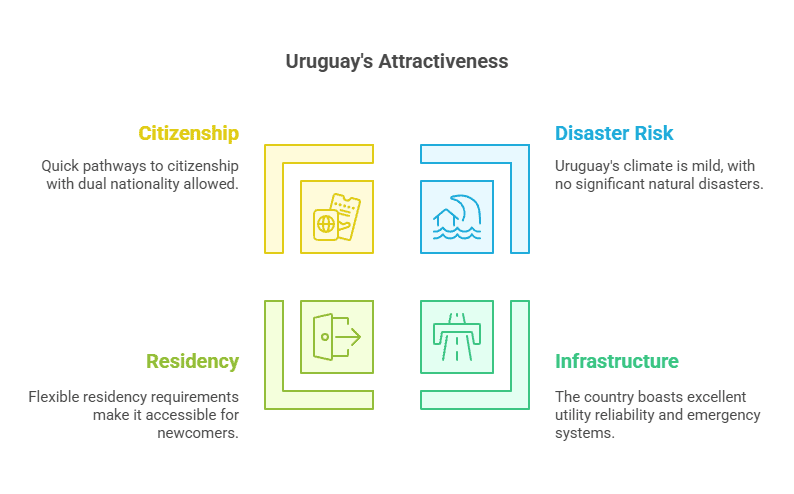
Climate Resilience
Uruguay is often called the “Switzerland of South America” not only for its stability and prosperity, but also for its lack of natural disaster risks. This small nation sandwiched between Argentina and Brazil enjoys a temperate climate without the extremes that plague many other countries. Uruguay has no record of significant earthquakes, hurricanes, or volcanic activity. It sits in a geologically calm area – far from the earthquake-prone Andes and Caribbean hurricane paths. Unlike some neighbors, Uruguay doesn’t have high mountains (so no landslide or avalanche issues), and it’s not in the tropics (so no tropical storms).
The country’s most notable hazards are likely seasonal floods or droughts. Being a fairly flat country with many rivers (like the Rio Negro and Uruguay River), heavy rains can cause river flooding in some regions. However, these floods tend to be infrequent and managed with river levees and dams. The government has good monitoring systems and will evacuate areas if needed. Droughts occasionally hit (impacting agriculture – Uruguay has a lot of cattle ranching), but for residents this might just mean water use restrictions in severe cases, which are rare. Uruguay does experience strong winds or pamperos (cold fronts) occasionally, but nothing approaching the devastation of tornados (which are virtually nonexistent here) or cyclones.
Importantly, Uruguay’s latitude (roughly 30°–35°S) gives it four distinct seasons but none too harsh. Winters are mild (some storms, but snow is almost unheard of except maybe a flurry every couple decades), and summers are warm but not scalding, with no monsoons or typhoons. It is one of the very few countries in the Americas that has never recorded a major natural catastrophe in modern history. This makes it a prime choice for anyone seeking a secure environmental fallback.
Infrastructure & Emergency Preparedness
For a country of only 3.5 million people, Uruguay punches above its weight in infrastructure. The roads are well-maintained, electricity coverage is near-universal (with a high rate of renewable energy usage – over 95% of its electricity is from renewables, meaning a robust grid less prone to fuel supply issues). Cities like Montevideo, Punta del Este, and Colonia have reliable water, telecom, and healthcare infrastructure. Montevideo’s drinking water consistently ranks as high quality.
Uruguay’s government institutions are strong and proactive. There’s a National Emergency System (SINAE) which coordinates disaster risk reduction and response across the country. They issue alerts for heavy rains or storms, and the population generally trusts and follows guidance (a benefit of Uruguay’s high education levels and social cohesion).
Healthcare is excellent: Uruguay has an extensive public healthcare system and private hospitals; the country is known for its advanced medical services in the region. In emergencies, these facilities are well-prepared. For instance, during flooding events, Uruguay’s military and SINAE collaborate to airlift supplies or evacuate communities as needed, showing good preparedness despite events being rare.
Infrastructure-wise, Uruguay has invested in resilient structures— for example, its largest dams (on Rio Negro) are well-engineered and also help in flood control. The country’s modest size again is an advantage: national agencies can quickly focus on any trouble spot. Internationally, Uruguay has been a leader in climate adaptation among developing countries, working on coastal protection (as Montevideo sits on the River Plate estuary, though significant sea-level rise impact is a distant concern).
Additionally, Uruguay has a reliable banking and utility system – not exactly disaster preparedness, but relevant to expat peace of mind that things function as expected. Rolling blackouts or water shortages are almost nonexistent.
Ease of Obtaining Residency: Uruguay is famously welcoming to immigrants. Its immigration laws are straightforward and not quota-based. In fact, Uruguay’s government openly encourages foreigners to settle and invest, as noted by how welcoming Uruguayans are to newcomers. Key points:
No minimum investment or income required: Unlike many countries, Uruguay doesn’t mandate a specific dollar amount to be brought in. If you want to become a resident, you apply for residency (either temporary, which leads to permanent, or now one can apply directly for permanent residency) and you must show you have means to support yourself, but this can be through foreign income, pension, savings, or a local job. There’s no hard number like "$X per month" in the law; practically, if you have at least $1,500/month or so to show, that’s often sufficient, but even less can work if you demonstrate free lodging or such. Essentially, Uruguay uses a case-by-case reasonable test.
Process: You can enter Uruguay on a tourist visa (most nationalities don’t need a visa for entry for 90 days) and then initiate a residency application in Montevideo. Once you’ve applied, you immediately get a provisional ID that lets you stay indefinitely until approval. Over the next several months, you’ll need to provide documents (birth certificate, clean police report, proof of income) – Uruguay often accepts foreign income like remote work or pensions, which many countries don’t. After roughly a year (timelines can vary), you get permanent resident status.
Path to Citizenship: Uruguay’s naturalization timeline is very short: 3 years of residency for families (married or with a Uruguayan child), or 5 years for single individuals. And Uruguay is generous in how it counts residency – it counts from when you arrive and file for the permit, not from permit approval. During those years, you are expected to spend a good amount of time in Uruguay (the law requires making it your primary residence, generally interpreted as at least 6 months a year, but they are flexible if you have genuine ties like property, business, or family in Uruguay).
Dual citizenship allowed: Uruguay allows and even encourages dual citizenship. You do not have to give up your original passport. This means you can gain a Uruguayan passport (which allows visa-free travel to ~150 countries) and keep your other nationality.
Family inclusion: When one person applies, they can include their spouse and dependents easily. Uruguay values family unity; there’s even a special concession that if you bring elderly parents and can support them, they can get residency too.
There is also a new tax residency incentive Uruguay has rolled out: foreign investors or new residents can get a 10-year tax holiday on foreign income. This has drawn many Argentine and European high-net-worth individuals in recent years.
Investment Requirements
As mentioned, there’s technically no set investment needed. However, many expats do choose to either buy property (Uruguay has no restrictions on foreigners buying land or real estate) or show financial means by depositing some funds in a local bank just to strengthen their application. For example, buying a house or farmland can demonstrate commitment (but again, not required).
Cost of living in Uruguay is moderate. It’s cheaper than the US or Europe in some ways (housing, domestic help, healthcare) but more expensive in others (electronics, gasoline, cars) due to import costs. Montevideo is the priciest city; smaller towns are quite affordable. Many retirees find Uruguay very reasonable, though not as dirt-cheap as some other Latin American countries. The good part is you don’t have to maintain an expensive property or business — you could rent a small apartment and still be a resident.
Path to PR/Citizenship
You become a permanent resident likely within 1-2 years of applying (during which you can live there and enjoy all rights except voting). After 3 or 5 years of actual residence (counted from initial entry for residency), you can apply for citizenship. Uruguay requires demonstrating some integration – typically an interview in basic Spanish and showing some connection (like involvement in a local activity or property ownership or Uruguayan friends – nothing too onerous). The language requirement is not strictly defined in law, but in practice basic conversational Spanish ability is needed. Given that Spanish is the national language, expats generally pick it up during their residency period.
Once you have citizenship, Uruguay allows you to keep it even if you later live abroad (it’s not lost due to absence, unlike some countries). This is fantastic for a “second passport” scenario.
Panama – Hurricane-Free Tropical Retreat with Easy Residency

Climate Resilience
Panama is uniquely positioned in Central America as a country largely spared from the region’s worst natural disaster risks. Most notably, Panama lies outside the hurricane belt that affects the Caribbean and Gulf of Mexico. While its neighbors to the north (Nicaragua, Honduras) and to the west (Costa Rica) have experienced hurricanes or tropical storms, Panama has no recorded landfall of a hurricane in modern times. The country is flanked by the Caribbean Sea to the north and Pacific Ocean to the south, but due to equatorial influences and atmospheric patterns, cyclonic storms veer away. Panama’s skies are also free of tornadoes and severe thunderstorms seen in higher latitudes.
In terms of earthquakes, Panama does experience occasional moderate tremors, especially near its borders (with Costa Rica to the west and Colombia to the east). However, it sits on the far southern end of the Central American isthmus, away from the main Pacific “Ring of Fire” subduction zones. As a result, major earthquakes are relatively rare and typically mild. There are a few fault lines in Panama; the strongest quakes historically have been in the western provinces (Chiriquí, Bocas del Toro), but even those are infrequent and of moderate magnitude (6-7 range maybe once in a few decades). Panama has no active volcanoes (the one dormant volcano, Barú, hasn’t erupted in millennia).
The biggest natural threat in Panama is heavy rainfall leading to flooding or landslides in some areas. Panama has a tropical climate with a rainy season (April to December on the Pacific side, with a peak in Oct-Nov). During especially heavy downpours or prolonged rains, rivers can flood or hillsides can slide. But these events are usually localized. The Panama Canal watershed is carefully managed (since the canal’s operation relies on freshwater from rain), so Panama has strong hydrological monitoring. Occasionally, low-lying parts of Panama City might get flash floods from poor drainage, but the city has been upgrading its systems.
Panama’s lack of hurricanes and major quakes makes it one of the safest countries in the Western Hemisphere disaster-wise. It’s often cited that “Panama is blessed by being boring, geologically speaking.” The country’s infrastructure, like the Canal, has never suffered catastrophic natural damage, underlining this stability.
Infrastructure & Emergency Preparedness
Panama is a mix of first-world and developing-world infrastructure. In Panama City (the capital) and Canal Zone areas, infrastructure is modern and robust. The Panama Canal itself, a crucial global infrastructure, is maintained to very high standards. Panama City has a skyline of high-rises (built with modern engineering, some by international firms, capable of withstanding the moderate seismic risk) and recently built a metro system. Roads connecting major cities are good (the Pan-American Highway runs through Panama). Rural areas have more basic roads and utilities.
Emergency preparedness in Panama is handled by SINAPROC (National Civil Protection System). They issue weather alerts, coordinate disaster response, and run community preparedness programs in flood-prone villages. Panama’s size (a population of around 4.4 million) allows for fairly centralized disaster management. The country has received assistance and training from US and international agencies to improve its disaster response given the canal’s strategic importance.
The canal itself has extensive emergency protocols, including for earthquakes (gates and locks are built to resist them) and for handling extreme rain (Gatun Lake levels). This spills over into national preparedness; for example, a large portion of Panama’s GDP is tied to logistics, so continuity plans for port operations exist even in severe weather.
Healthcare in Panama is quite advanced in the city – many hospitals are affiliated with US institutions (like Johns Hopkins). This means in any disaster or health emergency, treatment is available and of quality, especially in the urban centers. For expats, it’s comforting that Panama City has some of the best medical facilities in Latin America.
Power and water: The electric grid is generally stable, though occasional outages happen in storms. Water supply in the city is good (sourced from the canal’s lakes), but rural areas might rely on wells or smaller systems that can be affected by floods (Panama is working on water infrastructure upgrades).
Another point: Panama’s military was abolished, but it has dedicated public forces that handle emergencies (Frontier Service, Aeronaval service that does search and rescue at sea, etc.). They are regularly called upon for things like rescuing people in flood or in jungles (Panama has the Darién Gap, a dense jungle with some adventurous travelers needing rescue at times).
Ease of Obtaining Residency
Panama has long been known as a top choice for expat residency due to its flexible and friendly immigration options:
Friendly Nations Visa (FNV): Introduced in 2012, this visa initially allowed citizens of ~50 “friendly” countries (mostly Western, plus some like Japan, Brazil, etc.) to get fast-track permanent residency by simply showing an economic tie to Panama (like opening a local company or getting a job). Up until 2021, one could deposit $5,000 in a Panamanian bank and incorporate a local company (even if just nominal) and get permanent residence in a matter of months – it was one of the easiest in the world. In August 2021, Panama adjusted the Friendly Nations Visa: now it grants a two-year temporary residency, then permanent; and it requires either purchasing real estate worth at least $200,000 or obtaining a local job offer, as the primary qualifying criteria (the simple bank deposit route was removed). Even with this change, it remains relatively easy, especially via the property route, for many expats to obtain residency. After the 2 years temporary, you become a permanent resident.
Pensionado (Retiree) Visa: This is famously one of the best retirement visas globally. If you have a lifetime pension (or annuity) of at least $1,000 per month ($750 if you buy property $100k+), you can get this visa. It grants immediate permanent residency. While technically you can’t easily convert it to citizenship (unless you give up the pension condition by later switching visa categories), most retirees don’t care because as Pensionados they also get numerous perks: discounts on everything from flights (25% off) to movie tickets, electric bills, healthcare, etc., mandated by Panamanian law for resident retirees. There’s no minimum age by law; you just need the pension income.
Professional Employment Visa: If you get a job in Panama, an employer can sponsor a work permit. Panama limits foreign workers to 10% of a company’s workforce generally, but there are exempt positions and multinational HQ companies (like Dell, Procter & Gamble have offices in Panama) that have their own visas via a special law. This is more for people transferred by companies. Most expats prefer the other visas that don’t tie them to a job.
Self Economic Solvency Visa / Investor Visas: Panama also has options to become a resident by investing a larger sum: e.g., putting $300k in a fixed deposit in a Panamanian bank for 3 years, or investing $500k in the stock market, or $300k in real estate (this one is now overshadowed by the Friendly Nations which requires less). There’s also a Qualified Investor Program that grants immediate permanent residency if you invest $500k in real estate (or $750k in the stock market or $200k in a venture capital fund) – this was meant to attract big investors.
New “Golden Passport” for Remote Workers: In 2021 Panama teased a digital nomad visa allowing 9 months stay (extendable to 18) for remote workers with income above $36k/year. It’s not a path to permanent residency but a good option for those wanting to test waters.
In practice, most expats go for Friendly Nations or Pensionado. These are straightforward: hire a lawyer (Panama’s bureaucracy is navigable but easier with an immigration lawyer, cost ~$1500-$3000 in fees), gather required docs (police record, proof of funds or pension), make the investment or deposit if needed, and apply. Many retirees have gotten their Pensionado in as fast as 3 months.
Investment Requirements: As noted:
FNV now: $200k property purchase or an employment contract.
Pensionado: $1k monthly pension (no lump sum needed).
Others: $300k deposit (which you get back after 3 years) for one investor visa type. So compared to some golden visas, Panama is relatively low cost. Buying a $200k condo in Panama City or a small house in the interior is quite doable for a lot of North American or European homeowners selling their homes.
Panama uses the US Dollar (officially Balboa tied 1:1 to USD), so currency stability is a plus – no exchange risk.
Path to PR/Citizenship
Most Panama visas (FNV, Pensionado, etc.) lead to permanent residency either immediately or after a short temporary period. For citizenship: Panama requires 5 years of residence before you can apply for naturalization (3 years if married to a Panamanian). During those 5 years, you’re expected to spend the majority in Panama, though in practice they aren’t super strict if you travel as long as Panama is clearly your primary home base.
Citizenship also requires a Spanish language and history test and an interview where they prefer you’ve integrated (e.g. participation in community, etc.). Panama does allow dual citizenship de facto (it doesn’t force you to renounce your prior, although officially you pledge an oath to Panama). Many Americans, for instance, have become dual Panamanian-US citizens.
However, anecdotal evidence says Panama’s citizenship process can be slow and sometimes arbitrary (some wait years after applying). Many expats are content just having the permanent residence, which in Panama is almost as good as citizenship except for voting and holding some public offices. PRs can even obtain the local cedula ID.
Panama is a very popular expat destination, particularly for retirees from the US and Canada, but also for younger expats and families seeking a warm climate:
Panama is one of the safer countries in Latin America. Violent crime is lower than in neighboring Central American nations. There are some areas of Panama City to avoid, but generally expats feel safe, especially in communities where they tend to settle (like Boquete, Coronado, El Valle, Pedasí, and upscale parts of Panama City). There’s no civil conflict or anything – Panama has been stable since the US invasion ousted Noriega in 1989, and its democracy is quite robust now.

In today’s world, safety and security are top priorities for individuals and families looking to relocate or invest in a new country. Safe haven countries offer a secure environment, political stability, and a low risk of natural disasters, making them attractive options for those seeking a peaceful and stable lifestyle.
Choosing a “plan B” country for residency is a significant decision, but focusing on climate-safe, well-governed destinations can ensure your family’s security and peace of mind. The countries compared above – from disaster-proof microstates and high-tech Asian hubs to temperate Latin American sanctuaries – all offer a blend of geographic safety, solid infrastructure, and accessible residency pathways. Each has its unique advantages: for instance, Singapore and Switzerland (not listed but known) provide stability and wealth (albeit with high entry requirements), while Uruguay and Panama offer ease and warmth, and places like Portugal combine moderate climate with an easy route to EU citizenship.
Ultimately, the best choice depends on your personal circumstances – budget, language preferences, whether you’re relocating solo or with family, and long-term goals like citizenship or simply a secure bolthole. It’s wise to consider not just the risk factors of your home country, but the pull factors of the new one: quality of life, culture, economy, and how it fits your future plans.
In all cases, the countries highlighted show that it is quite feasible to acquire a “residence permit insurance policy” against natural disasters. By obtaining residency (and possibly a second citizenship) in a safe country, expats can ensure that in the face of climate change and increasing global uncertainties, they have a reliable place to live without starting from scratch. These nations welcome foreign residents – whether through investments, skills, or simply the desire to live there – and many even allow you to bring your belongings, capital, and even pets with relative ease.
As always, one should conduct thorough research and perhaps visit the country before committing, to verify that it suits one’s lifestyle and needs. Fortunately, many of these countries have large expat networks and resources that can help newcomers adapt quickly.
In summary, by leveraging the opportunities in these climate-resilient, expat-friendly countries, individuals and families can create a safety net – a peaceful second home ready in case Mother Nature wreaks havoc on their primary home. Given the rising tide of natural disasters worldwide, such foresight could prove invaluable. Safe havens do exist, and with the information and comparisons provided, you can take confident steps toward securing your own.

Lusine Sargsyan
Attorney
