

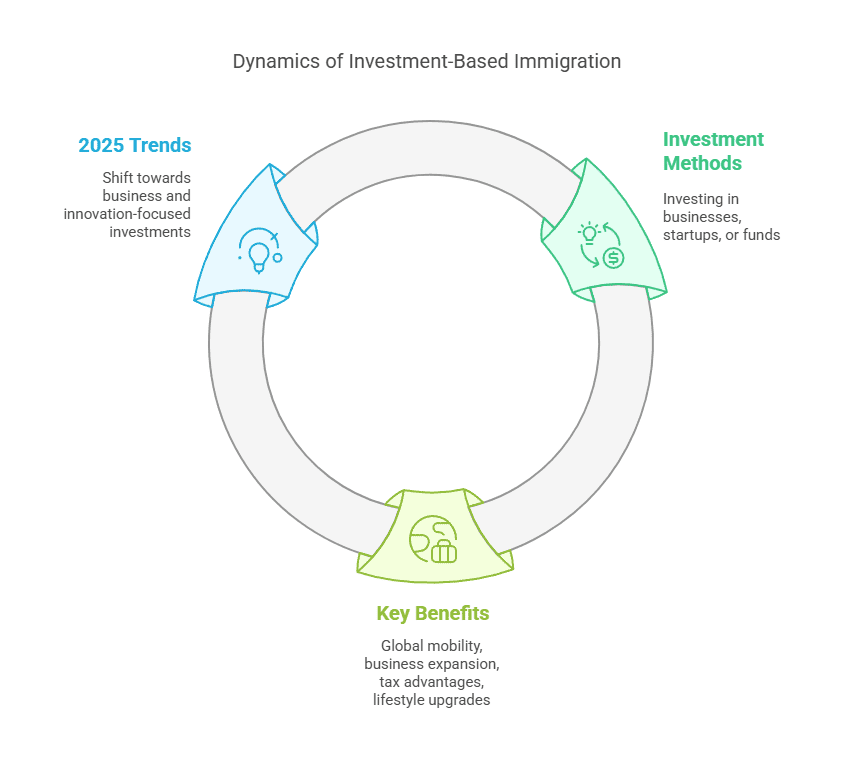
Investment-based immigration programs – often dubbed “Golden Visas” or citizenship-by-investment schemes – offer expats, entrepreneurs, and high-net-worth individuals a pathway to residency or even a new passport in exchange for investing in local businesses, startups, real estate, or funds. These programs can provide strategic relocation opportunities, global mobility, and business expansion into new markets. Investing in European countries offers additional benefits such as access to the Schengen Zone for travel, as well as the stability and quality of life these nations provide.
What is Residency by Investment?
Residency by investment (RBI) is a program that allows foreign nationals to obtain a residence permit or permanent residency in a country by making a significant financial investment in the local economy. This investment can take various forms, such as purchasing real estate, investing in a business, or contributing to government bonds or funds. RBI programs are designed to attract foreign investment and boost the economy of the host country. By participating in these programs, investors can secure a residence permit, which often leads to permanent residency and, in some cases, citizenship. The flexibility of investment options, ranging from real estate to government bonds, makes RBI programs appealing to a wide range of foreign nationals looking to establish a new base or diversify their global presence.
Comparative Tables: Residency/Citizenship by Investment Programs
Country & Program | Min. Investment (USD equivalent) | Residency/Citizenship Timeline | Restrictions |
|---|---|---|---|
Portugal (Golden Visa) | €250k–€500k (≈$270k–$540k) depending on routeCommon: €500k in real estate or funds | Residency: ~6–8 months to get 2-year residency card. Citizenship: Eligible after 5 years (with basic language exam) Minimal physical presence required. | Non-EU only. Cannot invest in residential property in Lisbon/Porto/coast. Must maintain investment ≥5 years. Strict due diligence on funds. |
Greece (Golden Visa) | €250k (≈$270k) was base; now €400k (≈$430k) in most areas; €800k in premium areas €250k still for special properties | Residency: ~2–4 months to issue 5-year residence permit Renewable indefinitely. Permanent Residence Permits: Eligible after 5 years of living in Greece. Citizenship: After 7 years of actual residency (183 days/yr)+ language test. | Non-EU only. Real estate threshold now higher in Athens/tourist areas Must hold investment to keep visa. Citizenship requires living in Greece 7 years and Greek language. |
USA (EB-5 Investor Visa) | $800,000 in a project located in a TEA (rural or high-unemployment area) ; or $1,050,000 in non-TEA Must create 10 jobs for U.S. workers | Conditional Residency: ~24+ months for I-526 approval (faster for rural TEA), then 2-year conditional green card. Permanent Residency: after 2 years, show 10 jobs created to get permanent Green Card (I-829). Citizenship: Eligible after 5 years of being a green card holder (including conditional period). | Limited visas per country per year (backlogs for some nationals). Investment must be “at-risk” (no guaranteed return) 10 full-time US jobs must result – strict requirement. Intensive source-of-funds vetting. Nationals of sanctioned countries (e.g. Iran, N.Korea) effectively blocked. |
Canada (Start-Up Visa) | No fixed amount by applicant – Must secure Angel investment ≥ $50k or VC ≥ $140k, or admission to a Canadian incubator Also need ~$9k personal settlement funds. | PR Processing: ~12–30 months (high demand; caps in place). Work Permit possible in ~3–6 months to start business during PR processing. Citizenship: Eligible after 3 years of physical presence in Canada (within a 5-year span) as a PR. | Must have qualifying business idea and get approved by a designated investor/incubator (high bar for innovation). Language proficiency CLB 5 in English/French required. Must intend to actively run the startup. Multiple founders (max 5) allowed, but if any essential founder quits, others’ PR could be at risk. PR status has residency days requirement (to keep PR and for citizenship). |
Singapore (Global Investor) | $7.4M in new or expanded business, or $18.5M in approved funds Family Office: $1.8M + $18,5M AUM . Must also meet high revenue/net worth criteria. | PR Approval: ~9–12 months processing PR valid 5 years, extendable if investment conditions (like hiring 30 employees or maintaining S$25M fund) are met Citizenship: Can apply after 2+ years as PR, but approval is very selective (many remain PR indefinitely). | Very high entry requirements: investor must have substantial business success (e.g. company >S$200M turnover/year). Must commit to creating jobs (Option A: 30 jobs by year 5) Dual citizenship not allowed (must renounce original if taking SG citizenship). PR renewal conditional on continued investment. Male PRs’ sons subject to military draft. |
St. Kitts & Nevis (Citizenship) | Donation: $250k (single or family up to 4) to govt fund (non-refundable). Real Estate: $200k–$400k in approved property (plus fees) held for 5–7 years. | Citizenship: ~4 months (could be 60 days with expedited process) after application and due diligence. Passport issued upon approval and investment payment. No period of residency needed prior or post. Citizenship is permanent (passport renewable every 10 years). | Certain nationalities barred (e.g. applicants from Afghanistan, Iran, N.Korea, etc., unless exempted by gov) Strict background checks – clean source of funds required. Real estate must be held minimum 5 years (7 if $200k share) or citizenship can be revoked. Program terms subject to change by gov’t. |
Country & Program | Govt. Incentives & Benefits | Eligible Investment Sectors | Taxation on Returns |
|---|---|---|---|
Portugal (Golden Visa) | EU residency for family; minimal stay (7 days/year); path to citizenship after 5 years NHR tax regime: 0% tax on foreign income for 10 years Schengen travel freedom. | Venture capital funds, R&D or arts donation, business creating ≥10 jobs | No tax on non-Portugal income for non-residents 20% flat tax on local income under special regime 28% tax on rental or capital gains for non-residents. No wealth/inheritance tax. |
Greece (Golden Visa) | 5-year residency with no residence requirement Family included. Option for 15-year flat €100k tax on worldwide income (non-dom) Schengen zone access. | Real estate (tiers by location) ; or €400k in Greek company, equity fund or gov’t bonds ; €500k term deposit Startup option €250k planned 2025 | No tax on foreign income if not tax-resident Local income taxed only if >183 days in Greece. Flat €100k/yr tax option for new residents (covers global income) No inheritance/wealth tax. |
USA (EB-5 Investor Visa) | U.S. conditional Green Card for investor, spouse, children < 21. Live/work anywhere in US. Can convert to full permanent residence then citizenship. Premium processing for rural TEA investments Access to U.S. education, market, etc. No special tax breaks (same rights and obligations as other residents). | Any lawful commercial enterprise: e.g. real estate development, franchise, manufacturing, startup, etc. Often via regional center projects (pooled real estate or infrastructure) to count indirect jobs. Targeted sectors encouraged: rural development, infrastructure | Once green card is obtained, worldwide income taxable by US No distinction for EB-5 – standard US tax rates (federal up to 37% + state) on personal income. No US tax on income prior to residency start. No VAT/wealth tax, but estate and gift taxes apply to residents. |
Canada (Start-Up Visa) | Permanent Residence (PR) granted immediately to founding entrepreneurs and family. Access to Canada’s healthcare, education, etc. Work permit available in interim Many startup support programs (incubation, mentorship). After PR, path to citizenship in ~3 years. Canadian small-business incentives: R&D tax credits, grants. | Innovative startups in any sector (tech, manufacturing, services, etc.) with high growth potential. Requires backing from designated Canadian VC funds, angel investor groups, or business incubators (these organizations vet the business idea). | Canada taxes residents on worldwide income. Corporate tax ~15% federal (small biz 9%) + provincial (~11–15%). Generous R&D credits (35% refundable) for company Personal income tax up to ~50% at high incomes (varies by province). No capital gains tax on first ~$1M gain from qualified small business stock (lifetime exemption) No inheritance tax. |
Singapore (Global Investor) | Permanent Residency (PR) for investor & immediate family. No need for prior employment. 5-year PR, renewable if meeting economic milestones (job creation, expenditure) Singapore offers zero capital gains tax, no dividend tax, and top-notch business infrastructure Safe, high quality of life, global financial hub. | Business investment in approved industries (e.g. electronics, IT, healthcare, sustainability, fintech, logistics, etc.) for Option A Option B: invest in designated private equity/VC funds (which in turn invest in various sectors in Singapore) Option C: Family office across diversified assets (public equities, funds, etc.) | No tax on foreign income not remitted. No capital gains or wealth tax. Corporate tax 17% (with exemptions effectively ~5-10% for many firms). Personal tax up to 22% (for residents on Singapore-sourced income). As PR, only income earned in SG is taxed (no global taxation; territorial system). Attractive schemes for family offices to be tax-exempt on investment gains |
St. Kitts & Nevis (Citizenship) | Citizenship & passport in ~4–6 months No residency or visit required ever Full citizenship rights for life for investor and family. Visa-free travel to ~150 countries (EU, UK, etc.) No personal income, capital gains, or inheritance taxes in St. Kitts Dual citizenship allowed with no disclosure. | Government Fund (used for national development projects) or tourism real estate (shares in resorts, villas). No business or job creation requirement – it’s a citizenship purchase scheme. Other options: approved alternative investment or donation to sustainable growth projects (case-by-case). | St. Kitts has zero income tax on individuals No capital gains or estate tax If one rents out real estate, rental income not taxed. If one doesn’t live there, St. Kitts imposes no taxes on foreign income either. Small property tax (~0.2% annually) if property owned. |
Portugal – Golden Visa Program (Residency by Investment)
Minimum Investment & Sectors
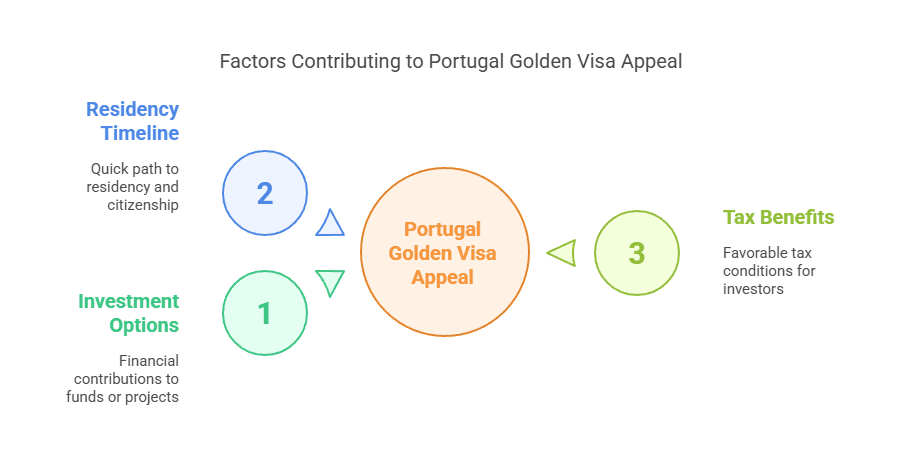
Portugal’s Golden Visa offers multiple investment options, with minimums starting from €250,000 for special contributions (e.g. arts or heritage donation). The most common routes are €500,000 in qualified venture capital funds (which often support tech startups). Other eligible sectors include scientific research (€500,000), business/job creation (€500,000 + 5 jobs), or cultural projects (€250,000). This variety allows investors to choose property, funds, or direct business investments.
Government Incentives
Beyond residency rights, Portugal offers attractive incentives such as tax breaks under the Non-Habitual Resident (NHR) regime (recently updated as IFICI). Golden Visa holders who don’t become tax-residents pay no tax on non-Portugal income. Those who do settle in Portugal can opt for a flat 20% tax on local qualifying income and exemption on most foreign income for 10 years under the new incentive scheme. The government also allows family reunification (spouse, children, parents) under one investment, and imposes only a minimal stay of 7 days in the first year and 14 days each subsequent 2-year period – a very flexible requirement. These incentives, coupled with Portugal’s startup-friendly ecosystem and EU market access, have made the Golden Visa highly popular.
Residency & Citizenship Timeline
Approval for the temporary residence permit typically takes around 6–8 months. The initial residency is valid for 2 years (after an initial 1-year card) and can be renewed. After 5 years, investors become eligible for permanent residency or citizenship. Portugal offers a direct path to EU citizenship after 5 years of maintaining the investment, provided basic language ability (A2 Portuguese) and other criteria are met. Importantly, one can qualify for citizenship without full-time residency, due to the minimal stay requirement. This means an investor can obtain a Portuguese passport (and with it EU citizenship benefits) in about five to six years while only spending short periods in-country annually. After 5 years, investors become eligible for a permanent residence permit or citizenship.
Taxation on Returns
If an investor earns returns in Portugal (say rental income or business profits) without becoming a tax resident, those Portuguese-source earnings are taxed at flat rates (e.g. 28% on rental income) and there is no tax on foreign income for non-residents. If the investor becomes a tax resident, Portugal’s special regime can apply: under the updated NHR/IFICI, foreign-sourced income (except pensions) can be exempt, and local employment or business income may be taxed at a flat 20% for 10 years. Capital gains from Portuguese investments are taxed at 28% for individuals, though certain exemptions exist. Notably, Portugal has no wealth tax, and inheritance/gift taxes are limited. These tax policies, plus the ability to repatriate profits freely, make Portugal fiscally attractive to investors.
Restrictions on Foreign Investors
The Golden Visa is open only to non-EU/EEA/Swiss nationals (since EU citizens don’t need a visa). Portugal imposes investment-specific restrictions such as the ban on residential real estate investments in Lisbon, Porto, and most coastal Algarve areas (investors can still buy commercial properties or invest in interior regions and islands) to avoid overheating property markets. Investors must maintain the investment for at least five years (or until obtaining a permanent status) – selling or withdrawing earlier could void the residency. All applicants undergo strict due diligence and background checks (clean criminal record, lawful funds). Otherwise, Portugal places few barriers: foreign investors can fully own businesses and property (with the above location caveats) and are generally afforded national treatment in the economy.
Greece – Golden Visa Program (Residency by Investment)
Minimum Investment & Sectors
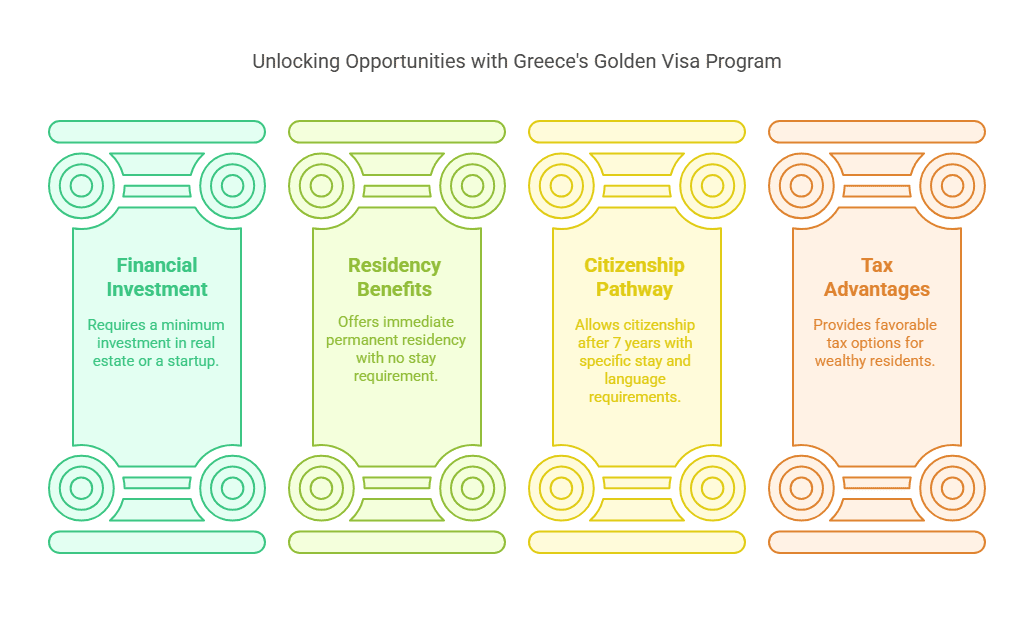
Greece has one of Europe’s most accessible investor visa programs. Until recently, the minimum investment was €250,000 in Greek real estate – the lowest entry in the EU. As of 2023–2024, new tiered rules apply: in most regions the minimum for property is now €400,000, while in certain high-demand areas (e.g. central Athens, Thessaloniki, Mykonos, Santorini) it’s €800,000. However, Greece still allows €250,000 investments in specific cases, such as properties that are part of a commercial-to-residential conversion or of cultural significance, to qualify under certain tiers. Real estate investment is a primary option for foreign nationals to gain residency in Greece. Beyond real estate, Greece offers alternate routes: an investor can put €400,000 into a Greek business or equity fund, or into Greek government bonds or venture capital, among other financial assets. Notably, Greece is launching a startup route – a €250,000 investment in innovative Greek startups is expected to qualify from 2025 – underscoring government focus on technology and enterprise.
Government Incentives
Greece’s Golden Visa confers immediate 5-year residency (renewable indefinitely) with no minimum stay requirement at all – one can maintain Greek residency without living there, which is a major draw. For those who do relocate, Greece has introduced lucrative tax incentives: new residents can opt for a flat €100,000 annual tax on all global income for 15 years (the non-dom regime), effectively capping tax for very wealthy individuals. Alternatively, non-residents (or those who don’t use the flat tax scheme) are taxed only on Greek-sourced income. This means a Golden Visa holder who keeps their primary tax home elsewhere pays no Greek tax on foreign earnings and only pays Greek tax on local profits (e.g. rental income) – and even then Greece’s rates are moderate.
Additionally, Greece offers a special lump-sum tax of €100k (with €20k for each additional family member) to attract foreign retirees or high-net-worth individuals, and a flat 7% tax for foreign pensioners who transfer their tax residence to Greece. Other incentives include full family inclusion (spouse, children up to age 21, and dependent parents) under one investment, and access to public healthcare/education as residents. Overall, Greece combines low entry cost (for some properties) with high lifestyle and tax perks, making it highly attractive.
Residency & Citizenship Timeline
The Golden Visa itself is typically approved within 2–4 months, one of the fastest processing times in Europe. The residency permit is valid for 5 years and can be renewed every 5 years as long as the investment is retained. For those seeking a passport, Greek citizenship is obtainable after 7 years of residence. It’s important to note that to naturalize as a Greek citizen, an investor must actually reside in Greece for the majority of those 7 years (at least 183 days per year) and pass a language/civics test.
In other words, Greece’s program does not offer an easy path to citizenship unless you commit to living there. However, having the Golden Visa for 7+ years can facilitate the citizenship process if the physical presence condition is met. Many Golden Visa holders simply maintain the permanent residency (which has no stay requirement) for flexibility. In summary, you can get permanent EU residence in ~3 months with no need to live in Greece, and citizenship in 7 years if you do decide to make Greece your home.
Taxation on Returns
For non-resident investors, any income generated by the Greek investment (for example, rental income from property) is taxed at a flat 15% on capital gains from property sales and various rates on rental or dividend income (usually 5%–45%, or 7.5% on dividends from Greek companies, etc.), but no tax is due on global income unless you become a tax resident. If one does become a Greek tax resident, worldwide income is taxable under progressive rates (up to ~44% for high incomes); however, the available lump-sum €100k non-dom tax means an ultra-wealthy investor can opt to pay a fixed €100k regardless of actual income. Moreover, Greece has no wealth tax, and recent reforms have made inheritance and gift tax more favorable for family assets. The country also boasts relatively low property taxes compared to Western Europe. In essence, Greece allows investors to enjoy Greek assets with minimal tax if they remain officially non-resident or to relocate and take advantage of a unique flat-tax regime to cap their fiscal exposure.
Restrictions on Foreign Investors
Greece’s investment program is open to all nationalities (no specific country bans as of 2025). Investors must be non-EU citizens and at least 18, with a clean criminal record and legal source of funds. The recent increase in the real estate minimum (to €400k/€800k) was aimed at protecting locals from soaring housing prices, but the program still offers €250k options for designated property types to keep a low entry point. There are no restrictions on property ownership apart from the regional pricing rules – foreigners can buy land and multiple properties (except near national borders or military zones, which might require special permission).
If investing via the business route, certain sectors (like defense or strategic industries) might require extra licensing, but generally Greece allows 100% foreign ownership of companies. One important restriction: to maintain the Golden Visa, the investment must be kept; for example, if you purchase real estate, selling it (without replacing with another qualifying property) would terminate the visa, so liquidity is tied up. Lastly, while Greece imposes no stay requirement for residency, obtaining citizenship later mandates actual integration (language proficiency and living in Greece), as noted. Overall, Greece’s rules for investors are straightforward and welcoming, with the main changes being the increased financial thresholds in prime areas to ensure the program’s sustainability.
United States – EB-5 Immigrant Investor Program (Residency/Green Card by Investment)

Minimum Investment & Sectors
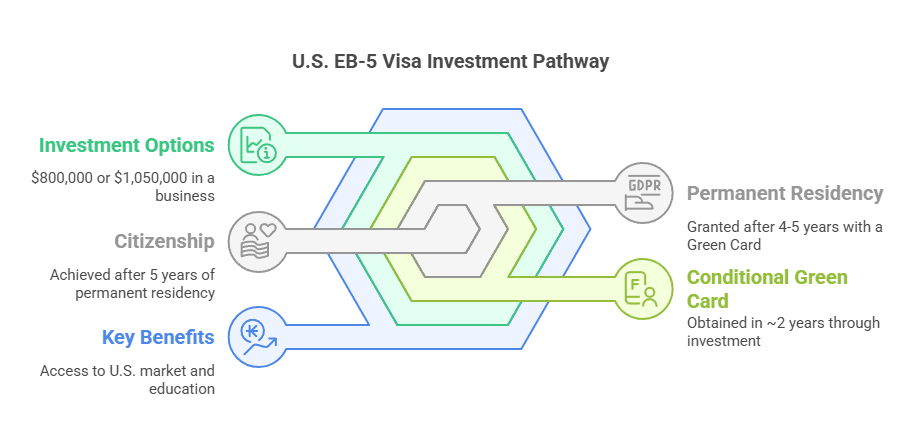
The U.S. offers a residence-by-investment pathway through the EB-5 visa (Employment-Based Fifth Preference). The EB-5 program requires investing in a new commercial enterprise that creates jobs. The minimum investment amount is $1,050,000, but it is lowered to $800,000 if the investment is in a Targeted Employment Area (TEA), which includes rural regions or areas of high unemployment, or in certain qualifying infrastructure projects. The EB-5 program requires a significant financial contribution, such as $800,000 in a TEA or $1,050,000 in a non-TEA. Most EB-5 investors seek the reduced $800k route by choosing projects in TEAs. The investment must lead to the creation of at least 10 full-time jobs for U.S. workers.
Eligible investment sectors are quite broad – any for-profit business can qualify, from technology startups and manufacturing plants to real estate developments, hotels, or farms, as long as the requisite jobs are created. Investors can invest directly in their own new business or through approved “Regional Center” projects, which pool funds into larger developments (e.g. building a resort or mixed-use complex). Regional center investments are popular as they allow counting indirect job creation (e.g. construction jobs) and are often structured as passive investments. In recent reforms (2022), the U.S. set aside some EB-5 visas for rural projects (20% of annual spots) and urban distressed areas (10%), incentivizing those sectors. In summary, the EB-5 demands a substantial capital injection ($800k/$1.05M) into a new U.S. enterprise spanning any industry, with the core requirement of creating ten jobs.
Government Incentives
The primary benefit of EB-5 is a U.S. Green Card (conditional permanent residence) for the investor, their spouse, and children under 21. This grants the right to live, work, or study anywhere in the United States and is a path to eventual citizenship. The U.S. doesn’t offer special tax holidays or grants specifically for EB-5 investors – once you become a resident, you’re treated like any other permanent resident. However, EB-5 investors can take advantage of general incentives: for instance, if starting a business, there may be state-level incentives (tax credits, training grants) depending on the project’s location (many states have programs to attract job-creating investments).
The 2022 EB-5 reform introduced priority processing for investments in rural TEAs, which is an incentive to invest in underdeveloped areas, potentially speeding up Green Card approval. Another indirect benefit: children of EB-5 investors often qualify as domestic students for U.S. university tuition and can work freely after school. Also, the EB-5 visa has no language, education or prior business experience requirement – it’s purely investment-based, which in itself is a draw for many. The EB-5 program saw an increase in the minimum investment in recent years, but it remains in demand, especially from those looking to access the large U.S. market and education system. In sum, while the U.S. program does not provide tax breaks or government financing to investors, it offers the highly coveted reward of American permanent residency and eventually citizenship for the investor and family, alongside the chance to operate in the world’s largest economy.
Residency & Citizenship Timeline
Obtaining the Green Card via EB-5 is not instantaneous. After the investment is made and the application (Form I-526E) is filed, approval can take 1.5 to 2.5 years on average (processing times vary by country of origin and whether it’s a TEA investment with priority). Once the I-526E is approved, the investor becomes a conditional permanent resident (a 2-year Green Card). Near the end of those 2 years, the investor must file another petition (I-829) to demonstrate that the investment was sustained and 10 jobs were created, to remove conditions. Upon I-829 approval, the investor (and family) get a permanent Green Card (10-year, renewable). The entire conditional phase + approval can easily take 3–4 years or more, especially if there are adjudication delays or retrogression (visa quota backlogs for nationals of oversubscribed countries like China).
However, recent changes aim to expedite certain cases (rural TEA might be processed faster, potentially around 1 year for the initial stage). As for citizenship: EB-5 investors can apply for U.S. citizenship 5 years after first obtaining conditional residency (the two years of conditional status count toward this). In practice, given processing times, many reach the 5-year mark while conditions are being removed or shortly after. So the overall timeline could be roughly 5–7 years from investment to eligibility for naturalization. One thing to note: there are annual quotas (approximately 10,000 EB-5 visas/year including family members), and per-country caps – if too many applicants from one country, a backlog forms. Currently, investors from China, Vietnam, and India have faced multi-year wait times due to demand exceeding the cap, though the set-aside visas for TEAs help mitigate that for new applicants. Summed up, an investor can expect a conditional green card in ~2 years, a full green card in ~4 years, and citizenship in about 5–7 years after starting the process, assuming all requirements are met.
Taxation on Returns
A critical consideration: EB-5 investors become U.S. “resident aliens” for tax purposes as soon as they obtain their conditional Green Card. The U.S. taxes its residents (and citizens) on their worldwide income. This means once you have the Green Card, all your global investment income, salary, and capital gains are subject to U.S. tax reporting (though foreign tax credits and tax treaties can reduce double taxation). There is no special tax exemption for EB-5 participants – they are treated like any permanent U.S. resident. Before the Green Card is issued (while waiting, if not living in the U.S.), a foreign investor is a non-resident for tax purposes and only U.S.-source income (if any) is taxed. After obtaining residency, expect federal income tax up to 37% on ordinary income, 15–20% on long-term capital gains, plus any applicable state taxes.
The U.S. has no federal VAT or wealth tax, but it does have estate and gift taxes that can affect wealthy individuals (EB-5 investors should engage in tax planning as they become U.S. persons, e.g. setting up trusts if needed). On the flip side, being a resident allows access to the U.S. business environment – corporate taxes have been lowered to 21%, and certain states offer low or no personal income tax. If an EB-5 investor simply maintains their investment and does not actively work in the U.S., they still must file annual U.S. tax returns on worldwide income.
Restrictions on Foreign Investors
The EB-5 program is open to investors from nearly all countries, but there are practical restrictions. Nationals of countries under U.S. sanctions (e.g. North Korea, Iran) can face difficulties – while not outright banned by law, their applications undergo heightened scrutiny and need proof funds are not from prohibited sources. The investment funds must be lawfully sourced and traceable, which can restrict those from countries with capital controls or those unable to document income. An important program rule is that the investor’s money must be truly “at risk” – there can be no guaranteed buy-back or fixed return; this ensures the investment genuinely contributes to the economy.
Additionally, the requirement of creating 10 full-time jobs for U.S. workers is a strict threshold – if an investor’s business only creates 8 or 9 jobs, their permanent Green Card could be denied. This job requirement can be seen as a restriction shaping the nature of projects EB-5 investors choose (favoring larger enterprises). Unlike many countries’ programs, partial investments or joint smaller investments do not qualify – the full minimum amount must come from each main applicant (except spouses can combine funds as one application). Regional center projects are a popular mechanism but they must be USCIS-approved; post-2022, regional centers have to meet new compliance rules, and there are more oversight measures in place to protect investors. Another implicit restriction: visa backlogs by country – as mentioned, applicants from some high-demand countries may wait extra years due to the annual country cap, which effectively restricts how quickly some can obtain the Green Card. On the business side, EB-5 investors can own and operate any legal business in the U.S.; certain sectors (like aviation, telecom, defense) may require special licensing or citizenship for certain operations, but that rarely affects typical EB-5 projects.
Finally, EB-5 has a quota of about 10,000 visas/year including family – if demand is high, the program cannot issue more, leaving some in waiting. All EB-5 candidates undergo extensive background checks to ensure funds are not of illicit origin and the individual is admissible (no serious criminal history or national security concerns). In conclusion, the U.S. program’s main hurdles are financial and administrative: the high investment sum, the job creation rule, and the complex application process – but there are few explicit nationality bans or ownership limits. Successful applicants gain the same rights as any U.S. permanent resident, which is the program’s chief allure.
Canada – Start-Up Visa Program (Residency for Entrepreneurs)

Minimum Investment & Sectors
Canada’s Start-Up Visa (SUV) is uniquely tailored to entrepreneurs launching innovative businesses. Unlike traditional investor visas, there is no fixed minimum investment that the applicant must contribute. Instead, the key requirement is to secure support from a designated Canadian venture capital fund, angel investor group, or business incubator. This typically means: at least C$200,000 (USD 140k) investment commitment from a designated VC fund, or C$75,000 (USD 50K) from a designated angel group (if multiple investors, it can be combined), or acceptance into a government-approved incubator program (no set funding required).
In practice, many Start-Up Visa candidates join an incubator which often comes with a program fee and guidance rather than cash investment. However, if going the investor route, those funding minimums apply. The business itself must be a new, innovative start-up with the potential to compete globally and create jobs in Canada. All sectors are welcome – from technology (software, AI, biotech) to manufacturing or green energy – as long as the idea is innovative and scalable. There’s a strong emphasis on tech and knowledge-based sectors; a basic retail or real estate business, for example, would not qualify as an “innovative” start-up.
Up to five founders can apply together for PR under one start-up, provided each holds at least 10% ownership and the designated organization backs the venture. Importantly, the program doesn’t require the applicant’s own money beyond maintaining some personal settlement funds (around C$20,000 (USD 13k) for a family, to ensure they can support themselves initially). Thus, the “investment” is more in the form of effort and external backing rather than a set monetary amount from the immigrant – a big difference from typical golden visas. Eligible business sectors are broad, but the business plan must show innovation; for example, a fintech app, a novel agricultural technology, or a creative digital platform would fit the bill better than a standard franchise business.
Government Incentives
The Start-Up Visa grants direct permanent residency (PR) to the entrepreneur and their family upfront, rather than a temporary visa. This is a huge incentive – successful applicants land in Canada as PRs, with all the benefits (ability to work for any employer, study, access healthcare, etc.) and a pathway to citizenship typically after 3 years of residency. Additionally, the Start-Up Visa grants residence permits to the entrepreneur and their family, allowing them to live and work in Canada. To help the entrepreneur succeed, Canada offers a rich ecosystem of government support for startups: participants often go through incubators or accelerators that provide mentorship, networking, and sometimes office space. The Canadian government and provinces also provide research and development tax credits (the SR&ED credit can refund up to 35% of R&D expenses), grants and loans for new businesses, and startup visa-specific consulting services.
Furthermore, there are no government fees for the SUV beyond regular immigration fees, making it cost-effective (though incubators charge fees for their programs). Another benefit is that SUV applicants can request a temporary work permit to come to Canada and start building the business while their PR application (which can take a while) is in process. On the tax side, Canada provides numerous incentives for businesses: a relatively low small-business corporate tax rate (~9% federal on the first C$500k of active business income, plus provincial rates), and the ability for founders to potentially claim a lifetime capital gains exemption (~C$1 million) on the sale of their qualifying small business shares, meaning they pay no tax on the first C$1M of gain when exiting the startup. Also, as PRs, the entrepreneurs can sponsor their families and enjoy Canada’s high living standards. In sum, Canada’s program incentivizes not via cash handouts but by providing immediate permanent status, integration into a robust startup ecosystem, and a favorable environment (funding sources, tax credits, incubators) for growing a new venture.

Residency & Citizenship Timeline
The process for the Start-Up Visa can be a bit lengthy. Once an applicant has a letter of support from a designated investor or incubator, they apply for PR. Current processing times for the PR can range from 12 to 30 months (as of 2025, the program has grown popular and backlogs have formed). Immigration Canada introduced an annual cap of applications per incubator to manage intake. Because of the potentially long PR wait, many entrepreneurs first get a temporary work permit (valid for up to 1 year, tied to the start-up) to move to Canada sooner and start working on the business. This work permit can often be issued in 1–3 months if the letter of support is in hand. Meanwhile, the PR application continues in parallel. Once PR is granted, the entrepreneur and family land as permanent residents (no conditions attached – unlike EB-5, there’s no requirement to prove business success later to keep PR).
After obtaining PR, the timeline to citizenship is 3 years (within a 5-year window) of physical presence in Canada. So, if an entrepreneur moves to Canada on a work permit and then gets PR, they could potentially qualify for Canadian citizenship in about 3–4 years after becoming a PR (Canada requires 1,095 days of presence in a 5-year period for naturalization). Therefore, a fast-moving case might look like: incubator acceptance, work permit in a few months, PR in ~1.5 years, and then citizenship by about the 5th or 6th year from start. However, practically many SUV PR applications are taking closer to 2–3 years to finalize, so that can delay the citizenship timeline accordingly.
The key point is that permanent residency is granted early, giving security to the entrepreneur to build their company without immigration worries. Another timeline aspect: if the start-up fails or the founders part ways, it does not cancel the PR – once landed, the PR is yours as long as you meet the residency days obligation. This is a generous aspect: the program is designed to take the risk on the immigrant (knowing not all start-ups succeed). All in all, candidates should anticipate around 1–2 years to PR and about 5 years to citizenship, with the ability to live and work in Canada during that period.
Taxation on Returns
As Canadian permanent residents, Start-Up Visa holders become subject to Canadian taxes on worldwide income once they are tax resident in Canada (generally after spending >183 days in a year or establishing primary residence). Canada’s personal tax rates are progressive, ranging roughly from 20% up to ~54% combined federal and provincial for high incomes (varies by province). However, for investment returns from the startup: Canadian-controlled private corporations (CCPCs) enjoy a low corporate tax rate (about 9–12% on the first C$500k of active business income, depending on province). Dividends paid out to the founders would be taxed at personal dividend tax rates (effectively 0–~40% depending on other income and whether they are eligible for dividend credits).
If the business succeeds and is sold, as mentioned, founders can potentially use the Lifetime Capital Gains Exemption – now around C$1 million tax-free for each founder on the sale of qualifying small business shares. This is a major tax incentive for entrepreneurs; it effectively means a good chunk of their “exit” is untaxed. Canada does not have a wealth tax, and its capital gains tax for individuals is effectively applied to 50% of the gain (so maximum ~27% tax on capital gains if the exemption doesn’t apply). Moreover, Canada has tax treaties with many countries, and new immigrants can sometimes benefit from a 5-year tax exemption on foreign income via a “departure tax” planning (Canada doesn’t automatically tax pre-arrival assets’ growth if structured properly). For day-to-day, if the investor still has foreign assets or business, Canada taxes residents on worldwide income but offers foreign tax credits and exemptions for certain temporary residents. If the entrepreneur does not actually move to Canada (it’s possible, though not intended, to get PR and not reside enough to be tax resident), then they would only pay Canadian tax on Canadian-source income.
Most SUV immigrants do settle in Canada given the program’s intent. Lastly, sales tax (GST/HST) in Canada is ~5-15% on goods/services (depending on province), and there’s no inheritance tax (though there is a deemed disposition at death for capital gains). In summary, Canada’s tax regime for a new business is quite favorable (low corporate tax, R&D credits, and possible tax-free gain on sale), while personal taxes for high earners are on the higher side globally. The program itself doesn’t give a tax holiday, but the Canadian system provides various incentives to startups and entrepreneurs by default – which Start-Up Visa immigrants can fully leverage.
Restrictions on Foreign Investors
The Start-Up Visa has specific eligibility criteria. Applicants must meet language proficiency (Canadian Language Benchmark 5 in English or French – intermediate level)and have at least one year of post-secondary education (or equivalent experience). They also need to show sufficient settlement funds (roughly C$13,000 (USD 9,000) for single applicant, more for family) to support themselves initially. A critical restriction is that the start-up must be genuinely supported by a designated organization – if an idea is not innovative or convincing enough to secure an incubator’s acceptance or an investor’s commitment, it won’t qualify. There’s a limit of 10 start-up groups per incubator per year to prevent abuse, making the process somewhat competitive. Only certain organizations are designated by the government to issue support letters; foreign investors cannot just invest their own money and self-endorse – they need Canadian institutional backing.
Once PR is obtained, there is no requirement to meet business milestones to retain it (no performance condition), but if the applicant misrepresented intentions (e.g., never had any plan to pursue the business), that could be an issue. On the business side, Canada generally allows 100% foreign ownership of companies (except in a few sectors like cultural industries or telecom beyond certain size, which require review). One restriction relevant to expats was the foreign buyer ban on residential real estate (2023-2025) which temporarily barred foreign non-residents from buying homes; however, as a PR, an SUV holder is exempt from that ban. Additionally, certain sensitive industries (like banking or defense) might have ownership regulations, but a start-up is usually in tech or services where 100% foreign-founded companies are normal.
The SUV program also requires that the business be incorporated and active in Canada – essentially, the founders should plan to locate significant operations in Canada, not just use the program to get PR and run the business elsewhere. If multiple co-founders apply, Canada can refuse some and accept others if it doubts the role or necessity of certain team members. Finally, as with all immigration, there are background and medical checks – a criminal record or serious health issue might make one ineligible. In essence, the restrictions are ensuring the applicant is a bona fide entrepreneur with an innovative business and the ability to integrate (language skills). Once in Canada, they face the same regulatory environment as any Canadian business. The Start-Up Visa is a relatively open-door program for innovators, but it’s not for passive investors or those unwilling to actually work on a start-up.
Singapore – Global Investor Programme (Permanent Residence by Investment)
Minimum Investment & Sectors
Singapore’s Global Investor Programme (GIP) grants investors and entrepreneurs a path to Singapore Permanent Residency. As of recent updates (2023), the minimum investment sums have significantly increased to target ultra-high-net-worth individuals. Applicants must commit to invest between S$10 million and S$25 million (US$ 7.5 million-US$18million) in Singapore, depending on the option. There are three main options: (A) invest at least S$10 million in a new or expanding business in Singapore (and meet hefty employment and expenditure targets), (B) invest S$25 million in a Singapore-registered fund that invests in local companies, or (C) establish a Single-Family Office with at least S$200 million (US$ 150 million) in assets under management, of which at least S$50M must be deployed in Singapore (such as in equities, funds, or bonds).
Eligible sectors for Option A are generally high-growth or strategic industries listed by the government (e.g. technology, urban solutions, financial services, logistics, biomedical, consumer products, energy, etc. – Singapore focuses on advanced manufacturing, fintech, healthcare, sustainability, and other sectors that drive its economy). In fact, applicants via Option A must submit a detailed 5-year business plan showing how their investment will create jobs and contribute in approved sectors. For Option B, the funds are typically venture capital or private equity funds focusing on Singapore-based enterprises, spanning various industries. Option C is aimed at wealthy families setting up shop in Singapore’s financial hub.
Government Incentives
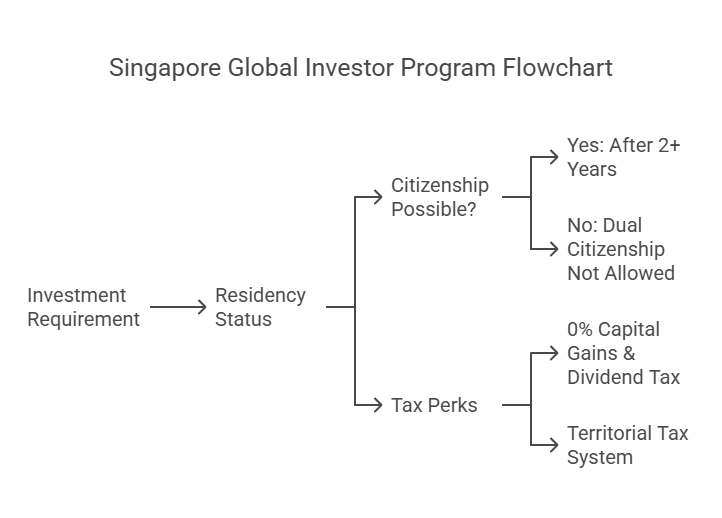
Successful GIP applicants are granted Singapore Permanent Resident (PR) status for themselves, spouse, and children under 21. Singapore PR is a coveted status, allowing one to live in a stable, low-tax, high-standard-of-living country at the heart of Asia. With PR, investors can eventually apply for Singaporean citizenship (though Singapore is quite selective about granting citizenship). The Singapore government offers an attractive tax regime to all businesses and residents: corporate tax is a flat 17% (with exemptions effectively lowering it for smaller profits), and there are no taxes on capital gains or dividends for individuals.
In comparison, obtaining citizenship in a European country through investment programs can offer benefits such as visa-free travel across the Schengen Area and favorable investment conditions. These programs often emphasize the advantages of global mobility and economic contributions to the host country.
Personal income tax rates are relatively low to moderate (progressive up to 24% for top earners). Moreover, Singapore has no wealth tax, no inheritance tax, and no foreign income tax (foreign-sourced income is tax-free unless remitted under certain conditions, and even then many types like dividends are exempt). These general policies mean an investor’s returns on Singapore investments can be very tax-efficient – e.g., selling shares in a Singapore company incurs no capital gains tax. Additionally, the Economic Development Board (EDB) which administers the GIP may facilitate introductions and support for investors’ business plans. Large businesses might qualify for additional schemes like the Pioneer Certificate or Development and Expansion Incentive, which can cut corporate tax to even 5 or 10% for a period if they commit to high economic contributions (this is outside the GIP but could apply to a GIP investor’s project).
Singapore also boasts world-class infrastructure, rule of law, and intellectual property protection – the general business-friendly environment is itself an incentive. GIP participants get a 5-year Re-Entry Permit (to maintain PR status) and this is renewable if they meet certain business milestones (like job creation or maintaining funds). Another perk: Singapore’s connectivity – PRs can easily travel visa-free to many countries and operate regionally. While the program doesn’t provide financial aid or tax breaks beyond what’s already available to any business, it gives high-net-worth investors an expedited route to residency in one of the world’s most stable economies, plus encouragement to integrate and hire locally (e.g., to renew the PR after 5 years, Option A investors must hire at least 30 employees, half locals). Summarily, the incentives are permanent residence in a safe, global financial hub and a superb pro-business climate (low taxes, stable governance).
Residency & Citizenship Timeline
The processing time for GIP applications is around 9–12 months. Once approved, the investor will receive an Approval-in-Principle PR status, and after making the full investment and meeting any specific conditions, they are issued the final PR (typically a 5-year PR Re-Entry Permit initially). That PR is conditional on fulfilling the investment and business plan commitments over the five years. After the first 5 years, if milestones are met (such as the required number of jobs created and expenditures or maintaining the fund investment), the PR status can be renewed for another 3 or 5 years. As for citizenship, Singapore does not have an automatic or guaranteed path from PR to citizenship; it is granted at the government’s discretion.
Generally, after 2 years of PR, one can apply for Singaporean citizenship, but approvals are tough – Singapore looks for investors who sink roots (e.g., family in Singapore, philanthropic contributions, integration into society) and who can contribute exceptional value. Many GIP investors remain PR for the long term. PR itself needs maintenance: one should spend a reasonable amount of time in Singapore or demonstrate significant economic ties to get Re-Entry Permit renewals. A typical timeline could be: invest and get PR in ~1 year, run business or hold investment for 5 years, renew PR for another 5 years (or transition to citizenship if approved after a few years). If an investor does aim for citizenship, realistically it might take 4–6 years or more of involvement in Singapore; some never get it if they don’t truly reside or integrate.
Notably, Singapore restricts dual citizenship – adult naturalized citizens are required to renounce their previous citizenship. This is a major consideration for GIP investors when weighing whether to pursue citizenship or keep the PR (which allows them to keep their original nationality). In summary, the PR is relatively fast (under 1 year) if you meet the high requirements, but citizenship is neither guaranteed nor quick – it’s a separate, selective process that only some will attain. The PR grants most practical benefits anyway (except voting rights) and can be renewed indefinitely as long as conditions are satisfied, giving investors a stable long-term status in Singapore.
St. Kitts & Nevis – Citizenship by Investment Program (Direct Citizenship)
Minimum Investment & Sectors
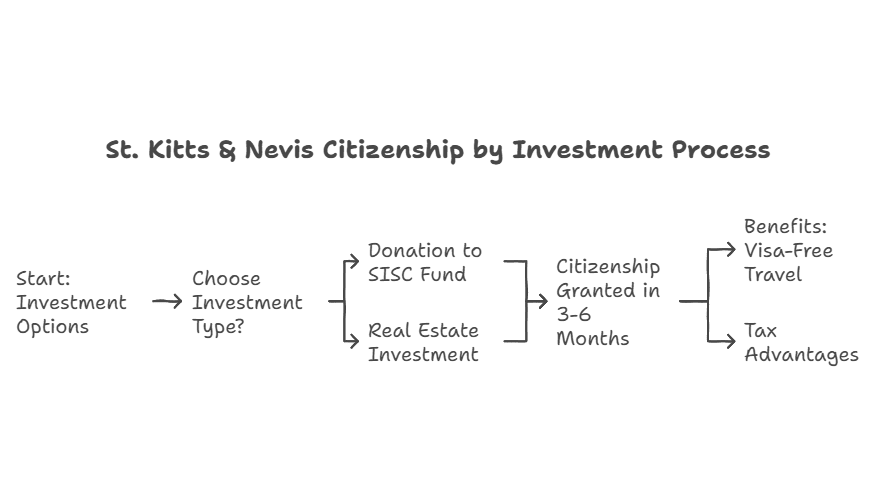
St. Kitts & Nevis, a Caribbean nation, operates the world’s longest-running Citizenship by Investment (CBI) program (since 1984). It offers direct citizenship (a passport) in exchange for an investment. The two main investment options are a government fund contribution or real estate purchase. Under the newest iteration (2023), the minimum donation (Sustainable Island State Contribution) starts at US$250,000 for a single applicant (this may cover up to a family of four). Previously, the threshold was $150k for a single applicant in the “Sustainable Growth Fund”, but recent changes increased it alongside program reforms. The other route is investing in government-approved real estate, typically at least US$325,000–$400,000 in a tourism or resort development, to be held for 7 years (or 5 years if $400k). Additionally, there is sometimes an option to invest in alternative projects or public-benefit initiatives (such as infrastructure or enterprise development) at similar price points. Eligible sectors are essentially real estate (luxury resorts, villas) or a direct contribution to a national development fund – unlike residency programs, you aren’t investing in operating businesses or startups (though the fund money is used by the government broadly). Real estate investors often buy shares or units in resorts; the purchase qualifies them for citizenship and they can usually resell after the hold period. It’s worth noting the contribution option is by far the most popular for its simplicity.
Government Incentives
The chief incentive is instant citizenship for the investor and immediate family, granting a second passport with extensive visa-free travel (St. Kitts & Nevis passport has visa-free or visa-on-arrival access to around 150+ countries including the EU Schengen area, UK, Singapore, etc.). Processing is relatively fast: standard applications take about 4–6 months, and there’s even an accelerated process (60-day approval) for an extra fee. There are no residency requirements at all – one can obtain the passport without ever visiting the country. For those who do choose to relocate or spend time there, St. Kitts offers a pleasant Caribbean lifestyle, and tax advantages: the country imposes no personal income tax, no capital gains tax, no wealth or inheritance taxes.
This makes it attractive as a tax haven or Plan B location. Additionally, St. Kitts recognizes dual citizenship, so investors don’t have to renounce their original citizenship. The government periodically runs limited-time promotions (for instance, reduced donation amounts or inclusion of additional dependents at lower cost) to boost interest. Holding citizenship also entitles one to live, work, and own property in St. Kitts & Nevis, and as a citizen you can benefit from any local incentives for investors (the islands do promote tourism development, offering some concessions to hotel developers, etc., though most CBI investors are passive). Another hidden benefit: access to the wider Caribbean community – St. Kitts & Nevis is part of CARICOM and the OECS, which means citizens can travel and even reside in other member states like Antigua, Dominica, St. Lucia, etc., relatively freely. Moreover, a St. Kitts citizenship can facilitate obtaining certain business visas (for example, some use a Caribbean passport to then apply for an E-2 investor visa to the US via treaty, though St. Kitts itself is not an E-2 treaty country, so that strategy works with Grenada’s passport, not St. Kitts). The security of having a stable second citizenship is itself the selling point – it’s an insurance policy. The government’s promise is straightforward: make the investment, pass background checks, and receive a passport for life (which can be passed to future children in most cases). In summary, incentives are fast and easy access to citizenship and a host of travel/tax freedoms, without the need to relocate or wait years. While St. Kitts & Nevis offers direct citizenship, other programs may offer a permanent residence permit as a step towards citizenship.
Residency & Citizenship Timeline
The program grants citizenship directly, so there is no interim residency stage required. Upon approval and completion of the investment, a citizenship certificate and passport are issued. The timeline for a standard application is roughly 4 to 6 months. There is an Accelerated Application Process (AAP) which can shorten this to about 60 days (2 months) for an additional fee (several thousands of dollars). After citizenship, there is no further timeline to maintain anything – the investor is a full citizen for life. St. Kitts passports are valid for 10 years (5 years for children) and then renewable. There’s no requirement to ever visit or reside, neither before nor after citizenship. Because it’s direct citizenship, concepts like permanent residency or naturalization waiting periods don’t apply. One interesting aspect: dependent children over a certain age and parents/grandparents can also be included, but older dependents must be shown to be financially supported by the main applicant.
In 2023, St. Kitts tightened some due diligence processes, so sometimes it may take closer to 6 months if background vetting uncovers complexities. But compared to traditional immigration, it is extremely fast – you can realistically apply in January and be a citizen by June. If the real estate route is chosen, one timeline consideration is the property purchase, which might take some weeks to process (and in some cases, citizenship is contingent on completion of the purchase agreement and payment). After obtaining citizenship, there’s no timeline to maintain investment for the donation route (it’s one-time).
For real estate, you must hold the property for at least 5 or 7 years (depending on the minimum amount) before you can resell; selling earlier could trigger revocation of citizenship (in practice, they ensure you don’t get a release of escrow until the time is up). But the citizenship itself once granted is not conditional or temporary – it’s immediate and irrevocable except in cases of fraud or serious criminal subsequent activity. This makes the timeline to full benefits essentially the few months processing time. Compared to residency programs that might require 5+ years to get a passport, St. Kitts’s program is instantaneous in outcome. It’s worth noting that St. Kitts & Nevis has recently been doing program reviews under new leadership, so conditions and timelines may evolve, but as of the updated guide in 2025, 4-6 months to citizenship is standard.
Conclusion
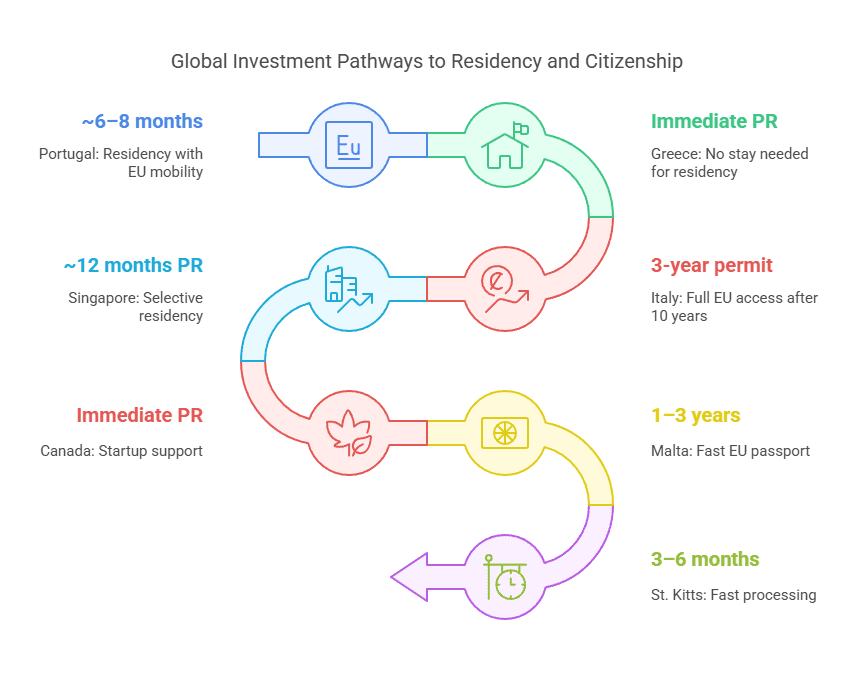
Choosing the best investment immigration program depends on an individual’s goals, capital, and timeline. European “Golden Visas” like Portugal and Greece offer a blend of lifestyle and eventual EU citizenship, with moderate investment thresholds and strong real estate options – ideal for those seeking mobility within Europe and a backup residency. North American programs differ: the U.S. EB-5 demands substantial funds and taxes worldwide income but grants access to the American market and a coveted Green Card, while Canada’s Start-Up Visa focuses on innovation, providing immediate permanent residency for entrepreneurs who can secure local support, making it attractive for startup founders eyeing North America.
In Asia, Singapore’s GIP stands out for high-net-worth individuals aiming for an Asian base with world-class financial infrastructure – though the price tag is steep, the payoff is PR in a no-tax-haven for capital gains. Middle Eastern options like the UAE Golden Visa (not tabulated above) also offer zero income tax and a 10-year residence for sizable investments (~$550k in property or business), appealing to those seeking a tax-free, global business hub in Dubai or Abu Dhabi. Meanwhile, Citizenship-by-investment programs such as St. Kitts & Nevis provide the fastest route to a second passport, beneficial for global mobility and asset diversification, though they don’t confer the residency rights in major economies that other programs do.
For investors, key considerations include how soon residency or citizenship is needed, whether living in the new country is part of the plan, and the tax implications of each option. For example, an entrepreneur wanting to actually relocate and build a company may favor Canada or Portugal for their welcoming ecosystems, whereas a wealthy individual interested purely in visa-free travel and a “plan B” might opt for a Caribbean passport or UAE residency. Each program has trade-offs: European programs require longer timelines for citizenship but give EU freedom; the U.S. offers immediate family Green Cards but with heavy compliance and tax costs; some countries demand a purely economic contribution (donation), others expect you to actively invest or do business.
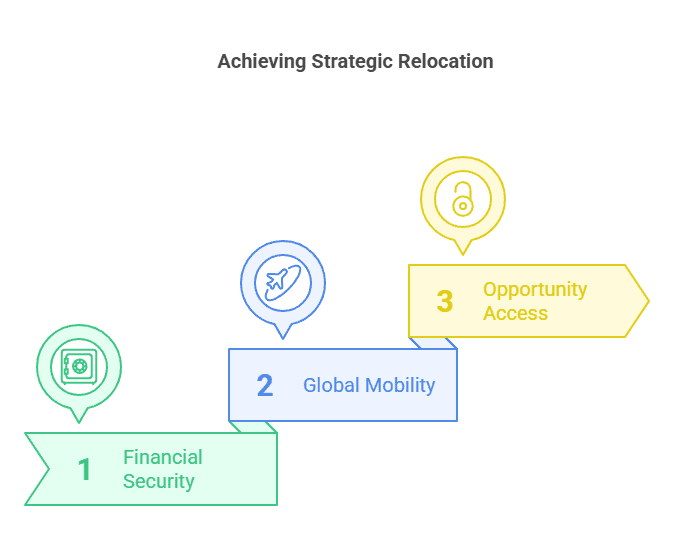
In all cases, due diligence is crucial – both the government vetting the investor, and the investor vetting the program’s stability and the investment’s soundness. Recent trends show some tightening (e.g. Spain closing its golden visa, Singapore raising investment minimums) as nations balance economic interests with local sensitivities. Nonetheless, investment migration remains a strategic tool for high-net-worth individuals and entrepreneurs. By analyzing factors like required investment, eligible sectors (from real estate to tech startups), government incentives (tax breaks, fast-track processing), timeframe to residency or citizenship, tax regime, and investor conditions, one can identify the program that best aligns with their wealth management and lifestyle objectives.
Ultimately, the “best” program is subjective: it could be Portugal’s Golden Visa for a diversified portfolio and EU access, Greece’s for cost-effectiveness, Singapore’s for elite business networking, the US EB-5 for American opportunities, or St. Kitts’ for quick global mobility. Many programs offer permanent residence permits as a pathway to citizenship, providing long-term stability and benefits for investors. By weighing the data and comparative insights provided, investors can make an informed decision and embark on the journey of global residency or citizenship that supports their personal and professional growth.

Lusine Sargsyan
Attorney
