

Finding a country of residence with low or zero capital gains tax can significantly boost an investor’s after-tax returns, especially when considering capital gains tax countries. High-net-worth individuals and entrepreneurs often consider relocating their personal tax residency to jurisdictions that won’t heavily tax the sale of assets, stock trades, crypto gains, or business proceeds. In this comparative analysis, we examine 10 of the top countries that offer capital gains tax freedom or very favorable tax treatment for expatriates.
Comparative Overview of Tax Systems
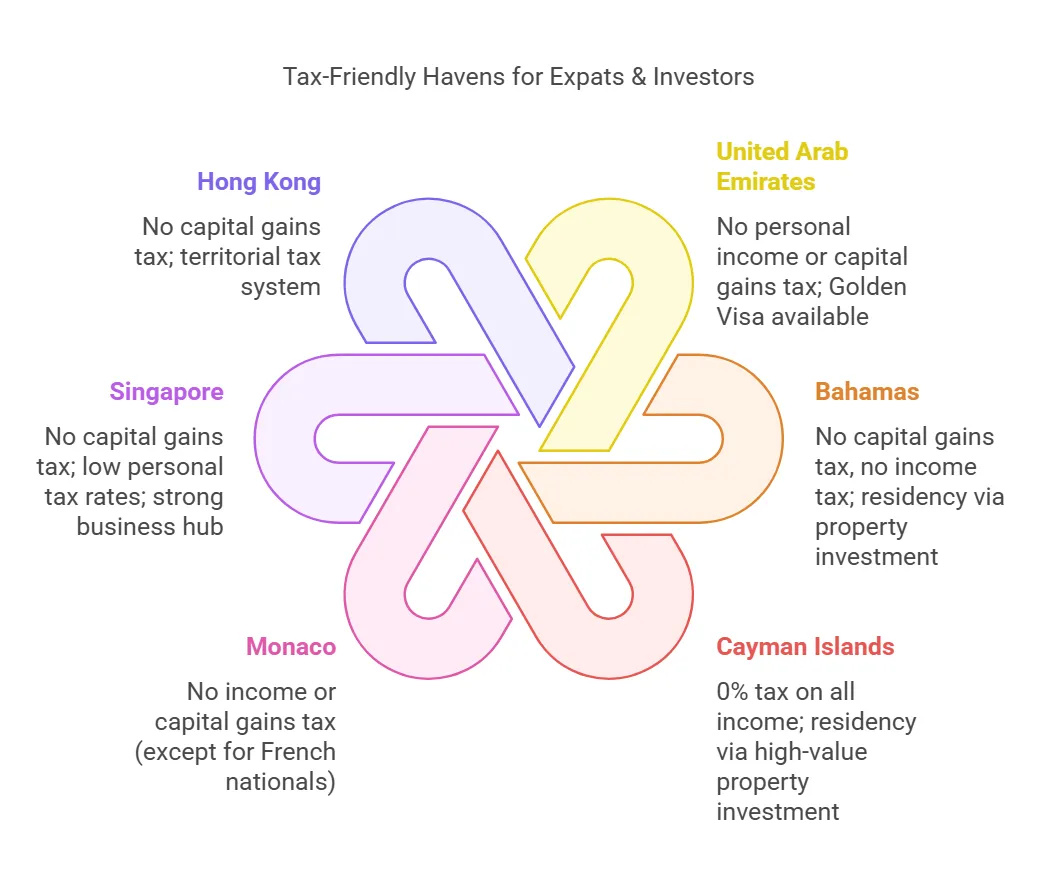
In this comparative overview, we examine the capital gains tax rates and other tax systems of 10 top countries that offer capital gains tax freedom or very favorable tax treatment for expatriates.
Country | Capital Gains Tax | Personal Income Tax | Tax System |
|---|---|---|---|
United Arab Emirates | 0% (no tax on capital gains) | 0% (no personal income tax) | No income tax (tax-free for individuals) |
Bahamas | 0% (no capital gains tax) | 0% (no personal income tax) | No personal income, capital gains, or corporate taxes (tax-free jurisdiction) |
Cayman Islands | 0% (no capital gains tax) | 0% (no personal income tax) | No direct taxation (no income, CGT, inheritance, etc.) |
Monaco | 0% (no CGT for residents; French citizens excepted) | 0% (no personal income tax) | No income tax (except special treaty for French nationals) |
Singapore | 0% (no capital gains tax) | Progressive up to 22% (24% from 2024) | Territorial (no tax on foreign-sourced income for individuals) |
Hong Kong | 0% (no capital gains tax) | Progressive up to ~17% (15% standard rate) | Territorial (only Hong Kong–sourced income taxed; no tax on investment gains) |
Malaysia | 0% (no CGT on stocks; real estate gains taxed if < 5 years) | Progressive up to 30% | Territorial (foreign income generally exempt; no CGT on investments) |
Switzerland | 0% (no CGT on private securities) | Progressive ~up to 40% (varies by canton) | Worldwide income taxed (no CGT for private investors; wealth tax applies) |
Andorra | 0% (exempt if < 25% stake or >10-year hold; otherwise 10%) | 0–10% (flat 10% on income > €40k) | Low-tax (no tax on most capital gains; flat low income tax) |
Belize | 0% (no capital gains tax on investments) | 0% on foreign-sourced income; 25% on local income | Territorial (offshore income and gains untaxed) |
1. United Arab Emirates (UAE)
Tax Rates: The UAE imposes no personal income tax and no capital gains tax on individuals. While the UAE imposes no personal income tax and no capital gains tax on individuals, it does have a corporate income tax of 9% on company profits over a certain threshold starting from 2023. This means expatriates pay 0% tax on investment profits, including stock or crypto gains, and on any personal income. (Note: A corporate tax of 9% applies to company profits over a threshold from 2023, but it doesn’t affect personal or investment income.)
Residency Requirements: The UAE offers several residency visas. A popular option is the investor visa – for example, a 2-year renewable residency by purchasing property worth at least AED 750,000 (~USD 204k), or a 10-year Golden Visa with an investment of AED 2 million (~USD 545k). Entrepreneurs can also obtain visas by establishing a business, and employment visas are common for foreign workers.
Physical Presence Obligations: Uniquely, the UAE does not mandate a minimum stay to maintain most residency visas. Residency is valid with only a short visit every 6–12 months, making it very flexible for globetrotters. There is no 183-day rule – one can spend considerable time abroad without losing UAE tax residency, as long as the visa is kept active.
Citizenship Options: Naturalization in the UAE is rare – it’s generally not a viable strategy for expats. The UAE only grants citizenship in special cases (e.g. to investors or talent by nomination) and does not have a routine citizenship-by-residency process. Most expats remain on long-term residence permits.
Investment Requirements: For the Golden Visa, a property investment of AED 2 million is required (multiple properties totaling that amount also qualify). There are also investor visas for starting or investing in companies (e.g. depositing capital in a UAE company). These investments grant residency but are not “fees” – the money remains the investor’s asset (property, business equity, etc.).
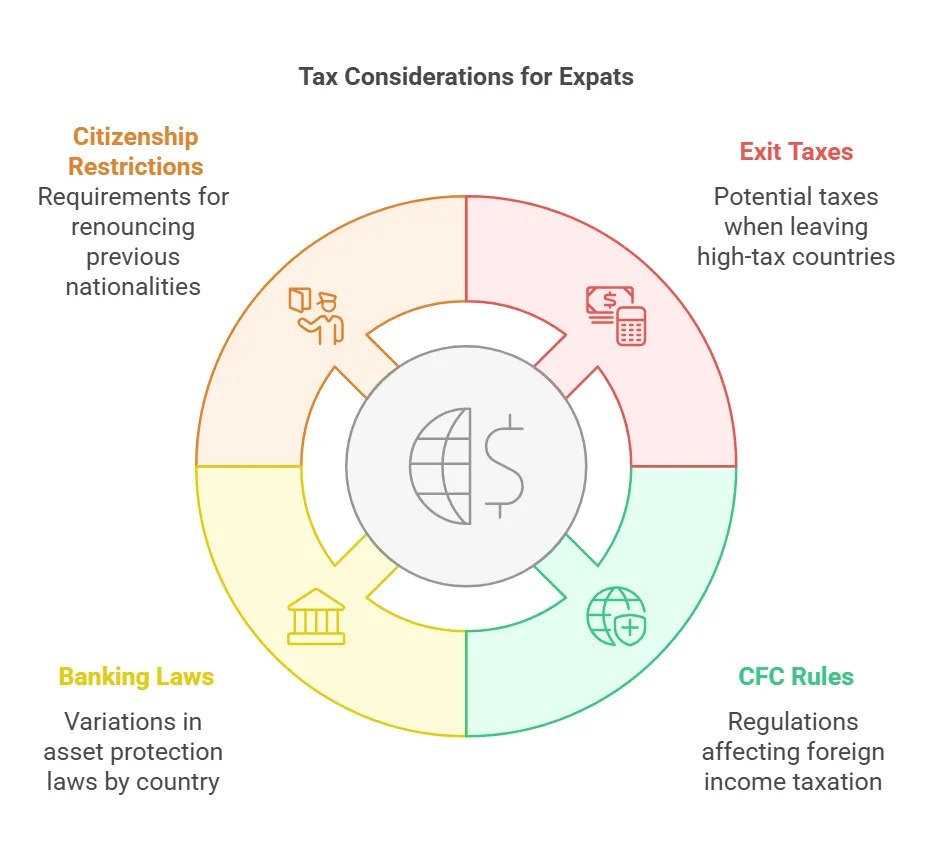
Legal Considerations: The UAE has no personal income tax regime, so it has no controlled foreign corporation (CFC) rules for individuals and no taxes on overseas earnings. This means UAE residents can hold foreign companies or assets without local tax reporting. However, one should ensure they properly exit their previous country’s tax system – for example, obtaining a tax residence certificate from the UAE. Some high-tax countries may impose an exit tax on unrealized capital gains when emigrating (for instance, Canada taxes accrued gains when one gives up Canadian residency). The UAE itself does not tax individuals who leave its jurisdiction.
Restrictions & Benefits for Foreign Investors: The UAE is very welcoming to foreign investors. Expats can own property in designated freehold areas and can own 100% of companies in most sectors. There are no foreign exchange controls, and the UAE dirham is pegged to the US dollar, providing stability. One restriction is that personal bank accounts and finances in the UAE are reportable under CRS to one’s home country (since UAE participates in global transparency efforts). On the benefit side, the UAE offers world-class infrastructure, a high standard of living, and a strategic geographic location. Zero capital gains and income taxes, combined with modern amenities and safety, make it a top choice for high-net-worth individuals seeking tax efficiency.
2. The Bahamas

Tax Rates: The Bahamas levies no income tax, capital gains tax, or wealth tax on individuals. The Bahamas is particularly attractive for expatriates due to its zero income tax policy, which means individuals pay no tax on their personal or business income. For expatriates, this means 0% tax on capital gains from investments and 0% on any personal or business income earned worldwide. The country funds itself through consumption taxes (VAT), import duties, and tourism, instead of taxing personal income.
Residency Requirements: Bahamas residency is often obtained via the Permanent Residency (PR) by Investment program. The typical requirement is an investment in real estate: purchase of property valued at BSD 750,000 or more (roughly USD 750k) grants the investor permanent resident status (with faster processing for USD 1.5 million+). There are also annual residency permits and a “economic permanent residency” route for those renting or with lower investments, but the $750k property route is the most straightforward path for a tax-motivated move.
Physical Presence Obligations: To be recognized as a tax resident of the Bahamas (and obtain a tax residency certificate), an individual must spend at least 90 days in-country per calendar year and not spend more than 183 days in any other single country. This rule was introduced to prevent “paper residency.” Practically, the Bahamas doesn’t strictly enforce day-counts for retaining your residency permit, but for the tax certificate (useful to show other tax authorities), the 90-day presence is required. Many HNWIs therefore reside in the Bahamas a few months a year and travel elsewhere the rest.
Citizenship Options: Obtaining Bahamian citizenship is possible after a long period – the law allows one to apply after 10 years of permanent residence. However, approvals are discretionary and not guaranteed. The Bahamas does allow dual citizenship in practice for those who naturalize. Most expats use the Bahamas as a tax residence and retain their original citizenship (there’s no need to become a Bahamian citizen to enjoy the tax benefits; PR is sufficient).
Investment Requirements: The primary investment for residency is real estate. The minimum of $750k can be a single property or multiple, and must be maintained to keep status. Unlike some jurisdictions, there’s no donation required – you are investing in your own property. There are no additional large fees apart from legal and government application fees. Notably, foreign buyers in the Bahamas enjoy freehold property rights and no property tax on owner-occupied residences valued under $250k (above that, property tax applies on a sliding scale).
Legal Considerations: The Bahamas has no income taxation, so like other tax havens it imposes no CFC rules or exit taxes on individuals. Its legal system (based on English common law) is business-friendly and has strong financial privacy. However, international transparency standards (CRS) mean that banking in the Bahamas is not anonymous – information can be shared with home countries. If an expat is leaving a country like the US, UK, or Canada, they should be mindful of exit formalities in that country (e.g. the US taxes citizens on worldwide income even after they move, unless they renounce citizenship). The Bahamas itself does not tax you when you depart or when you sell assets – even real estate sales are free of capital gains tax (though there is a stamp duty on property transfers).
Restrictions & Benefits for Foreign Investors: Foreigners can own land and businesses in the Bahamas (with some business sectors requiring permits). The key benefit is the tax-free environment and a relaxed island lifestyle relatively close to the US. The Bahamas has modern banking and communications, but one restriction is the high cost of living and import costs (since many goods are imported and carry duties). The government encourages offshore financial activities, and there are special zones and incentives for certain investments. For retirees or digital nomads, the Bahamas offers a pleasant climate and stable, democratic governance. It’s important to note that while taxes are nil, one should have sufficient income or assets to meet the immigration’s financial requirements and to sustain the island’s living expenses.
3. Cayman Islands
Tax Rates: The Cayman Islands is famously tax-neutral. The Cayman Islands' tax-neutral environment is designed to attract foreign capital, making it a prime destination for international investors. There are no personal income taxes, no capital gains taxes, no inheritance or estate taxes, and even no corporate taxes for most businesses. An expatriate in Cayman will pay 0% on investment income and realized capital gains. Government revenue comes from work permit fees, import duties, tourism, and financial services fees instead of traditional taxation.
Residency Requirements: Gaining residency in Cayman typically requires being a person of independent means. The fastest path is through a substantial real estate investment: purchasing developed real estate of at least KYD 2 million (≈ USD 2.4 million) qualifies one for a Permanent Residence Certificate. This grants the right to reside indefinitely (and to eventually seek citizenship). There is also a 25-year residency option with a lower investment (~USD 1.2 million in real estate), and a residency by substantial business presence for those who establish businesses and employ locals. For shorter stays, Cayman also offers a Digital Nomad visa (up to 2 years) and the option of renewable work permits if employed by a Cayman company.
Physical Presence Obligations: Cayman’s rules are very accommodating – permanent residents are only required to spend a minimal time (as little as 1 day per year) in the Islands to maintain PR. This means an investor can maintain Cayman as their legal domicile for tax purposes without needing to live there full-time. However, to truly be seen as a tax resident of Cayman (and not be claimed by another country), one would typically make Cayman the primary home. The government can issue a tax residency certificate if needed, though many use Cayman’s absence of taxes without formal certificates since no income tax exists.
Citizenship Options: The Cayman Islands is a British Overseas Territory. There is no direct “citizenship-by-investment” – instead, after 5 years of residency, one can apply for British Overseas Territories Citizenship (BOTC – Cayman). BOTC can then lead to a British passport (UK citizenship) after a further waiting period and a request to register as a full UK citizen. However, obtaining BOTC via Cayman residency is a legal process that requires maintaining substantial ties. Many investors are content with the residency itself because Cayman residency already confers the full tax benefits.

Investment Requirements: The headline requirement is the multi-million dollar real estate purchase. The property can be residential or commercial, and it must be maintained (you shouldn’t sell below the threshold or you risk losing the status). In addition to the property cost, there are government application fees (and a one-time stamp duty on property purchase, about 7.5%). Applicants must also show a steady financial means (e.g. a high annual income or assets) to prove they won’t be a burden.
Legal Considerations: Cayman has no direct taxation and thus no CFC or foreign income reporting for individuals. This allows expats to hold global investments and companies without local tax interference. The one caveat is that because Cayman itself doesn’t tax or scrutinize personal income, an expat’s home country might apply anti-avoidance rules if they have not properly severed tax residency there. For example, UK residents must genuinely leave the UK and meet non-resident criteria or they could still be taxed by the UK despite living in Cayman. Cayman has strong asset protection and privacy laws, but as part of international commitments it can exchange financial information (under FATF/CRS) for foreign taxpayers. There is no estate or inheritance tax, but if an expat dies, their home country laws might still apply to their estate unless planned for.
Restrictions & Benefits for Foreign Investors: One major benefit is that foreign investors have equal property rights – Cayman imposes no restrictions on foreign ownership of land or businesses (and no direct taxes on them). The Cayman Islands is a global financial center with excellent professional services (lawyers, banks, fund administrators), which is beneficial for entrepreneurs managing wealth. It is politically stable (a British territory) and has a high standard of living (but also a high cost of living). A potential restriction is that gaining residency is expensive – it’s essentially open only to fairly high-net-worth individuals. There is also a requirement to maintain the investment and pay an annual fee for the PR certificate. But in return, residents enjoy a safe tropical island, robust legal system, and freedom from personal taxes, making Cayman a premier choice for wealth preservation and capital gains tax avoidance.
4. Monaco
Tax Rates: Monaco is renowned for its zero personal income tax policy – since 1869 it has not taxed residents’ incomes. Likewise, Monaco imposes no capital gains tax on individuals. Investment profits, stock trades, and other capital gains are entirely tax-free for Monaco residents. (The only exception is French nationals residing in Monaco, who per a bilateral treaty must still pay French taxes as if living in France.) While Monaco imposes no capital gains tax on individuals, French nationals residing in Monaco are subject to the normal French tax rates due to a bilateral treaty.
Residency Requirements: Monaco doesn’t sell citizenship or have a formal “golden visa,” but it grants residency to those who can prove financial sufficiency and accommodation in Monaco. To obtain the Carte de Séjour (residency card), an applicant must have a local address (own or rent an apartment) and a Monégasque bank account with substantial funds. In practice, at least €500,000 is the minimum deposit to get a bank reference letter, though higher amounts may be required depending on the bank. There is no minimum investment to the government – it’s about showing you have the means to live without working in Monaco. The process involves an interview and background checks (clean criminal record).
Physical Presence Obligations: Monaco authorities expect residents to genuinely reside in the Principality. Generally, one should spend at least 3 months per year in Monaco to maintain the residency card. At renewal time, Monaco may ask for proof like utility bills or credit card usage in-country to verify you’ve been around. While not as strict as a 183-day rule, failing to spend sufficient time could jeopardize renewal. Many residents do actually live most of the year in Monaco, given its small size and exclusivity.
Citizenship Options: Acquiring Monégasque citizenship as an expat is challenging. One can apply for naturalization after 10 years of continuous residency (with proof of integrating into Monégasque life), but approval is at the Prince’s discretion. Moreover, Monaco typically requires renunciation of the previous citizenship upon granting theirs. Because of these hurdles, most expatriates in Monaco simply remain long-term residents – enjoying the tax benefits without a Monégasque passport.
Investment Requirements: There is no fixed investment cost aside from needing housing and the bank deposit. Applicants often rent apartments (Monaco’s real estate is very expensive – even a small studio can cost over €1 million to buy or several thousand euros a month to rent). The significant financial requirement is maintaining the bank balance (e.g. €500k or more) to show continuing means. Monaco also requires health insurance coverage. There’s no mandatory donation or government bond purchase (contrasting with some other countries’ programs).
Legal Considerations: Monaco’s lack of income and capital gains taxes means it has no complex anti-avoidance laws for individuals – there’s simply no tax to avoid. However, when a new resident moves to Monaco, they should be aware of any exit taxes from their prior country (for instance, some European countries tax unrealized gains if one moves out as a tax resident). Monaco has no wealth tax, but French nationals in Monaco are subject to French wealth tax due to separate agreements. There is no CFC regime affecting Monaco residents’ foreign companies, since Monaco itself doesn’t tax worldwide income. One consideration: Monaco does not have tax treaties (besides with France), which typically isn’t an issue since it doesn’t tax, but it means other countries might not recognize Monaco residency to avoid their own taxes unless one truly cuts ties.
Restrictions & Benefits for Foreign Investors: Monaco offers security, prestige, and a fully tax-free environment on personal income. It is extremely stable, with low crime and high-end amenities (yachts, casinos, luxury retail). Foreigners can freely buy property (though prices are among the highest in the world). A notable restriction is economic – the cost of living and entry is very high. Only those with considerable wealth can practically establish residency. Also, businesses in Monaco are subject to tax (Monaco levies a profit tax of 33.3% on companies earning over 25% of revenue outside Monaco), but this usually doesn’t affect someone who just holds investments. For an entrepreneur, Monaco offers an attractive base in terms of lifestyle, though running an active company might invoke that corporate tax. In summary, Monaco’s chief draw is zero capital gains and income tax coupled with a glamorous lifestyle – available to those who can afford the high entry bar.
5. Singapore
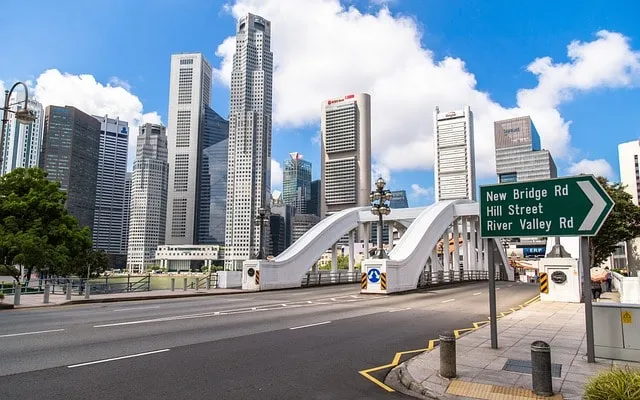
Tax Rates: Singapore has no capital gains tax at all. This means profits from the sale of assets, such as stocks or real estate, are not taxed as long as they are capital in nature (not part of a trading business). Singapore does not levy capital gains taxes on individuals, making it an attractive destination for investors looking to maximize their returns. Singapore also does not tax most foreign-sourced income for individuals. Local personal income (e.g. salary from working in Singapore) is taxed at progressive resident rates up to 22% (recently raised to 24% for incomes above S$1 million), which is still relatively low by global standards. Additionally, there are no estate or inheritance taxes.
Residency Requirements: Many expatriates move to Singapore on an employment pass (work visa) and may later become Permanent Residents (PR). For high-net-worth investors, the Global Investor Programme (GIP) is the main route to residency by investment. It requires an investment of at least S$2.5 million (~USD 1.8 million) in either a new/existing Singapore business or an approved fund. Successful applicants and their immediate family can obtain PR status. Another option is the Entrepreneur Pass (EntrePass) for those who want to start a venture; it has lower capital requirements but more entrepreneurial criteria.
Physical Presence Obligations: Singapore does not impose a strict minimum stay for tax purposes – tax residency is generally determined by spending ≥183 days in a year or by establishing it as a permanent home. PR holders are expected to make Singapore their main residence (especially when renewing the Re-Entry Permit every 5 years). However, there is flexibility; many PRs travel extensively but maintain their home and family in Singapore. To maintain PR status, one should demonstrate ties to Singapore (e.g. family, property, business) if not meeting the day count.
Citizenship Options: Singapore offers a coveted passport, but naturalization is selective. A typical pathway is to live in Singapore as a PR for several years (often at least 2–3 years) and then apply for citizenship. Approval depends on factors like integration, economic contributions, and usually requires relinquishing your previous citizenship (Singapore does not allow dual citizenship for adults). The timeline to citizenship can vary; some high-profile investors obtain it in as little as 2–5 years, whereas others may remain PR for longer.
Investment Requirements: Under the GIP investor PR scheme, beyond the S$2.5M investment, applicants must have a successful entrepreneurial background (e.g. substantial business turnover or being an established founder). The investment must be maintained for a number of years. If going the business route, it involves active involvement in the enterprise. Simply bringing funds into a bank account is not enough for PR; it has to be an approved investment. There’s also a “family office” option where ultra-HNWIs can set up a family investment office in Singapore, enjoy tax exemptions on investment income (under schemes like 13O/13U), and this can help in obtaining PR, albeit indirectly.
Legal Considerations: Singapore’s territorial tax system means that if an expat’s income or gains are derived outside Singapore and not remitted, they are not taxed locally. Even remitted foreign income is exempt in most cases (except certain corporate earnings or if it falls under specific anti-abuse provisions). Singapore has no CFC rules for individuals – individuals can hold companies abroad and only pay tax on what’s locally sourced. Singapore does have strict laws on tax evasion (as a crime), but the tax regime itself is straightforward and investor-friendly. When relocating, expats should check if their home country will impose exit taxes or still tax them as non-residents. For example, U.S. citizens will continue to owe U.S. tax on worldwide income despite living in Singapore, unless they renounce citizenship.
Restrictions & Benefits for Foreign Investors: Singapore is frequently rated as a very pro-business environment: stable government, strong rule of law, and excellent infrastructure. Benefits include robust asset protection, a wide network of tax treaties, and an English-speaking environment. There are virtually no restrictions on foreign ownership of businesses or assets (aside from some real estate curbs – foreigners cannot buy landed residential property without approval, but can buy condos).
Singapore’s cost of living is high (especially housing), and cars are extremely expensive due to vehicle quotas. But high-net-worth individuals often find the safety, cleanliness, and global connectivity well worth it. Singapore also offers top-notch healthcare and education, making it attractive for those relocating with families. In summary, Singapore provides a blend of low-tax living (especially for capital gains and foreign income) and high-quality urban life, making it a prime choice for entrepreneurs and investors in Asia.
6. Hong Kong
Tax Rates: Hong Kong does not tax capital gains for individuals. If you buy and sell stocks, real estate, or other assets as an investment (not as a business dealer), any gain is yours to keep tax-free. Hong Kong’s capital gains tax rate is effectively zero for individuals, as it does not tax capital gains on personal investments. Hong Kong’s tax system is territorial: only income arising from or derived in Hong Kong is subject to tax. Salaries (employment income) are taxed at progressive rates from 2% to 17%, with a cap such that tax does not exceed 15% of income (after allowances). There is no tax on bank interest or dividends, and no sales tax or VAT. In essence, Hong Kong’s personal taxes are very low and capital gains are zero.
Residency Requirements: To live in Hong Kong, most expats obtain an employment visa or a visa under special talent schemes. Hong Kong used to have an investment visa program called the Capital Investment Entrant Scheme (CIES), but it’s been suspended since 2015. In its place, Hong Kong has programs like the Quality Migrant Admission Scheme (QMAS), which is a quota-based scheme for highly skilled or wealthy individuals (no investment required, but a points-based selection). Entrepreneurs can apply for an Investment as Entrepreneur visa by starting a business and hiring locals. After 7 years of continuous ordinary residence, one becomes eligible for Permanent Resident (PR) status, which gives the Right of Abode.
Physical Presence Obligations: Hong Kong doesn’t mandate a strict number of days in-country for visa holders, but to be considered “ordinarily resident” (for the 7-year period towards PR), one should avoid long absences. Typically, spending at least a majority of time each year (e.g. >180 days) in Hong Kong would ensure continuity of residence. Once you have PR, you can come and go freely, but if you leave Hong Kong for over 36 months in a row without returning, your PR status can be lost. For tax purposes, Hong Kong uses primarily the source principle, not days count – even a short-term resident is not taxed on offshore income.
Citizenship Options: Hong Kong is a Special Administrative Region of China. Becoming a Chinese citizen via Hong Kong is possible, but not common for Western expats. After obtaining Permanent Residency and holding it (and usually living in HK) for some time, one could theoretically apply for naturalization as a Chinese national (which grants a Hong Kong SAR passport). China does not allow dual citizenship, so you would have to renounce your original citizenship. Most expats do not pursue this; instead they keep their original passports and enjoy Hong Kong permanent residency, which is sufficient for all practical purposes (right to live and work indefinitely in Hong Kong).
Investment Requirements: Since there’s currently no passive investor visa, there is no fixed sum that one can invest to get residency. However, if using the entrepreneur route, one should invest enough capital to plausibly run and grow a business (and create local jobs). For QMAS, having a strong financial background (assets, income) helps in the points assessment but there’s no set minimum investment. Many wealthy individuals simply relocate by obtaining an employment visa as a director of their own Hong Kong company, injecting a reasonable amount of capital to satisfy immigration that the business can sustain the person.
Legal Considerations: Hong Kong’s territorial tax rule means offshore income and capital gains are not taxable, but if one is actively trading assets as a business, the tax authority could deem that profits are business income (taxable at the flat 15% rate). For typical personal portfolio investing, this isn’t an issue. Hong Kong has no CFC rules targeting personal holdings, as individuals aren’t taxed on foreign income anyway. However, U.S. citizens in Hong Kong must still file U.S. taxes (with some exclusions) due to citizenship-based taxation. Hong Kong has robust legal institutions and dispute resolution, which is a benefit for protecting investor assets. On exit, Hong Kong does not impose exit taxes – if you cease to be a resident, you simply settle any final taxes on Hong Kong-sourced income up to that point.
Restrictions & Benefits for Foreign Investors: Hong Kong allows 100% foreign ownership of companies and properties (with a minor exception that non-permanent residents pay a higher stamp duty when buying real estate). The city is a major financial hub with deep capital markets, making it very convenient for investors to manage portfolios. Banking and brokerage services are world-class and accessible. A big benefit is ease of doing business – setting up companies is quick and straightforward, and there are minimal currency controls (the HKD is freely convertible and pegged to the USD). On the flip side, Hong Kong has a high cost of housing and has experienced sociopolitical changes in recent years. The introduction of the National Security Law and closer integration with mainland China have made some expatriates cautious. However, from a tax planning perspective, Hong Kong remains extremely attractive: no taxes on capital gains, wealth, or foreign income, and relatively simple tax filing. It’s especially favored by entrepreneurs and financiers in Asia who want a low-tax base without going completely offshore to a tiny island nation.
7. Malaysia

Tax Rates: Malaysia does not impose capital gains tax on investments like equities. The only capital gains tax is a Real Property Gains Tax (RPGT) on real estate sales – for non-residents, property sold within 5 years of purchase incurs RPGT (30% if within 5 years, 10% thereafter). Other than that, capital gains (stocks, crypto, etc.) are tax-free. Malaysia’s personal income tax rates are progressive, up to 30% on high incomes. Importantly, Malaysia follows a territorial tax system for individuals: foreign-sourced income is generally not taxable (and currently even foreign income remitted to Malaysia is exempt under a temporary measure until 2026). This means an expatriate living in Malaysia can often arrange their finances such that their income is received from abroad and thus not taxed in Malaysia.
Residency Requirements: Malaysia offers long-term residency visas to attract foreigners. The well-known program is Malaysia My Second Home (MM2H). The West Malaysia (peninsular) MM2H program requires applicants to have liquid assets of at least MYR 1.5 million (~USD 330k) and a monthly offshore income of MYR 40,000 (~USD 9k), and to place MYR 1 million (~USD 220k) in a fixed deposit in a Malaysian bank (partially withdrawable after a year) as proof of funds. Malaysia's favorable tax policies make it an attractive destination for tax residents, particularly those who can benefit from the Malaysia My Second Home (MM2H) program. The MM2H visa is valid for 5 or 10 years (depending on recent changes) and is renewable. There are also state-level variants such as Sarawak MM2H, which has lower financial thresholds (e.g. ~MYR 150k fixed deposit) and a 15-day per year stay requirement. Another recent option is the “DE Rantau” Digital Nomad Pass, a 1-year renewable pass for remote workers with a relatively low income requirement (~USD 24k annual income).
Physical Presence Obligations: Under the new MM2H rules, visa holders in West Malaysia are required to spend at least 90 cumulative days per year in Malaysia. This is to ensure participants contribute to the local economy. (Sarawak’s version requires only 15 days/year.) For those simply seeking tax residence, Malaysia considers you tax-resident if you stay >182 days in the country in a year. Notably, even if one is a tax resident, foreign income can be exempt. Many MM2H holders do end up residing in Malaysia for significant portions of the year given the lifestyle advantages (low cost of living, warm climate).
Citizenship Options: Malaysia is quite restrictive on citizenship. Naturalization is typically possible only after 10 years of permanent residency, and Malaysia generally disallows dual citizenship – meaning one would have to renounce their original nationality. Gaining PR itself is not automatic with MM2H; MM2H is a long-term visa, not a PR grant. There is a pathway to apply for PR (for example, after 5 years on certain employment or spouse visas, or by special approval), but it’s selective. Therefore, most expats in Malaysia remain on renewable visas. Fortunately, one doesn’t need to be a citizen or PR to benefit from Malaysia’s tax system.
Investment Requirements: The MM2H program’s “investment” is essentially the fixed deposit requirement (MYR 1 million in a bank) plus demonstrating high monthly income. This is not a fee; the money remains yours (though part of the FD must be maintained throughout your stay). Other visa types like the nomad pass have minimal investment requirements (just proving income). If one seeks an investor-type route, Malaysia also has options to incorporate a company and obtain an employment pass through your own company, which requires some paid-up capital (often around USD 50k or more to be safe) and local hiring. But compared to many countries, Malaysia’s financial entry bar for a long-term visa is relatively moderate.
Legal Considerations: Because Malaysia doesn’t tax foreign income, expats often structure their finances to earn offshore. One thing to watch is Malaysia’s stance on what constitutes foreign vs local source income can evolve; at one point, they considered taxing foreign income remittances but have deferred it. Also, if an expat has a Malaysian company or local rental income, that is taxable locally (corporate tax ~24%, rental income at progressive rates). There aren’t specialized CFC rules targeting individuals, since generally offshore income is outside scope. Malaysia has no inheritance tax and no wealth tax. When leaving Malaysia, there is no exit tax on individuals – you simply settle any due taxes on Malaysian-sourced income up to your departure. It’s important for expats to remain compliant (file tax returns if you have any local income).
Restrictions & Benefits for Foreign Investors: Foreigners in Malaysia can own property (with some minimum price thresholds set by state, often around MYR 1 million for a condo). They can also own 100% of businesses in most sectors (a few industries are restricted). The biggest benefits of Malaysia are affordability and lifestyle – cost of living is a fraction of Singapore’s while still offering good infrastructure, healthcare, and an English-speaking environment in major cities. From a tax perspective, the ability to live in a well-connected country while legally paying zero tax on offshore capital gains and income is highly attractive. A potential drawback is political changes – tax policies can change and the MM2H program rules have tightened before (as seen in 2021). Also, Malaysia’s bureaucracy can be slower than some places (visa processing can take time). Nonetheless, Malaysia remains a favorite for retirees and businesspeople seeking a low-tax base in Southeast Asia without the price tag of Singapore or the ultra-exclusive nature of Monaco.
8. Switzerland

Tax Rates: Switzerland has a unique tax situation regarding capital gains. For individual residents, capital gains on privately held assets (like stocks) are generally tax-free – as long as those gains are from managing one’s private wealth and not frequent trading as a business. Selling shares or other securities at a profit usually incurs no tax. Switzerland's capital gains tax rate for privately held assets is generally zero, making it an attractive destination for investors. There are caveats: If someone is deemed a “professional securities dealer” (e.g., very high-frequency trading or using significant leverage), gains can be reclassified as income. Real estate gains are taxed, but at the cantonal level (each canton has its own property gains tax). Apart from capital gains, Swiss residents pay income tax on worldwide income (federal + cantonal/communal rates). Top combined income tax rates range roughly from 20% to 40% depending on canton. Additionally, Switzerland imposes an annual wealth tax on net assets (typically around 0.1% to 1% per year, varying by canton).
Residency Requirements: To move to Switzerland, non-EU nationals usually need a residence permit tied to employment or substantial wealth. One popular route for wealthy retirees or financially independent individuals is the lump-sum taxation (forfait) regime. Under this, instead of taxing actual income, Switzerland can levy a flat tax based on one’s living expenses (often roughly equal to 5x one’s annual rent or a minimum amount set by canton, e.g. at least CHF 150,000 tax per year in many cantons). In exchange, the individual (typically must be not working in Switzerland) gets a residence permit. Another way is to establish a Swiss company and obtain a permit as a key employee (this route requires business substance and local jobs). EU citizens have easier access due to free movement. Each canton has quotas and slight differences for granting permits.
Physical Presence Obligations: Once you have a Swiss residence permit, you are expected to spend the majority of your time in Switzerland. Technically, being absent for more than 6 months can lead to permit revocation. For tax residency, generally staying 183 days or more in a year in Switzerland will make you a tax resident (and even shorter stays if it’s your center of vital interests). People on lump-sum taxation typically do make Switzerland their main home, although travel is fine. Switzerland is a small country, so many residents often hop over to neighboring countries for short trips, but they still primarily reside in Switzerland year-round.
Citizenship Options: Switzerland offers citizenship through naturalization after typically 10 years of residency (and meeting integration criteria such as language proficiency in the local canton’s language and community involvement). The process also involves communal and cantonal approvals – it can be quite rigorous. Switzerland does permit dual citizenship, so an expat can keep their original nationality. Some wealthy individuals bypass long wait times elsewhere by facilitated naturalization (for instance, if married to a Swiss or through special cantonal programs), but generally it’s a long-term prospect.
Investment Requirements: If pursuing the lump-sum tax residency, the “investment” is essentially agreeing to pay the annual tax, which for many wealthy individuals is far lower than what they’d pay on worldwide income in a high-tax country. They may also need to purchase or rent a high-end property as part of the deal (since the tax is often a multiple of rent). If coming via a business, one might need to invest substantial capital into that venture and create jobs to satisfy authorities. There’s no set minimum for a business investor, but the business plan must convince the canton that it’s beneficial economically. Compared to golden visas elsewhere, Switzerland’s path is more of a pay-to-play tax scheme than a direct investment sum – yet it achieves a similar goal of residence for money.
Legal Considerations: Switzerland’s tax law is complex due to cantonal variations. However, key points for expats: no CFC rules (Swiss residents aren’t penalized for owning companies abroad, aside from having to declare certain foreign assets for wealth tax). If you opt for lump-sum taxation, you generally cannot earn Swiss-sourced income (except maybe investment income which can sometimes be excluded) – that’s a condition, so one might keep business activities offshore. There is no exit tax when leaving Switzerland (you just settle any due taxes up to departure; unrealized gains remain untaxed). Privacy in banking has eroded due to international agreements, but Switzerland still offers strong legal protections for assets. One note: U.S. citizens can use Switzerland’s lump-sum for local taxes, but the U.S. IRS will still tax them on worldwide income (no treaty exemption for forfait tax), which can complicate matters.
Restrictions & Benefits for Foreign Investors: Benefits of Swiss residency include a high quality of life, political stability, excellent healthcare, education, and infrastructure, and for those on lump-sum, a potentially much lower tax burden than in their home country. Swiss cities like Zurich, Geneva, and Zug are hubs for finance and crypto, attracting investors. Restrictions or downsides: the cost of living is very high (especially housing, insurance, services). Obtaining residency as a non-EU person requires either being very wealthy or employed by a company that can sponsor you – it’s not as straightforward as some golden visa programs. Also, each canton may negotiate or set different lump-sum tax amounts, and some (like Zurich) don’t offer lump-sum taxation at all (it was abolished there). Foreigners face some restrictions in buying real estate (the Lex Koller law limits non-residents in buying residential property except under certain conditions or in tourist zones). Overall, Switzerland is ideal for those seeking capital gains tax relief in a well-developed country – particularly if they are prepared to contribute a fixed tax and integrate into Swiss life.
9. Andorra

Tax Rates: Andorra has a low-tax regime. Capital gains for individuals are mostly tax-free if certain conditions are met. Specifically, if you hold under 25% of an asset (i.e. not a major shareholder) or hold an investment for at least 10 years, any capital gain on sale is exempt from tax. If those conditions aren’t met, capital gains are taxed as part of investment income at a flat 10% rate (with a small €3,000 exemption). Andorra’s capital gains tax rate is effectively zero for most individuals, provided certain conditions are met. Andorra’s personal income tax (implemented in 2015) is a flat 10% on most income above a threshold (the first €24,000 is 0%, next €16,000 at 5%, then 10% beyond that). There are no wealth taxes, and no inheritance or gift taxes in Andorra. This makes Andorra’s overall tax burden one of the lowest in Europe.
Residency Requirements: Andorra offers two main types of residency: active residency (with work rights, requiring an employment or business in Andorra) and passive residency (often for retirees or investors, not working locally). The passive residency “Residència sense activitat lucrativa” requires a financial investment in Andorra. Currently, the requirement is an investment of at least €600,000 in Andorran assets. This can be fulfilled by purchasing property, government bonds, or other local investments; notably, €47,500 of this must be a deposit to Andorra’s INAF (financial authority) as a bond that is kept for the duration of residency. Active residency can be obtained by incorporating a company in Andorra and owning at least 21% of it and hiring a local, among other criteria (and also requires a smaller bond deposit of €15,000). Both types demand a clean criminal record and proof of income/wealth sufficient to live on.
Physical Presence Obligations: Passive residents must spend a minimum of 90 days per year in Andorra. They actually cannot spend more than 183 days in another single country, otherwise they might be deemed tax resident elsewhere. Active residents (those working in Andorra) are generally expected to reside at least 183 days a year in Andorra (since they are employed there). Andorra’s small size often means residents travel frequently to neighboring Spain or France, but maintaining the minimum presence is important for renewing the residency permit.
Citizenship Options: Andorran citizenship is difficult to obtain. Naturalization requires 20 years of residency (reduced to 10 years for those who have been through Andorran schools). Andorra does not allow dual citizenship, so one would have to renounce their current citizenship to become Andorran. Because of these strict rules, most expatriates in Andorra remain as residents long-term rather than citizens. Residents can however eventually apply for an Andorran passport if they commit to the long residency and integration (including passing a Catalan language and history exam for citizenship).
Investment Requirements: The headline €600,000 investment for passive residency can include real estate purchases in Andorra (many choose to buy a property and count that toward the sum). It can also include investments like buying into an Andorran investment fund or simply increasing the mandatory government bond beyond the €47.5k. You have 7 months after in-principle approval to show you’ve made the required investment. This capital is yours (apart from the frozen bond) and can even yield returns (e.g., rental or interest), so unlike a donation, it’s not lost value. For active residency via business, the requirement is more about business setup than a fixed sum, though naturally some capital is needed to start the business and maintain the €15k bond deposit.
Legal Considerations: Andorra’s tax laws are straightforward and very favorable to residents. With no significant capital gains or dividend taxes in many cases, there’s little need for complex avoidance schemes. Andorra has been signing tax information exchange agreements, so it’s not a secrecy jurisdiction in the way it once was. It means while your foreign assets aren’t taxed, major countries may still require reporting of those assets if you are a citizen of theirs. There are no CFC rules targeting individuals (since personal foreign income often isn’t taxed anyway). One should be aware that if leaving a high-tax country to settle in Andorra, exit taxes or temporary tax rules might apply back home. For instance, Spain has an exit tax for individuals who give up Spanish tax residency after having a large wealth – moving to Andorra triggered that for some Spanish nationals in the past.
Restrictions & Benefits for Foreign Investors: Andorra offers a unique combination of tax advantages and high standard of living (it’s safe, with excellent healthcare, and nestled in the Pyrenees offering skiing and nature). Benefits include the use of euro currency, and a convenient location between France and Spain. The residency program’s financial bar (€600k) is high but not as high as some other jurisdictions in absolute terms. A restriction historically was that foreign ownership of property was limited – however, Andorra has opened up and now foreigners (including passive residents) can purchase property without special permission.
Business-wise, an active resident must usually form a company (which requires some local administrative fees and hiring). Banking in Andorra is stable, but as a small country, choices are fewer. Overall, Andorra’s draw is that one can live in Europe (albeit not in the EU) with a very low tax bill – no tax on most capital gains, low flat income tax, and moderate costs compared to big cities. It appeals especially to retirees, traders, and crypto investors who want to legalize their tax affairs in a safe haven.
10. Belize

Tax Rates: Belize provides a very tax-friendly environment for foreign residents. It does not impose capital gains tax on individuals for most assets. So, profits from selling investments are generally yours tax-free. Belize’s capital gains tax rate is zero for most assets, making it an attractive destination for investors. Belize’s income tax system is territorial: foreign-sourced income is not taxed in Belize. Local earnings (if you work for a Belizean company or have a business in Belize) are taxed at a flat rate of 25% after a small exemption. There is no payroll tax, but there are other small taxes like a 1.75% to 3% “social fee” on business turnover (depending on the business) which can effectively substitute for income tax in some cases. There are no inheritance or estate taxes.
Residency Requirements: One of the popular ways for expats to reside in Belize is the Qualified Retired Persons (QRP) Program. The QRP is essentially a retirement visa available to anyone over 45 years old (and their family) who can prove a monthly income of at least USD $2,000 from abroad (pension, investment income, etc.). QRP holders are exempt from Belizean taxes on their foreign income and can even import personal goods and a car duty-free.
The QRP is a residency status that must be renewed annually (with a fee) but has no strict stay requirement beyond visiting 30 days a year. For those not eligible or not choosing QRP, the alternative is to become a permanent resident. This usually involves residing in Belize for a continuous year on a tourist visa (or other long stay visa) and then applying for PR, demonstrating some means of support. Another option is to invest in a business and get a work permit, then PR. After 5 years of PR, one can apply for citizenship.
Physical Presence Obligations: The QRP program requires that you spend at least 30 consecutive days each year in Belize to maintain the status. Apart from that, you’re free to travel. If you become a Permanent Resident through the regular route, you are expected to make Belize your main home (at least for that first year prior to PR approval you must be in-country 50 out of 52 weeks). Once you have PR, occasional travel is fine, but if you left for too long without ties, authorities might question your residency. For tax residency purposes, an advantage of Belize is that if you are a QRP or PR and you have no tax obligations locally (because your income is foreign), you effectively have no income to report or tax to pay, regardless of days in-country.
Citizenship Options: Belize allows naturalization after 5 years of legal residence (which could include time on PR or possibly time on QRP if converted). Belize generally permits dual citizenship, so an expat could keep their original nationality. Citizenship gives you a Belize passport (which has modest visa-free travel benefits). However, many QRP participants don’t bother with citizenship unless they plan to engage in activities requiring it (like voting or unrestricted business ownership), as the tax benefits are already available with residency.
Investment Requirements: The QRP has no hefty investment requirement – just the proof of $2,000 per month income (which equates to $24k/year). Regular permanent residency doesn’t have a fixed investment, but if one is aiming to qualify via investment, you might start a Belizean business or purchase real estate and show that as your means of support. Real estate in Belize is relatively affordable (one could, for example, buy a seaside condo for well under $300k). There isn’t an official golden visa, but significant investors (e.g. who invest BZD $500,000 or more in Belize) might potentially negotiate facilitated residency. Generally, the financial bar to live in Belize is quite low compared to the other countries in this list.
Legal Considerations: Belize’s territorial tax system and QRP ensure foreign income and capital gains are not subject to Belizean tax. However, if an expat earns Belize-source income (say they set up a local company or rent out property in Belize), that income is taxed at standard rates. Belize has had a reputation as an offshore financial center in the past, meaning it has some international scrutiny. It has adopted common reporting standards (CRS), so foreign account info may be shared. QRP participants must not engage in employment in Belize (though they can own a business, they just can’t actively work in it).
There are no specific anti-avoidance rules targeting individuals, given the low-tax framework. When leaving one’s home country for Belize, it’s important to formally sever tax residency with the home country to fully enjoy Belize’s no-tax benefits – for instance, Canadians must cut residential ties to stop being taxed as residents, and Americans will continue to be taxed by the US on worldwide income despite living in Belize (citizenship-based taxation).
Restrictions & Benefits for Foreign Investors: Under QRP, you cannot work for a Belizean firm, but you can continue to earn from abroad or have online business income. As a foreigner, you can own property in Belize without restrictions, and land prices are lower than many Caribbean locales. The benefits of Belize include its English-speaking population (Belize is the only country in Central America with English as the official language), warm climate, and a laid-back lifestyle. It’s also relatively close to the US.
There are some downsides: the infrastructure and healthcare are not as developed as in wealthier nations, and the crime rate is higher in some areas. But many expats settle in the calmer islands or towns (like Ambergris Caye or Placencia) and enjoy a peaceful life. In summary, Belize is an attractive choice for those who want a legally tax-free retirement or remote-work base with minimal bureaucratic hurdles – essentially, zero tax on global income and gains, in exchange for simple residency conditions and enjoying life in a tropical setting.
Residency and Citizenship Programs
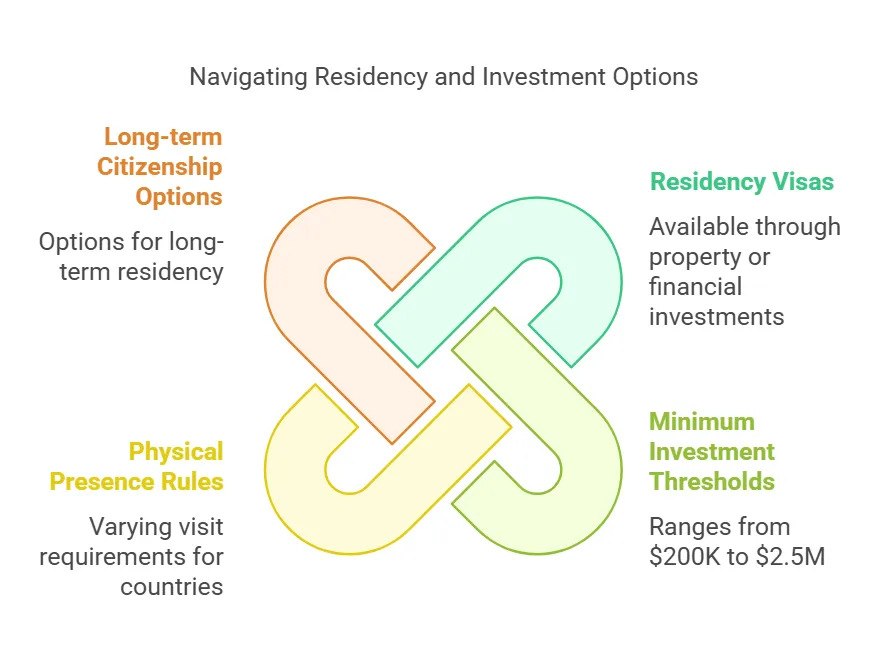
Understanding the capital gains tax rate in each country is crucial for investors looking to maximize their returns and choose the best residency or citizenship program.
Country | Residency Route (Investment Requirement) | Minimum Stay per Year | Citizenship Eligibility |
|---|---|---|---|
UAE | Property Investor Visa – 2-year with AED 750k ($204k) or 10-year “Golden Visa” with AED 2 million ($545k) investment (also options via business or employment). | None (residing is not obligatory; a visit once every 6–12 months suffices). | Difficult – no standard naturalization; citizenship only by exception (not a typical pathway). |
Bahamas | Permanent Residence by investment – purchase property ≥ $750,000 (accelerated at $1.5M). Annual residency permits available for lower investment. | ~90 days (must spend at least 90 days in Bahamas and ≤183 days elsewhere to maintain tax resident status). | Possible after 10+ years of residency, but discretionary; dual citizenship allowed. |
Cayman Islands | Permanent Residency (PR) – invest ≥ US$2.4 million in real estate (25-year residency with US$1.2M investment). Business entrepreneur permits available. | Minimal (1 day per year to maintain PR). | Eligible for British Overseas Territories citizenship after 5+ years of PR (leads to British passport). |
Monaco | Residence Permit – demonstrate at least €500k in a Monaco bank + own or rent property in Monaco. No direct investment-to-government; must show financial self-sufficiency. | ~90 days (approx. 3 months/year minimum stay to maintain residency). | Eligible after 10 years of residency (citizenship by naturalization is discretionary and requires renouncing previous citizenship). |
Singapore | Global Investor Programme – invest ≥ S$2.5 million (~US$1.8M) in a business or fund to obtain PR. Alternatively, employment pass (work visa) leading to PR. | No fixed minimum, but PR renewal depends on maintaining ties; generally tax resident if ≥183 days/year. | Eligible to apply for citizenship after ~2+ years as PR (must renounce prior citizenship; selective approval). |
Hong Kong | No current investment visa (suspended); common routes are employment visa or Quality Migrant scheme (points-based, no investment). PR attained after 7 years. | No explicit requirement, but generally should reside >6 months/year for continuity (PR status can lapse after 36 months away). | Eligible for PR after 7 years, and then can naturalize as Chinese citizen (rare, dual citizenship not recognized). |
Malaysia | “Malaysia My Second Home” (MM2H) 5-year renewable visa – ~MYR 1 million (≈$220k) fixed deposit + proof of MYR 40k/month income. (Sarawak state MM2H has lower requirements.) Also 1-year digital nomad visas (≈$24k/yr income). | 90 days/year (MM2H Peninsular); 15 days/year (Sarawak). Tax resident status if ≥182 days. | Very difficult – >10 years residency required for naturalization, and Malaysia disallows dual citizenship. |
Switzerland | Lump-sum taxation residence – negotiate annual tax (often CHF 150k+); or investor/work visa via business creation. | ~183 days (absences >6 months can void permit). Expected to make Switzerland primary home. | Eligible after 10 years (with integration and language criteria); dual citizenship allowed. |
Andorra | Passive residency (non-lucrative) – invest ≥ €600,000 in Andorran assets (incl. €47k government bond). Active residency requires an Andorran business. | 90 days/year (passive resident). Active residents 183+ days. | Eligible after 20 years (or 10 years if schooled in Andorra); no dual citizenship (must renounce original nationality). |
Belize | Qualified Retired Persons (QRP) Program – age 45+ with USD $2,000/month foreign income (no investment required). Or after 1 year residency, apply for Permanent Residence. | QRP: 30 days/year. (Permanent Residents should intend to reside most of the year). | Eligible after 5 years of residency; dual citizenship permitted. |
Choosing the Best Tax Haven for Your Needs
Living in a country with no capital gains tax can significantly boost investment returns. Without the burden of capital gains tax, investors can retain more of their profits, allowing their wealth to grow faster. This can be life-changing if planned wisely, as even a small difference in taxes can lead to a substantial jump in net worth over time. For instance, an investor who doesn’t have to pay capital gains tax can reinvest the full amount of their profits, benefiting from the power of compound interest. Over the years, this can result in a much larger portfolio compared to an investor who has to pay a portion of their gains in taxes. Therefore, countries with no capital gains tax are highly attractive for those seeking to maximize their investment returns and achieve financial independence.
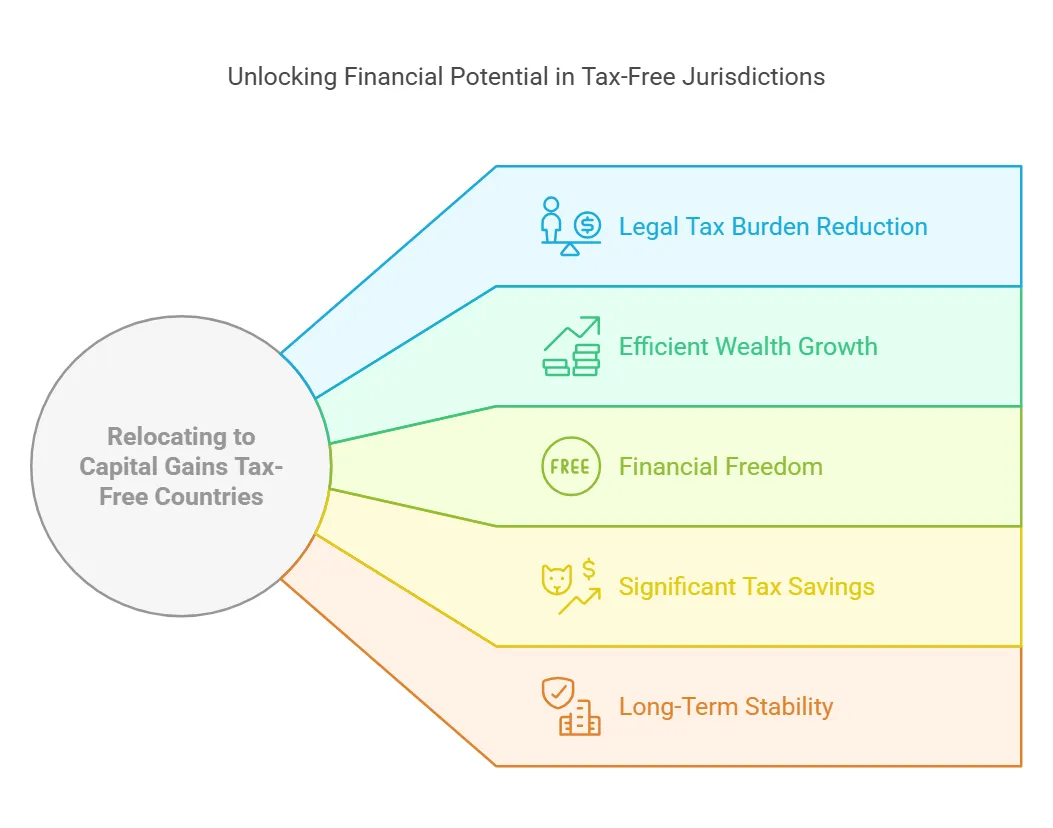
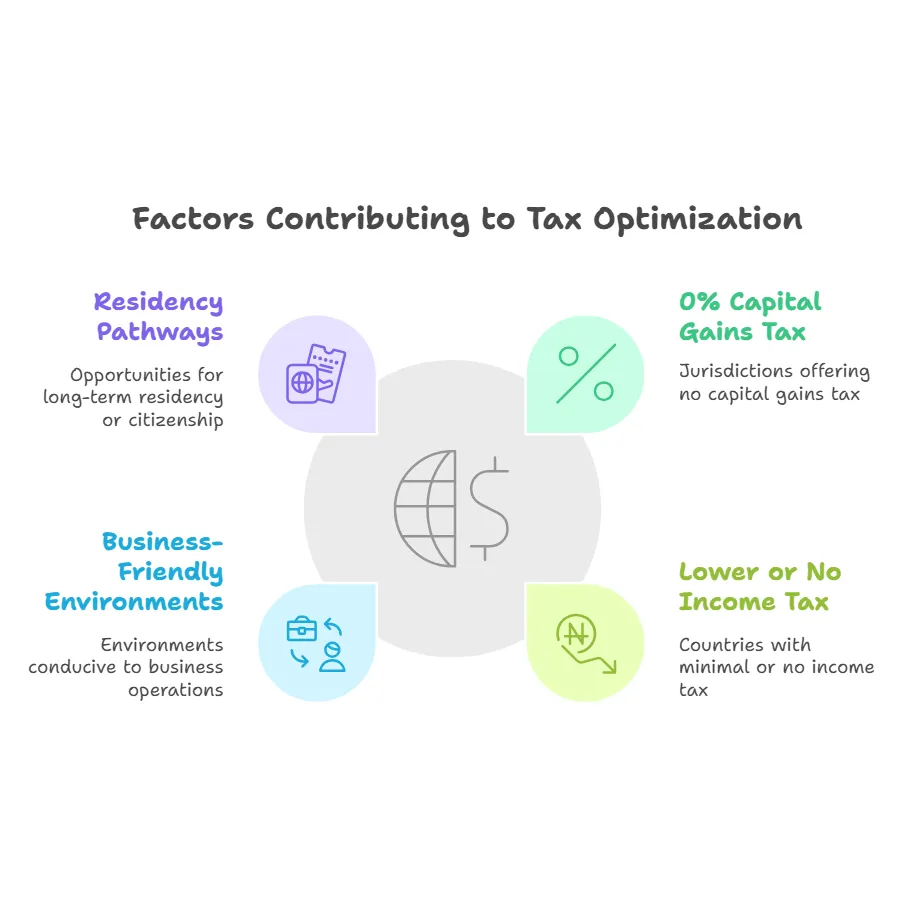
Relocating to a tax-friendly country can be a game-changer for expats, investors, and entrepreneurs looking to reduce capital gains tax and optimize their financial future. Whether you prefer the zero-tax environments of the UAE, Bahamas, or Cayman Islands, the business-friendly hubs of Singapore and Hong Kong, or the low-tax regimes of Andorra and Switzerland, each country offers unique advantages based on residency requirements, investment options, and long-term citizenship pathways.
Before making a move, it’s crucial to consider factors such as legal residency obligations, tax treaties, banking access, and quality of life. Additionally, consulting with a tax professional can help ensure compliance with exit taxes and anti-avoidance rules in your home country.
By choosing the right destination, you can maximize your wealth, protect your assets, and enjoy a tax-efficient lifestyle in 2025 and beyond. When choosing a tax haven, understanding the capital gains tax rate is essential to ensure you maximize your investment returns and achieve financial efficiency. Whether you seek a tropical retreat, a European base, or a global financial hub, these top tax havens for expats offer excellent opportunities for those looking to legally minimize their tax burden.

Lusine Sargsyan
Attorney
