
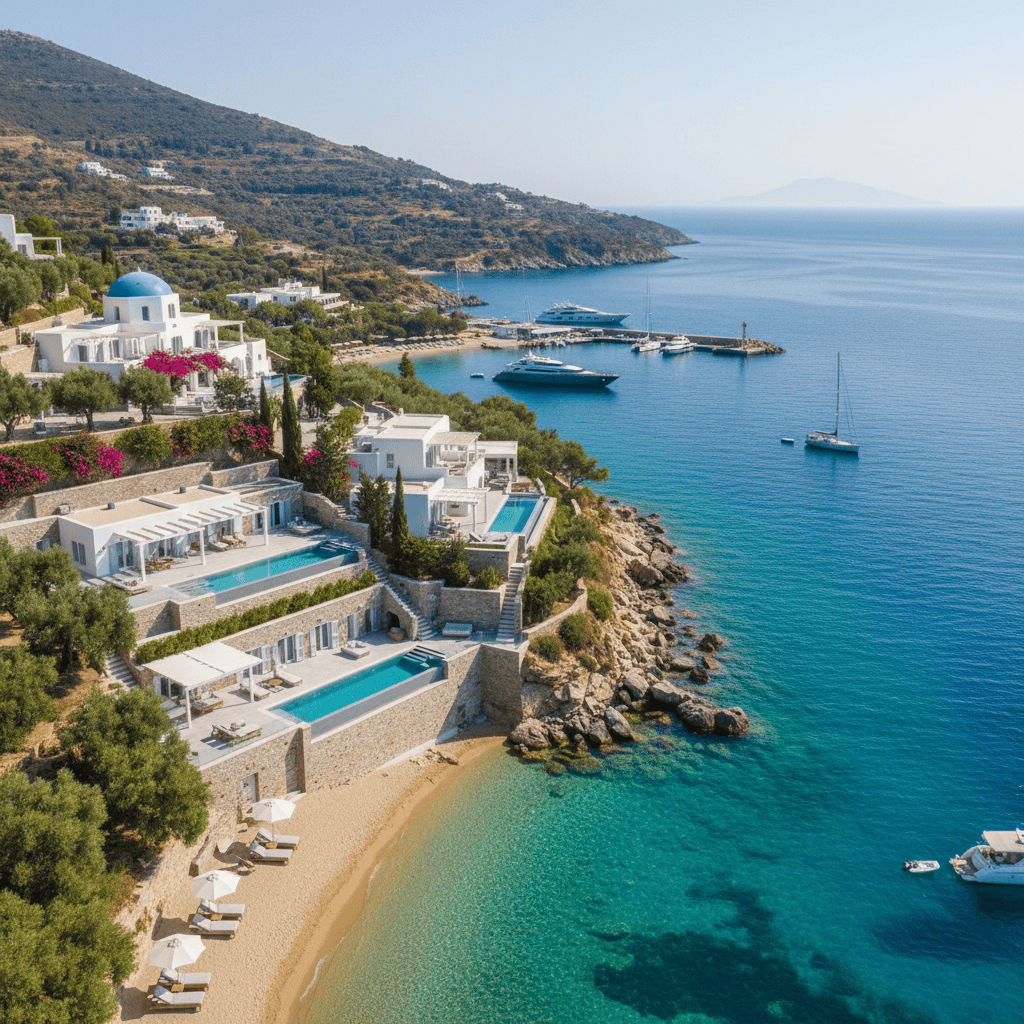
- Greece’s non-dom regime (Article 5A) lets qualifying tax residents pay a flat € 100,000 प्रति वर्ष on all foreign-sourced income for up to 15 years.
- The Golden Visa now requires €400,000- €800,000 in real estate depending on location, after Law 5100/2024 raised thresholds from the former €250,000 blanket minimum.
- UK reforms abolishing non-dom status (effective 6 अप्रैल 2025) are accelerating HNWI outflows — Greek Golden Visas granted to UK citizens rose 48.9% साल-दर-साल सितम्बर 2025 तक।
- EU scrutiny of investment-migration is intensifying — the ECJ ruled against Malta’s golden passport on 29 अप्रैल 2025 (Case C-181/23) — demanding stronger compliance from all investor-residency programs.
With EU scrutiny rising and the UK dismantling its non-dom status, high-net-worth individuals are re-evaluating where they base their lives, investments, and tax residency. Greece stands out with two powerful mechanisms: a flat €100,000 non-dom tax on foreign income under Article 5A and a Golden Visa program that — despite recent threshold increases — remains one of the more accessible investor-residency routes in Europe.
For Armenian diaspora members and international entrepreneurs already considering the Caucasus–Europe corridor, Greece’s proximity and EU membership make it a natural complement to an Armenia residence-by-investment रणनीति या अर्मेनियाई व्यवसाय पंजीकरण.
Why Greece is attracting HNWIs in 2026
Greece offers two cornerstone advantages that directly address HNWI priorities — tax predictability and accessible EU residency:
Tax residency with capped exposure. The Article 5A non-dom regime caps foreign-sourced income tax at a flat €100,000 per year for qualifying individuals who transfer their tax residency to Greece. Greek-source income continues to be taxed under normal progressive rates (up to 44%).
Investor-residency through the Golden Visa. Despite the 2024 threshold increases, Greece’s real estate investment minimums of €400,000 in most areas remain competitive against EU peers like Portugal and Spain.
Against a backdrop of tightening tax and compliance norms in major economies and heightened EU due diligence on investment-migration, the Greek package combines cost certainty with relatively modest entry requirements. For broader mobility planning, see our guides on वीजा, करों, तथा नागरिकता के रास्ते.
एक नज़र: ग्रीस का HNWI प्रस्ताव
| Feature | विवरण |
|---|---|
| Non-dom flat tax | €100,000/year on foreign income + €20,000 per family member, up to 15 years |
| Golden Visa (Tier 1 zones) | €800,000 — Athens/Attica, Thessaloniki, Mykonos, Santorini, islands >3,100 pop. |
| Golden Visa (Tier 2 zones) | €400,000 — all other mainland regions and smaller islands |
| Golden Visa (special cases) | €250,000 — commercial-to-residential conversions and listed building restorations only |
| Non-dom eligibility | Not Greek tax resident for 7 of previous 8 years; €500,000 investment within 3 years |
| नागरिकता का मार्ग | 7 years actual residence, language proficiency, integration requirements |
| UK push factor | Non-dom abolished 6 April 2025; projected 16,500 millionaire outflows in 2025 |
How Greece’s non-dom regime works under Article 5A
Greece’s non-dom framework under Article 5A of the Income Tax Code is designed to attract foreign tax residents by capping liability on foreign-sourced income at a fixed annual charge.
जरूरी योग्यता
Prior non-residency. The applicant must not have been a Greek tax resident for at least 7 of the previous 8 years before transferring tax residency to Greece.
Qualifying investment. A minimum investment of €500,000 in Greek assets — real estate, business participation, or securities — must be completed within 3 years of the application date.
भौतिक रूप से उपस्थित। The applicant must actually transfer tax residency to Greece, typically spending 183+ days per year in the country.
आवेदन की समय सीमा। Applications are filed with the Greek tax authority (AADE), generally by 31 March of the relevant tax year.
Tax treatment under the regime
विदेशी स्रोत से आय: Taxed at a flat €100,000 per year regardless of amount, for up to 15 tax years. An additional €20,000 per year applies for each qualifying family member (spouse, civil partner, direct ascendants and descendants) who elects to be included.
Greek-sourced income: Taxed under Greece’s normal progressive rates, with the top marginal bracket reaching 44% (as of 1 January 2026). This includes employment income, business income, and rental income generated within Greece.
No extension beyond 15 years. If the taxpayer stops paying the flat tax or fails to maintain conditions, the regime terminates early. There is no renewal beyond the 15-year maximum.
Greece vs. Italy: non-dom comparison (2026)
| Feature | Greece (Art. 5A) | Italy (New Residents) |
|---|---|---|
| Annual flat tax (main applicant) | €100,000 | €300,000 (from 2026) |
| Per family member | € 20,000 / वर्ष | €50,000/year (from 2026) |
| अधिकतम अवधि | 15 साल | 15 साल |
| Prior non-residency | 7 of previous 8 years | 9 of previous 10 years |
| निवेश की आवश्यकता | €500,000 within 3 years | None under core flat tax |
| Domestic income | Normal Greek rates (up to 44%) | Normal Italian rates |
From 2026, Italy’s regime is substantially more expensive (€300,000/€50,000) while Greece remains at €100,000/€20,000 — making Greece the significantly more cost-effective option for HNWIs comparing EU non-dom alternatives.
Golden Visa 2026: zone-based pricing and investment routes
Greece’s investor-residency program underwent a major overhaul with Law 5100/2024, passed by the Greek Parliament on 2 April 2024. The law replaced the former blanket €250,000 real estate minimum with a dual-zone system. The new thresholds took effect via a transitional deadline of 31 August 2024, after which applicants must meet the higher requirements.
Real estate investment tiers
Tier 1 — High-demand areas: €800,000. Includes the entire Attica region (Athens), the regional unit of Thessaloniki, Mykonos, Santorini, and all islands with a population exceeding 3,100. The investment must be in a single property with at least 120 sq m of main living space.
Tier 2 — Other regions: €400,000. All other mainland regions and smaller islands outside the Tier 1 definition. Same single-property and 120 sq m requirements apply.
Special cases: €250,000. The original threshold survives only for two categories — commercial-to-residential property conversions (change of use must be completed before application) and restorations of listed or protected buildings.
Alternative investment routes (non-real-estate)
Greece also offers several non-property pathways to the Golden Visa. These include time deposits or bank deposits (€500,000 minimum), Greek government bonds (€500,000 minimum, 3-year maturity), and investment in Greek companies or Real Estate Investment Companies (€500,000 minimum). Fund-based pathways through mutual funds or alternative investment fund structures may qualify at lower thresholds (from €350,000), while portfolio-of-listed-securities routes can require €800,000.
Residency rights and path to citizenship
The Golden Visa grants a 5-year renewable residence permit, with indefinite renewal in 5-year increments as long as the qualifying investment is maintained. Eligible family members — spouse or registered partner, unmarried children under 21, and parents of both the investor and spouse — receive permits on the same terms.
For EU long-term residence, general conditions must be met after 5 years of continuous legal residence plus integration criteria. Greek citizenship requires 7 years of actual residence in Greece, language proficiency, integration tests, and compliance with tax and other obligations. Current processing times for the Golden Visa permit run approximately 3–6 months from complete file submission.
UK tax reforms as a push factor
Several converging policy shifts in the UK have accelerated interest in EU investor-residency programs and tax-resident regimes like Greece’s.
End of UK non-dom status
The UK government announced the abolition of its long-standing non-domiciled tax status on 6 March 2024 (Spring Budget 2024). The new Foreign Income and Gains (FIG) regime took effect on 6 April 2025, replacing the remittance basis. Under FIG, only individuals within their first 4 years of UK tax residence — following at least 10 consecutive years of non-UK tax residence — receive exemption from UK tax on foreign income and gains. Long-term UK residents who previously relied on non-dom status lost access to the remittance basis entirely.
Millionaire outflows and demand for Greece
According to the Henley Private Wealth Migration Report 2025, the UK experienced a net loss of approximately 10,800 millionaires in 2024, with a projected net outflow of around 16,500 in 2025 — the largest projected net outflow of any country. Top destination countries for departing UK HNWIs include the UAE (particularly Dubai), Italy, Portugal, Greece, and Monaco.
The impact on Greece is measurable: Greek government statistics show a 48.9% year-on-year increase in Golden Visa permits granted to UK citizens through the end of September 2025 (from 495 initial investor permits to 737). While multiple factors drive this trend, commentary explicitly links the rise to UK tax increases and the broader policy environment.
EU enforcement and compliance landscape
EU institutions have intensified scrutiny of investment-migration, particularly citizenship-by-investment. On 29 April 2025, the Court of Justice of the European Union issued a Grand Chamber judgment in Case C-181/23 (European Commission v Republic of Malta), ruling that Malta’s investor citizenship scheme was contrary to EU law and that EU citizenship cannot be acquired through a “commercial transaction.”
This judgment directly concerns citizenship-by-investment (“golden passports”), not residence-by-investment (“golden visas”). No 2025–2026 sources indicate EU infringement proceedings targeting Greece’s Golden Visa program specifically. However, the direction of travel is clear: document your source of funds, tax position, and ongoing compliance carefully.
Compliance checklist for advisors and investors
कर निवास मानचित्रण: Confirm tax residence transition timing and interaction with foreign-sourced income treatment in both origin and destination jurisdictions.
Source-of-funds documentation: Assemble bank statements, contracts of sale, and corporate distributions supporting the investment well before filing.
जोखिम जांच: Pre-check sanctions, PEP status, and adverse media. Align with EU AML standards before application.
परिसंपत्ति रणनीति: व्यक्तिगत गतिशीलता लक्ष्यों के साथ-साथ निवेश स्थान, तरलता और निकास परिदृश्यों का तनाव-परीक्षण करें।
रिपोर्टिंग कैलेंडर: Align filings across jurisdictions to avoid mismatches during the transition year.
Digital nomad visa as an alternative pathway
For remote workers and entrepreneurs who do not meet the investment thresholds for the Golden Visa or the non-dom regime, Greece also offers a digital nomad visa. This allows non-EU nationals to live and work remotely from Greece while employed by or contracting with entities outside the country.
Armenia offers a similar डिजिटल खानाबदोश वीजा program, and the two can be part of a coordinated mobility strategy for professionals splitting time between the Caucasus and the EU. For those exploring आर्मेनिया में निवास परमिट, combining both jurisdictions provides geographic flexibility while maintaining compliant tax positioning.
For HNWIs recalibrating their strategy, Greece’s non-dom tax residency and updated Golden Visa program provide a compelling combination of predictability and EU access — but the landscape has changed significantly since the old €250,000 era.
ब्रिटेन के कर सुधारों और यूरोपीय संघ की मजबूत तत्परता के मद्देनजर, अब समय आ गया है कि आप अपनी संरचना, दस्तावेज की तैयारी और बहु-क्षेत्राधिकार कर स्थिति का ऑडिट करें।
