
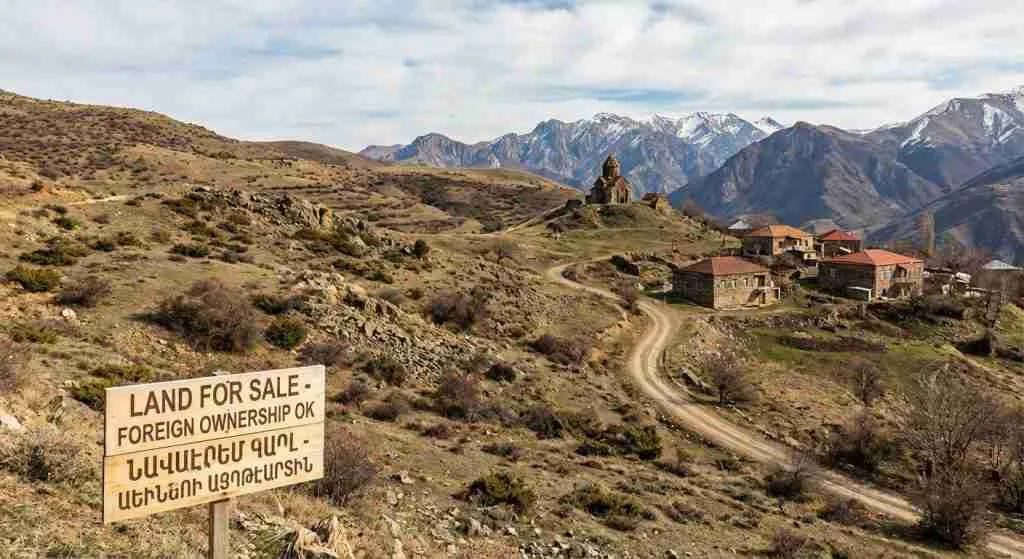
TL;DR
- Foreigners can freely buy non‑agricultural real estate in Armenia (urban/commercial/residential), but not agricultural land (farmland) (see rules and steps) (source; source).
- You need an Armenian Tax Identification Number (TIN) before the notary signs the sale and before Cadastre registration (source).
- Farmland is commonly accessed via long‑term leases or compliant local structures under Armenia’s Foreign Investment Law—not by direct foreign ownership (source).
- Expect typical buyer closing costs of about 3–5% of the purchase price, plus ongoing property tax on cadastral value (source; source).
- Every deal must be notarized and registered with the Cadastre to transfer title safely (source; source).
Can a foreigner buy land in Armenia? Yes—if it’s non‑agricultural land or built property. But Armenia’s agricultural land restrictions are strict, and buyers must plan ahead for a TIN, notary, and Cadastre registration. This guide explains how to classify land, structure deals involving farmland, and close a compliant transaction in Armenia.
Quick answer: what foreigners can and cannot buy in Armenia
Foreigners may buy and register apartments, houses, offices, retail premises, and other non‑agricultural real estate in Armenia. These transfers are routinely notarized and recorded at the Cadastre in the buyer’s name (source).
Direct foreign ownership of agricultural land (farmland) is not permitted under Armenian law (source). If a parcel is classified as agricultural, you should not attempt to purchase it personally as a foreigner; consider compliant alternatives explained below.
| Property type | Direct foreign ownership? | Notes |
|---|---|---|
| Non‑agricultural land and built property (urban/commercial/residential) | Yes | Standard notary + Cadastre registration applies (source). |
| Agricultural land (farmland) | No | Foreigners typically use long‑term leases or compliant local structures—not direct ownership (source; source). |
Agricultural land: the legal ban
Armenian law bars foreign citizens from owning agricultural land. The policy objective is to keep farmland ownership in Armenian hands while still allowing foreign investment through other instruments (source).
In practice, the key step for any buyer is to verify the land’s classification—agricultural vs. non‑agricultural—before paying a deposit. Classification determines whether a foreigner can take title personally or must use a different structure. Your notary or counsel can obtain the official extract and zoning from the Cadastre as part of due diligence (source).
scale of farmland and why it matters
Armenia has a substantial agricultural footprint: about 58.9% of the country’s land area was classified as agricultural in 2018 (source). That means a large share of parcels outside cities and towns may be subject to the agricultural land restriction—and why early classification and structuring is essential for foreign buyers and diaspora investors.
Legal workarounds for farmland: leases
Although foreigners cannot own farmland directly, they can usually lease it. Armenia’s Foreign Investment Law protects foreign investors’ rights to invest and to enter civil transactions such as leases under Armenian law (source).
Typical steps for a farmland lease include: confirming the lessor’s title, negotiating lease term and permitted uses, notarizing the lease if required by law or agreed by the parties, and registering the lease with the Cadastre when the term triggers registration. Proper registration secures your rights against third parties (source).
Armenian companies and the Foreign Investment Law
Many foreign investors choose to operate through an Armenian company to hold non‑agricultural assets, hire staff, and contract locally. Armenia’s Foreign Investment Law provides national treatment and safeguards for investments made through local legal entities, subject to sector‑specific limitations (source).
Important: the agricultural land ownership ban still applies. Whether an Armenian legal entity can own farmland depends on the entity’s ownership and Armenia’s land laws; foreigners generally should not assume that a newly formed company will circumvent farmland restrictions without careful structuring and legal confirmation (source).
Resources if you plan to structure through a local company:
- Registering an Armenian company for real estate or operations: Business registration in Armenia.
- Understanding investment routes and protections: Invest in Armenia.
- Corporate and property tax context: Taxes in Armenia.
Buying urban
For a foreigner looking to buy property in Armenia’s cities—Yerevan, Gyumri, Vanadzor—the process is straightforward. Foreign buyers routinely purchase apartments, penthouses, retail units, offices, and non‑agricultural plots designated for construction or commercial use. These transactions are recognized and registrable at the Cadastre (source).
Before you sign, secure your Armenian TIN. Notaries and the Cadastre will require it to identify you in the registry system (source). If you intend to rent out the property or operate a business on site, consider whether you need to establish an Armenian company for operations and tax efficiency (source).
For a broader overview of the market and buyer protections, see our hub on Armenia real estate.
commercial and residential property: notary
Sale-purchase agreements for real estate are formalized at a notary office. In a typical closing, the parties verify identities (including the buyer’s TIN), review the title-clearance extract, sign the sale-purchase agreement, and the notary certifies it. The notarized contract is then submitted to the Cadastre for registration of title transfer (source; source).
Foreign-language documents may require translation and, where applicable, legalization/apostille before the notary accepts them. Plan translation and document prep early to avoid delays (source).
cadastre and title-transfer steps
In Armenia, the transfer of ownership is perfected when the Cadastre registers you as the new owner. This step is mandatory; failing to file can leave title in the seller’s name and expose you to risk (source).
How to apply: step-by-step for foreign buyers
- Obtain your Armenian TIN (Tax Identification Number). Apply before signing; the TIN is required at the notary and Cadastre (source).
- Classify the property. Confirm with the Cadastre whether the parcel is agricultural or non‑agricultural to ensure the buyer can take title (source; source).
- Conduct due diligence. Order a title extract, check encumbrances, boundaries, and seller’s authority; prepare translations/legalizations as needed (source).
- Notarize the sale-purchase agreement. Sign at the notary with required IDs, TIN, and supporting documents; the notary certifies the contract (source).
- Register the transfer at the Cadastre. File the notarized agreement and receive the updated ownership certificate listing you as the owner (source).
Buyer costs and ongoing taxes
Budget the following when you buy property in Armenia:
| Cost item | What it covers | Indicative impact | Source |
|---|---|---|---|
| Notary and registration fees | Notarization of sale; Cadastre filing | Included in ~3–5% total closing costs | source |
| Translations/legalizations | Certified translations; apostille where needed | Included in ~3–5% total closing costs | source |
| Legal due diligence | Title checks; zoning; contract review | Included in ~3–5% total closing costs | source |
| Estimated total closing costs | All buyer-side costs at closing | Approximately 3–5% of price | source |
| Annual property tax (ongoing) | Municipal property tax on cadastral value | Roughly 0.05%–1.5% of cadastral value | source |
If you plan to rent out or develop, align your structure with Armenian tax rules early: Taxes in Armenia.
Final checklists to stay compliant when you buy property in Armenia as a foreigner:
- Confirm land classification (agricultural vs non‑agricultural) with a Cadastre extract before paying a deposit (source).
- Obtain your TIN ahead of the notary appointment (source).
- Use leases or approved structures for agricultural land; do not attempt direct ownership as a foreigner (source; source).
- Notarize the sale and register the title transfer at the Cadastre to perfect ownership (source).
Buying non‑agricultural property is straightforward for a foreigner in Armenia, but agricultural land restrictions and registration formalities require care. For tailored support on due diligence, zoning checks, TIN, and safe closings—or help structuring farmland investments—contact our team today: Get in touch.
FAQ
Can a foreigner buy land in Armenia?
Can a foreigner own agricultural land through an Armenian company?
Farmland ownership is restricted by law. While foreign investors may establish Armenian companies and enjoy protections under the Foreign Investment Law, farmland restrictions still apply and must be evaluated case‑by‑case. Many investors use long‑term leases to access farmland instead (source; source).
Do I need an Armenian TIN to buy property?
Yes. A TIN is required at the notary and for Cadastre registration. Obtain it before signing to avoid delays (source).
What are typical closing costs when I buy property in Armenia?
Related guides: Armenia visas, Armenia residency, Armenian citizenship.
