
At a glance
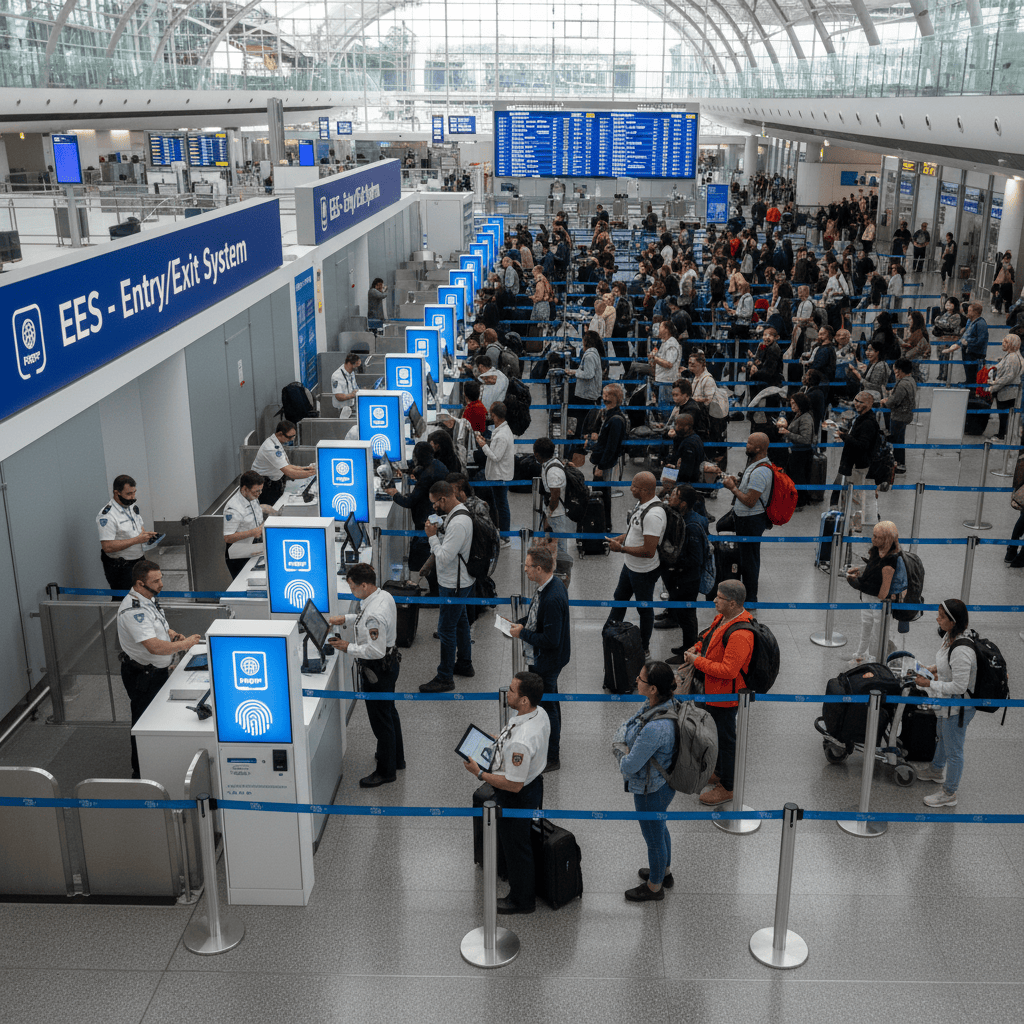
- EES is fully operational since April 10, 2026 — biometric capture (face and fingerprints) is now mandatory for non-EU short-stay travelers at all Schengen external borders. Manual passport stamping has ended.
- Golden Visa and RBI holders with a valid residence permit card are exempt from EES registration. You must present your physical residence card alongside your passport at the border.
- Expect longer queues at major airports — wait times of 2–4 hours have been reported at peak periods. Some airports have temporarily suspended biometric checks under the EU’s “emergency brake” mechanism.
- Your EES data is retained for up to 3 years under EU Regulation 2017/2226 (1 year for special family-member categories; 5 years if no exit is recorded).
- ETIAS is not yet live — the European Travel Information and Authorisation System is expected to launch in Q4 2026 as a separate but coordinated system.
Why this matters: The EU Entry/Exit System (EES) has transformed how non-EU travelers cross Schengen borders. With biometric checks now standard, passport stamps eliminated, and 90/180-day stays tracked automatically, Golden Visa holders and other third-country nationals need to understand what has changed — and how to avoid delays, missed flights, and inadvertent overstays.
Table of contents
- EES scope and current status
- Biometric checks and rollout timeline
- Who must register — and who is exempt
- What happens at the border
- EES vs ETIAS: what is the difference?
- Operational impact: wait times and the “emergency brake”
- Documentation strategy for Golden Visa holders
- Overstay penalties under EES
- Frequently asked questions
EES scope and current status
The EU Entry/Exit System is a centralized border system that automatically registers non-EU nationals admitted for short stays at the Schengen Area’s external borders. It collects biographical and biometric data — including fingerprints and a facial image — and replaces the manual stamping of passports. The system applies at air, sea, and land border crossing points across 29 participating European countries.
EES launched on October 12, 2025 and became fully operational on April 10, 2026. The European Commission confirmed that by that date, more than 52 million entries and exits had been recorded, along with over 27,000 entry refusals and 700 security-risk identifications.
What EES changes for travelers
- Mandatory biometric capture — a facial image and four fingerprints are taken at first entry. Subsequent crossings use stored data for faster processing.
- Automatic 90/180-day tracking — the system digitally calculates your remaining Schengen short-stay allowance (90 days in any 180-day period).
- No more passport stamps — manual stamping has been discontinued at border points where EES is active. The system is now the authoritative record for stay calculations.
- Refusal of biometrics means entry denied — if you refuse to provide fingerprints or a facial image, border authorities will deny entry.
Biometric checks and rollout timeline
The rollout proceeded in phases across participating countries. The first airports to go live were Basel EuroAirport and Geneva Airport on October 12, 2025. Zurich Airport followed on November 17, 2025, with self-service kiosks and e-gates in all non-Schengen arrival halls. Berlin Brandenburg Airport began kiosk-based registration in January 2026.
| Milestone | Date | Notes |
|---|---|---|
| System launch | Oct 12, 2025 | Basel and Geneva airports first; phased activation begins |
| Zurich Airport live | Nov 17, 2025 | Self-service kiosks and e-gates operational |
| Berlin kiosk rollout | Jan 2026 | Self-service registration available at BER |
| Fully operational | Apr 10, 2026 | 52M+ entries/exits recorded; Commission confirms full coverage |
Who must register — and who is exempt
EES applies to non-EU nationals entering the Schengen Area for short stays — both visa-exempt travelers and holders of Schengen short-stay visas. At first entry, the system captures your identity, travel-document data, and biometric identifiers (facial image and fingerprints) to create a digital record. Each exit is recorded the same way to calculate your remaining 90/180-day allowance.
Key exemptions
- Holders of valid Schengen residence permits (including Golden Visa residence cards and long-stay visas) are exempt from both EES registration and, once operational, ETIAS. This is confirmed by the Netherlands official EES guidance and Swiss government statements.
- Children under 12 are exempt from fingerprint capture, though a facial image may still be taken and an EES record created.
- Physical impossibility — if fingerprints cannot be captured due to medical conditions, a documented exemption applies.
Golden Visa and RBI holders: a critical distinction
If you hold a valid residence permit card issued by a Schengen member state, you are processed under residence rules — not the short-stay EES workflow. Present your residence card alongside your passport, and you will bypass EES enrollment entirely.
However, a Golden Visa approval letter, pending application, or proof of property investment does not qualify as a valid residence permit. If you arrive without your physical residence card, you will be processed as a short-stay visitor with full EES enrollment and 90/180-day tracking.
Similarly, a citizenship-by-investment passport from a non-Schengen country does not grant a Schengen residence exemption. You would still be subject to EES (and eventually ETIAS) when entering as a short-stay visitor.
What happens at the border
At any Schengen external border point, non-EU short-stay travelers now go through EES processing. In practice, this means:
- Identity and document capture: your name, nationality, date of birth, and travel-document data are recorded digitally.
- Biometric enrollment: a live facial image and four fingerprints are taken. At airports with self-service kiosks, you can complete this step before reaching a border officer.
- No passport stamps: stamps have been formally discontinued for non-EU short-stay travelers. The EES record is now the sole official record.
- Pre-registration option: the EU’s “Travel to Europe” app allows voluntary pre-registration within 72 hours of arrival or departure, which can speed up border processing.
EES applies only at external Schengen border crossings. Travel between Schengen member states (such as flying from Paris to Rome) does not involve EES checks.
For travelers entering through the UK — such as at Dover, the Eurotunnel at Folkestone, or Eurostar at St Pancras — EES registration takes place on UK soil before departure under “juxtaposed controls” arrangements.
EES vs ETIAS: what is the difference?
EES and ETIAS are legally and technically distinct systems governed by separate EU regulations, though they are designed to work together. EES automatically queries ETIAS status at the border once both are operational.
| Feature | EES | ETIAS |
|---|---|---|
| Purpose | Records entry/exit events and biometrics at the border | Pre-travel authorization (similar to US ESTA) |
| When used | At the border during entry/exit | Before travel (online application) |
| Applies to | All non-EU short-stay travelers | Visa-exempt non-EU travelers only |
| Status | Fully operational (April 10, 2026) | Not yet launched (expected Q4 2026) |
| Residence permit holders | Exempt | Exempt |
Be cautious of websites currently advertising ETIAS authorizations — these are fraudulent, as the system has not yet launched. Official ETIAS applications will be available only through the EU’s designated platform.
Operational impact: wait times and the “emergency brake”
The rollout has brought significant disruptions at major border points. Airports across Europe have reported substantially longer processing times, particularly during peak travel periods.
Reported wait times at major airports
- Lisbon: experienced queues of up to 7 hours, leading to a roughly 3-month suspension of EES checks before resuming with additional staffing.
- Amsterdam Schiphol: 2–4 hour waits common during peak periods.
- Paris CDG: peaks of up to 3 hours; reports of passengers missing flights.
- Frankfurt: 15–40 minutes extra on average, with peaks of 2–3 hours.
Industry groups including ACI Europe, A4E, and IATA have warned travelers to allow 1–2 extra hours at major hubs, with potential waits of 4 or more hours during summer 2026 peaks.
The “emergency brake” mechanism
On May 4, 2026, the European Commission authorized Schengen states to temporarily suspend biometric checks during exceptional periods of excessive waiting times. Under this mechanism, member states can pause biometric capture for up to 90 days, with a possible 60-day extension.
During suspension periods, borders may temporarily revert to manual stamping. However, the EES database continues logging entries in the background, creating a “hybrid” state. This increases the risk of 90/180-day calculation errors — making it especially important to retain your boarding passes and carrier records as backup proof of entry and exit dates.
Documentation strategy for Golden Visa holders
How you are processed at the border depends entirely on your travel profile. Before departure, decide whether you are entering as a resident or a short-stay visitor, and prepare accordingly.
Entering as a resident (recommended if eligible)
- Valid passport plus your valid residence permit card
- Evidence that your permit is still valid (if renewal is in progress, carry the renewal-in-process receipt)
- Family members’ residence cards and relationship documents
- Copies of your residence-permit issuance or renewal decision
- Use the residence/long-stay lane — not the short-stay EES visitor lane
Entering as a short-stay visitor
- Valid passport plus short-stay visa (if required for your nationality)
- Proof of onward travel, accommodation, and financial means
- Full EES enrollment at first entry — facial image and fingerprints
- Automatic 90/180-day tracking begins immediately
Practical planning tips
- Add at least 1–2 extra hours at major hubs; avoid tight connections on inbound flights.
- Stagger family or associate arrivals to reduce collective delay risk.
- Book flexible or changeable tickets during peak travel periods.
- Keep digital copies of all residence cards, visas, and itineraries.
- Retain boarding passes and carrier records as backup proof of travel dates.
- Download the EU’s “Travel to Europe” app for voluntary pre-registration within 72 hours of arrival.
Overstay penalties under EES
EES makes overstay detection far more efficient. The system automatically generates alerts when a traveler’s permitted stay expires, and this information is shared across national authorities through an automated overstayer list. Europol also has access to EES data for law-enforcement purposes.
Penalties for overstaying the 90/180-day limit are not harmonized across the EU — each member state sets its own rules. For example, in Germany, overstaying can result in fines of up to EUR 3,000 and may constitute a criminal offense in some circumstances. In Spain, fines range from EUR 501 to EUR 10,000, or alternatively expulsion with an entry ban of up to 5 years (under Spanish law, the fine and expulsion cannot both be imposed for the same facts).
To protect yourself, track your remaining days carefully and consult with an immigration advisor if you are unsure about your status. If you hold a residence permit and are concerned about overstay situations, professional guidance can help you navigate the process.
Data protection and retention
Under Article 34 of EU Regulation 2017/2226, EES entry/exit records are retained for up to 3 years after the last recorded exit or refusal of entry, provided no new entry occurs during that period. Special retention periods apply: 1 year for certain family-member categories and up to 5 years if no exit is recorded (to assist in identifying potential overstays).
Travelers have the right to request rectification, completion, or deletion of their EES data under EU data-protection rules. For visa-exempt travelers, fingerprints are stored directly in the EES database. For travelers who hold Schengen visas, fingerprints are generally stored in the Visa Information System (VIS) rather than duplicated in EES.
