
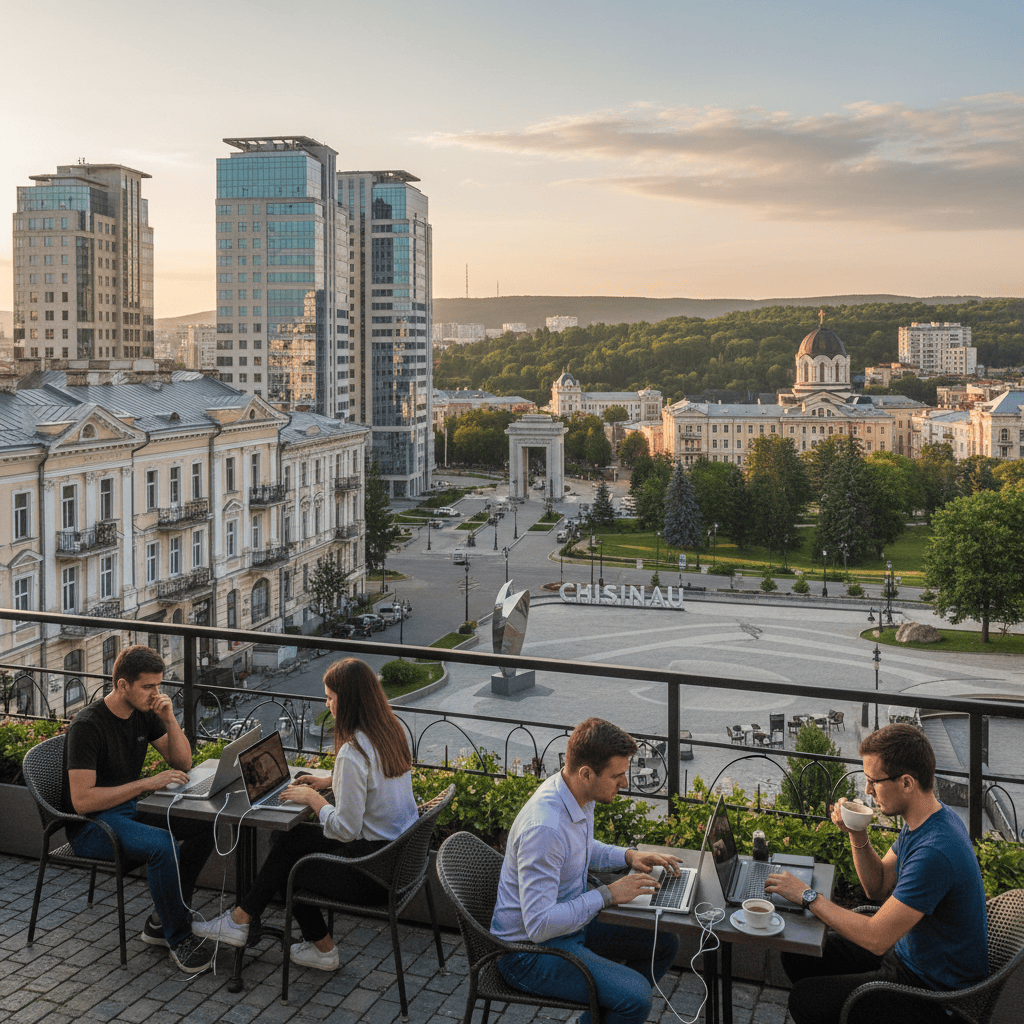
Moldova Digital Nomad Visa: 2026 Guide to Requirements, Tax and Application
At a glance
- Moldova’s digital nomad visa has been operational since 20 September 2025 and offers up to two years of residence for remote workers earning from abroad.
- For 2026, the minimum income threshold is approximately €2,700–2,800 per month (52,200 MDL) — pegged to 3× the national average salary and recalculated annually.
- Application fee: EUR 80–100. Processing time: 30–45 calendar days. Submission via the online state portal, the Bureau of Migration and Asylum (BMA) in Chișinău, or Moldovan embassies/consulates abroad.
- Tax regime: 12% flat personal income tax (Fiscal Code, Art. 15) with exemption from social contributions and mandatory health insurance on foreign-sourced income.
- Initial permit of 1 year is renewable once (+1 year), for a maximum of 2 years as a DNV holder.
Moldova’s digital nomad visa is now a fully operational residence route for international remote professionals. Since its launch under Law 144/2025, the program has given eligible applicants a clear path to medium-term residence in a low-cost, EU-candidate country with a simple flat tax on foreign income. This 2026 guide sets out the confirmed requirements, fees, tax rules and application logistics — and compares Moldova’s program to the digital nomad options in neighboring Armenia and Georgia.
Legal framework and program status
Moldova formally recognized the “digital nomad” status through Law 144/2025, which entered into force in September 2025. The program is administered by the Bureau of Migration and Asylum (BMA) within the Ministry of Internal Affairs. No major amendments have been introduced since launch — the annual recalculation of the income threshold is a mathematical update built into the law, not a legislative change.
Moldova’s Economic Council projected approximately 1,500 nomad arrivals per year at launch, with an estimated annual economic impact of around 280 million MDL. Post-launch statistics on the actual number of approved applications are not yet published by Moldovan authorities; the 1,500 figure should be read as a pre-launch projection.
Official requirements for 2026
The Moldova DNV targets three categories of applicants: (1) employees of companies registered outside Moldova, (2) independent service providers with foreign clients, and (3) shareholders or partners in foreign companies. Local Moldovan employment is expressly excluded — applicants cannot derive their income from a Moldovan employer or from a locally registered company.
Income threshold
Applicants must demonstrate a stable monthly income of at least 3× the forecasted national average monthly salary. For 2026, Moldova’s forecasted average monthly salary is 17,400 MDL, which puts the DNV threshold at 52,200 MDL — approximately €2,700–2,800 per month (roughly USD 2,900–3,100). The threshold recalculates every year based on the updated macroeconomic indicator. Applicants supporting dependents must show augmented income above this baseline.
Note: Many relocation blogs still cite the 2025 launch-era estimate of roughly USD 1,500–2,000 per month. That figure is outdated for 2026 and should not be relied on when preparing an application.
Document checklist
| Requirement | Accepted evidence |
|---|---|
| Foreign-sourced income | Employment contract with a non-Moldovan employer; foreign company registration documents; service contracts with foreign clients |
| Income proof (≥52,200 MDL/mo) | Last 6 months of bank statements; payslips; tax returns |
| International health insurance | Policy covering Moldova for the full duration of stay |
| Criminal record certificate | Police clearance from country of residence, within validity window |
| Proof of accommodation in Moldova | Rental contract, hotel booking, or property ownership documents |
| Valid passport | Minimum 6 months remaining validity |
Foreign documents typically need to be translated into Romanian (or Russian) and legalized — either with an apostille for Hague Convention signatories or through consular legalization for non-signatory countries.
How to apply
Applications can be submitted through three channels: (1) online via Moldova’s state digital portal, (2) in person at the Bureau of Migration and Asylum (BMA) headquarters in Chișinău, or (3) through a Moldovan embassy or consulate abroad before travel.
- Prepare documentation: Gather passport, foreign employment or business documents, 6 months of income evidence, international health insurance, criminal record certificate, and proof of accommodation in Moldova. Translate and legalize foreign documents as needed.
- Submit the application: File online through the state portal, at BMA Chișinău, or via a Moldovan consulate. Pay the government fee of EUR 80–100 (or MDL equivalent).
- Wait for adjudication: Standard processing takes 30–45 calendar days.
- Receive decision and collect permit: Successful applicants receive a residence permit valid for 1 year, renewable for a further year.
- Register after arrival: Within 30 days of entering Moldova, DNV holders must complete a mandatory post-arrival registration with the BMA.
Tax rules for Moldova nomads
Digital nomad visa holders are taxed at a 12% flat personal income tax (PIT) rate under Article 15 of Moldova’s Fiscal Code. DNV holders are legally exempted from social security contributions and from the mandatory state health insurance premium on foreign-sourced income. Foreign tax credit mechanisms are available under Moldova’s network of double taxation treaties to prevent taxing the same income twice.
Important — the 7% Moldova IT Park regime is NOT available to DNV holders. The 7% preferential rate under the Moldova IT Park (MITP) requires registering a local Moldovan company (SRL), which is expressly prohibited for DNV holders. Any source suggesting that nomads can combine the DNV with the 7% IT Park rate is incorrect and creates a compliance hazard.
A further point for foreign employers: long-term remote work from Moldova can, in some cases, create a permanent establishment (PE) risk for the non-Moldovan employer under domestic and treaty rules. Employers of DNV holders should review their PE exposure before approving extended stays.
Residency length, renewal and pathway to permanence
The DNV is issued for an initial period of one year and can be renewed once for another year, giving a maximum of two years of residence as a nomad. After reaching the 5-year legal residency threshold (across different residence statuses), individuals may apply for standard permanent residency or naturalization under Moldova’s general immigration law — this is a separate process, not a simple DNV extension.
Moldova DNV vs Armenia and Georgia
| Feature | Moldova | Armenia | Georgia (Remotely) |
|---|---|---|---|
| Maximum duration | 2 years (1+1) | 1 year, renewable | 180 days, renewable |
| Income threshold | ~€2,700–2,800/mo (52,200 MDL) | No fixed threshold | USD 2,000/mo |
| Personal income tax | 12% flat | Up to 20% (with incentives) | 1% or 20% (small business regime) |
| EU status | EU candidate (since 2022) | Non-EU | EU candidate |
| Schengen area | No | No | No |
Moldova stands out for its longer authorized residency and low flat tax. Armenia is more flexible on income and is a strong option for applicants who cannot meet Moldova’s 52,200 MDL threshold — our guide to Armenia’s digital nomad visa walks through the Armenian process in detail. Note that none of the three countries are in the Schengen area, so none can be used to “reset” Schengen 90/180-day limits.
Moldova DNV vs Moldova’s investment residency
The digital nomad visa is sometimes confused with Moldova’s “golden visa” or investment residency. These are entirely separate tracks. The DNV is a remote-work residence permit tied to foreign employment income. Investment residency, by contrast, is earned by deploying capital into qualifying Moldovan assets (property or business investment) and does not depend on a foreign employer. Applicants should pick the track that matches their source of funds rather than trying to combine them.
