
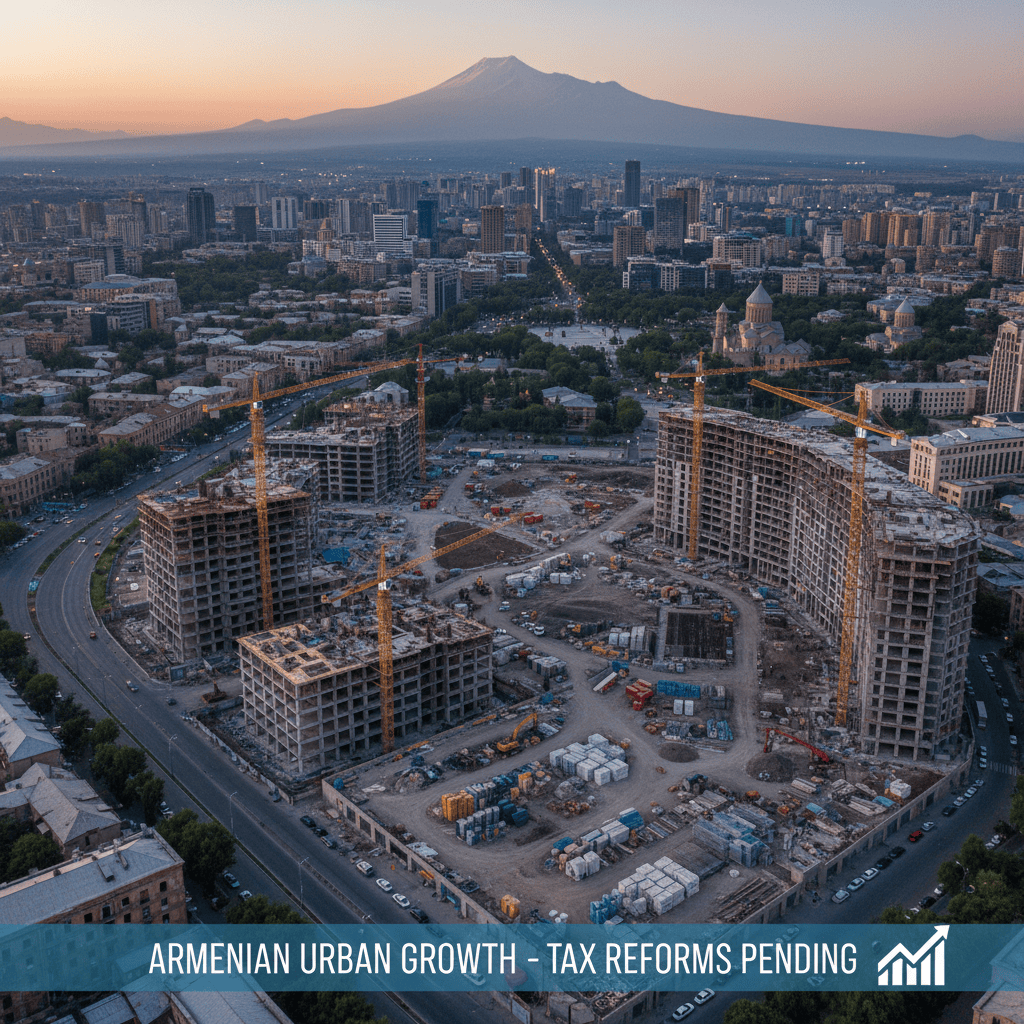
- AMD 120M annual turnover remains the key threshold in 2025: cross it and your business migrates to the general regime with 20% VAT and 18% profit tax.
- Many construction, real-estate brokerage, and engineering activities are reclassified into the VAT/profit-tax regime regardless of turnover.
- VAT invoicing and delayed input-credit recovery can strain cash flows on progress billings, changing deal pricing and payment terms.
- Foreign investors should model entity turnover, transaction flows, and invoicing to manage VAT exposure and compliance, including e‑invoicing.
- Early structuring around contracts, milestones, and procurement can mitigate VAT triggers and align with Armenia's turnover tax reform.
Need expert guidance on Armenia real estate investment structuring?
Explore Investment SolutionsTable of Contents
- Reform at a glance: what changed
- Why it matters (Armenia-specific impact)
- Turnover threshold: trigger mechanics and immediate tax consequences
- Which real‑estate and construction activities lose turnover‑tax treatment
- VAT and profit‑tax mechanics under the general regime
- Invoicing and input‑credit timing
- New compliance requirements: e‑invoicing
Reform at a glance: what changed
From January 2025, Armenia maintains the AMD 120,000,000 annual turnover cap for SMEs but tightens outcomes for those exceeding it: crossing the cap moves a business to the standard regime, where invoices carry 20% VAT and profits are taxed at 18% rather than a simplified turnover tax. Media reporting also notes higher turnover-tax rates for SMEs, keeping the same cap, which heightens threshold sensitivity for small operators near the line. Under the general regime, real estate and construction transactions face 20% VAT on taxable supplies and 18% profit tax.
Separately, 2025 amendments move many construction, real-estate brokerage and engineering activities into the VAT/profit-tax regime regardless of turnover, removing simplified turnover-tax treatment for those sectors.
Why it matters (Armenia-specific impact)
Construction and property deals in Armenia frequently involve progress billings and large milestone payments—transactions that can push an entity over the AMD 120M line quickly. That single crossing converts a simplified, predictable turnover-tax outlay into a 20% VAT-on-invoice plus 18% profit tax environment, altering cash flows and margins for ongoing projects.
The government's stated objective is to broaden the tax base and reduce preferential treatment; public reporting projects additional annual budget revenues from these reforms, underscoring the policy's reach across sectors. For foreign investors, this means Armenia real estate VAT exposure must be modeled at the SPV level and embedded in pricing, contract structures, and payment schedules.
Planning a real estate project in Armenia? Let our attorneys help you structure for optimal tax efficiency.
Get Professional Legal SupportTurnover threshold: trigger mechanics and immediate tax consequences
The AMD 120M annual turnover threshold is the pivot point. Once your entity exceeds it, you migrate from turnover tax to the general regime, where taxable sales are subject to 20% VAT, and profits are taxed at 18%. The practical consequences for ongoing real estate and construction projects include:
- VAT invoicing: Taxable invoices to clients or buyers must include 20% VAT once you are under the general regime.
- Profit tax on earnings: Profits are taxed at 18%, replacing simplified turnover-tax calculations.
- Accounting and systems: You must operate accrual accounting and comply with VAT rules, including e‑invoices and dedicated VAT reporting.
Important: Sector reclassification (next section) can place you in the general regime even before you reach AMD 120M.
Which real‑estate and construction activities lose turnover‑tax treatment (sector reclassification)
Under the 2025 amendments, multiple real estate–related activities are reclassified into the VAT/profit-tax system regardless of turnover. The affected set includes many construction services, real-estate brokerage/agency, and engineering-type activities, which no longer benefit from simplified turnover-tax treatment even under the AMD 120M cap.
For investors, this means SPVs conducting these activities should plan for VAT from day one, including systems, pricing, and contract terms.
VAT and profit‑tax mechanics under the general regime: rates
Key mechanics when you are under the general regime:
- VAT: Standard 20% VAT applies to taxable supplies; VAT is charged on invoices and may be creditable on inputs, subject to proper documentation and timing.
- Profit tax: Corporate profits are taxed at 18%.
- Accounting: Full VAT bookkeeping and accrual accounting are required, affecting recognition of revenue and input tax.
Real estate deals: regime comparison at a glance
| Item | Turnover-tax regime (≤ AMD 120M and not reclassified) | General regime (VAT + profit tax) |
|---|---|---|
| Sales tax on invoices | No VAT on invoices under simplified regime | 20% VAT on taxable invoices |
| Profits | Simplified turnover-tax methodology applies (rates vary by activity) | 18% profit tax on corporate profits |
| Threshold relevance | Available up to AMD 120M turnover (unless sector is reclassified) | Applies once threshold is exceeded or if sector is reclassified |
| Compliance | Simplified accounting | E‑invoicing and full VAT bookkeeping required |
Invoicing and input‑credit timing
Under VAT, tax is charged on invoices and input credits are claimed when valid VAT invoices are received and recorded. For construction and commercial property projects, this creates timing gaps between charging output VAT to clients and recovering input VAT on materials, subcontractors, or professional fees. The result is a working-capital squeeze, especially with progress-billing contracts that front-load large VAT outlays before input credits are fully available.
Structuring checklist to manage VAT timing
- Align procurement and billing cycles so input VAT hits the same VAT periods as output VAT where feasible.
- Use milestones that reflect cost build-up to reduce net VAT exposure on each invoice.
- Negotiate payment terms (e.g., shorter remittance windows) to reduce the float on VAT payable.
- Model SPV turnover to anticipate if/when the AMD 120M threshold will be crossed, and bake VAT into pricing and contracts.
- For reclassified activities, assume VAT from day one and design systems accordingly.
New compliance requirements: e‑invoicing
Once you exceed the threshold—or if you operate in reclassified activities—expect full VAT compliance requirements, including:
- VAT registration and ongoing VAT return filings.
- Mandatory e‑invoicing and accrual-accounting practices aligned with Armenia's VAT rules.
- Systems and process changes to capture input VAT, track tax points, and reconcile monthly VAT positions.
For entities new to Armenia, build VAT into your operations roadmap from the start. Our team can coordinate business registration, real estate deal support, and investment structuring so your SPV is VAT‑ready before the first invoice is issued.
Bottom line for property investment in Armenia: The 2025 turnover tax reform makes the AMD 120M threshold—and sector reclassification—the decisive triggers for Armenia real estate VAT and 18% profit tax. Model your SPV's turnover, contracts, and payment schedules early to keep effective rates, cash flow, and compliance under control.
Contact Our Legal TeamFAQ
Ready to structure your Armenia real estate investment the right way?
Our attorneys specialize in cross-border transactions, tax planning, and regulatory compliance for real estate projects in Armenia.
Start Your Investment Journey