
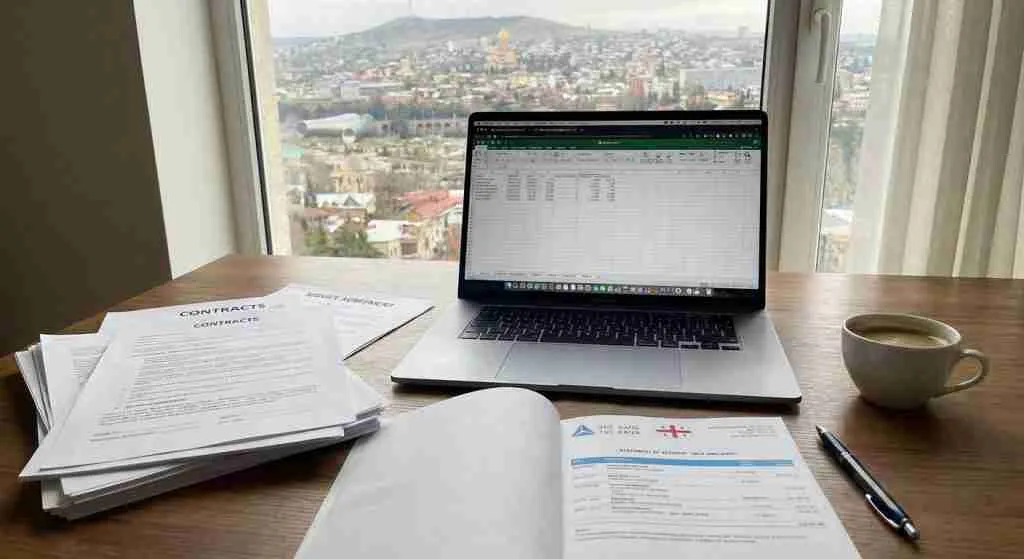
- To qualify for a Georgia temporary residence permit on a work/self-employment basis, you must meet legal income thresholds: either personal earnings of at least 5× the subsistence minimum or business turnover of ≥50,000 GEL (≈ USD 18,500) in the last 12 months (35,000 GEL (≈ USD 12,950) for education/medical) (see Law of Georgia on the Legal Status of Aliens and Stateless Persons).
- Proof typically includes client contracts plus a Georgian bank statement or Revenue Service turnover certificate confirming your income/turnover (work-residence track).
- Many freelancers register as Individual Entrepreneurs and opt for Small Business status (1% tax on gross up to 500,000 GEL (≈ USD 185,000)), subject to activity restrictions.
- Processing is usually 30 days (GEL 210 ≈ USD 80), with expedited 20-day (GEL 330 ≈ USD 120) and 10-day (GEL 410 ≈ USD 150) options available.
- Accepted self-employed fields commonly include IT, digital, and export-oriented professional services.
Georgia has become a hub for mobile professionals seeking a straightforward path to legal stay and taxation. If you are a freelancer or independent contractor, the Georgia self-employed residency route—formally a temporary residence permit on a work basis—can be both attainable and tax-efficient.
This guide explains the eligibility thresholds, the exact documents immigration expects (contracts, Georgian bank statements or tax certificates), how to register for 1% Small Business tax, and how to apply—plus common pitfalls to avoid.
Eligibility & Financial Thresholds for Self-Employed Residency in Georgia
Georgia issues temporary residence permits on a "work" basis to both employees and self-employed persons. The law sets measurable financial criteria. You qualify if you can demonstrate either personal income of at least five times the subsistence minimum or, for entrepreneurial activity, annual turnover of at least 50,000 GEL (≈ USD 18,500) within the preceding 12 months. For education and medical activities, the turnover threshold is 35,000 GEL (≈ USD 12,950).
Quick self-check
- Can you show contracts for services rendered to clients (local or international)?
- Do your Georgian bank statements or a Revenue Service certificate confirm turnover ≥50,000 GEL (≈ USD 18,500) in the last 12 months (or 35,000 GEL (≈ USD 12,950) for education/medical)?
- Is your activity compatible with Georgia's Small Business tax status if you plan to use the 1% regime?
Documentation Required: Contracts
Immigration expects evidence of lawful, ongoing work. For self-employed applicants, this typically begins with contracts or service agreements showing who your clients are, what services you provide, and the remuneration terms. These documents anchor your application and link your claimed professional activity to actual income streams that will appear in your supporting financial evidence.
Where relevant, include invoices and payment confirmations that match the contract terms. This alignment strengthens the case that your income is real and recurring, which is important for meeting the financial thresholds set in law.
Georgian Bank Statements and Turnover Certificates
Two pieces of financial evidence are particularly effective for freelance residency applications:
- Georgian bank statements showing incoming payments from clients that correspond to your contracts. These statements help verify both the volume and legitimacy of your income in Georgia's financial system.
- Revenue Service turnover certificate confirming your past 12 months' turnover. This document is especially useful when applying on the entrepreneurial-activity track where the 50,000 GEL (≈ USD 18,500) (or 35,000 GEL (≈ USD 12,950) for education/medical) threshold is determinative.
Common challenges to prepare for
- Insufficient documented turnover: Falling short of the 50,000 GEL (≈ USD 18,500) threshold—or lacking clear documentation that ties client payments to your activity—can derail the application. Align contracts, invoices, and bank inflows with the turnover standard in the law.
- Unclear banking trail: If your income proof relies on statements, ensure transactions are traceable and consistent with your contracts, as immigration uses bank data to verify genuine activity.
- Activity misalignment with tax status: If planning to use the 1% Small Business regime for tax, confirm your profession is not on the list of excluded activities that nullify Small Business status.
Tax Registration & Operating as an Individual Entrepreneur (Small-Business 1% Regime)
While tax registration is not the same as immigration approval, self-employed foreigners commonly register as Individual Entrepreneurs (IEs) and apply for Small Business status. Under this regime, qualifying freelancers pay a flat 1% tax on gross revenue up to 500,000 GEL (≈ USD 185,000) per year, making Georgia's system very attractive for independent professionals.
However, not all activities qualify for the Small Business regime. Georgia defines a list of prohibited activities (for example, certain professional services) that disqualify a taxpayer from 1% status, so it is essential to confirm your activity is eligible before relying on this tax plan.
For practical guidance on registering a business vehicle for your activity, see our overview of business registration and how this integrates with tax planning when structuring cross-border service businesses.
Which Freelance Professions and Activities Are Typically Accepted (IT, Digital, Export-Oriented Services)
Georgia's work-residency route is well-suited to export-oriented services—i.e., services delivered from Georgia to clients abroad—especially in fields that are easy to evidence with contracts and bank inflows. Common examples include:
- IT and software (software engineering, DevOps, QA, product management)
- Digital services (digital marketing, SEO/SEM, social media, design, content production)
- Professional consulting (management, finance/analytics, business development) provided to foreign clients
If your activity is in education or medicine, note the special turnover threshold of 35,000 GEL (≈ USD 12,950) under the law for the entrepreneurial-activity route.
Before choosing a tax track, cross-check your profession against the exclusions for Small Business status to ensure you can retain the 1% rate.
Step-by-Step Application Process
-
Organize your client documentation.
Gather signed contracts and related invoices that describe your freelance services and fee terms. These will serve as primary proof of your self-employment activity. -
Document income and turnover.
Obtain recent Georgian bank statements showing client payments and/or request a turnover certificate from the Revenue Service covering the last 12 months, to evidence that you meet the legal thresholds (≥50,000 GEL (≈ USD 18,500) turnover, or 35,000 GEL (≈ USD 12,950) for education/medical). -
(Optional but common) Register as an Individual Entrepreneur and apply for Small Business status.
Many freelancers structure their Georgia activity this way to access the 1% tax on gross up to 500,000 GEL (≈ USD 185,000), subject to exclusions. -
Submit your temporary residence permit application and pay the fee.
Standard processing is about 30 calendar days; fee GEL 210 (≈ USD 80). You can select expedited options at higher fees as shown below. -
Monitor the decision.
Keep all evidence consistent and available in case immigration requests clarifications about your contracts or financial documents (bank or turnover certificate).
Processing times and fees
| Service speed | Processing time | Government fee (GEL / approx. USD) |
|---|---|---|
| Standard | 30 days | 210 GEL (≈ USD 80) |
| Expedited | 20 days | 330 GEL (≈ USD 120) |
| Urgent | 10 days | 410 GEL (≈ USD 150) |
If you are comparing pathways across the region, see our guides on residence permits, visas, and investment routes, and plan your structure alongside tax strategy and business registration.
Key Takeaways for Freelancers
- Georgia's self-employed residency route hinges on demonstrable income/turnover under the work-residence category; prepare contracts plus banking/tax proof that satisfy the legal thresholds.
- The 1% Small Business regime is attractive but activity-restricted; confirm eligibility before relying on it for your projections.
- IT, digital, and export-oriented services are typically well-suited for this path and easy to substantiate.
Conclusion
For independent professionals, Georgia's work-based temporary residence permit offers a realistic path—provided you can show client contracts and meet the legal income or turnover thresholds, ideally supported by Georgian bank statements or a Revenue Service certificate. Pairing this with Individual Entrepreneur registration and Small Business status can keep taxes predictable at 1% if your activity qualifies.
If you need help aligning your documents, activity, and tax setup with Georgia's rules
Contact UsFAQ
What is the minimum income or turnover for self-employed residency in Georgia?
Under the work-residence category, you must show either personal earnings of at least 5× the national subsistence minimum or business turnover of ≥50,000 GEL (≈ USD 18,500) in the last 12 months (35,000 GEL (≈ USD 12,950) for education/medical activities).
What documents prove my freelance income?
Client contracts plus either Georgian bank statements showing incoming payments or a Revenue Service turnover certificate are commonly used to evidence income and business activity for the permit.
How long does the application take and what does it cost?
Standard processing is about 30 days (GEL 210 ≈ USD 80). Expedited options are available: 20 days (GEL 330 ≈ USD 120) and 10 days (GEL 410 ≈ USD 150).
Can freelancers use the 1% Small Business tax regime?
Many self-employed foreigners register as Individual Entrepreneurs and apply for Small Business status, paying 1% on gross income up to 500,000 GEL (≈ USD 185,000) annually—provided their activity is not on the excluded list.
Which freelance professions are commonly accepted?
IT (software/DevOps/QA), digital services (marketing/design/content), and export-oriented consulting are typical examples that fit the work-residence path for self-employed applicants.
