
At a glance
- Russia’s 90-day-per-calendar-year stay limit (Federal Law No. 260-FZ, in force since January 1, 2025) remains the binding constraint for most Armenian drivers as of April 2026.
- EAEU membership offers only a partial path: Armenian nationals with a formal employment contract in Russia can bypass the 90-day cap, but commercial transport drivers are generally still constrained.
- The grace period expired on September 10, 2025; Russian authorities are now issuing 3-10 year entry bans, and roughly 1,100 Armenians were deported in 2024.
- Armenia exported about USD 3.16 billion to Russia in 2024 (24.2% of total exports), rising to roughly 35.3% of exports in 2025; remittances from Russia fell 52.3-52.8% in 2024 but recovered about 1.5% in 2025 to around USD 3.9 billion.
- A draft Russian MVD regime would lift the freight-driver cap to 180 days and Kazakhstan reportedly secured a temporary exemption in October 2025, but no bilateral Armenia-Russia deal has been finalized as of April 2026.
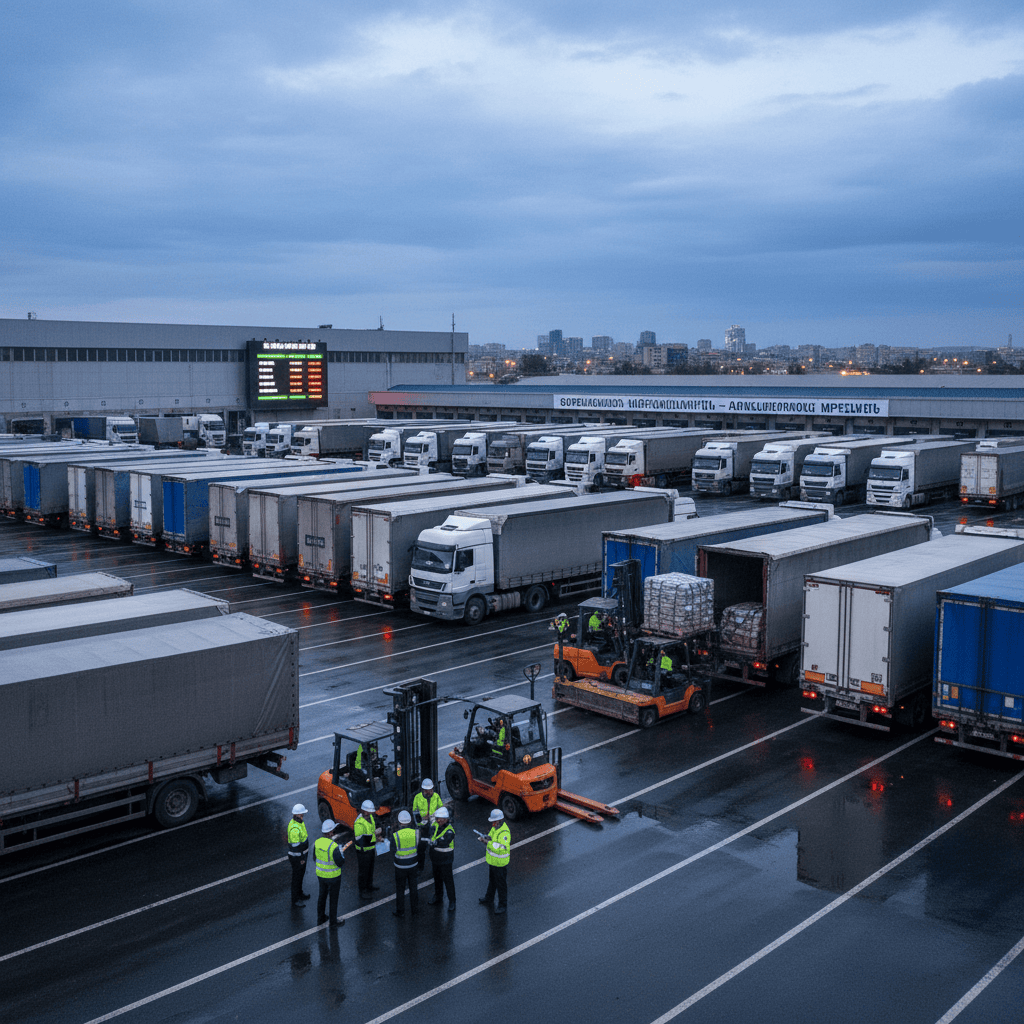
Russia’s migration tightening is now one of the top operational risks for Armenian carriers. With the 90-day-per-year cap firmly in force, the September 2025 grace period expired, and a new digital surveillance layer (ruID, Gosuslugi, the Registry of Controlled Persons) coming online in 2026, transport and logistics leaders must act quickly to protect routes, workforce continuity, and remittance-linked cashflows. This playbook sets out the current legal picture, the real enforcement reality at the border, the macro stakes for Armenia, and a practical compliance checklist for carriers and drivers.
Table of contents
- Russia’s 90-day rule: what the law actually says
- EAEU membership: a partial, not a full, exemption
- Enforcement reality: bans, digital surveillance, Verkhniy Lars
- Macro stakes: Armenia’s trade and remittance exposure
- Protests, the Spayka case and workforce impact
- Diplomatic and legislative outlook
- Compliance checklist for carriers and drivers
- Frequently asked questions
Russia’s 90-day rule: what the law actually says
Since January 1, 2025, Russian Federal Law No. 260-FZ limits most foreign nationals to 90 days of presence in Russia within a single calendar year, unless they hold a residence permit (RVP or permanent residence), a work permit, a formal employment contract, or another statutory basis for a longer stay. For Armenian nationals, this effectively compresses what was previously tolerated as an annual 180-day visa-free stay down to 90 days, with no sliding-window flexibility: the count resets on January 1, not on a rolling basis.
In practical terms, each day a driver physically spends in Russia – including border waiting time at checkpoints like Verkhniy Lars – counts against the 90-day budget. Once the limit is reached, the driver must leave and cannot return for the rest of the calendar year. Breaching the cap triggers administrative removal procedures and, increasingly, multi-year entry bans.
Stay rules: before vs. now
| Operational dimension | Before Jan 2025 | Now (Federal Law No. 260-FZ) |
|---|---|---|
| Visa-free days allowed in Russia per year | Commonly treated as up to ~180 days | 90 days per calendar year (hard cap) |
| Risk on exceeding the limit | Lower; inconsistent enforcement | 3-10 year entry ban via administrative procedure |
| Documentation burden | Passport stamps sufficient in practice | ruID/Gosuslugi profile, Registry of Controlled Persons check |
| Grace period for prior overstayers | N/A | Expired September 10, 2025 |
EAEU membership: a partial, not a full, exemption
A common misconception is that Armenia’s EAEU membership automatically exempts its nationals from the 90-day cap. It does not. The Eurasian Economic Union’s labor mobility provisions do give Armenian citizens the right to work in Russia without a separate work permit, and Armenian nationals with a formal written employment contract can lawfully stay in Russia for the duration of that contract, effectively bypassing the 90-day calendar-year limit. Family members of a contracted worker receive derivative rights.
The catch for the logistics sector is structural. Most Armenian truck drivers operate under Armenian employment relationships with Armenian carriers, crossing into Russia as visa-free foreign nationals rather than as contracted workers of a Russian employer. In that configuration, EAEU rules do not rescue them from the 90-day cap. Only Belarus, under the separate Union State agreement with Russia, enjoys a broad stay exemption – and that framework is not extended to other EAEU members.
Drivers who want to convert to the “employment-contract” track need to be legitimately hired (or seconded) by a Russian-registered employer, with proper tax and pension registration. For many Armenian carriers this is a significant commercial and tax restructuring question, not a simple paperwork fix.
Enforcement reality: bans, digital surveillance and Verkhniy Lars
The grace period for prior overstayers expired on September 10, 2025, and enforcement since then has been active. Reported data points include roughly 1,100 Armenian nationals deported from Russia in 2024 and entry bans of three to ten years being issued through administrative (not judicial) procedure once a violation is logged. Anecdotally, “dozens to hundreds” of Armenian drivers have been placed on entry watchlists, though no consolidated official figure exists.
Three enforcement dynamics matter for carriers:
- The Verkhniy Lars bottleneck. The only practical road link between Armenia and Russia runs through Georgia and the Verkhniy Lars checkpoint. Queues reported at 3,400 trucks (later easing to around 2,200) mean drivers can burn ten days of their 90-day allowance just waiting to cross. Over a year of regular rotations, border waiting time alone can consume the entire annual budget.
- Multi-agency proxy enforcement. Beyond migration law, Russian authorities have used sanitary inspections, tax evasion claims and road-safety audits as secondary pressure tools. Compliance now requires audit readiness across several agencies, not just calendar tracking.
- Digital surveillance (2026). The Russian Ministry of Internal Affairs (MVD) is rolling out ruID digital migration IDs, Gosuslugi integration, biometric enrolment and a consolidated Registry of Controlled Persons. Drivers crossing without a clean digital profile can be flagged automatically at the border.
Macro stakes: Armenia’s trade and remittance exposure
Russia remains Armenia’s single largest export destination. Official figures put 2024 exports to Russia at approximately USD 3.16 billion (about 24.2% of total Armenian exports). Preliminary 2025 data suggests the absolute value edged down slightly to around USD 3.0 billion, but Russia’s share of Armenia’s export mix climbed to roughly 35.3% as other destinations contracted faster – meaning concentration risk has actually increased, not decreased.
Road freight volumes held up reasonably well: trucked goods through the Armenia-Russia corridor totalled around 12.1 million tons through November 2025, though turnover (in value terms) dropped significantly. The Iranian corridor is expanding as a partial hedge (about USD 737 million in 2024), and the TRIPP transit agreement has been signed, but implementation is early-stage and cannot yet absorb a major diversion of Russia-bound cargo.
On the household side, remittances from Russia to Armenia fell by between 52.3% and 52.8% in 2024 (net basis), confirming the scale of the shock. Gross inflows in 2025 recovered modestly – about +1.5% year on year, with total gross inflows of roughly USD 3.9 billion – but remain well below pre-2024 levels. For finance leaders at carriers, that translates into continued liquidity pressure on drivers and subcontractors and justifies more conservative working-capital assumptions on Russia-dependent lanes.
Protests, the Spayka case and workforce impact
Armenian truckers staged repeated protests in Yerevan on or around October 12-13, 2025, with further actions on October 16 and 20, drawing hundreds of participants. Their core demands were an extension of the stay window from 90 to 180 days, a bilateral exemption for freight drivers, and direct government support for drivers caught in the grace-period cleanup.
The most high-profile corporate casualty reported so far is Spayka, Armenia’s largest food exporter, which had around 100 trucks stalled in Russia during the enforcement tightening. The Spayka episode illustrates how a single policy shift can pull an entire export category – perishables, in this case – offline within days, with knock-on effects across packaging, farm-gate prices and employment in rural Armenia.
As of early 2026, no formal Armenian government support program has been announced for affected drivers. The Ministry of Foreign Affairs and the Ministry of Economy have confirmed that negotiations are under way, but no structured assistance scheme – legal aid, compensation, or re-employment – has been published.
Diplomatic and legislative outlook
The regulatory picture is not static. Three active tracks are worth watching:
- Kazakhstan precedent. Kazakhstan reportedly secured a temporary stay exemption for its transport workers in October 2025. Armenian officials have pointed to this as a template, but no equivalent bilateral deal has been concluded for Armenia as of April 2026.
- MVD draft 180-day regime. The Russian Ministry of Internal Affairs has circulated a draft decree that would allow commercial freight drivers to stay in Russia for up to 180 days, subject to an application via Gosuslugi, a valid employment contract, and tax/documentation prerequisites. The draft has not been finalized or published in the official gazette.
- EAEU-level proposal. Armenian parliamentary representative Tatevik Bezhanyan has floated an EAEU-wide transport exemption as a structural fix. The proposal is at the discussion stage within EAEU bodies; no binding instrument has been adopted.
Carriers should plan for the current 90-day regime to remain in force through at least mid-2026 and treat any relief as upside.
Compliance checklist for carriers and drivers
Driver eligibility and document control
- Track every driver’s Russia day-count in real time for the current calendar year and block dispatches that would breach the 90-day cap (including border waiting time).
- Maintain copies of passports, licenses and all entry/exit evidence (tickets, border slips, digital logs) in a single repository for audits and incident response.
- Run a pre-dispatch ban and blacklist check against the Registry of Controlled Persons for each driver; if a driver has been previously refused entry, avoid assigning Russian routes until the status is cleared.
- For drivers holding a Russian RVP, work permit or formal employment contract, track validity and renewal dates closely. Our work permits team and immigration team can help structure these arrangements.
- Enrol drivers on ruID/Gosuslugi where required and confirm biometric data is current before assigning Russia-route trips.
Rotations, handovers and subcontracting
- Design 90-day-safe rotations. Reduce dwell time in Russia by using handover points near the border; plan rest periods outside Russia when day-counts are high.
- Build a substitution bench. For each lane, maintain paired drivers who can swap in to avoid breaching limits.
- Pre-qualify subcontractors. Russian-registered carriers can absorb spikes when drivers hit the 90-day ceiling. Align documentation, insurance and payment terms.
- Consider an EOR structure. For drivers who need to operate under a Russian employment contract, an Employer of Record setup on the Armenian side can simplify the tax and payroll mechanics.
Contracts, routes and cashflow
- Alternative corridors. Map and price non-Russian routings for priority cargo (Iran, Georgia-Turkey, Black Sea ferry options). Maintain lane cards with transit times, seasonal constraints and handover points. Run pilots before peak seasons.
- Contractual safeguards. Include force majeure, change-in-law and scheduling-flexibility clauses tied to migration enforcement. Add notification and renegotiation triggers when day-counts or entry denials occur.
- Fleet utilization scenarios. Model 10%, 20% and 30% driver-day losses. Pre-assign assets to domestic or alternative export lanes to keep trucks productive.
- Cashflow buffers. Align receivables with realistic transit windows; factor potential layovers from substitution. Consider shorter payment cycles for high-risk lanes.
HR, legal and scenario planning
- Policy watch. Assign owners in HR, Legal and Ops to monitor MVD announcements, EAEU statements and Armenian Foreign Ministry updates.
- Driver communications. Brief drivers on day-count rules, documentation and incident reporting. Provide a hotline for border issues.
- Incident playbooks. Standardize responses for refusals and blacklisting: recovery carrier, cargo custody, client notices, demurrage handling and insurance notification.
- Remuneration resilience. Stabilize take-home pay for affected drivers to mitigate remittance shocks. Monitor household impact given the broader remittance decline from Russia.
30-day action plan
- Implement a centralized Russia day-counter per driver with 75/85/90-day threshold alerts.
- Audit and digitize entry/exit proofs for the last 12 months for every Russia-route driver.
- Enrol all Russia-route drivers on ruID/Gosuslugi and verify their Registry of Controlled Persons status.
- Stand up a substitution roster and pre-qualify at least two Russian-registered subcontractors per high-volume lane.
- Amend key client contracts with change-in-law and scheduling protections.
- Pilot one alternative corridor (Iran or Black Sea ferry) for time-sensitive exports.
- Run a tabletop exercise for a border-refusal scenario (driver banned mid-route) using real consignments.
- Engage immigration counsel on RVP, work permit or contract-based strategies for long-tenure drivers.
