
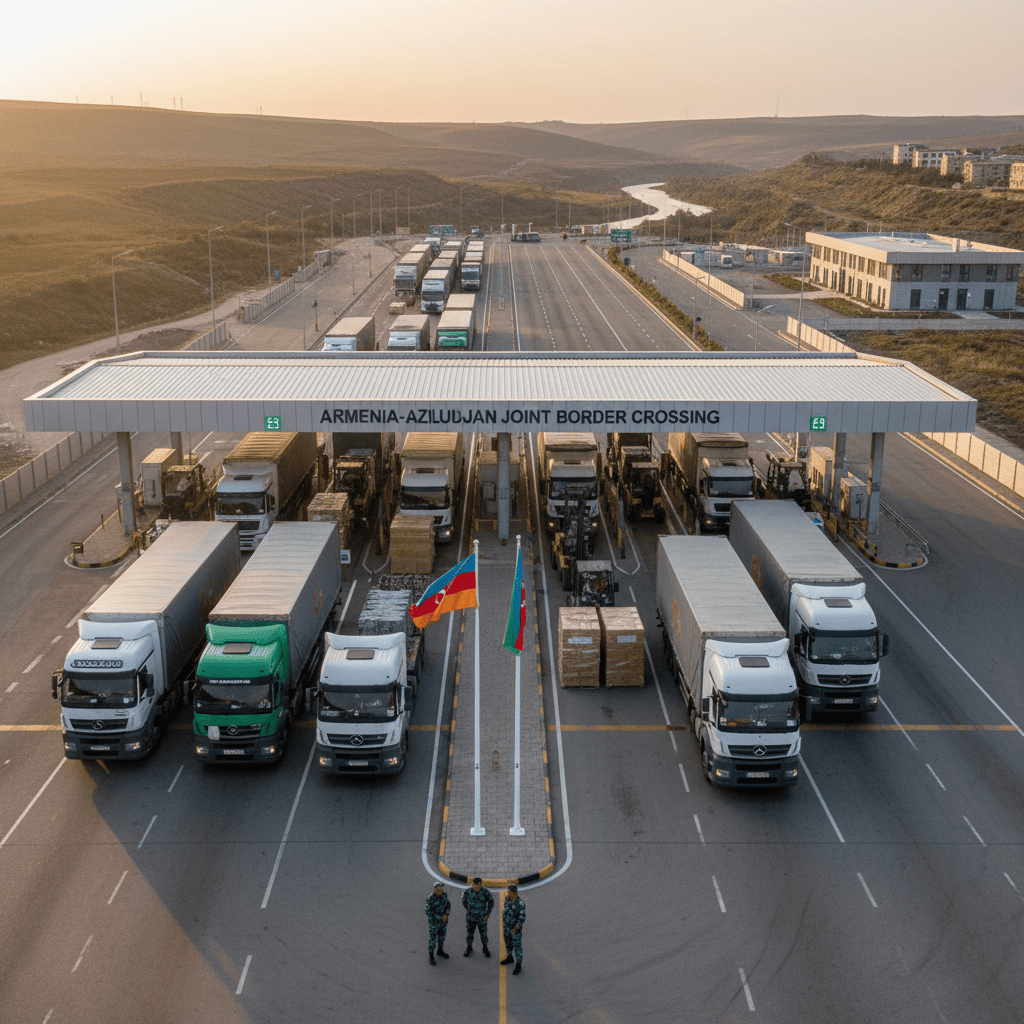
- A US-brokered peace accord is expected to include simplified border and trade cooperation between Armenia and Azerbaijan, opening a strategic transit route through Armenia and reducing logistics friction for regional shippers.
- The deal features a direct Azerbaijan–Nakhchivan corridor via Armenia, creating new routing options subject to Armenian jurisdiction and bilateral controls.
- Armenia has floated digital pre-clearance and advance cargo scanning to enable day-one transit with fewer stops and faster clearance at reopened borders.
- Azerbaijan's 2025 roadmap mandates an Electronic Single Window for all import/export submissions by late 2025, paving the way for cross-border data exchange.
- Legal and security details remain to be finalized; businesses should monitor rules on customs, security, and reciprocal transit rights to avoid compliance gaps.
The prospect of streamlined Armenia–Azerbaijan border procedures is a potential game-changer for cross-border trade and logistics in the South Caucasus. Customs simplification, a new transit route, and digital integration can lower costs and improve reliability for manufacturers, traders, and carriers. This guide outlines what the announced reforms may mean for Armenia border procedures, logistics Armenia operators, and companies eyeing Azerbaijan transit.
Planning Your Armenia Business Strategy?
Discover comprehensive legal and business support for investors in Armenia
Explore Investment ServicesTable of Contents
- Peace agreement: what Armenia–Azerbaijan commitments mean for borders and trade
- The TRIPP strategic transit corridor through Armenia: routes, control and commercial implications
- Armenia's digital pre‑clearance and cargo‑scanning proposals: how day‑one transit could work
- Electronic Single Window and IT integration: Azerbaijan's roadmap, timeline and cross‑border data exchange
- Customs, security and legal gaps to monitor: transit rights
Peace Agreement: What Armenia–Azerbaijan Commitments Mean for Borders and Trade
A US-brokered peace agreement announced in August 2025 is expected to include measures on border security and trade cooperation between Armenia and Azerbaijan, laying groundwork for simpler customs procedures and coordinated infrastructure at crossing points. The accord also secures US development backing for a strategic transit corridor enabling direct movement between Azerbaijan and its Nakhchivan exclave via Armenian territory, opening a shorter regional trade path.
Today, formal bilateral trade is modest. Reported Armenia exports to Azerbaijan totaled about $1.26 million in 2022, while imports from Azerbaijan were roughly $0.722 million in 2021—figures that underscore how much room there is for growth if border procedures normalize. If procedures are simplified and key corridors reopen, manufacturers and logistics operators can expect lower friction, rerouting options, and more reliable delivery SLAs anchored by clearer customs and security coordination.
The TRIPP Strategic Transit Corridor Through Armenia: Routes
The peace framework includes a direct Azerbaijan–Nakhchivan corridor traversing Armenia, often referenced as a strategic transit project in public reporting. Regional actors have publicly welcomed the connectedness benefits, highlighting the corridor's potential to reconfigure flows between the South Caucasus and neighboring markets.
While precise routing and physical border checkpoints will be determined by the parties, companies should plan for a through-Armenia alignment designed to minimize detours and interface with national customs control points. Expect a corridor framework embedded in Armenian jurisdiction and connected to existing road/rail nodes, subject to the bilateral customs, security, and transit arrangements set out in the peace deal's implementation protocols.
Control and Commercial Implications
From an operational standpoint, a shorter, controlled corridor reduces transit distance variance and the number of control interfaces, which can compress door-to-door lead times and limit buffer inventory needs for regional shippers. Regionally, this could redirect flows otherwise routed via longer detours, aligning with broader connectivity gains noted by neighboring stakeholders.
Commercially, the reopened corridor should enable new service offerings (e.g., time-definite road/rail transits between Azerbaijan and Nakhchivan via Armenia) and allow Armenian 3PLs and carriers to price more competitive lanes. The value proposition strengthens further if border agencies implement risk-based controls and synchronized checks at entry/exit, as outlined in simplification scenarios under discussion.
Armenia's Digital Pre‑Clearance and Cargo‑Scanning Proposals: How Day‑One Transit Could Work
Armenian officials have floated a simplified model built on pre-arrival data exchange and advance scanning to streamline border passage once the corridor opens. In practical terms, "day-one" transit could proceed as follows:
- Pre-arrival data: Shippers/brokers transmit digital declarations and cargo data to border agencies before the truck or train reaches the border, enabling risk assessment in advance.
- Advance scanning: Cargo is scanned ahead of border arrival or at the first point of entry with high-throughput equipment, supporting non-intrusive inspection and reducing manual checks.
- Risk-based lane assignment: Low-risk consignments use green lanes; higher-risk consignments are routed to secondary inspection, limiting overall congestion.
- Synchronized controls for transit: Entry and exit checks are harmonized to shorten dwell time and maintain seal integrity across the corridor.
The approach aims to cut queues and manual paperwork, lowering operational costs for exporters, importers, and carriers, provided that both sides' systems and procedures interoperate effectively.
Need Legal Support for Cross-Border Trade?
Our team of licensed attorneys can help you navigate customs, compliance, and contracts
Contact Our Legal TeamElectronic Single Window and IT Integration: Azerbaijan's Roadmap
Azerbaijan's 2025 border trade roadmap mandates an Electronic Single Window for import/export submissions by late 2025, centralizing permits and customs documentation in a unified online portal. Public reporting indicates a scheduled launch around November 2025 for the core module, which is designed to speed clearance and reduce errors by consolidating applications across agencies.
For cross-border transit, the Single Window can be a key enabler of joint risk management if paired with pre-arrival data from Armenia and standardized message formats. Traders using brokers integrated to both countries' systems should benefit most from fewer duplicate submissions and faster status updates once the corridor opens.
Timeline and Cross‑Border Data Exchange
Milestones to watch include the formal signing of the peace agreement and the roll-out of Azerbaijan's Single Window by late 2025, both of which shape the earliest date for friction-reduced transits and data exchange. Observers note that key legal and technical details are still being finalized, which could affect the pace of implementation.
Key Timeline Signals for Cross-Border Trade Readiness
| Milestone | Indicative Timing |
|---|---|
| Peace agreement with border/trade cooperation | Announced August 2025 |
| Strategic transit corridor inclusion | Announced August 2025 |
| Azerbaijan Electronic Single Window | Scheduled late 2025 (around Nov.) |
Given the fast-evolving framework, companies should align data formats with anticipated pre-arrival requirements and prepare for API connections with brokers and carriers to transmit declarations early in the journey. Early testing with counterparties can minimize delays when the corridor opens.
Customs
Customs simplification will be the linchpin of reliable, low-friction transit. Armenian proposals suggest advance data submission and scanning to minimize stops, which—if implemented jointly—should reduce manual clearance and inspection time at the reopened border. On the Azerbaijani side, the Single Window is intended to centralize permits and customs formalities into one portal, reducing duplicate processes for traders.
That said, observers have flagged unresolved legal issues around customs controls and reciprocal rights that could affect practical rollout and the degree of simplification achieved at launch. Businesses should therefore map possible process variants (e.g., level of documentary checks; joint vs. sequential inspections) and maintain buffer time in early months.
Action points:
- Pre-validate HS classifications, origin proofs, and licenses with your customs broker to fit pre-arrival submission formats.
- Integrate EDI/API for data sharing with carriers and brokers in both countries to support Single Window interactions.
- Scenario-plan for inspection rates and potential staggered implementation while legal frameworks finalize.
Security and Legal Gaps to Monitor: Transit Rights
Despite political momentum, unresolved legal and security issues could still affect the corridor's efficiency. Analysts caution that details on customs jurisdiction, security protocols, and reciprocity of transit rights remain sensitive and could influence implementation timelines and control intensity. Companies should monitor how reciprocal access is defined, where inspections occur, and what data elements are mandated to enable risk-based controls at scale.
Operational Readiness Checklist
| Area | What to Prepare |
|---|---|
| Routing and SLAs | Model corridor transit times and alternative routes; update customer SLAs and buffers. |
| Customs data | Standardize HS codes, origin docs, permits; set up pre-arrival datasets with brokers. |
| IT integration | Enable EDI/API with carriers/brokers to support Single Window and advance risk screening. |
| Security & compliance | Track rulemaking on reciprocal transit, inspection points, and seal practices. |
| Human mobility | Assess driver visa/work document needs and rotation policies for cross-border moves. |
Where This Creates Upside in Armenia
- Logistics services: Armenian 3PLs can package time-definite Azerbaijan–Nakhchivan services and multimodal options as routing improves.
- Industrial/warehousing: Corridor-adjacent sites may see demand for consolidation, cross-dock, and value-added services; explore locations and permits via our Real Estate and Business registration guidance.
- Trade finance and tax: New flows can change VAT, customs, and permanent establishment exposure; align structures early with our Taxes and Investment resources.
- Mobility planning: Drivers and technicians may require visas/permits depending on the final regime; coordinate early with our Visas team.
Bottom line: With customs simplification on the table and Azerbaijan's Single Window nearing launch, early coordination with brokers and carriers is the best way to capture time and cost gains as reforms roll out.
Ready to Navigate Armenia's Trade Opportunities?
If you are mapping supply chains, setting up an Armenian entity, or planning cross-border logistics, our team of licensed attorneys can help you structure routes, compliance, and contracts.
Get Professional Legal SupportFAQ
What changes are expected at the Armenia–Azerbaijan border?
The peace framework envisions border security and trade cooperation measures that support simpler customs procedures and coordinated infrastructure, including a new transit corridor through Armenia.
How will customs simplification work in practice?
Armenia has proposed pre-arrival data exchange and advance cargo scanning to enable risk-based, faster transit with fewer manual checks, paired with synchronized entry/exit controls.
When will Azerbaijan's Electronic Single Window go live?
Azerbaijan's roadmap schedules the Single Window for late 2025 (around November), centralizing online submissions for import/export processes.
Are transit rights and security protocols finalized?
Not yet. Observers caution that customs, security, and reciprocal transit rights remain to be clarified, which could influence timelines and the level of control at launch.
What should businesses do now to prepare?
Standardize customs data for pre-arrival filings, integrate with brokers' IT systems, model new routing options and SLAs, and monitor legal terms of reciprocal transit while Azerbaijan's Single Window comes online.
