
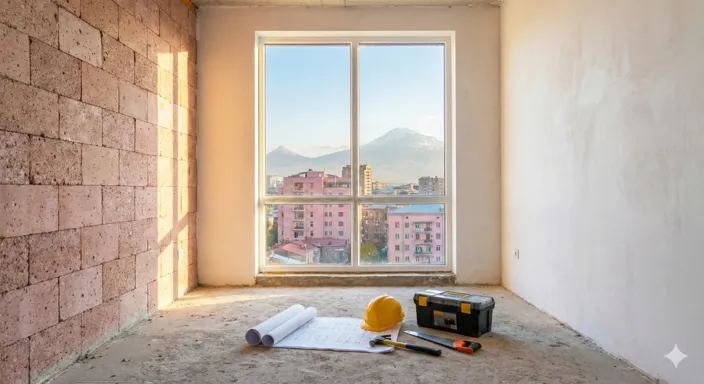
A practical, step-by-step guide for diaspora Armenians and foreign buyers who want to purchase an older apartment or off-plan unit in Yerevan, renovate it, and either move in or rent it out.
In This Guide
- Why Buy a Fixer-Upper in Yerevan?
- What Foreigners Can (and Cannot) Own
- Finding the Right Property
- Legal Due Diligence Before You Buy
- The Purchase Process, Step by Step
- Renovation Permits: When You Need One and When You Don't
- Hiring and Managing Contractors
- Taxes and Transaction Costs
- Property Ownership and Residency
- Common Pitfalls to Avoid
- How Vardanyan & Partners Can Help
- Frequently Asked Questions
Why Buy a Fixer-Upper in Yerevan?
Armenia's real estate market recorded 247,926 transactions in 2024, and foreign-involved deals accounted for roughly 6.7% of that total. Interest from diaspora Armenians and foreign nationals has been climbing steadily, with about 6.8% foreign participation in the first half of 2025.
Two categories of fixer-upper attract the most buyer interest. The first is Soviet-era apartments — typically built between the 1960s and 1980s — that come at a significant discount to renovated units. The second is off-plan units purchased directly from developers at pre-completion prices, which buyers then finish and customize to their own standards.
Average property prices across Yerevan range widely by district, from around $590 per square meter in peripheral areas like Nubarashen to approximately $2,342 per square meter in the Kentron center. Mid-range neighborhoods such as Arabkir ($1,619–1,643/sq.m) and Kanaker-Zeytun ($1,130/sq.m) offer a balance of price and livability. Premium properties in well-preserved Soviet-era "stalinkas" or newly built buildings in the city center can reach $3,000–5,000 per square meter. Central Yerevan prices rose 9.2% between April 2023 and March 2024, and peripheral districts have shown even higher growth rates.
Annual rental yields in Yerevan run between 5% and 8%, with Kentron and Arabkir in highest demand from IT professionals, students, and repatriates. A well-renovated fixer-upper in the right neighborhood can generate immediate rental income or be resold at a meaningful premium.
What Foreigners Can (and Cannot) Own
Foreign individuals can freely purchase and own apartments, houses, and commercial premises in Armenia — no special permits, no residence requirement, and the same ownership rights as Armenian citizens. You can acquire, possess, lease, sell, and bequeath property on equal terms.
Foreigners can also own most common types of land directly. The one restriction is agricultural land, which foreign individuals cannot hold in their own name. If a project involves agricultural parcels, the standard workaround is to register an Armenian legal entity (which can be 100% foreign-owned) to hold the land, or to enter a long-term lease.
For properties that include both a building and the land beneath it — which is the typical situation for houses and apartment buildings in Yerevan — foreign buyers can own both the structure and the underlying urban or settlement land without restrictions.
Finding the Right Property
The typical property search in Armenia is conducted through licensed real estate agents, online listing platforms, or direct referrals. For diaspora buyers who are not physically in Armenia, working with a local attorney or agent who can visit properties, take photos and video, and report on condition is practically essential.
When evaluating a fixer-upper, the factors that matter most are location and district, structural condition (especially earthquake safety, given Armenia's seismic activity), the building's age and the state of common areas (roof, stairwells, elevators), and whether the property has clear title with no encumbrances.
For off-plan purchases, additional due diligence is needed: research the developer's completed project history, verify their licensing with the Ministry of Urban Development, visit previously completed buildings if possible, and check public records for litigation. Developer reliability varies significantly in Armenia's market.
If you plan to buy remotely, you can authorize a local representative through a notarized power of attorney. Powers of attorney issued abroad require an apostille (or legalization) and a certified Armenian translation before they can be used locally.
Legal Due Diligence Before You Buy
Thorough due diligence is non-negotiable. The State Committee of Real Estate Cadastre maintains the authoritative record of all immovable property in Armenia, and an official cadastre extract is the single most important document you will obtain before signing anything.
The extract confirms the seller's title and identifies any co-owners, provides the exact property description and cadastral code, and reveals all registered encumbrances — mortgages, liens, court seizures, and easements. Cadastre extracts are typically valid for 15 working days, so if closing is delayed, you will need a fresh one.
Beyond the cadastre extract, your due diligence checklist should include verifying land use classification and zoning to confirm the property can be used as intended, checking for spousal consent (property acquired during marriage is joint marital property under Armenian law, even if only one spouse is on title — the non-titled spouse must consent to the sale), and confirming co-owner pre-emption rights (co-owners have a 30-day right of first refusal if one owner sells their share).
For apartments, the seller is legally required to disclose the building's management form, outstanding maintenance obligations, mandatory payment amounts, and the seller's ownership share percentage.
For fixer-uppers specifically, pay close attention to whether there are any court injunctions from inheritance disputes or pending litigation — distressed properties often have complicated ownership histories involving heirs, divorces, or bankruptcies.
The Purchase Process, Step by Step
The complete purchase process — from preliminary agreement to registered ownership — typically takes 2 to 4 weeks when documents are in order.
Step 1: Prepare your documents. You will need your passport with a notarized Armenian translation.
Step 2: Sign a deposit agreement. If you are putting down earnest money, the deposit agreement should be notarized to be legally enforceable. A non-notarized deposit receipt only proves payment was made — it cannot enforce penalty provisions such as forfeiture if the buyer defaults or double return if the seller defaults.
Step 3: Conclude the sale-purchase contract. The contract must be notarized by a notary public. Before notarization, have your attorney review the contract for essential safeguards: detailed property specifications, clear quality standards and materials (for off-plan or renovation deals), payment schedules tied to milestones rather than arbitrary dates, penalties for delays, conditions for termination and refund, and dispute resolution mechanisms.
Step 4: Register with the Cadastre. After notarization, you have 30 working days to register the contract with the Cadastre to perfect your title. Registration takes 2–5 business days.
Payment rules: All real estate transactions must be conducted in Armenian drams (AMD). Denominating or settling in foreign currency is illegal and can result in fines equal to the transaction amount (minimum 2 million AMD). Since all real estate transactions are subject to registration, they must be completed via bank transfer. Your bank transfer reference should include the property address and notarial deed number to create a clean audit trail.
Renovation Permits: When You Need One and When You Don't
Not every renovation requires a building permit. Under Armenian law, current repairs and interior finishing work — such as painting, tiling, replacing fixtures, and cosmetic updates — do not require a construction permit. This covers most standard apartment renovations.
A construction permit is mandatory for reconstruction, restoration, structural strengthening, modernization, and expansion. In practical terms, if you are removing or relocating load-bearing walls, changing the building's footprint, adding a floor, or making structural modifications, you need a permit. Permits are issued by the community head (in Yerevan, the district community head) after approval of architectural-construction design documents.
If your renovation involves connecting to or modifying utilities — water, electricity, gas, sewage — you must obtain technical conditions from the relevant engineering service providers before starting work.
When the work is done, a construction completion certificate (avartakan akt) must be obtained for any work that required a permit. This certificate is issued by the community head, regional governor, or Yerevan mayor.
Working without required permits can result in fines, work stoppage orders, or demolition orders. The State Urban Development Inspectorate actively supervises compliance and can impose administrative penalties.
For apartment buildings, owners may freely modify interior walls within their own unit without other owners' consent, as long as mandatory building norms are maintained. Removing or relocating partition walls between adjacent units requires the adjacent owner's consent.
Hiring and Managing Contractors
Contractors performing construction work in Armenia must possess a license for the relevant activity. Before hiring anyone, verify their licensing status. Licensed contractors are legally required to comply with approved design documents and technical standards during construction.
Contractors also have rights that can affect your project timeline. They can refuse to use construction materials you provide if those materials do not comply with current standards. They can also halt work if they discover normative violations in your design documents and demand an alternative expert review.
The practical reality of construction in Armenia is that delays are common. Material shortages, labor issues, and administrative hurdles frequently extend timelines beyond initial projections. The general recommendation is to factor in a 6–12 month buffer beyond any promised completion date. Building materials can be of inconsistent quality, and even legally compliant construction may not meet Western expectations. For older properties, earthquake safety upgrades should be evaluated by a structural engineer before you commit.
To protect yourself, include detailed quality standards in your contract, link payment to verified milestones, and consider hiring an independent inspector to verify work quality throughout the project.
Taxes and Transaction Costs
Armenia's transaction costs are relatively low compared to most European markets.
At purchase: The primary costs are the cadastre registration fee of 45,000 AMD (approximately $115, with higher fees for fast-track processing) and notary fees of around 20,000–25,000 AMD. Armenia does not impose a transfer tax or stamp duty on real estate sales between individuals. If you use a real estate agent, commissions typically run 2–5% and are normally split between buyer and seller.
Annual property tax: Calculated on a progressive scale based on the property's cadastral value (which is typically lower than market value). Rates range from 0% for properties valued under 3 million AMD up to 0.6% for those over 40 million AMD. A property tax reform is phasing in updated cadastral values, reaching 100% of the new rates in 2026 — but rates remain low overall, roughly 0.1–1% of cadastral value. This tax applies regardless of your residency status.
Rental income tax: If you rent out your renovated property, the rate is 10% flat when your tenant is a company (the company withholds the tax for you). Many investors register as sole entrepreneurs to lock in the favorable 10% rate.
Capital gains tax: There is an exemption for individual-to-individual residential sales, making most fixer-upper exit transactions tax-efficient.
No VAT applies on resales between individuals. For new construction from a developer, 20% VAT is typically included in the quoted price.
Property Ownership and Residency
Buying property in Armenia does not automatically grant you a residence permit. However, under current rules, if you operate your property as a rental business registered as an individual entrepreneur, that business activity can serve as the basis for a residency application.
A significant change is expected: from August 1, 2026, investment in Armenian property is anticipated to become a standalone basis for residency applications. The enabling legislation has been passed, but the implementing decree — which will set the minimum investment threshold and procedural details — has not yet been published.
Common Pitfalls to Avoid
Skipping the cadastre check. This is the single most common and most dangerous mistake. Without a fresh cadastre extract, you have no reliable way to know whether the seller actually owns the property, whether there are mortgages or liens on it, or whether co-owners have pre-emption rights that could invalidate your purchase.
Paying in foreign currency. All real estate transactions must be settled in Armenian drams. The penalties for violating this rule are severe — fines equal to the full transaction amount, with a minimum of 2 million AMD.
Informal deposit agreements. Handing over earnest money without a notarized deposit agreement is extremely common in Armenia — and it leaves you with no legal recourse if the deal falls through. Always notarize.
Ignoring spousal consent. If the seller acquired the property during marriage, the other spouse must consent to the sale — even if they are not on the title. Failing to obtain this consent can void the entire transaction.
Underestimating renovation timelines. Between permit applications, contractor delays, material sourcing, and inspections, renovations in Armenia reliably take longer than planned. Build a 6–12 month cushion into your timeline and budget accordingly.
Skipping earthquake assessment. Armenia is in a seismically active zone. Older Soviet-era buildings may not meet current safety standards. Have a structural assessment done before you buy, especially if you plan significant renovation work.
Inheriting the previous owner's debts. New property owners inherit prior mandatory maintenance obligations and unpaid fees unless the previous owner specifically assumes them in the sale contract. Confirm all maintenance payments are current before closing.
How Vardanyan & Partners Can Help
We work with diaspora Armenians and foreign buyers at every stage of the fixer-upper process.
Before you buy, we run full legal due diligence — cadastre title searches, encumbrance checks, zoning verification, and co-owner and spousal consent confirmations. We review the seller's documentation and flag any issues before you commit.
During the purchase, we draft and review sale-purchase contracts with the safeguards that protect your interests, manage the notarization process, and handle cadastre registration. For remote buyers, we can act under power of attorney so you do not need to be in Armenia for closing.
During renovation, we advise on permit requirements, review contractor agreements, and ensure your renovation complies with Armenian building regulations.
After completion, we assist with rental structuring (including sole entrepreneur registration for tax-efficient rental income), property tax compliance, and — when the rules take effect — investment-based residency applications.
With 11+ years of experience, 1,500+ cases handled across 97 nationalities, and a 4.9-star Google rating, we bring deep local expertise combined with the international perspective that diaspora and foreign buyers need.
Thinking About a Fixer-Upper in Armenia?
Schedule a free consultation to discuss your property plans and get clear guidance on the legal steps ahead.
Get a Free ConsultationFrequently Asked Questions
Can a foreign citizen buy property in Armenia?
Yes. Foreign individuals can freely purchase and own apartments, houses, and commercial premises with the same rights as Armenian citizens. No special permits or residence status are required. The only restriction applies to agricultural land, which must be held through an Armenian legal entity.
Can foreigners own land in Armenia?
Foreigners can own most common types of land directly, including urban and settlement land for residential or commercial use. Agricultural land is the exception — foreign individuals cannot hold it in their own name, but can access it through an Armenian-registered company (which can be 100% foreign-owned) or through a lease arrangement.
How long does the purchase process take?
From preliminary agreement to registered ownership, expect 2 to 4 weeks. The main steps are preparing your notarized documents, concluding the notarized sale contract, and registering with the Cadastre Committee (2–5 business days).
Do I need to be in Armenia to buy property?
No. You can authorize a local representative through a notarized power of attorney to handle the transaction on your behalf. Powers of attorney issued abroad need an apostille and certified Armenian translation.
Do I need a building permit for renovating an apartment?
It depends on the scope of work. Cosmetic repairs — painting, tiling, replacing fixtures, and interior finishing — do not require a permit. Structural changes — removing load-bearing walls, expanding the footprint, or reconstruction work — require a construction permit issued by the local community head after approval of design documents.
What taxes will I pay on my Armenian property?
Annual property tax ranges from 0% to 0.6% of cadastral value on a progressive scale. There is no transfer tax or stamp duty on sales between individuals. Rental income is taxed at a 10% flat rate. Capital gains on resale between individuals are exempt for residential property.
Will buying property help me get Armenian residency?
Currently, property ownership alone does not grant residency — but operating your property as a rental business (registered as an individual entrepreneur) can qualify you. Starting August 1, 2026, property investment is expected to become a standalone basis for residency applications, though the implementing decree with minimum investment thresholds has not yet been published.
Can I pay for property in US dollars or euros?
No. All real estate transactions must be settled in Armenian drams (AMD) via bank transfer. Paying in foreign currency is illegal and carries fines equal to the full transaction amount (minimum 2 million AMD). You can convert your foreign currency at an Armenian bank before closing.
