

Overview: Employment of Iranian Citizens in Armenia
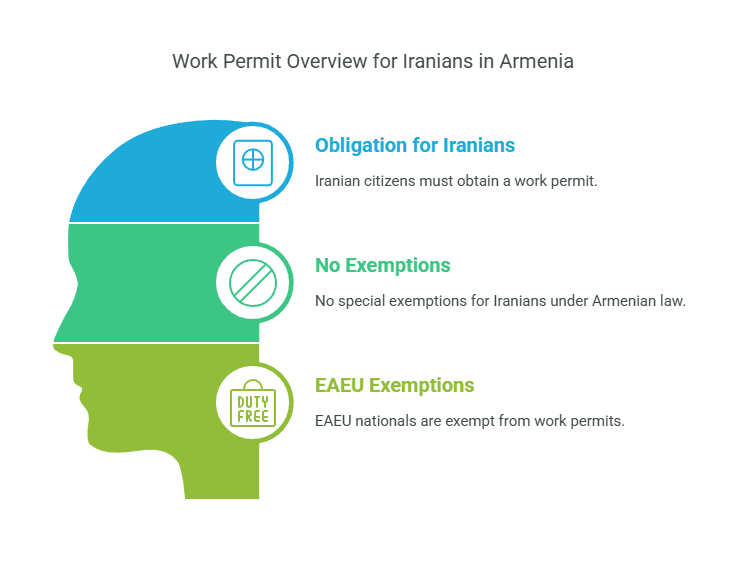
Under Armenian immigration law, foreign citizens, including Iranian nationals, must obtain a work permit (and corresponding residence status) to be legally employed in Armenia. Iranian citizens, like most non-EAEU foreign nationals, require a work permit to work in Armenia – there are no special exemptions based solely on Iranian nationality. (Citizens of the Eurasian Economic Union (EAEU) countries such as Russia or Kazakhstan are exempt from work permits by treaty, but this exemption does not apply to Iranians.)
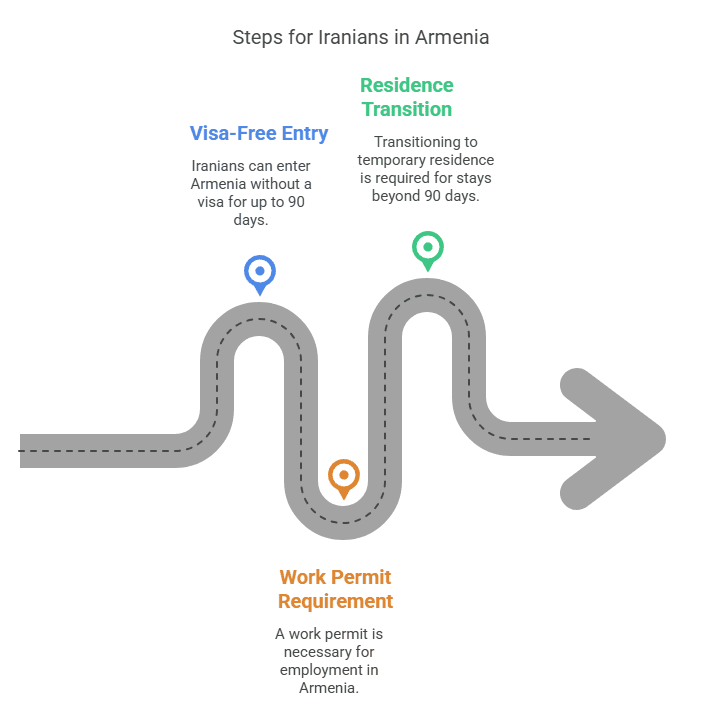
Visa Requirements: Iran and Armenia maintain a visa liberalization regime. Iranian nationals can visit Armenia without a visa for up to 90 days within a 180-day period. This visa-free entry is intended for tourism or short visits, and does not by itself authorize employment. To work beyond short visits, Iranians must go through the work permit and temporary residence permit process described in this guide. In practice, an Iranian citizen typically enters Armenia visa-free (or on a long-term entry visa if required) and then obtains a work permit and a Temporary Residence Card (residence permit) tied to employment. We will explain the Armenia work visa process (in effect, the work permit/residence process) step by step.
Legal Framework Under Armenian Immigration Law
Primary Legislation: The hiring of foreign workers in Armenia is governed by the Law of the Republic of Armenia “On Foreigners”, along with relevant provisions of the Labor Code and Government decisions. This legal framework stipulates that any foreign national must have a valid work permit to engage in employment in Armenia (unless an international agreement provides an exemption). In other words, holding even a long-term visa or being present in Armenia does not alone grant the right to work – a specific employment authorization is required.
Exemptions: Armenian law enumerates certain cases where a foreigner can work without a permit. The most notable exemption is for citizens of EAEU member states, who can work freely in Armenia by virtue of international treaty. Additionally, some categories of highly qualified foreigners may be exempt from work permit requirements – for example, certain highly skilled specialists, company executives, or investor-business owners invited to work in Armenia. Additionally, employees retained by foreign companies may be exempt from work permit requirements, particularly if they are foreign specialists or representatives. These cases are exceptions, however. Iranian citizens hired in regular employment roles are not exempt and must follow the standard work permit process.
Temporary vs. Permanent Residency: Armenian immigration law provides that a work permit is typically linked to a Temporary Residence status. A foreign employee who secures a work permit will be granted a Temporary Residence Card (up to one year validity), renewable annually as long as the employment continues. This temporary residence based on employment can be extended each year. After a number of years and meeting certain conditions, longer-term settlement options become available (discussed in a later section on long-term residency pathways).
Recent Reforms: In January 2022, Armenia overhauled its work permit system to streamline and digitize the process. Amendments to the Law on Foreigners, Labor Code, and Law on State Duty introduced an integrated online platform (workpermit.am) for handling work permit applications. This reform merged the previously separate steps (labor market clearance and residence permit issuance) into one coordinated procedure. Now, an employer’s online application triggers both a labor market test and, once approved, the issuance of a temporary residence status for the foreign worker. The foreign employee ultimately receives a single document: a Temporary Residence Card (work basis), rather than separate work and residence permits. These changes have significantly simplified administrative steps and reduced processing times, benefiting both employers and foreign employees.
Visa and Entry Considerations for Iranian Applicants
Before initiating employment, Iranian nationals should understand their entry status into Armenia:
Visa-Free Entry: As of 2024, Iranian citizens do not need a visa for short stays in Armenia (up to 90 days in any 180-day period). This visa waiver allows Iranian visitors to enter on a passport stamp as tourists or for business visits. An Iranian job seeker or newly hired employee can therefore enter Armenia without a visa to begin the work permit process or to attend interviews/meetings.
Longer Stays for Work: The 90-day visa-free stay is insufficient for long-term employment, which will require staying in Armenia beyond 90 days. To legally remain and work, the individual must transition to a temporary residence status based on the work permit. This is typically done after arrival (since the work permit process can be completed while the person is in-country). It is important that the Iranian national not work until the permit is approved; working on a tourist entry without a permit can invalidate their legal status and incur penalties. Navigating the legal requirements for obtaining a work permit in a foreign country can be complex, and expert guidance is often recommended.
Entry Visa (if required): In the unlikely event the visa-free policy changes or if the individual needs to stay beyond 90 days before obtaining the residence card, an Armenian entry visa might be required. Armenia issues long-term visitor visas (up to 120 days, extendable 60 days) that could cover the interim period. However, for Iranian nationals under the current regime, this is rarely needed due to the visa waiver. Employers should ensure the Iranian candidate enters Armenia lawfully (visa-free or with the appropriate visa) before the 90-day period lapses or coordinate a visa extension if necessary.
In summary, Iranian employees can arrive in Armenia relatively easily under visa-free travel, but must promptly engage in the work authorization process to remain compliant. Next, we outline the specific procedures each party (employer and employee) must follow to secure the work permit and temporary residence for the Iranian national.
Step-by-Step Work Permit Application Process for Armenian Employers
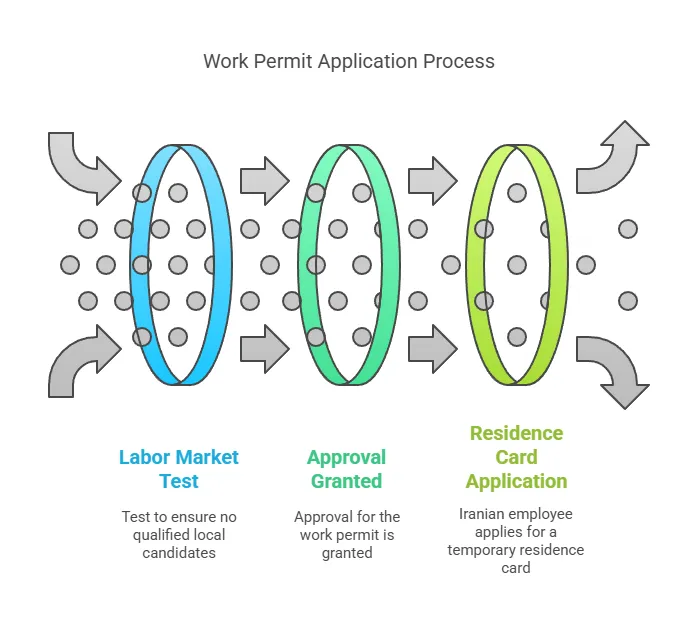
Securing a work permit for an Iranian national involves several steps that require the active participation of both the employer and the employee. Employers in Armenia bear the primary responsibility for obtaining permission to hire a foreign worker. Below is a step-by-step guide for employers on securing a work permit for an Iranian national:
Job Offer and Contract: The employer must first extend a job offer and sign a contract with the Iranian national.
Labor Market Test: The employer must conduct a labor market test to ensure that no local candidates are available for the position.
Application Submission: The employer submits the necessary documents to the relevant authorities for initial approval.
Work Permit Application Process: With clearance to hire a foreigner, the employer can now formally apply for the work permit for the Iranian candidate, initiating the work permit application process on the platform.
Ensuring compliance with local labor laws and regulations is crucial throughout this process, and employers must adhere to all legal requirements.
Step 1: Register Your Company on the Work Permit Platform
The process begins with the employer’s registration on the Armenian government’s unified electronic platform for work permits, accessible at workpermit.am. The employer (or an authorized HR representative) must create an account and register the company details on this portal. Registration typically requires providing the company’s identification information and authorizing a representative to act on its behalf. This one-time registration enables the employer to submit vacancy and work permit applications online.
Tip: Have your company’s state registration details and contact information handy for the signup. The platform may require verification of the company’s taxpayer ID or business license information. Once registered, the employer can manage all foreign work permit requests through this dashboard.
Step 2: Post the Job Vacancy and Description
After registering, the employer creates a new job vacancy posting on the platform. This involves filling in the job description, requirements, and salary for the position intended for the foreign (Iranian) candidate. The platform uses this information to initiate a labor market test. Under Armenian law, employers must first consider local Armenian candidates for any job before hiring a foreigner.
When the vacancy is posted, the Migration Service (in coordination with the Ministry of Labor) will review the job requirements and check if any qualified Armenian job seekers are available to fill the role. The Migration Service may even refer some local candidates or require the employer to interview them as part of this labor market assessment.
Legal Requirement: This step is essentially the labor market test mandated by law. It helps demonstrate that hiring a foreign national will not displace local workers. Employers should ensure the job description is accurate and justifies any specialized skills required (especially if using the rationale that no local can fill the role). Armenian authorities typically respond to the vacancy posting within a short period (several working days) with either potential local candidates or clearance to proceed.
Step 3: Labor Market Clearance and Rejection of Local Candidates
If the Migration Service (and Ministry of Labor) identify Armenian candidates for the position, they will forward those local candidates’ details to the employer. The employer is usually free to interview them. However, Armenian employers are not forced to hire these candidates – you may lawfully reject the proposed local candidates if they do not meet the job requirements or if you prefer the Iranian candidateIn many cases, especially for specialized roles or language-specific jobs, no suitable local candidate will be found.
Once the employer either confirms no suitable local was found or formally rejects the referred candidates, the authorities will give the green light to proceed with hiring the foreign national. Essentially, failure to find a local replacement is documented, satisfying the labor test. At this point, the process moves to applying for the foreign worker’s permit.
Timeline: The labor market check is designed to be quick. Reforms have limited the timelines for this stage – if the state does not respond within 5 business days, the process can move forward by default. In practice, expect about 5–15 business days for the labor market clearance. Promptly communicate your decision on any local candidates via the platform to avoid delays.
Step 4: Submit the Work Permit Application (Foreign Worker’s Details)
With clearance to hire a foreigner, the employer can now formally apply for the work permit for the Iranian candidate on the platform. This involves entering the personal data of the Iranian national and uploading required documents. At this stage, the platform will prompt for specific information and attachments about the foreign worker:
Documents/Data the Employer Must Provide:
Personal details of the foreign candidate (name, date of birth, citizenship, etc.).
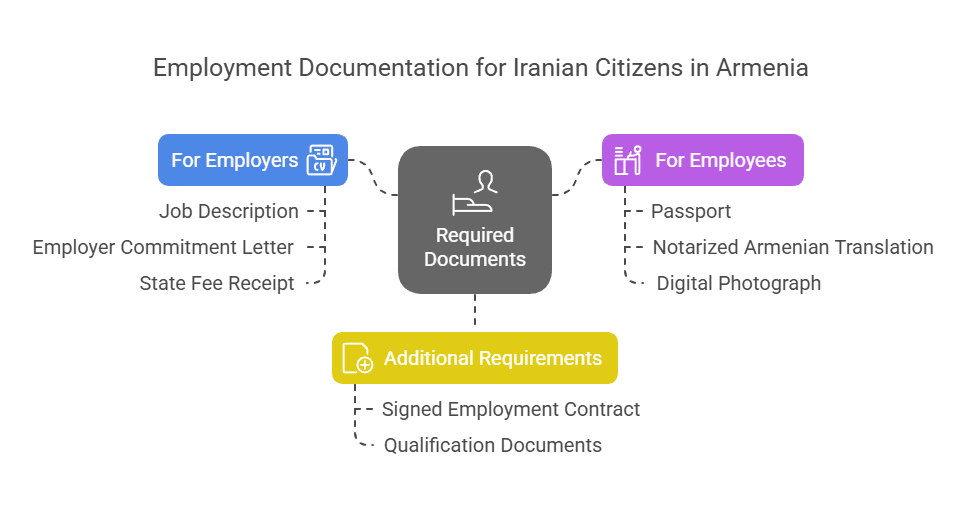
Passport copy of the Iranian national and a notarized Armenian translation of the passport.
Digital passport-sized photo of the foreigner (e.g. 35×45 mm, color).
Educational or qualification documents (e.g. diploma, certificates) to show the candidate meets the job requirements. These should be legalized or apostilled if applicable.
Employer’s commitment letter – a signed statement or offer letter confirming the intent to hire this foreigner once approval is granted. (Often this is an uploaded letter on company letterhead, essentially a promise to conclude an employment contract with the person upon permit issuance.)
Proof of state fee payment (if any) for the work permit/residence application. Currently, the government does not charge a separate fee for the work permit itself, but a fee will apply for the residence card (addressed in a later step).
Public Service Number (Social Security Number) of the foreigner, if available. (If the Iranian candidate has previously lived in Armenia and has a social security number, it should be provided. If not, the platform may require noting its absence or obtaining one later. Tip: A foreigner can obtain an Armenian Public Services Number through the local authorities; however, this can also be done during the residence card stage if they don’t have one yet.)
Utilizing professional work permit services can greatly facilitate this process, ensuring that all documentation is correctly submitted and compliance is maintained.
Once all data is entered and documents uploaded, the employer submits the application through the platform. The system will then route the application for approvals and security checks by Armenian authorities. Specifically, the National Security Service (NSS) and police immigration authorities will review the foreigner’s background and the application details, which by law takes up to 4-8 weeks for a decision or clearance. If no objection arises (e.g. no security issues), the conclusion is considered positive and the work permit request proceeds.
Step 5: Government Decision and Work Permit Approval
Following review, the employer will receive a notification on the platform of the work permit decision. If approved, the platform typically indicates that the “temporary residence status on work basis” for the foreigner is granted. An email notification is also sent to the foreign candidate about the status.
At this point, the employer can move forward to formally hire the Iranian employee. Important: Even though the work permit is approved, the process is not fully complete until the foreign worker obtains their Temporary Residence Card. However, the approval means there are no further obstacles to issuing the residence/work permit card.
If the work permit application is rejected, the platform will provide a reason. Common grounds for rejection include: the labor market analysis determined an Armenian could fill the role (and authorities decided not to allow the foreign hire), the position legally requires an Armenian citizen, the documents were incorrect or fraudulent, the employer has prior violations in hiring foreigners, or security concerns about the candidate. In case of rejection, the employer may need to address the issue (for example, provide additional justification or choose a different candidate) before reapplying.
Assuming approval, the employer and Iranian candidate should proceed quickly to the next steps. The law now expects the employer to finalize the hire by concluding an employment contract with the foreigner within a stipulated time.
Step 6: Sign the Employment Contract
After work permit approval, the employment contract must be signed between the employer and the Iranian employee. Armenian labor law requires a written contract for all employees, and for foreign nationals this contract is usually contingent on the work authorization. In fact, the Migration Service’s platform and Armenian law link the residence status to the existence of an employment contract.
Usually, the employer prepares a standard employment contract (in Armenian, or bilingual with Persian/English if needed) stating the role, salary, and terms of employment, and both parties sign it. This should be done promptly after permit approval. According to regulations, the foreigner’s temporary residence status obtained via the work permit can be invalidated if a signed employment contract is not concluded within 15 working days of the residence permit issuance. In practice, you will want to sign the contract before or by the time the foreigner receives the residence card.
The signed employment agreement may need to be uploaded to the online platform or presented to authorities as proof of completion. Indeed, the online system expects the employment agreement signed by both sides to be submitted as part of finalizing the process. This ensures the foreigner is genuinely employed under the terms for which the permit was granted.
Employer Note: At this stage, you should also register the Iranian employee in your payroll/social security system as required for any new hire. They will be subject to Armenian labor law standards – including minimum wage, working hours, and social contribution requirements – just like local employees. The work permit grants the foreign worker equal labor rights in Armenia, so the employment relationship must comply with the Labor Code.
Step 7: Ongoing Compliance (Renewals & Notifications)
With the contract signed and the employee set to start work (once they have their residence card in hand), the employer’s focus shifts to compliance and future renewals:
Maintain Valid Status: Ensure the foreign employee always has a valid residence permit while employed. A temporary residence card is valid for up to 1 year at a time. If you intend to continue employment beyond the card’s expiry, you (and the employee) should begin the renewal process at least 30 days before expiration. Renewals also occur through the migration authorities and may require updated documents, though generally the labor market test is not repeated if it’s a continuation of the same employment.
Notify Authorities of Changes: If the Iranian employee’s job is terminated early or if there are significant changes (role, location of work, etc.), inform the Migration Service. While the law doesn’t explicitly mandate employers to report termination, the residence permit is tied to the employment; if the job ends, the basis for the foreigner’s stay ends. Proactively notifying or cancelling the work authorization can protect the employer from any liability. The foreigner may have to leave Armenia or find a new sponsor if employment ceases.
By following these steps diligently, Armenian employers can navigate the work permit process for Iranian nationals efficiently.
Step-by-Step Process for Iranian Applicants (Employees)
If you are an Iranian citizen pursuing employment in Armenia, below is what you need to know and do at each stage. Many steps will be handled by your prospective Armenian employer, but you should be prepared to provide documents and take certain actions yourself:
Step 1: Secure a Job Offer in Armenia
The first and most important step is to have a job offer or contract with an Armenian employer. You cannot obtain a work permit on your own without an employer sponsor – the process is employer-driven. Ensure you have a clear offer of employment. Typically, the employer will give you a job offer letter or preliminary contract which confirms they intend to hire you pending work permit approval. You will likely need to show proof of this job offer in the application process (the employer will upload a letter of commitment as described earlier).
Note: It’s possible to search for jobs and even enter Armenia temporarily to interview, since Armenia allows visa-free visits for Iranians. Some Iranian professionals travel to Armenia on a short visit, secure employment, and then proceed with the work permit process in-country.
Step 2: Gather Required Personal Documents
Prepare the documents you will need to give your employer (and later to the Armenian authorities). Having these ready in advance will speed up the application:
Passport: A valid Iranian passport with at least 6+ months validity remaining. You will need to provide a clear copy of the passport’s photo page. You will also later need an official translation of your passport into Armenian, so budget time and cost for a notarized translation. Many translation offices in Armenia can do this within a day.
Photographs: Passport-sized color photograph (typically 35 x 45 mm). This will be used for the work permit application and for the residence card issuance. Having a few extra photos in the required size is advisable.
Educational Certificates: Any diploma, degree, or professional certificates that qualify you for the job. For example, if you are being hired as an engineer, provide your engineering degree. Originals may be needed for verification. Have these documents legalized or apostilled in Iran if possible (or as directed by your employer), so that Armenian authorities accept them as authentic. If they are in Persian or another language, get official translations to English or Armenian. Additionally, if you are applying for benefits or leave entitlements, you may need to provide documentation related to a family member, such as a marriage certificate or birth certificate.
Work Experience Letters (if applicable): While not always required by law, it can help to have reference letters or prior employment certificates if your job is specialized. These can support your qualifications during the labor market test stage.
Medical Certificate: Armenia requires a medical certificate for residence permit applications. This typically means you must undergo a basic medical exam/tests (for infectious diseases, etc.) at a clinic in Armenia. You do not need to do this before arrival; it can be done after you are in Armenia but before applying for the Temporary Residence Card. Plan to visit a local medical center for the requisite health check and obtain the certificate. Your employer or an immigration consultant can guide you on approved clinics.
Police Clearance (if requested): The standard list of documents does not explicitly mention a police clearance certificate for work permits. However, some foreign applicants provide a background check from their home country for peace of mind. It’s generally not required unless specifically asked due to your case. Armenian authorities will conduct their own security screening internally.
Public Service Number (optional): If you have previously lived in Armenia and have an Armenian Public Services Number (PSN/SSN), inform your employer. If not, you can usually apply for one concurrently with your residence permit. (For EAEU nationals, a PSN is needed to print their certificate, but for others it will be created as part of the residence card issuance if they never had one.)
Having electronic scans of these documents can be helpful, as the employer will upload many of them to the online system. Also be ready to provide any additional info (e.g. your father’s name, address, etc.) that might be needed for forms.
Step 3: Coordinate with Your Employer During Application
The work permit application itself is submitted by your employer, but your cooperation is crucial for a successful outcome:
Provide Information Promptly: Fill out any forms or information requests your employer gives you. This may include personal data forms required for the online platform or for security clearance. Double-check that all personal details (name spelling, birth date, passport number) are accurate and exactly match your passport.
Sign Necessary Documents: The employer might ask you to sign a letter (in advance) confirming your intention to work for them. You should also review the draft employment contract terms at this stage so there are no surprises later. Typically, the formal contract is signed after work permit approval, but being in agreement beforehand is wise.
Stay Accessible: Once the employer submits the application, the authorities might conceivably request additional information. While uncommon, be prepared to quickly furnish any extra documents or clarifications if needed. Also, you (the foreign applicant) will receive an email notification when the residence/work authorization is granted. Monitor your email (including spam folder) for communication from the Armenian Migration Service or the workpermit.am system.
Do Not Work Yet: Remember that until you have the official Temporary Residence Card with work status, you are not allowed to begin working and drawing a salary in Armenia. Starting work too early (even if informally) could jeopardize your status. Patience in this period is important – wait for the legal approval and card.
During this phase, most of the heavy lifting is on the employer’s side (job posting, labor test, application submission). Your main job is to stay in contact and provide what they need quickly. Typically, it takes a few weeks for the application to be processed. Once you get word that it’s approved, you will move on to the next steps.
Step 4: Travel to Armenia (If Not Already There)
If you were not already in Armenia during the application process, you will need to enter Armenia to finalize the procedure. As noted, Iranians can come visa-free for 90 days, which is usually sufficient for this purpose. Plan your travel such that you arrive around the time the work permit approval is obtained or shortly before.
Upon arrival, ensure that your passport is stamped (documenting your entry date). Keep your migration card (arrival card) if one is provided at the border. While Armenia is generally straightforward for entry, it’s wise to carry a copy of your job offer letter and possibly a printout of any email/confirmation of your work permit status, in case border officers inquire about the purpose of your visit. (Simply stating you are coming as a tourist or for business discussions is usually enough – you don’t need to announce “I’m coming to work” until you have the permit.)
Important: Do not exceed your initial 90-day legal stay without obtaining your temporary residence. If there are delays in the work permit process, you might need to exit and re-enter or get a visa extension. However, such situations are rare if the process is managed efficiently.
Step 5: Apply for the Temporary Residence Card (Work Permit Residence)
With your work permit approved and documents in hand, the crucial final step is to apply for and obtain your Temporary Residence Card. In Armenia, this is the physical residence permit ID card that denotes your legal status and permission to work. The process is as follows:
Where to Apply: Applications for temporary residency (on employment basis) are submitted to the Migration and Citizenship Service of Armenia (Ministry of Internal Affairs). There is a centralized office (often referred to as the Passport and Visa Department or the Joint Public Services office) in Yerevan that handles residence applications. As of 2024, the address is 17/10 Building, 4th District, Davtashen, Yerevan for the Migration & Citizenship Service main office. (Alternatively, the Joint Office at 3 Vazgen Sargsyan St. handles issuance of the card after approval.)
Documents You Must Submit: When applying for the Temporary Residence Card as an Iranian worker, prepare a file with the following:
Application form: This is a standard form for residence permit requests. It may be filled out on the spot or online beforehand. It will ask for your personal details and the basis of your application (work permit). Ensure all information is consistent with your work permit approval and job details.
Passport and Copy: Your original passport will be required for verification, along with a photocopy of the passport bio page and the notarized Armenian translation of your passport. They will check the original and keep the copies.
Photographs: 3 color photos (35 x 45 mm) – passport style. Even if you submitted digital photos earlier, you need physical photos for the residence card application (these might be used on your card).
Work Permit Approval/Employer Letter: Proof of the basis for your residence request. In practice, since the process is now integrated, the Migration Service should already have a record that your employer’s work permit request was approved (and you likely have an email or reference number). However, it’s wise to bring a copy of the employer’s application approval or an official letter from your employer confirming your job and the permit. Some employers provide a letter addressed to the Migration Service referencing the decision ID from the online platform. Additionally, bring your signed employment contract – this serves as strong evidence that you are employed under the terms of the approved permit, and in some cases the officials may ask to see it.
Medical Certificate: The health clearance certificate obtained from the clinic (with any required stamps).
Fee Payment Receipt: Proof that you paid the state duty for the Temporary Residence Card. The fee for a one-year temporary residence card is 105,000 AMD (Armenian drams), roughly $260 as of 2024. Payment can often be made at a bank, online via the e-payments system, or sometimes via a payment terminal at the migration office. Pay this fee and obtain a receipt before submitting your application, or pay on-site if that option is available, to include the receipt in your documents.
Public Service Number (Social Card): If you have an Armenian PSN/social card, include a copy or mention it. If you do not have one, the authorities will generate one for you during processing (they might have you fill an extra form). As noted in the official guidance, having a PSN is required to print the residence card/certificate. So if you haven’t done so already, applying for a PSN at the Public Services office might be part of the procedure.
Employers may also be responsible for covering expenses for the employee’s accompanying family members if the position is not provided as per the work permit requirements.
At the Migration office, you will submit your documents and likely be asked to provide biometric data: they will take your fingerprints and a photo for their records and for the residence card. Once everything is accepted, you will be given a receipt or slip confirming your application is under review.
Processing Time: By law, processing can take up to 30 days. In many cases, it is faster – sometimes a few weeks. However, be prepared to wait about a month. During this time, you are legally in Armenia with your application pending. (If your initial 90-day entry period was expiring, having the application submitted usually protects you from overstay issues, as you’re in-process for a residence permit.)
Step 6: Receive Your Temporary Residence Card and Begin Work
Once your Temporary Residence Card (TRC) is ready, you will be notified to collect it (or you may proactively check with the Migration Service after a few weeks). Go in person with your passport and the receipt they gave you to pick up the card. The Temporary Residence Card – Work is a plastic ID card showing your name, photo, personal details, and validity dates (one year from date of issue). It will typically be labeled “Temporary Residence Card – Work” and indicate the dates of validity and the issuing authority (Migration and Citizenship Service of RA).
When you receive this card, check all details (name spelling, dates) for accuracy. This card is the proof of your legal residency and work authorization in Armenia. You should always carry it (or a copy) along with your passport, as local authorities may request to see proof of your legal status.
Now you are officially allowed to start working in Armenia for your employer. You should meet with your employer’s HR to finalize any onboarding. They will register you for social security and tax purposes using your residence permit/PSN. Foreign specialists may also be involved in efforts to train local staff, particularly in operating machinery or equipment purchased from foreign companies.
After Starting Work: Be mindful of the card’s expiration date. It is your responsibility (in coordination with your employer) to renew the card before it expires if you will continue working. Mark the calendar to start the renewal process (which may again involve some paperwork and the fee) about 1–2 months before expiration. Renewals are generally easier since you have an existing record, but do not leave it to the last minute.
If you ever lose your residence card, report it immediately and apply for a replacement. If a person who has received a work permit leaves their job, the employer must immediately notify the Migration Service by writing an application addressed to the head of the service and attaching the document that serves as the basis for dismissal. If the person finds a new job within 30 days from the date of dismissal (the period provided for administrative proceedings), the new employer must write a new application to the head of the Service and attach the document that serves as the basis for employment. If this 30-day period is met, the card remains valid.
By following these steps, Iranian professionals can successfully navigate the Armenian work permit system and legally build their career in Armenia.
Processing Time, Validity, and Renewal
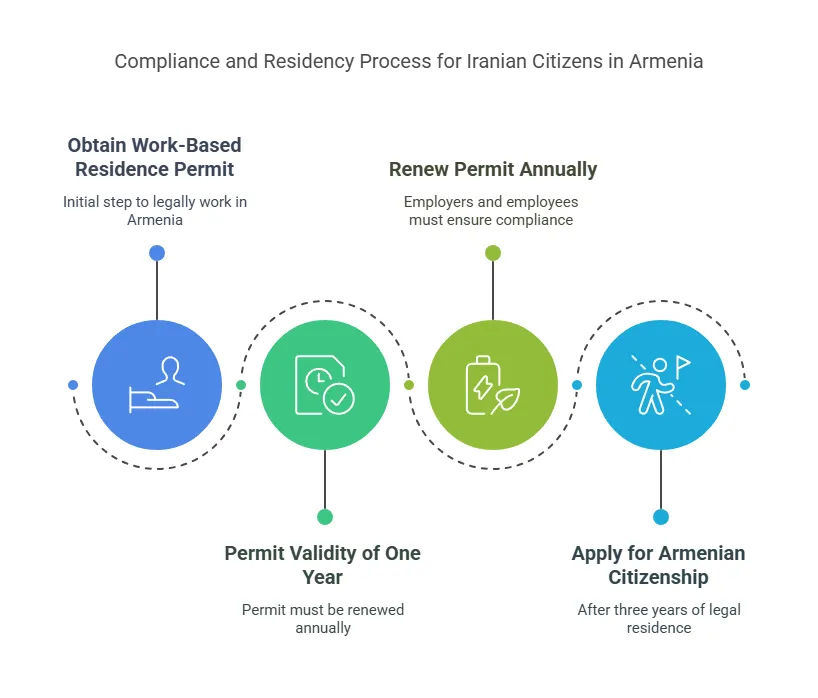
Processing Times: The overall timeline from job offer to having the residence card in hand can vary, but typically expect around 4–8 weeks total. Recent practice shows many cases finishing in roughly one month, but delays can occur. Breaking it down:
Labor market test and work permit approval: ~2–3 weeks (often about 15–20 business days) in standard cases. In some instances it can be as quick as 10 business days if no local candidates and swift security clearance.
Residence card processing: up to 30 days by law, though sometimes issued sooner (2–3 weeks). Plan for the maximum to be safe.
Employers should initiate the process well in advance of the intended start date for the Iranian employee. A lead time of 2 months is wise. Iranian applicants should likewise factor in this waiting period when planning relocation or giving notice to current employers.
Validity of Permits: A work-based Temporary Residence Card in Armenia is issued for 1 year at a time. The card’s validity usually aligns with the employment contract period if it’s less than a year, or one year by default if the contract is open-ended or longer term (it can be renewed annually).
There is no fixed limit on how many times you can renew a temporary residence for work – it can be extended each year as long as the underlying employment continues and you still meet the criteria. Some foreign employees have lived and worked in Armenia for many years by sequential renewals.
Renewal Process: To extend the work permit and residence for another year, a renewal application must be submitted at least 30 days before the current residence card expires. The process is similar: the employer would confirm continued employment (often via a letter) and the foreign national would apply for an extension at the Migration Service, with updated photos, passport, and payment of the fee for the new card. The authorities may require proof that the conditions of employment remain the same (e.g. the contract is still valid or renewed). Generally, the labor market test is not repeated for a straightforward extension with the same employer and position.
If the foreigner changes jobs to a new employer, that is not a renewal – it triggers a new work permit application with the new employer (again from scratch with labor market test for the new role). Changing jobs without leaving Armenia is possible, but the new employer must secure a new permit before the foreigner can start the new job; the individual may also need to switch their residence basis to the new employer.
Multi-Year and Permanent Options: Armenia does not currently issue multi-year temporary residence cards for employment (each is one year, renewable). However, after several years, a foreigner might consider transitioning to a Permanent Residence Card, which has a 5-year validity. Permanent residency in Armenia is typically reserved for those who have strong ties to the country (such as being married to an Armenian citizen, having Armenian heritage, or significant business investments) and at least 3 years of prior residency. An Iranian worker who has lived in Armenia for years solely on temporary work permits would not automatically get a permanent card unless they meet one of the specific criteria (for example, if they marry a local and have 3 years of residence, or start a qualifying business).
End of Employment: If the employment ends (resignation, termination, project conclusion), the work permit and temporary residence status can be affected. The residence card remains valid until its expiry, but since the basis (job) has ended, the individual is expected to either leave Armenia or find a new basis (new job or other residence ground) when the current permit runs out. There is no short grace period beyond the 15 working days to sign a contract after issuance. Practically, if an Iranian national loses their job, they should inform the Migration Service and either apply for a different status or depart to avoid overstaying. Employers should likewise notify if they know the person is no longer employed, to avoid being associated with any potential violation.
In summary, plan renewals proactively, keep track of dates, and maintain compliance each year. Armenia’s system is quite accommodating to yearly extensions, and many foreigners use it as a stepping stone to longer residency or citizenship, as discussed next.
Pathways to Long-Term Residency and Settlement
Employment-based temporary residency can be a stepping stone to more permanent status in Armenia. Iranian nationals working in Armenia should be aware of the longer-term opportunities:
Continuous Temporary Residency: There is no hard time limit on renewing the 1-year work residence permits. As long as you have a job in Armenia, you can keep extending your temporary residence indefinitely. This allows you to reside in Armenia long-term, but it is a temporary status (you must maintain the qualifying job or find another). Some individuals are content with renewing annually for many years.
Permanent Residence (5-year card): Armenian law provides a Permanent Residence Card (valid 5 years, renewable) for those who establish deeper ties. The main eligibility routes for a permanent card are:
Being the spouse or close relative of an Armenian citizen (and having lived in Armenia for at least 3 years).
Business activity in Armenia – e.g. if you run a business or make a substantial investment, you might qualify for permanent residency.
Being of Armenian origin (ethnicity). (This likely doesn’t apply to most Iranians unless they have Armenian ancestry.)
Simply working for a long time (beyond 3 years) does not automatically grant permanent residency unless one of the above conditions is met. However, many foreign professionals transition to business or marry locals over time, making them eligible to apply. The advantage of a permanent card is a longer validity (5 years at a time) and more stability; you are not tied to a specific employer to maintain status. The process to apply involves proving the eligibility (e.g. marriage certificate, property or business ownership, etc.) and showing you have adequate accommodation and means to live in Armenia. The fee for a permanent card is 140,000 AMD.
Naturalization (Citizenship): Armenia is relatively accessible when it comes to citizenship by naturalization. A foreign national may apply for Armenian citizenship after 3 years of lawful residence in Armenia, provided they can demonstrate proficiency in the Armenian language and knowledge of the Constitution. In practice, this means if an Iranian national lives in Armenia continuously on temporary residence (work permits) for at least three years, they become eligible to seek Armenian citizenship, subject to passing a language exam and a civics test. The requirement is lawful residence for the preceding 3 years – which time on a work residence permit fulfills – and then successfully completing the application and tests. There are exceptions where the 3-year rule is waived (e.g. marriage to an Armenian for 2 years + 1 year residence, or being a recognized refugee), but generally, three years is the key timeline. Gaining Armenian citizenship would grant the individual all rights of an Armenian, including working without any permits, voting, etc. Armenia allows dual citizenship, so the Iranian national could potentially retain their Iranian citizenship as well (subject to Iranian law) while holding an Armenian passport.
Long-Term Integration: Even without citizenship or permanent residence, staying in Armenia on renewed work permits can lead to other benefits. After a certain period, one might qualify for privileges such as long-term residency status if policies change, or simply build a record that makes future immigration processes smoother. Additionally, having been a temporary resident for a while can ease the path if you later decide to start a business or switch to a different visa category (since you understand the system and meet many prerequisites).
Strategic Tip: Iranian nationals aiming for eventual permanent settlement in Armenia might consider investing in property or business during their stay. While owning property is not an explicit ground for permanent residency, it strengthens your profile (showing accommodation and financial stability, which are considered in permanent residency applications). Also, learning the Armenian language is highly advisable – not only for everyday integration but because it’s required for citizenship. There are Armenian language courses available in Yerevan that foreign residents take advantage of.
In summary, the employment-based permit is often the first step toward making Armenia a long-term home. After a few years of working and living in Armenia, Iranian nationals can explore upgrading their status to a 5-year permanent resident or even obtaining Armenian citizenship through naturalization. Many foreigners find Armenia welcoming in this regard, given the relatively short residency requirement for citizenship and the country’s acceptance of dual citizenship.
Compliance and Practical Considerations for Employers
For Armenian employers hiring Iranian citizens, compliance with immigration and labor laws is critical. Below are additional practical points and legal obligations to keep in mind:
State Fees and Costs: While the work permit application itself currently has no state fee, the employer or employee must ensure the 105,000 AMD state duty for the residence card is paid. Often, employers cover this cost as part of relocation expenses, but it should be agreed in advance. There may be incidental costs: notarizations (passport translation ~10,000 AMD), medical exam (~20,000–30,000 AMD at some clinics), and any translation of documents. These are relatively modest, but for clarity, decide which party pays. Many employers cover all costs to facilitate the process.
Salary and Taxes: Foreign employees with a work permit must be paid officially and have taxes withheld according to Armenian law, just like local employees. Armenia has a flat income tax rate (20% as of mid-2020s) and employers must also pay social security contributions. Ensure your payroll team registers the Iranian employee’s social security number and that contributions are made. There is no separate “expat tax” – the foreign worker is taxed as a resident if they spend over 183 days/year in Armenia.
Labor Law Compliance: Once hired, Iranian workers are entitled to the same protections under the Labor Code (e.g. working hours, overtime pay, vacation, termination notice) as locals. Language of the contract can be an issue: the official contract should be in Armenian (or bilingual). If the employee doesn’t read Armenian, provide a translated version for their understanding, but the signed Armenian version is what authorities will recognize.
Probation and Termination: It’s advisable to align any probationary period with the work permit timeline. If for some reason the employment doesn’t work out and you end the contract early, you should notify the Migration Service. Be mindful that terminating a foreign employee might obligate the company to cover their repatriation travel costs as mentioned earlier. Always document the end of employment formally so that both parties can show immigration authorities if needed.
Penalties for Non-Compliance: Hiring a foreign national without a work permit or valid residence can result in penalties. Armenian law sets fines in the range of AMD 100,000–150,000 for employers who employ a foreigner illegally. The foreigner themselves can be fined AMD 50,000–100,000 for overstay or unauthorized work. Additionally, the foreigner’s entry visa (if any) can be voided for violating work rules, and they could face difficulties re-entering. For employers, repeat or serious violations might attract higher scrutiny for future permit applications. Thus, it’s in the employer’s interest to strictly follow the legal procedure outlined in this guide.
Record-Keeping: Maintain a file for each foreign employee with copies of their passport, residence card, contract, and renewal documents. Keep track of expiry dates. The online platform will have records of the work permit issuance and can be referenced for renewals or audits. Good record-keeping will also help if you’re ever asked to prove that all employees are legal.
Utilize Resources: The Armenian Migration Service has support lines (as noted on workpermit.am). If unsure about any step, don’t hesitate to contact them or consult an immigration lawyer. Given that the system was recently digitized, minor technical issues can occur, and having official guidance is useful. Also, stay updated with any new announcements on the platform or government websites – e.g. changes in fees or procedures are sometimes posted in the Announcements section.
By remaining diligent on these points, employers can ensure a smooth experience and avoid legal complications. Armenia has made the process fairly straightforward and transparent for employers – once you’ve done it the first time, subsequent foreign hires (even from other countries) will be easier using the same platform and process.
Conclusion
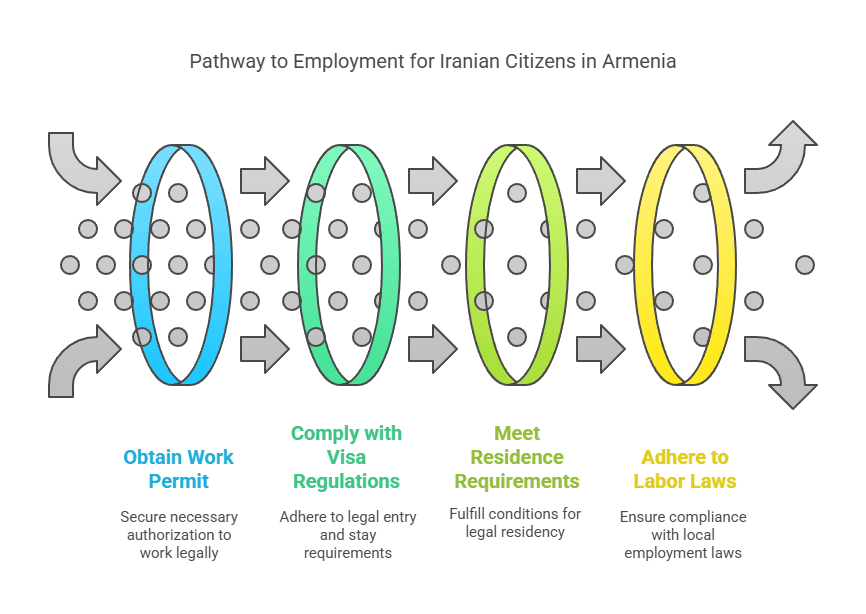
Armenia’s work permit process for Iranian nationals is now a streamlined, digitally enabled procedure that, while involving several steps, can be navigated successfully with proper preparation. Both employers and Iranian job applicants must collaborate closely – employers handle the official filings and compliance, while candidates provide the necessary documentation and follow through with residence formalities.
In summary, hiring an Iranian citizen in Armenia involves: a labor market test to protect local employment, government authorization via the workpermit.am platform, and issuance of a one-year residence/work permit card that can be renewed annually. All of this operates under the framework of Armenia’s immigration laws which aim to balance economic opportunity with legal oversight.
For Iranian professionals, Armenia offers an attractive opportunity – the country welcomes skilled workers and has relatively accessible long-term residency and citizenship options for those who decide to build their future there. The key is to remain compliant at each step: enter legally, obtain your work permit before starting work, and renew your status as needed. Armenian immigration authorities are generally helpful, and the new online system provides transparency in the process.
