

Armenia has quickly become a hotspot for digital nomads and foreign freelancers, offering a blend of low living costs and attractive tax policies. The country offers various tax incentives that make it an attractive destination for remote workers. For non-Armenian citizens working remotely from Armenia, understanding the local tax system is key to legally minimizing your tax burden. This comprehensive guide breaks down Armenia’s personal income tax for foreigners – from qualifying as an Armenian tax resident to leveraging special regimes (like the micro-business status and flat turnover tax) that can help you pay less tax in Armenia legally.
Whether you’re a freelancer, consultant, or globally mobile professional, here’s everything you need to know about remote work taxes in Armenia and strategies to optimize them.
Tax Residency in Armenia: Criteria and Implications
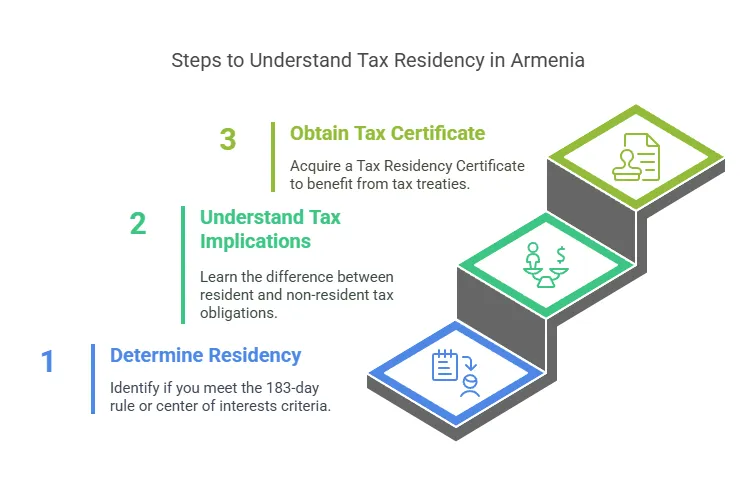
Tax residency is the foundation of your tax obligations in Armenia. Simply holding an Armenian residency permit or visa does not automatically make you a tax resident – it depends on your physical presence and ties to the country. Under Armenian law, you will be considered an Armenian tax resident if you meet either of the following criteria:
183-Day Rule: You are physically present in Armenia for at least 183 days in a calendar year (January 1 – December 31). Days of entry and exit count towards this total.
Centre of Vital Interests: You spend less than 183 days in Armenia but can demonstrate that Armenia is the center of your vital interests (e.g. your family lives in Armenia or your primary economic activities/property are in Armenia). In other words, if your personal and economic ties to Armenia are stronger than to any other country, the tax authorities may treat you as a resident.
Implications of Tax Residency:
If you qualify as a tax resident, Armenia taxes you on your worldwide income, regardless of where it is earned. Non-residents, by contrast, are taxed only on income from Armenian sources (more on what counts as Armenian-source income below). Being a tax resident also means you can obtain an official tax residency certificate, useful for claiming tax treaty benefits and proving your status to foreign authorities. This certificate can be applied for in person or via a representative and is typically issued within two business days.
Don’t confuse immigration with taxation: Holding a temporary or permanent residence permit in Armenia alone doesn’t trigger tax residency – you still must meet the 183-day or vital interest test. It’s entirely possible to live in Armenia with a residency permit and yet be a non-tax-resident (for example, if you stay less than 6 months). Likewise, one could be a tax resident without a residence permit if they simply spend enough time in the country.
Tax Obligations for Armenian Tax Residents vs Non-Residents
If you become an Armenian tax resident, you will need to declare your global income and potentially pay Armenian tax on it. This includes income from abroad – for instance, your freelance earnings from foreign clients or salary from a remote employer. However, Armenia offers foreign tax credits and extensive tax treaty protections to prevent double taxation. Effective tax planning can help you take full advantage of these benefits and minimize your tax liability.
By contrast, if you are a non-resident of Armenia, you are only liable for Armenian taxes on Armenian-source income. Armenian-source income generally means money you earn from work performed in Armenia or from Armenian entities. For example, a non-resident who does a short gig for a local Armenian company or rents out property in Armenia would owe tax on that Armenian income. But your purely foreign earnings (say, freelancing for overseas clients while you travel) would not be subject to Armenian tax for non-residents. This 183-day threshold therefore offers an important planning opportunity: if you limit your time in Armenia (or maintain stronger ties elsewhere), you might avoid Armenian taxes on your foreign income entirely – as long as you don’t trigger tax residency in another high-tax country in the process.
However, many remote workers intentionally choose to become Armenian tax residents because of the country’s favorable tax regime. Armenia’s personal taxes are relatively low, and by establishing yourself in Armenia you can potentially take advantage of special tax statuses and treaties. The next sections delve into Armenia’s tax system and how you can make it work to your advantage.
Overview of Armenia’s Personal Income Tax System for Foreigners
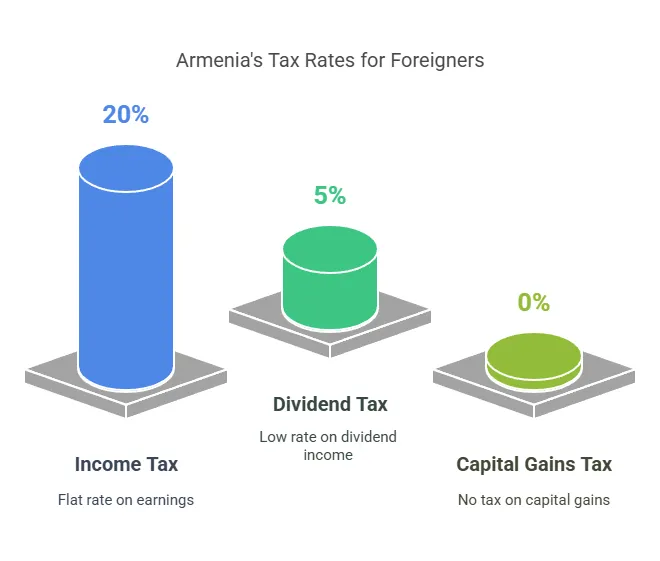
If you qualify as an Armenian tax resident, you join a system known for its flat income tax and various exemptions. Here’s a breakdown of what foreign remote workers need to know about personal income tax in Armenia for foreigners:
Flat Income Tax Rate: Since 2023, Armenia imposes a flat 20% tax on most types of personal income, replacing the old progressive tax bands. This flat rate applies to salaries, self-employment and business income, and other earnings. For example, if you freelance or consult as an individual, your net income is taxed at 20%. Employers withhold 20% from employee salaries as a final tax. This simplicity makes calculating your liability straightforward.
Dividends and Interest: Armenia offers especially low rates on investment income. Dividends you receive (e.g. from a company’s profits) are taxed at just 5%, whether you’re a foreigner or an Armenian citizen. Interest income (from bank deposits, etc.) is taxed at 10% by default, although Armenian government bonds are exempt and certain foreign-source interest might be exempt under treaties. These low rates make Armenia attractive for investors and entrepreneurs who may pay themselves in dividends.
Capital Gains: Most capital gains are exempt from personal income tax in Armenia. If you sell stocks, cryptocurrencies, or even real estate, any gain is generally not taxed. This exemption applies regardless of where the asset is located or the gain arises. For example, a tax resident who sells shares of a US company at a profit would not owe Armenian tax on that gain. This is a significant perk for those with investment income or those considering stock equity as part of their compensation.
Other Exempt Income: A number of income types are tax-free in Armenia. Insurance payouts and pensions are not taxed. Gifts and inheritances are also fully exempt from income tax. There is no wealth or net worth tax on individuals. These rules can benefit expats who might receive overseas pension income or inheritances while residing in Armenia.
Non-Resident Taxation: If you are a non-resident earning some income from Armenian sources, note that specific withholding rates may apply. For instance, Armenian-source dividends to non-residents may be subject to a 5% withholding, interest 10%, royalties 10%, etc., under domestic law. But many tax treaties reduce or eliminate these withholdings. Also, any salary or contractor fees paid to a non-resident for work in Armenia would typically have 20% tax withheld at source by the Armenian payer.
In summary, Armenia’s tax system is quite friendly to individual taxpayers. A flat 20% tax on active income means you won’t face higher tax brackets as your earnings grow. And the ultra-low 5–10% rates on passive income (or zero tax on capital gains) present opportunities to optimize how you receive your income. Next, we’ll explore legal ways to reduce your taxes further, taking advantage of special regimes and smart structuring.
Legal Ways to Reduce Your Income Tax in Armenia
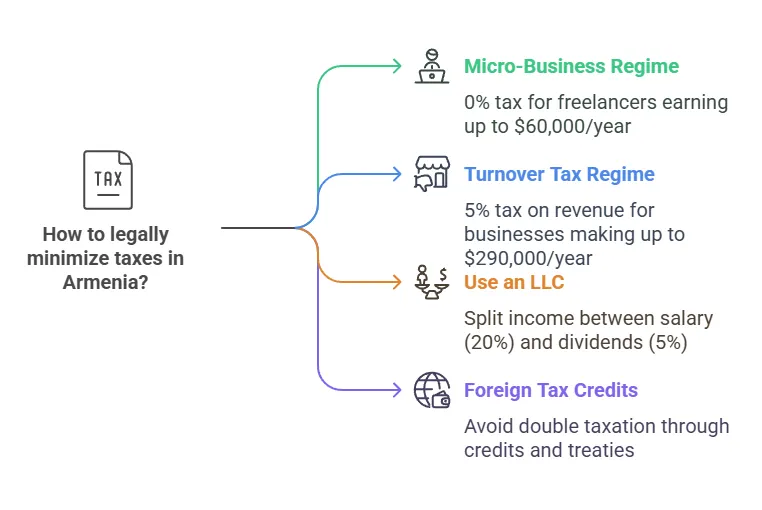
Even with Armenia’s moderate tax rates, careful tax planning can drive your liability even lower – often to single digits or zero. Below are several strategies for foreign remote workers to pay less tax in Armenia legally, all while staying fully compliant with Armenian law. These range from choosing the right residency status to utilizing special tax regimes designed for small businesses. These strategies are part of a broader tax optimization approach to minimize your tax liability while staying compliant with Armenian law.
a. Optimizing Your Tax Residency Status
Your first decision is whether to become an Armenian tax resident or not, and if so, when to do so. Each option can offer tax advantages:
Remain a Non-Resident (If Feasible): If you expect to work in Armenia only temporarily or can structure your stays to be less than 183 days a year, you might deliberately avoid becoming a tax resident. As a non-resident, you won’t pay Armenian tax on your foreign-sourced income at all. For example, suppose you spend 5 months each year in Armenia and the rest traveling; the income from your freelance work for U.S. or EU clients would be outside Armenia’s tax scope. This strategy works best if you also ensure you’re not triggering tax residency in another country during the year (or if you come from a country, like the UAE, that doesn’t tax foreign income). Essentially, you could legally pay 0% tax to Armenia on remote work earnings by staying under the residency threshold (Do note: You would still owe tax in any country where you remain a tax resident. Americans, for instance, remain subject to U.S. taxes globally, though they can use the Foreign Earned Income Exclusion and tax credits to offset).
Become a Tax Resident of Armenia: If you plan to base yourself in Armenia long-term or want the benefits of Armenian residency (e.g. access to local banking, a residency certificate for treaty use, etc.), then embracing tax residency and using Armenia as your main tax home can be advantageous compared to higher-tax jurisdictions. Armenia’s 20% flat tax may be significantly lower than tax rates in Western Europe, North America, or many Asian countries. By shifting your tax residency to Armenia, you may be able to exit the higher taxes of your home country (following proper tax exit procedures there) and enjoy Armenia’s lower rates and exemptions on your worldwide income. This is a common play for digital nomads seeking a tax-friendly base.
Timing and Split-Year Considerations: If you do plan to make Armenia your tax home, consider the timing. You become a resident for the whole calendar year once you hit 183 days in that year. Some expats schedule their moves strategically – for example, arriving in July so that they won’t meet 183 days in the first calendar year, thereby staying non-resident (and not taxable) in Armenia until January of the next year. This can split your tax year and potentially minimize taxes for the transition year. Conversely, if you want to accelerate tax residency, Armenia’s “centre of vital interests” test could allow you to get residency status before hitting 183 days. For instance, if you move with your family to Armenia or shift business operations here, you might apply for a tax residency certificate after just a few months by proving your primary ties to Armenia. This could help you claim treaty benefits sooner or solidify your non-residency in your former country.
In short, choose the residency path that results in the lighter tax burden overall. Many nomads use Armenia as part of a broader strategy, toggling between non-resident status (to avoid any local tax) and full Armenian residency (to leverage its low-tax regime) depending on their annual plans.
b. Using Armenia’s Micro-Business Regime (0% Tax)
One of the most powerful tax optimization tools in Armenia is the Micro-entrepreneurship (Micro-Business) regime, essentially a tax-free status for very small businesses. If you’re a solo freelancer or consultant, this can apply to you. Under the micro-business regime:
Qualifying Income Threshold: Your gross annual revenue must not exceed AMD 24 million (Armenian drams), roughly equivalent to $60,000–$65,000 USD. This limit is assessed per calendar year. Staying under this cap is crucial; exceeding it could terminate your micro-business status or shift you to another tax regime.
Tax Rate: 0% income tax. Micro-businesses are exempt from all main taxes, including profit tax (for companies), personal income tax (for individual entrepreneurs), and even VAT. In other words, the profits you earn under this regime are not taxed at all in Armenia. This is an incredibly favorable outcome – effectively a legal tax haven on active business income up to the threshold.
Who Can Use It: Both individual entrepreneurs (sole proprietors) and small LLCs can elect micro-business status, as long as they meet the criteria. In practice, many expats choose to register as a Private Entrepreneur (PE) – the Armenian term for a sole proprietor/individual entrepreneur – to use this regime. You can even have employees and still be a micro-business. Initially, micro-business employees enjoyed a token low flat tax (AMD 5,000 per month), but from July 2023 employees’ salaries are just taxed at the standard 20% rate. (This change mainly affects the employees’ withholding, not your business profits – your own business income remains tax-free.)
Excluded Activities: To prevent abuse, certain businesses cannot use the micro regime. Notably, many service businesses in Yerevan are excluded. For example, if you run a consulting, accounting, legal, financial, or marketing practice in Yerevan, you may be ineligible for micro-business status. The idea is to stop high-earning professionals in the capital from claiming to be “micro”. Retail traders in specific goods (like excisable items) are also excluded. However, many digital nomads can qualify – especially if your activity isn’t explicitly barred. Online tutors, designers, etc., often fit the criteria.
How to Register: You must opt in to the micro-entrepreneur regime within 20 days of registering your business. Registration is simple and fast (often one day, done via the online business registry). No upfront tax payment is needed; you’ll just file periodic reports to confirm your revenue stays under the cap.
Example: Let’s say you’re an independent marketing consultant earning $50,000 a year from clients in the US and Europe. You register as an Individual Entrepreneur in Armenia and elect micro-business status. Because your revenue stays under the AMD 24 million threshold, you pay zero tax on that $50k – effectively saving $10,000 compared to the standard 20% income tax rate. Meanwhile, an Armenian employee earning the same salary would be subject to a 20% tax withholding. This stark difference demonstrates why the government sees the micro-business regime as a vital support tool for small enterprises, and why it’s such a valuable option for foreign professionals. As long as you stay within the income cap and meet the basic reporting requirements, your entire income remains legally tax-free in Armenia.
Caution: The micro-business regime is hugely beneficial, but keep an eye on policy changes. It remains in effect for 2024 and 2025, but authorities periodically review it. Currently, it’s intact (with the only recent change being the removal of the special low tax for employees) Always double-check that your specific work activity isn’t on the exclusion list and monitor for any announcements in case the government refines the criteria.
c. Taking Advantage of the Turnover Tax Regime (1–10% Activity-Based Tax)
If your earnings exceed the micro-business threshold or your activity is not eligible for micro status, Armenia’s turnover tax regime remains a highly attractive alternative—particularly for freelancers, consultants, and small business owners who prioritize simplicity and legal tax efficiency.
- Eligibility: The regime is available to small businesses with annual sales under AMD 115 million (approximately $298,000). This includes both individual entrepreneurs (PEs) and limited liability companies (LLCs) operating in a wide range of service or trade sectors.
- Tax Rate: The turnover tax acts as a simplified sales tax, replacing both corporate income tax (CIT) and value-added tax (VAT). Rates vary by activity and typically range between 1.5% and 10% of gross revenue.
- Expense Deduction Option: Although turnover tax is generally based on gross income (i.e., without deductions), businesses are now allowed to deduct expenses of up to 9% from their taxable base. This means the effective tax rate can be as low as 1%, depending on your business model and deductible costs. For instance, if your gross income is AMD 100 million and you deduct 9% in eligible expenses, you would pay turnover tax on AMD 91 million instead.
- Quarterly Filing: Turnover tax returns are submitted on a quarterly basis, making compliance predictable and relatively low-maintenance. Businesses simply report their gross income and apply the relevant rate.
- Streamlined taxation: No need to track or calculate net profit or apply VAT, which is especially advantageous for small businesses with few expenses.
- Legal tax reduction: Thanks to the 9% expense deduction allowance, many professionals can lower their effective tax rate well below the headline percentage.
- Ideal for high-margin service providers: Since it’s based on gross turnover, those with minimal costs (like consultants or remote freelancers) stand to gain the most.
- Rate Depends on Business Type: Different professions and sectors are assigned different turnover tax rates within the 1.5%–10% range. For example, certain types of trade or specialized services may be taxed at the higher end. It is important to confirm your exact rate upon registration or consult a tax advisor familiar with Armenia’s current classification system.
- No VAT Charged: Under this regime, businesses do not charge VAT on their invoices. This simplifies your pricing and invoicing for both local and foreign clients.
d. Registering as an Individual Entrepreneur (PE) for Tax Benefits
To utilize regimes like micro-business or turnover tax, you generally need to formalize your activity as a business. The simplest format is becoming an Individual Entrepreneur, locally termed Private Entrepreneur (PE). There are several tax advantages of registering as an IE for a foreign remote worker:
Access to Special Regimes: As discussed, only registered businesses can opt into the micro or turnover regimes. By default, your personal employment income or unregistered freelance income would just be taxed at 20% through withholding. By setting up a PE and opting into micro or turnover, you transform your tax profile from a standard employee to a business owner eligible for 0% or 5% rates. This is often the single biggest tax-saver.
Business Expense Deductions: If for some reason you operate under the general tax regime (not micro/turnover) – for instance, your income is too high or your activity was excluded – being a registered entrepreneur allows you to deduct expenses from your income before the 20% tax is applied. As a freelancer, deductible expenses could include your laptop, software subscriptions, travel costs for work, co-working space fees, etc. Armenia taxes net income for businesses, so you’d only pay 20% on your profits, not gross revenue. In contrast, if you simply earn salary or contractor fees as an individual without a business structure, there’s no concept of deducting your business expenses – you’d be taxed on everything.
Sole Proprietorship Simplicity: A PE is not a separate legal entity like an LLC, so it’s very easy to register and run. There’s no minimum capital, no complex accounting required for micro/turnover regimes, and you can use your personal bank account or open a simple business account. Many foreign PEs invoice their clients abroad and receive payments in Armenia or abroad directly. Legally, you as the entrepreneur are personally liable for your business debts, but if you’re just offering services, this risk is usually low. The simplicity keeps administrative costs down.
Quick and Cheap Setup: Armenia makes it extremely easy to start a business. Registration can often be done online in one day. There is no requirement for local shareholders or directors – as a foreigner you can be the 100% owner and the sole operator. In fact, no local partner is needed at all, and nationality is no barrier to registering a PE or company in Armenia. You also don’t need a local Armenian to act as a director. This means you can formalize your freelance activity swiftly upon arrival, enabling you to elect a beneficial tax regime from the get-go.
Overall, most remote workers from abroad who move to Armenia choose the Individual Entrepreneur route to optimize taxes. It essentially lets you pay yourself in a more tax-efficient way. Instead of being an employee taxed at 20%, you become a small business taxed at 0% or 5% (or 20% on a reduced base). You’ll have some light paperwork – e.g. quarterly revenue filings or an annual return – but the significantly lower tax bill is well worth it.
Note: If your remote work is for a single foreign employer and they insist on keeping you as an employee, you might not have the flexibility to become an IE for that income. However, you could negotiate to switch to contractor status, or at least consider other income streams where you act as an independent consultant to utilize these regimes.
e. Considering an LLC (Limited Liability Company) Structure
Another option is to form an Armenian LLC for your activities. Many of the tax benefits of an LLC overlap with those of a PE (LLCs can also opt for micro or turnover taxation, where eligible). But an LLC can be useful if you need limited liability protection or plan to scale beyond just yourself. Here are some points on Armenia LLC tax treatment and how it can reduce personal taxes:
Corporate Tax Rate: Armenia’s standard corporate income tax (CIT) is 18% of profits. This was recently reduced from 20%, making it quite competitive globally. If your LLC qualifies as a micro-business, it would pay 0% CIT on income under AMD 24m. If it opts for turnover tax, it pays 5% on revenue up to AMD 115m instead of CIT/VAT. The CIT only kicks in if you’re in the general regime (or once you exceed the SME thresholds).
Dividends to Owners: As mentioned, dividends are taxed at 5% in Armenia. This is a final withholding tax. So if your LLC earns profits and you, as a foreign owner, take those profits out as dividends, the company would withhold 5%. Foreign owners have no additional tax beyond that in Armenia, especially if a tax treaty applies (most treaties reduce dividend tax to 5% or 0% for qualifying participants anyway).
Potential Tax Deferral: By using an LLC, you can exercise some control over the timing of your personal taxes. The company pays 18% on profits each year, but you only pay the 5% dividend tax when you actually distribute profits to yourself. If you don’t need all the cash immediately, you might leave earnings in the company (for future investments, buffer, etc.) and defer taking dividends, thus deferring the additional 5% tax. In effect, you lock in an 18% tax (CIT) on those profits and can delay or avoid the personal level tax. Compare this to earning the income directly as a sole proprietor where you pay the full 20% in the year earned. An LLC could slightly reduce the rate (18% vs 20%) and defer the rest indefinitely. This strategy makes sense if you earn more than you personally need to spend; you can keep profits in the company and reinvest in assets or projects with only the low corporate tax applied.
Splitting Salary and Dividends: As the owner of an LLC, you could also choose to pay yourself a small salary and take the rest as dividends. Salary to you would be subject to 20% personal tax (and some social contributions), which the company deducts from its profit (saving 18% on that portion), and dividends at 5% on the remainder. The optimal split would depend on various factors (including Armenia’s modest pension fund contributions – typically 5-10% – which apply to salaries). In practice, some owners just take all profit as dividends given the low 5% rate and simplicity.
Limited Liability & International Image: Aside from pure tax, an LLC provides limited liability (protecting your personal assets from business liabilities) and can appear more “established” to certain clients. If you’re contracting with large companies, they may prefer to deal with a corporate entity. Forming an Armenian LLC is straightforward and doesn’t require local partners. You can be the sole shareholder and director, and run everything remotely if needed. There’s no minimum capital requirement. The compliance (accounting, etc.) is a bit heavier than a PE, but still light by European standards.
Bottom line: For a one-person operation, an Individual Entrepreneur is usually sufficient and simpler. But if you foresee expanding your team, raising capital, or just want that liability shield, an LLC with Armenia’s low 18% tax and 5% dividends is an excellent structure. The combined effective tax rate on fully distributed profits comes to about 22.1%, which is still lower than many countries’ personal income tax rates. And if you qualify for the small business regimes, your LLC could pay 0% or 5% just like a PE.
f. Claiming Deductions and Allowances
No matter your structure, it’s important to claim all applicable deductions or allowances to reduce your taxable income. Armenia’s tax code, while straightforward, does allow certain deductions:
Business Expenses: If you operate as a business (PE or LLC) under the general tax system, you can deduct “necessary and documented” expenses directly related to earning your income, effectively utilizing tax deductions to lower your net profit subject to the 18% or 20% tax. This includes costs like work equipment, travel for client meetings, marketing expenses, professional training, and even a home office to the extent used for work. By tracking and deducting these costs, you lower your net profit subject to the 18% or 20% tax. For instance, if you earned $80,000 but had $20,000 of valid expenses, you’d only pay tax on the $60,000 profit, saving thousands. Good bookkeeping is key: keep invoices, receipts, and contracts to substantiate your expenses in case of any tax audit.
Personal Allowances: Unlike some countries, Armenia does not have a standard personal tax-free allowance in the classic sense – the flat tax kicks in on the first dram of income. However, the special regimes (micro, turnover) effectively serve as large allowances (making income tax-free up to certain thresholds).
Tax Credits for Foreign Taxes: This isn’t a deduction per se, but worth mentioning: if you paid any income tax to another country on income that is also taxable in Armenia, Armenia will credit that foreign tax against your Armenian tax due. In essence, you won’t be double-taxed. For example, if you did some remote work for a client in Country X and X withholds a $1,000 tax, and that income would be $800 tax in Armenia, you’d owe Armenia $0 (because the $1,000 foreign tax covers it). If foreign tax was smaller, you’d just pay the difference to Armenia. Utilizing this foreign tax credit is automatic under Armenian law – just declare the income and the tax paid abroad in your Armenian return. (If a tax treaty is in place, it may dictate which country gets to tax certain income first, but the credit mechanism ensures you don’t pay twice.)
Industry-Specific Incentives: Armenia from time to time offers targeted tax incentives. For instance, in 2022–2024 there were special tax breaks for IT startups (e.g. 0% corporate tax and 10% income tax on engineers’ salaries under a certification program). Starting 2025, new incentives for high-tech companies include a reduced 1% turnover tax rate (instead of 5%) for tech activities and subsidies covering part of the income tax for certain new hires. If you are in the tech sector or another promoted industry (like some agricultural and tourism projects), research if there’s a special regime you can join. These can significantly cut your taxes, albeit usually with more administrative hoops (e.g. obtaining a certificate or license).
In summary, don’t leave money on the table. By structuring your work as a business, tracking expenses, and leveraging credits, you ensure that you’re only taxed on the smallest possible amount of income – and sometimes not taxed at all.
g. Using Double Tax Treaties to Avoid Double Taxation
Armenia’s wide network of double taxation treaties is a major asset for foreign professionals. These treaties (over 50 in force, including with countries like Russia, most of the EU, UK, Canada, China, India, etc.) prevent you from being taxed twice on the same income. Here’s how you can use them in tax planning:
Tie-Breaker for Residency: If you qualify as tax resident of Armenia and your home country in the same year, a tax treaty can determine which country gets to treat you as sole resident for tax purposes (via tie-breaker rules such as where your permanent home or center of vital interests is). Many nomads use this to solidify their exit from a high-tax country – showing the treaty tie-breaker favors Armenia, so only Armenia can tax them on global income, allowing them to enjoy tax treaty benefits. Since Armenia’s taxes are lower, this is beneficial.
Reduced Withholding Taxes: Treaties often reduce or eliminate withholding taxes on cross-border payments. For example, without a treaty, a payment from an Armenian company to a U.S. freelancer might face a 10% Armenian withholding tax. But under the U.S.-Armenia treaty (the old US-CIS treaty, which Armenia honors), that withholding might be reduced or waived. Similarly, if you receive dividends from a company in Armenia and you’re resident in, say, the UK, the treaty could cap the Armenian tax at 5% or 0%. Make sure to fill out any required treaty forms (often a residency certificate) to claim these benefits at source.
Foreign Tax Credits: As mentioned, even if no treaty applies, Armenia’s domestic law gives credits for foreign taxes. But treaties strengthen this by explicitly stating how each type of income is taxed. For instance, the treaty might say your home country cannot tax your business profits if you don’t have a permanent establishment there and you are an Armenian resident – meaning only Armenia taxes that income (at its low rates). Or vice versa for certain income types.
Avoiding Double Social Security: While not exactly income tax, being an Armenian resident might also affect whether you pay social security in another country. Armenia has some social security totalization agreements as well. If you’re an EU citizen, once you’re out of the EU and in Armenia, you likely stop contributing to EU social funds (and in Armenia, if you’re on a local payroll, the contributions are much lower). This is another form of tax saving, indirectly.
The key action item is to obtain an Armenian Tax Residency Certificate each year you are a resident. This official document (issued by the tax authority) is what you’ll use to claim treaty benefits and prove to foreign payers or your home country that you’re an Armenian tax resident from date X. With that in hand, you can invoke treaty clauses that reduce taxes on your foreign-sourced income or eliminate them in the other country, ensuring you only pay (minimal) tax in Armenia. Given Armenia’s growing list of treaties – currently covering most major economies from Europe to Asia – chances are your home country has an agreement in place.
Practical Examples: How Tax Bills Vary in Different Scenarios

To tie it all together, let’s look at a couple of hypothetical scenarios showing how a foreign remote worker’s tax liability in Armenia can change based on residency status and the use of an IE or LLC.
Scenario A – “Freelancer Alice”: Alice is a web designer from the UK who now lives in Armenia. She earns the equivalent of $50,000 a year from clients worldwide.
If Alice is not an Armenian tax resident: She spends only 5 months (150 days) in Armenia in 2024, so she’s not a tax resident. All her $50k income is foreign-sourced (clients abroad, work done online). Armenian tax due: $0.00 (She might owe tax in the UK if she’s still UK resident, but in Armenia, non-residents aren’t taxed on foreign income.)
If Alice becomes a tax resident and does nothing special: Say she stays over 183 days. Now her $50k worldwide income is taxable in Armenia. If she simply remained as a self-employed individual without opting into any regime, she’d pay 20% flat tax, or $10,000. Still lower than UK’s higher-rate taxes, but we can do better.
If Alice registers as a PE under the Micro-Business regime: She opens “Alice Design PE” and opts for micro status. Her $50k is below the AMD 24m cap. Tax due: $0. She maintains records but pays no income tax at all to Armenia. This is clearly the best outcome – a 0% effective tax rate legally achieved.
If Alice uses the 5% Turnover tax: If for some reason micro wasn’t available, she could choose turnover tax. At 5% of $50k, tax due: $2,500. That’s an effective rate of 5%. Even if the rate rises to 10%, it would be $5,000 (10%). Compare that to $10k under normal taxation – it’s half the tax (or even one-quarter, at 5%).
As you can see, by simply structuring her business, Alice can reduce her tax from 20% of income down to 0–5%. Over years, the savings are substantial, and it’s all fully legal within Armenia’s tax framework.
Scenario B – “Consultant Bob”: Bob is a management consultant from Canada who relocated to Yerevan. He has a thriving business bringing in $150,000 a year from international clients. He’s in Armenia full-time (tax resident).
No special structure: Bob would owe 20% on $150k, which is $30,000 in tax.
Turnover Tax regime: $150k is under the AMD 115m threshold, so Bob LLC or Bob PE could use the 5% turnover tax (through 2024). Tax due: 5% of $150k = $7,500. This saves him $22,500 compared to the normal route – a huge difference. If in 2025 the rate became 10%, it would be $15k, still half of the standard tax.
LLC with CIT + dividends: If Bob incorporated an LLC and had to be under the general regime (say, his consulting sector is forced out of turnover in 2025), his company would pay 18% CIT on profits. Assuming minimal expenses, profit ≈ $150k, CIT = $27,000. If he then distributes the remainder to himself, dividend tax 5% on $123k ≈ $6,150. Total = ~$33,150. This is actually a bit higher than the $30k personal tax would have been, so in his case the LLC general regime isn’t beneficial if he distributes all profits. But if Bob decides to retain earnings (for example, keep $50k in the company for future use), he’d only pay the 18% on that $50k and no dividend tax until a later year. This could, in effect, let him postpone or reduce some tax. Bob might also split some income with his spouse or hire an employee under certain incentives to further optimize, but that’s getting more complex.
Using a Treaty: Suppose part of Bob’s income ($50k) was from consulting work in a treaty country that withholds 10% tax at source. That $5k foreign tax would be credited against his Armenian tax. Under general tax, if 20% in Armenia exceeds the 10% withheld, he’d only pay the difference 10% in Armenia on that portion.
These examples illustrate that the way you organize your work in Armenia dramatically impacts your taxes. Most expats will find the sweet spot with either the micro or turnover regimes. Even for higher earners who may eventually lose access to simplified regimes, Armenia’s baseline taxes (20% personal or 18% corporate) remain moderate, and there are still tactics (like partial earnings retention in a company) to keep effective rates reasonable.
Legal Obligations: Registration, Reporting, and Compliance for Foreign Individuals
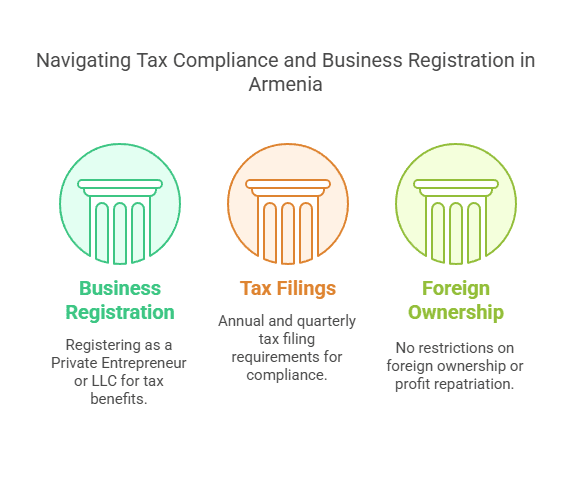
While chasing tax savings, don’t forget about the legal and administrative obligations that come with working in Armenia. Ensuring you’re compliant will protect you from penalties and keep your new tax status secure. Ensuring tax compliance will protect you from penalties and keep your new tax status secure. Here’s what foreign remote workers should keep in mind:
Business Registration: If you decide to register as an Individual Entrepreneur or set up an LLC, you’ll do this through Armenia’s State Register. The process is fast and inexpensive. You will receive a state registration certificate and a tax identification number (if you don’t already have one – foreigners are assigned a tax ID upon registration). There is no requirement to have a local partner, director, or shareholder in your business – you can own and run it fully as a foreigner. Also, you are not obliged to open an Armenian bank account, but it’s recommended for convenience. Many foreign PEs/LLCs operate with multi-currency accounts in Armenia to easily receive USD/EUR payments and convert to AMD when needed. Fortunately, Armenia imposes no restrictions on repatriating profits – you are free to move your money abroad after paying any due taxes.
Tax Registration: By default, registration as a PE or LLC includes tax registration. However, if you’re just working as an employee of a foreign company and not setting up a business, you might need to register with the tax authorities upon becoming a resident to file your annual return. When opting for micro or turnover regimes, ensure you submit the application for that regime within 20 days of registering the business.
Invoicing and Record-Keeping: Armenia’s rules for invoicing depend on your tax regime. Under turnover tax or general regime, you may need to issue invoices or receipts for each sale and keep those for your records. If you’re invoicing foreign clients, a simple invoice showing your PE/LLC details, date, service description, and amount should suffice. You are not required to charge Armenian VAT to foreign clients (export of services can be zero-rated or exempt) especially if you’re under the turnover threshold where VAT doesn’t apply. If under micro, the paperwork is minimal, but it’s wise to keep evidence of your income (contracts, PayPal statements, etc.) to prove you didn’t exceed the limit. Good record-keeping will also support any deductions you claim. Armenia’s tax authority may not ask for your books unless there’s an audit, but legally you should maintain them for several years.
Tax Filing and Payment: Annual Income Tax Return: Armenian citizens and residents who have taxes to pay must file an annual income tax declaration by April 20 of the following year reporting their income and taxes paid. PEs typically also do this, whereas LLCs file corporate tax returns by a slightly different deadline. Quarterly Reports: If on turnover tax, you file quarterly as noted. Micro-businesses have very light reporting (often just an annual confirmation of turnover). Payroll Withholding: If you have employees in Armenia, you’ll need to withhold 20% from their salaries, plus withhold their social contributions. This requires registering for payroll taxes. Many solo entrepreneurs won’t have employees initially, but if you hire an assistant locally, ensure to comply with this.
Social Security and Pension: Armenia has a funded pension system. As a foreigner working as an employee in Armenia, you would contribute 5% of salary (capped at a low ceiling) matched by 5% from the government. As an entrepreneur, you don’t contribute on your business profits, only on any wages you pay to yourself or others. It’s worth confirming your status – some expats voluntarily join for benefits, others are exempt.
Local Compliance (If Any): If your work involves any regulated activity (unlikely for typical remote work), you’d need the appropriate license. Also, if you rent an apartment in Armenia, note that your landlord should be paying a 10% tax on that rental income – as a tenant you aren’t responsible for it, but just be aware of the norm. Armenia has implemented stricter enforcement on rental and property taxes recently.
Staying Updated: Tax rules can change, so it’s wise to stay informed through official announcements or consult a local tax advisor yearly. For example, the phase-out of turnover tax in 2025 (mentioned earlier) is something you’d want to anticipate in your planning. Also, new treaties or legal amendments could open up fresh opportunities (or obligations).
In essence, Armenia’s compliance burden for small businesses is quite low – one of the reasons it’s attractive. There are few ongoing reporting requirements and no onerous local stipulations like having to employ locals or invest minimum capital. This means you can focus on your work while enjoying the tax perks, with just occasional paperwork to keep everything in good order.
Important Tax Updates and Reforms for Remote Workers

Lastly, let’s highlight some recent tax reforms to Armenia’s tax regime (as of 2024/2025) that expats and remote professionals should note:
Flat Income Tax Fully Implemented: Armenia completed its shift to a flat personal income tax. It was 21% in 2021, 20% in 2022 onward, and remains 20% flat in 2024. There are currently no plans to change this rate further, but always check the latest (it’s competitive as is).
Corporate Tax Rate Cut: The standard corporate tax was reduced from 20% to 18% to stimulate investment. This affects any LLCs under the general regime. It’s locked in at 18% for 2024 and beyond unless new legislation arises.
Turnover Tax Regime Changes: As discussed, a major reform is underway. In late 2023, the government announced the turnover (small business) tax will double to 10% for many businesses. The change is slated as the first phase of phasing out the simplified tax. By July 1, 2025, numerous sectors (professional services like consulting, accounting, legal, IT services, etc.) currently enjoying 5% will be shifted to the general tax system (18% profit tax + 20% VAT). This will effectively end the turnover tax benefit for those fields, aligning their taxation closer to regular companies. The motive is to address disparities where two people doing similar work pay very different tax based on legal form.
Micro-Entrepreneurship Regime Continuity: The micro regime remains in place as of 2024. One change that took effect July 2023 was the removal of the symbolic AMD 5,000 flat tax for employees of micro-businesses – now any salaries are taxed at 20%. This doesn’t affect the business’s tax-free status on profits, but it means you can’t hire staff completely tax-free anymore (still, a 20% payroll tax is standard and not a deterrent for small hires). The government has not indicated plans to abolish micro regime in the immediate term, but given its scrutiny of turnover tax, micro businesses might also face more conditions eventually. In 2025, it’s still a golden opportunity for small earners.
IT and High-Tech Incentives: The popular IT startup tax incentive (which granted newly registered IT companies a 0% profit tax and 10% reduced income tax for tech workers) formally expired on Jan 1, 2025. However, a new High-Tech incentives package (2025–2032) has been approved: this includes a 1% turnover tax (instead of 5%) for high-tech companies, and even government support to cover 50–100% of the income tax for certain tech employees (young hires and skilled immigrants) for a few years. If you are running a tech-oriented business or startup, look into these programs – they can dramatically lower operating costs. For a solo tech consultant, the turnover tax drop to 2% means you’d only pay $2,000 on $100k revenue, for instance. These incentives underscore Armenia’s push to become a regional tech hub.
International Tax Cooperation: Armenia is incrementally aligning with global tax standards. It signed on to the OECD’s Multilateral Instrument (MLI) to update tax treaties, which may affect how treaties apply (closing loopholes). Armenia also exchanges financial information under CRS (Common Reporting Standard) as of recent years. For the average freelancer, this has little direct impact except that one should not attempt to hide income – Armenia is quite transparent with international authorities now. On the positive side, new treaties are still being negotiated (recent ones with countries like UAE and Qatar came into force), expanding the treaty network.
Economic Zones and Other Tax Breaks: If you venture beyond remote work into import/export or manufacturing, note that Armenia offers Free Economic Zones where qualifying businesses pay zero taxes (no VAT, no profit tax, etc.). While not directly relevant to a digital nomad’s personal tax, it signals that Armenia continues to maintain very business-friendly pockets that one could utilize for side ventures.
In conclusion, Armenia’s tax landscape in 2024–2025 remains extremely favorable for foreign remote workers, with numerous legal avenues to reduce your tax burden. The key is staying informed about changes (like the turnover tax reform) and being agile in your tax planning. By doing so, you can enjoy Armenia’s rich culture and low cost of living while keeping your hard-earned income largely in your own pocket.
Conclusion

For internationally mobile professionals, Armenia presents an enticing combination of lifestyle and legal tax benefits. By understanding the tax residency rules and leveraging regimes such as the micro-business 0% tax or the 5% turnover tax (while it lasts), foreign remote workers can dramatically reduce their personal income tax in Armenia – all fully within the law. Add to that the benefits of double tax treaties, no capital gains tax, and straightforward flat rates, and it’s clear why Armenia is gaining popularity among digital nomads seeking a tax-friendly base.
That said, personalized advice is invaluable. Each individual’s situation – nationality, type of income, length of stay, future plans – will shape the optimal tax strategy. It’s wise to consult with a tax advisor familiar with expat taxation in Armenia to fine-tune your approach. Ensure you comply with all legal obligations from registration to filing, so that your tax-saving arrangements remain robust and trouble-free.
Armenia’s tax system in 2024 and 2025 offers a warm welcome to foreign entrepreneurs: low taxes, legal certainty, and an environment that rewards small business growth. By taking the steps outlined in this guide, you can confidently work from Armenia knowing you’re minimizing your tax burden in a lawful way – leaving you with more freedom and funds to enjoy your global nomad lifestyle. Cheers to that and to your success in Armenia!
