

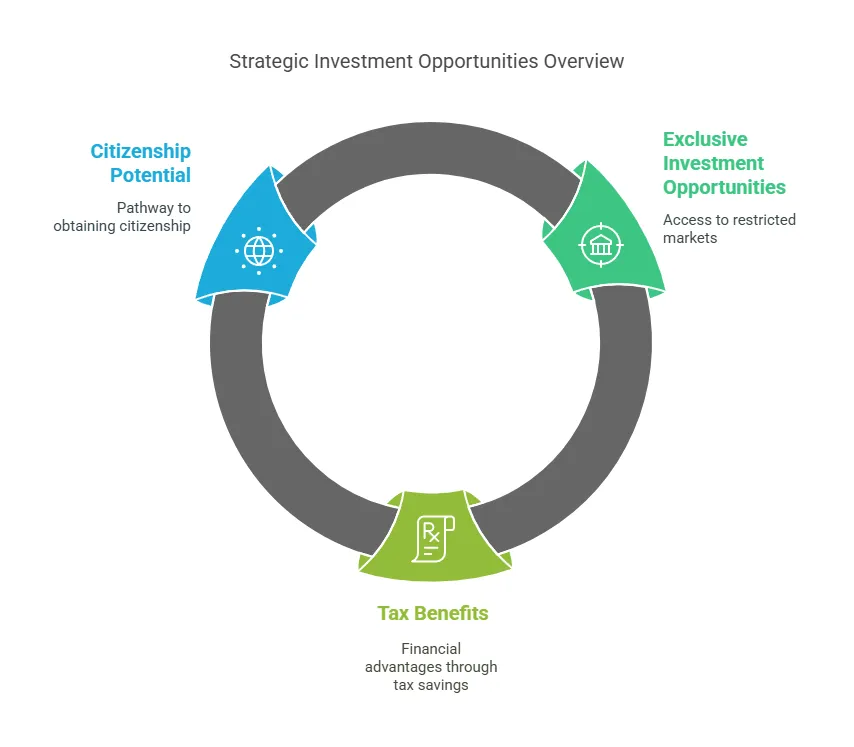
Investors and entrepreneurs, particularly foreign nationals, often seek residency abroad to unlock exclusive investment markets – from local stock exchanges to real estate – that are otherwise off-limits to non-residents. Below, we analyze top countries offering residency-by-investment programs that grant access to such opportunities. Each country profile covers: residency requirements and processing time, minimum investment thresholds, exclusive investment options for residents, investment taxation (capital gains, wealth taxes), pathways to citizenship, and additional investor benefits. Comparative tables and data-driven insights are provided for side-by-side evaluation.
Comparative Overview of Top Residency by Programs
The following table summarizes key aspects of seven leading investment residency programs worldwide, highlighting the requirements, benefits, and unique investment access in each investment program:
Country | Residency Program & Requirements | Min. Investment | Exclusive Investment Access | Citizenship Path & Benefits |
|---|---|---|---|---|
Portugal | Golden Visa (temporary residence); ~6–8 month process. Requires qualifying investment (e.g. €500k+ in funds or a company). | €500k+ (e.g. funds, Company) | Access EU-based investment funds and businesses via ARI program; local venture funds open only to residents. Real estate in high-demand areas via compliance routes. | Eligible for citizenship after 5 years (language/basic integration required). EU residency rights; visa-free Schengen travel; family reunification. |
Greece | Golden Visa (permanent residence); ~2–3 months processing. Requires real estate or investment (€400k–€800k, varies by region). No stay requirement. | €400k+ (property or securities) | Right to own unlimited properties (foreigners can buy property, but GV eases process in restricted zones). Access to Greek private equity funds and business investments for residents. | Permanent residence via visa; citizenship after ~7 years of residency (language test). Schengen area access; low cost of living; option for 15-year €100k flat tax on global income. |
Malta | Malta Permanent Residence Programme (MPRP); ~4–6 month process. Requires €500k net worth (€150k in financial assets) and property purchase (€350k+) or lease, plus government contribution (€30k+ fees). | €600k+ total (property + fees) | Ability to purchase multiple properties after 5 years (no permit needed). Access Maltese securities and investment funds reserved for residents. EU-only offerings (some IPOs, bonds) accessible via local brokerage. | Permanent residency (renewable); no direct citizenship via MPRP, but separate citizenship-by-investment available (~1–3 years with higher contribution). Schengen travel 90/180 days; include up to 4 generations in application. |
United Arab Emirates (UAE) | Golden Visa (10-year residence); 1–2 months processing. Requires AED 2 million ($550k) property investment (can be multiple properties) or significant business investment/entrepreneurship. | AED 2 M (~$545k) property; AED 500k for entrepreneurs. | Foreign investors gain full business ownership (100%) in most sectors (no local sponsor) and can buy property in designated freehold areas. Access to local IPOs and government bonds typically reserved for GCC residents. | No formal citizenship pathway (UAE dual citizenship is highly restricted). Long-term stability: renewable 10-year visa; family sponsorship; world-class infrastructure; tax-free investment returns. |
Singapore | Global Investor Programme (Permanent Residence); ~6 months processing. Requires S$10 million (~US$7.8M) business or fund investment. Lower tiers (S$2.5M) phased out in 2022. Physical stay ~1 day/year. | S$10 M (≈US$7.8M) in business or funds. | 60% property stamp duty waived for PRs (vs 60% for foreigners), enabling investment in Singapore’s lucrative real estate market. Access to government securities (e.g. Singapore Savings Bonds) and certain local IPO allocations only for citizens/PRs. Eligibility to purchase public housing (after some years as PR). | Eligible for citizenship after 2+ years of PR (must renounce other citizenship; stringent approval). Singapore passport offers visa-free access to 195 countries. Benefits: top financial hub, stable currency, strong legal protection for investors. |
Saudi Arabia | Premium Residency (“Saudi Green Card”); ~1 month approval. Unlimited-duration residence granted upon investing SAR 4 M in property (US$1.1M) or SAR 7 M in a business with license. No sponsor needed. | SAR 4 M (≈US$1.1M) in residential real estate, or SAR 7 M in a new business + 10 jobs. | Real estate ownership for expatriates: can own homes and invest in property (except Mecca/Medina holy sites). Allowed to trade on Tadawul (local stock exchange) via investor license without needing a local partner. Access to government investment initiatives and IPOs aimed at residents (part of Vision 2030). | No citizenship path (Saudi does not offer naturalization via investment). Benefits: permanent residence without renewal; sponsor family; start businesses freely; tax-free investment environment; priority airport services in a major G20 economy undergoing rapid growth. |
Thailand | Long-Term Residence (LTR) Visa (10-year); ~1–3 month process. Open to “Wealthy Global Citizens” investing ≥$500k in Thai assets (property, govt bonds) plus net worth ≥$1M. Other LTR categories for retirees, professionals with income criteria. | $500k in Thai property, bonds or FDI (plus financial qualifications for applicant). | Land ownership of 1 rai (~1600 m²) allowed for LTR visa holders investing ≥ THB 40 M (≈$1.1M) for ≥3 years – a privilege normally forbidden to foreigners. Access to local stock brokerage accounts and mutual funds not marketed to foreigners. Option to invest in Thailand’s booming Eastern Economic Corridor projects reserved for residents. | Permanent residency possible after 5 years on other visas (not guaranteed via LTR). Citizenship after 10+ years continuous residence, with language requirements. Additional perks for LTR: fast-track airport services, work permit inclusion, and 17% flat tax rate for highly skilled professionals. Attractive lifestyle at low cost; regional travel hub. |
Country Profiles and Analysis
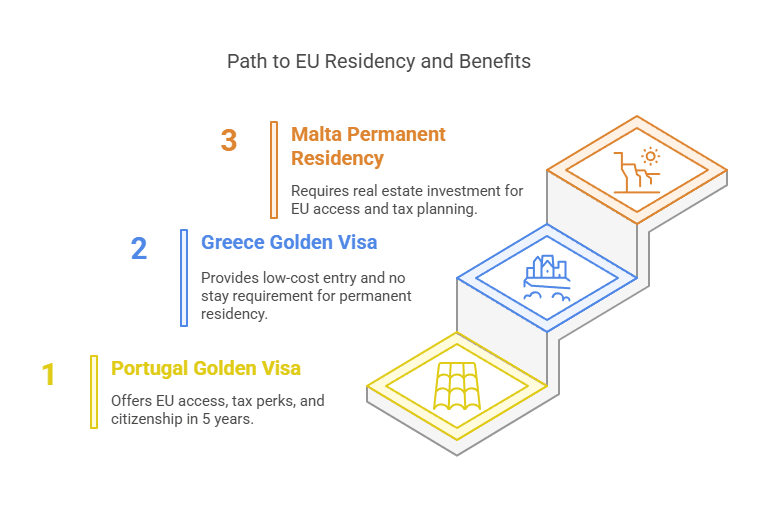
Below we provide detailed analysis for each destination, including the residency process, minimum investments, exclusive market access for residents, tax implications, and pathways to citizenship.
Portugal: Minimum Investment Requirements
Residency via Investment: Portugal’s Golden Visa (Autorização de Residência para Investimento) grants a renewable temporary residence permit within ~6–8 months, with several investment routes for obtaining residency. Applicants choose from several investment routes: e.g. a capital transfer of €1 million, €500,000 in qualifying investment funds or real estate (restricted to designated interior areas as of 2022), or €250,000 in cultural projects. A clean criminal record and health insurance are required. Initial residency is valid for 2 years, and renewal requires maintaining the investment and a short stay (~7 days first year, 14 days each subsequent two-year period).
Minimum Investment: €280,000–€500,000 is the typical minimum range depending on the investment type. For instance, €280k can qualify if invested in a rehabilitation project in a low-density region, while €500k is standard for investment funds or properties in eligible locations. (Note: In 2023 Portugal moved to wind down the real estate Golden Visa route in major cities, shifting focus to job creation and innovation investments.)
Exclusive Investment Opportunities: Residency opens doors to EU-based funds and ventures. Notably, Portugal’s program now emphasizes venture capital and private equity funds – an avenue available only to residents pursuing the Golden Visa. These specialized funds invest in Portuguese startups, wineries, hotels, etc., offering returns and an EU residency. As residents, investors also gain easier access to Eurozone banking and mortgage financing. While Portugal does not bar foreigners from buying property or stocks, Golden Visa holders have insider access to off-market real estate deals through developer partnerships and can tap into government bond issues earmarked for locals. Additionally, holding a Portuguese residence permit allows participation in certain tax-advantaged retirement funds and life insurance wrappers that are typically open only to EEA residents.
Taxation on Investments: Portugal attracts expats with favorable tax regimes. There is no wealth tax or inheritance tax on most assets. Capital gains tax on Portuguese securities and real estate is generally 28% for non-residents, but many Golden Visa investors elect for the Non-Habitual Resident (NHR) status. NHR offers a 10-year tax holiday on foreign-sourced investment income, including dividends, interest, and capital gains, which can be exempt from Portuguese tax (if an applicable tax treaty doesn’t mandate taxation) – a significant benefit for those with global portfolios. Domestic income (e.g. rental from a Portuguese property) is taxed at flat 28%, but strategic reinvestment or rollover relief can mitigate this. Importantly, no wealth tax means high-net-worth individuals (HNWIs) aren’t penalized for assets held worldwide, aside from an IMI property tax on Portuguese real estate (0.3–0.45% of value, with exemptions for personal residence).
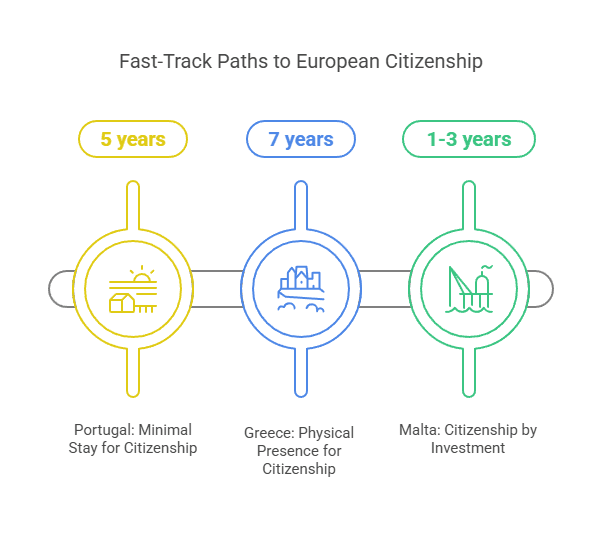
Pathway to Citizenship: A key attraction of Portugal is the relatively quick transition from resident to citizen. After 5 years of legal residency, Golden Visa holders become eligible to apply for Portuguese citizenship via naturalization. This requires passing a basic Portuguese language test (A2 level) and demonstrating ties to the country. Uniquely, Portugal does not require full-time physical presence – even on a part-time residency (as little as ~35 days total over 5 years), one can naturalize. Portuguese citizenship grants an EU passport with extensive travel and work rights across the European Union. Many investors consider this the ultimate ROI: a second passport in Europe.
Additional Benefits: Portugal consistently ranks highly for quality of life, safety, and cost of living. Investors enjoy a stable property market and tourism rental yields in popular regions like the Algarve (though direct Golden Visa realty investment in Lisbon/Porto is now restricted). Family reunification is straightforward – spouse and dependent children (even parents) can obtain residence under the main investor’s Golden Visa. Portugal’s healthcare and education systems are well-regarded, and residents can access other EU countries visa-free within Schengen. Overall, the Portuguese Golden Visa offers a blend of financial opportunity, lifestyle, and a clear path to an EU passport, explaining its popularity until recent reforms.
Greece: Real Estate Investment Opportunities

Residency via Investment: Greece’s Golden Visa grants a permanent residence permit upon a qualifying investment, with one of the fastest processes in Europe – approvals often in under 2–3 months. The primary route is real estate purchases: purchasing property worth at least €250,000. (From August 2023, the minimum doubled to €500,000 in certain high-demand areas like central Athens and popular islands, but remains €250k in others to encourage diverse investment). Alternative options include €400,000 in Greek government bonds or shares of Greek companies/funds. There is no minimum stay in Greece required and the residence permit is valid for 5 years at a time, renewable indefinitely as long as the investment is maintained.
Minimum Investment: €250,000 is the base threshold for the Golden Visa (for real estate in most regions). This relatively low entry point (the cheapest in the EU for a permanent residence) has made Greece’s program very popular. If focusing on prime locations (e.g. upscale Athens neighborhoods), investors should budget €500,000 to meet the new rules. Investments in securities or bank deposits also start at €400,000. Notably, these amounts exclude taxes like VAT on property (typically 24% on new builds) and legal fees.
Exclusive Investment Opportunities: Foreigners can generally buy property in Greece, but some border regions and islands (near Turkey) have ownership restrictions for non-EU citizens. Golden Visa holders, as legal residents, can more readily obtain permission to purchase in these strategic locations (subject to Defence Ministry approval). Moreover, Greek residency gives investors access to local stock initial public offerings (IPOs) and banking products. For instance, some Greek mutual funds or high-yield bond offerings might only be open to EU residents. With the Golden Visa, investors also qualify for Greece’s Non-Domicile incentives: by investing at least €500,000 in Greece, one can opt into a flat €100,000 annual tax on all foreign income – effectively granting tax residency and the ability to freely invest abroad without Greek taxes, a scheme only available to those who become residents. Additionally, Greece’s booming tourism industry offers Golden Visa investors exclusive access to licenses for short-term rental businesses and tourism developments, an opportunity not easily attainable as a non-resident.
Taxation on Investments: Greece has no wealth tax and no inheritance tax for close family, making it appealing to wealth planners. Investment income is taxed at standard rates: dividends 5%, interest 15%, capital gains 15% (for securities) or variable for real estate sales (15% on gains, though often main homes are exempt). However, as noted, Greece introduced a Non-Dom regime for HNWIs in 2020: new residents who invest €500k can opt to pay a flat €100k per year to cover all foreign-sourced income, regardless of amount.
This is essentially a substitute for wealth tax on global assets – an attractive trade-off for ultra-wealthy investors (and €20k/year for each additional family member to include them). Domestic income (Greek-source, e.g. local rental or business profits) is taxed normally up to ~45% for individuals. Greece also entices affluent retirees with a flat 7% tax on foreign pension income for 15 years if they become residents, though this is separate from the investor program. Importantly, Greece does not tax capital gains from the sale of shares listed on the Athens Exchange for non-Greek residents, and even for residents, such gains can be exempt if holding over 2 years with >10% stake.
Pathway to Citizenship: Greek citizenship by naturalization is possible after 7 years of continuous residence. Unlike Portugal, Greece expects more substantial physical presence – to naturalize, one should genuinely reside in Greece, integrate (language, some knowledge of history), and file taxes as a resident. The Golden Visa itself does not require living in Greece at all (many investors treat it as a plan B). Those aiming for a Greek/EU passport will need to spend the majority of each year in Greece and learn Greek to at least B1 level for the citizenship exam. There is also a provision for fast-track citizenship in 3 years for investors who make Greece their domicile and significantly increase investment (e.g. €1.5 million+ in strategic sectors), but this is relatively untested. Greece allows dual citizenship, so investors can maintain their original nationality.
Additional Benefits: A Greek residence permit gives full freedom of travel in Schengen Europe. Family inclusion is generous: the Golden Visa covers the main investor’s spouse, children up to age 21 (extendable to 24 if students), and even the parents of both the investor and spouse. Greece’s warm climate, Mediterranean lifestyle and low living costs are attractive. Property investors can see substantial rental income from tourism, and as residents, they benefit from Greece’s growing economy (projected growth in sectors like renewable energy, logistics). Education is another draw: Greece has international schools and English-language universities that residents can attend at local rates. Overall, Greece offers an accessible gateway to Europe with the added perk of special tax regimes for those bringing wealth – a combination that has made it a top-tier expat investment destination.
Malta
Residency via Investment: Malta’s Permanent Residence Programme (MPRP) provides a permanent residency status (indefinite, with a 5-year renewal card) to non-EU investors who contribute economically. The application process takes approximately 4–6 months, involving due diligence checks. Key requirements (as of 2025) include evidence of €500,000 in capital (€150k of which must be in financial assets) and an investment in Maltese real estate. Applicants have two options: buy property worth at least €350,000 (€300k in the less-developed south or Gozo) or rent for at least €10,000–€12,000 per year; in both cases a government contribution is required (€28,000 if buying, €58,000 if renting) along with a €2,000 donation to a Maltese NGO. Notably, Malta requires using a licensed agent to submit the application and strict source-of-funds documentation.
Minimum Investment: In practice, the total outlay for MPRP is ~€600,000+ for a family. This includes the property investment or lease (5-year minimum commitment) plus the non-refundable government contributions and fees. For example, one might purchase a €375,000 apartment and pay €30,000 contribution, €50,000 admin fee, and €10,000 for dependents – reaching around €465k, besides holding €150k in stocks or bonds. While Malta’s entry cost is higher than Portugal/Greece, it grants immediate permanent resident status (no temporary stage).
Exclusive Investment Opportunities: Malta has some unique market access features. Real estate: Non-EU foreigners without residency must obtain an AIP (Acquisition of Immovable Property) permit to buy property, and they are limited to one property for personal use. By becoming a Maltese resident, an investor can buy multiple properties (after 5 years of continuous residency, permit-free) or purchase in designated Special Designated Areas without a permit. This is key because Malta’s property values have steady appreciation and high rental demand. Finance: As an EU resident, one can open Maltese investment accounts to trade on the Malta Stock Exchange, participate in local IPOs (e.g. Malta government bonds or bank stocks often offered preferentially to locals), and even invest in Malta-based hedge funds or forex products not passported outside. Malta is also a growing fintech hub: residency might allow involvement in innovative sectors (blockchain, online gaming companies) including directorships or share options, which non-resident foreigners might be restricted from for regulatory reasons.
Taxation on Investments: Malta’s tax system is very favorable for resident investors, particularly those who are not domiciled in Malta. There is no wealth tax, no municipal taxes, and no inheritance tax (for direct heirs). Capital gains tax does not apply to gains on foreign securities for non-domiciled residents – meaning if you sell stocks or a company abroad while living in Malta, it can be tax-free in Malta as long as the proceeds aren’t remitted to a Maltese bank. Even on Maltese assets, capital gains on securities are often exempt after a short holding period, and real estate gains are exempt if the property was held for 3+ years and was owner-occupied.
Instead of global taxation, Malta uses a remittance basis for foreign income of non-domiciled residents: foreign-source income is only taxable if brought into Malta. This allows investor-residents to structure their wealth globally with minimal Maltese tax. Any foreign income remitted is taxed at a flat 15% (with a €5,000 minimum tax for MPRP holders, which is easily covered by the program’s fees). Furthermore, Malta offers tax credits for investing in local startups and has no capital duty on moving investment capital into the country. VAT at 18% applies to goods/services, but financial services and rents are VAT-exempt. Importantly, Malta does not tax capital gains from the sale of cryptocurrency as it views crypto as similar to securities for long-term investment.
Pathway to Citizenship: The standard route to citizenship in Malta is lengthy – 5 years of residency required for long-term residents to naturalize, and Maltese language proficiency plus deep ties must be shown, with no guarantee of approval. Notably, the MPRP itself does not lead to citizenship automatically. However, Malta runs a Citizenship by Investment (CBI) program in parallel, officially the Maltese Exceptional Investor Naturalisation (MEIN). By making a much larger contribution (roughly €750,000 after 1 year or €600,000 after 3 years, plus a €700,000 property purchase or €16,000/year rental, and €10,000 donation), an investor can apply for citizenship. This path is separate from MPRP and capped to a limited number of approvals annually. Successful applicants gain an EU passport typically in 1–3 years. For most MPRP residents, citizenship isn’t immediate, but they enjoy permanent EU residence rights and can live indefinitely in Malta (which is in the Schengen zone and Commonwealth). Malta allows dual citizenship, so if one does naturalize eventually, they can retain their original citizenship.
Additional Benefits: As an English-speaking country with a robust legal system and financial services sector, Malta is inviting to international investors. Residents benefit from Malta’s high-quality healthcare (ranked among the best in Europe) and an education system that includes international schools and English-language universities. Through Maltese residency, one can travel visa-free throughout Schengen for up to 90 days in 180.
The MPRP also uniquely lets the main applicant include not just spouse and minor children, but also unmarried adult children financially dependent on the parent, as well as parents or grandparents of the main applicant or spouse – four generations in one application. This makes it attractive for multi-generational wealth planning. Malta’s location is strategic for business, connecting EU with North Africa and the Middle East. It has a pleasant Mediterranean lifestyle and climate. For investors, Malta offers political stability, a pro-business environment (ranked high in ease of doing business), and strong asset protection under EU law. In summary, Malta is a prime choice for those seeking a forever EU residence with significant tax advantages on their investments.

United Arab Emirates (UAE)
Residency via Investment: The UAE (particularly Dubai and Abu Dhabi) has emerged as a top expat destination due to its Golden Visa scheme and lack of personal taxes. The UAE Golden Visa offers a 10-year renewable residence to investors, with a straightforward process often completed in 1–2 months. Key pathways for investors include: Real Estate Investment – investing at least AED 2 million in property; and Business Investment – e.g. founding a company with ~AED 500k capital or investing in an established company.
There are also categories for exceptionally talented professionals and entrepreneurs. For the property route, multiple properties totaling AED 2M qualify, and even mortgaged properties count if the down payment is ≥2M. Applicants must pass background checks and show valid income/resources. Unlike many countries, UAE visas are not citizenship-track; they purely confer residence rights. Nevertheless, the Golden Visa is attractive for its length (10 years without needing a local sponsor or employer) and the flexibility it provides in securing residency and doing business in the Emirates.
Minimum Investment: AED 2,000,000 (approximately US$545,000) in real estate is the headline requirement for a 10-year investor visa. This can be fulfilled by buying property in freehold areas in Dubai, Abu Dhabi, or other emirates. For entrepreneurs, having a company with at least AED 500,000 (approximately US$136,000) in capital or obtaining approval from an official business incubator is required. There is also a 5-year property visa for a lower investment of AED 1 million, but most HNWIs opt for the 10-year Golden Visa for security. The UAE does not ask for any donation – the investment remains your asset (property or business). Notably, the cost of real estate can often be partly financed: UAE banks will lend to non-residents, and once you have a property and Golden Visa, you can leverage local financing for further investments.
Exclusive Investment Opportunities: The UAE’s residency opens doors to lucrative opportunities in a way that being a foreign outsider cannot. Real Estate: While foreigners can buy property in designated areas without residency, holding a residence visa gives confidence and ease in property dealings, and sometimes access to off-plan developer deals reserved for locals or residents. Moreover, only residents can get local mortgage financing at good rates to expand their real estate portfolio – non-residents face higher down payments and interest. Business: As a resident, one can own 100% of onshore companies (a recent reform scrapped the requirement of 51% local sponsorship in most industries) and bid on government contracts. Certain sectors like telecommunications, oil & gas, etc., remain restricted, but overall, residency allows full participation in the domestic economy.
Stock Market: The UAE has public companies with foreign ownership limits; residents are often treated on par with citizens in terms of opening investment accounts. For example, to trade on the Abu Dhabi Securities Exchange or Dubai Financial Market, a local Investor Number is needed – easier to obtain with a UAE ID. Some IPOs (e.g., Aramco’s on Tadawul or ADNOC’s subsidiaries) have tranches for UAE nationals and GCC residents; being a resident might allow one to subscribe in the local tranche that foreigners outside can’t. Banking & Funds: UAE banks offer high-yield savings accounts and dirham-denominated investment products (often not marketed abroad). Residents also gain access to local private equity and venture capital funds focusing on Gulf region startups – often these funds only accept UAE/GCC domiciled investors due to regulatory reasons. Additionally, residency enables the purchase of carried interest in real estate projects (like bulk buying units or floors in a tower pre-construction) which developers typically offer to insiders.
Taxation on Investments: The UAE is known for its tax-free environment for personal income and investments. There is no personal income tax on salaries or investment earnings. Therefore, no capital gains tax applies to individuals – profits from selling stocks, real estate, crypto, etc., are all tax-free in the UAE. Similarly, there is no dividend tax or interest tax. The UAE also does not impose a net wealth tax, inheritance tax, or gift tax. This allows expat investors to accumulate and repatriate wealth freely. From 2023, the UAE introduced a 9% corporate tax, but it affects only business profits above AED 375k (~$102k) and not personal investment income.
Many investment activities (trading stocks on own account, renting out personally owned real estate) are not considered corporate businesses and remain untaxed. The only notable tax is VAT (5%) on most goods and services, which can indirectly affect cost of living but is low. Also, property transactions have fees: around 4% transfer fee in Dubai (similar to stamp duty). For context, even if an investor becomes a tax resident in UAE, they remain tax-free (useful for those leaving high-tax countries). The UAE has double tax treaties that can sometimes help avoid taxation in an expat’s home country as well. Finally, the absence of currency controls means investments can be moved in and out without restriction.
Pathway to Citizenship: Historically, UAE citizenship was nearly impossible for expats, but recent legal changes allow very selective naturalization of certain investors and professionals by nomination of the rulers. In practice, this is extremely rare and not an expected outcome of the Golden Visa. The UAE does not offer a formal citizenship timeline and does not recognize dual citizenship in most cases. Thus, most expats remain on renewable residency permits. However, the security of a 10-year visa (with essentially assured renewal if criteria still met) is a game-changer – previous visas were 2–3 years tied to employment or shorter investor visas requiring renewal. With a Golden Visa, investors can settle long-term, and even if the specific property is sold, one can reinvest and renew. Family benefits are excellent: a Golden Visa lets you sponsor your spouse, children, and even domestic workers easily, with the family visas having the same duration. Children can attend UAE schools and universities (which are high quality, with branches of global institutions).
Additional Benefits: The UAE, particularly Dubai, offers a lifestyle of luxury, safety, and connectivity. For investors, one huge benefit is being in a global travel hub – Dubai International Airport offers flights everywhere, often without the need for visas for residents. Quality of life is high, with world-class amenities, and the expat community is large and diverse. Importantly, the dirham is pegged to the US dollar, giving currency stability for financial planning. Residency in UAE can also shield one’s assets: the legal system (increasingly aligned with international norms) has strong property rights and no foreign exchange controls. The Golden Visa also grants perks like an Esaad privilege card for discounts, and in some emirates, Golden Visa holders get local benefits (e.g., Abu Dhabi offers Golden Visa holders a discount on property purchases from developers). Summing up, the UAE is ideal for those prioritizing tax efficiency, modern infrastructure, and a central base for global business, even though it’s not a path to a second passport.
Singapore: Tax Benefits for Investors

Residency via Investment: Singapore’s Global Investor Programme (GIP) offers a direct route to Permanent Residence (PR) for high-net-worth individuals. The process takes about 6 months from application to approval. Singapore’s criteria are stringent: as of 2023, the minimum investment was raised to S$10 million (~US$7.8M) into either a new or existing Singapore business, or into a GIP-approved fund investing in Singapore companies. There’s also an option C requiring setting up a Single Family Office with S$200M assets (with S$50M invested locally), targeting ultra-wealthy family investors. Applicants must also demonstrate a successful business track record (e.g. running a company with S$200M revenues) or entrepreneurial background. Upon in-principle approval, the investment must be made within 6 months. The GIP PR is granted upfront and is conditional for the first 5 years (you must maintain the investment and minimally spend part of each year in Singapore, or substantially hire locals, to renew the Re-Entry Permit). Unlike typical visas, GIP grants immediate permanent residency, reflecting Singapore’s desire to attract top-tier investors.
Minimum Investment: SGD 10,000,000 is the standard required investment for the GIP as of the latest update. Earlier, a S$2.5M option was available, but Singapore toughened requirements to focus on quality investors. The investment can be in various forms: injecting capital into one’s own new venture in Singapore, expanding an existing business locally, or placing funds into an approved private equity or venture capital fund. The government essentially wants active economic contribution – passive real estate investment alone is not an option (in fact, foreigners cannot buy landed property or public housing easily). There are additional costs: an application fee of S$10,000, and due diligence on the investor’s background. It’s worth noting that while S$10M is the minimum, many applicants invest more or multiple investments (e.g., business plus a fund) to strengthen their case, since approval is discretionary.
Exclusive Investment Opportunities: Becoming a Singapore Permanent Resident unlocks significant advantages in the local investment landscape. Real Estate: Perhaps the biggest immediate benefit – PRs pay only 5% Additional Buyer’s Stamp Duty (ABSD) on their first property, versus a massive 60% ABSD for foreign buyers. This means a PR can invest in Singapore’s sought-after residential property market at a fraction of the transaction cost a non-resident would incur. Given Singapore’s property has high rental yields and capital appreciation, this is a major exclusive opportunity. PR status also allows purchase of certain apartments and, after some years, even apply to buy landed houses on a case-by-case basis (foreigners generally cannot own landed residential property at all).
Stock Market & Funds: Foreigners can freely invest in Singapore stocks, but PRs may have access to local brokerage margin facilities and IPO allocations reserved for locals (for instance, the government’s Temasek-linked companies sometimes prioritize local shareholder base). Some government-linked investments like CPF (Central Provident Fund) Special Accounts and Singapore Savings Bonds are only open to citizens and PRs – offering safe yields above bank deposits.
Business opportunities: PRs have an easier time registering companies, getting licenses, and bidding for government projects. They count as “local” when setting up businesses, which can be important in sectors like finance or media where licensing might favor local ownership. Also, PRs can co-invest with government agencies (e.g. spring Singapore grants) that may not be available to foreign entities.
Human capital investments: While not a market instrument, PR status allows one’s family to live in Singapore. This opens access to local education (international student fees in schools are higher for foreigners) and to government-subsidized healthcare and services – indirectly freeing up capital for other investments.
Taxation on Investments: Singapore is famously friendly on taxes, especially for investment income. No capital gains tax – profits from sales of stocks, real estate, etc., are not taxed. No dividend tax on domestic or foreign dividends for individuals (though one’s home country might tax foreign dividends). Interest income is tax-free for individuals if from approved financial institutions. Singapore mainly taxes income from employment or business profits, at rates up to 24% for high earners. Investment-related taxes that do exist include a 22% levy on rental income (as part of personal income if you rent out property) after deducting expenses, and a 10% tax on local bank deposit interest for non-residents (waived for individuals).
Singapore also has no net wealth tax, no inheritance tax, and no gift tax. There is a property tax on real estate holdings (progressive rates up to 16% of annual rental value for investment property). For high-net-worth PRs, relocating to Singapore can significantly reduce global tax burdens – Singapore does not tax foreign income earned before you became a tax resident, nor foreign income not remitted to Singapore. Even if brought in, many types of foreign income (like dividends or capital gains) are exempt.
One caveat: since Singapore doesn’t tax capital gains, the tax authority may scrutinize if someone is actually trading professionally (e.g. flipping properties or stocks frequently) and deem it as income – but this is rare for genuine long-term investments. Singapore’s extensive tax treaty network also helps avoid double taxation for those doing international business. For GIP investors specifically, there was historically a five-year tax exemption on qualifying fund income under certain schemes, encouraging them to use Singapore as an investment base.
Pathway to Citizenship: After obtaining PR, an investor can consider Singapore citizenship. The legal waiting time is 2 years of permanent residency before one may apply for citizenship. In reality, many PRs wait longer (3–5 years) and demonstrate significant economic and social contributions to improve their chances, as approvals are not automatic. Singapore values integration – factors like residing in Singapore majority of the time, having family here, or children doing National Service (which male PRs are liable for) can influence the outcome.
If granted, Singapore citizenship is highly coveted: it provides visa-free/visa-on-arrival access to 189 countries (one of the strongest passports globally) and full rights in a stable, wealthy nation. However, a critical point: Singapore does not allow dual citizenship. Applicants must be willing to renounce their previous citizenship. This is often a tough decision for investors, and some remain PR for the long term instead. PR status itself can be kept indefinitely, subject to renewal every 5 years (which requires showing some ties like local income tax filings or property, to prove Singapore remains your base).
Additional Benefits: Singapore offers an exceptional living environment—ranked among the cleanest, safest cities with world-class healthcare and education. For investors, it’s a top global financial center: as a resident, it’s easier to establish family offices or trusts in Singapore to manage wealth. The regulatory regime is robust, giving confidence in the security of investments. Political stability and rule of law are major draws. Families benefit from a bilingual education system and multicultural society. Also, Singapore’s strategic location in Southeast Asia enables convenient investment into emerging Asian markets. Many regional headquarters of multinational companies are in Singapore, creating networking opportunities. The PR also comes with the ability to include your spouse and children; they get PR too, which means they can work without needing separate work visas. In summary, Singapore is ideal for those who can meet the high entry bar – it provides unparalleled access to Asian markets, top-tier asset protection, and a clear (if demanding) route to citizenship, all within a low-tax framework.
Saudi Arabia
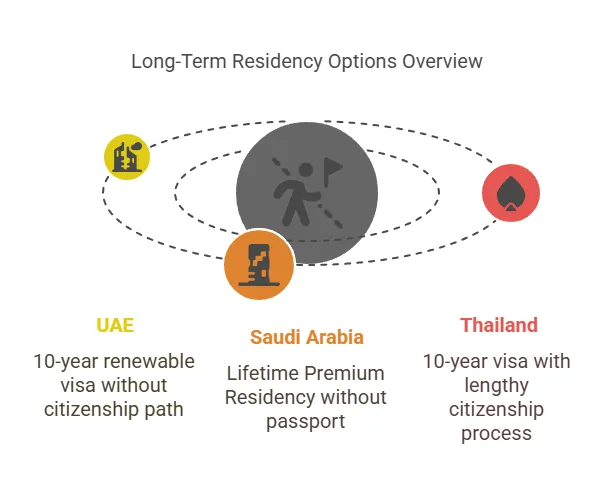
Residency via Investment: Saudi Arabia’s Premium Residency Program – colloquially the “Saudi Green Card” – was launched as part of the Vision 2030 reforms to attract talent and capital. It offers two types: an Indefinite Premium Residency (permanent) and a 1-year Renewable Residency. Investors typically pursue the permanent option, granted upon meeting the investment criteria and paying a one-time fee of SAR 800,000 (US$213,000) for permanent or SAR 100,000 ($26,600) annually for the limited term (these fees are separate from the investment itself). Processing is swift – often about 1 month from application to approval, as long as due diligence and security checks clear. The core requirements: be at least 21, have a valid passport, clean criminal record, and proof of self-sufficient finances. For the investment route, applicants either show a major real estate purchase in Saudi or an active business investment. Unlike traditional iqama (work visa), no local sponsor (kafeel) is needed, and the resident enjoys rights almost on par with a citizen (minus political rights).
Minimum Investment: The program sets clear investment thresholds: SAR 4 million (≈ US$1.06 million) in real estate or SAR 7 million (≈ US$1.85 million) invested in a Saudi business with an official investment license. The real estate investment must be in a residential property (not off-plan, and not in the holy cities Makkah and Medina) with the title deed under the applicant’s name, and must be held for the duration of residency. The business investment route requires obtaining a license from the Ministry of Investment and injecting the capital within 2 years, plus creating at least 10 local jobs. An investor could also meet the criteria by owning a Saudi company of equivalent capital. In 2023, Saudi also announced that investing SAR 4M in listed real estate funds or companies (e.g. REITs focusing on Makkah/Madina) would qualify for long-term residency, broadening options. Compared to other programs, Saudi’s required sums are high, but the unique advantage is no donation – all funds are in your assets (the only cost surrendered is the fee ~ $213k for lifetime rights, which is significant but one-time).
Exclusive Investment Opportunities: Gaining Saudi residency opens up the Middle East’s largest economy in ways foreigners normally cannot access. Stock Market (Tadawul): Without residency, foreign investors needed to be Qualified Foreign Investors (QFI) – an institutional status with minimum AUM requirements – to trade Saudi stocks freely. With Premium Residency, an individual can open a local brokerage account as a resident and trade on the Tadawul like any Saudi, bypassing the QFI barrier. This is key given many Saudi IPOs (like Aramco in 2019) were not easily accessible to retail foreigners. Real Estate: Saudi law historically restricted foreign ownership of real estate; now, a Premium Resident can buy property anywhere except in Mecca and Medina (and parts of border provinces). This includes lucrative sectors like owning apartments in Riyadh’s financial district or land for development – opportunities off-limits to non-resident foreigners.
The 2023 rule change even allows foreigners to invest in companies that own Mecca/Madina properties, but as a resident, one could potentially get priority or better insight into such offerings. Entrepreneurship: A Premium Residency allows one to establish and fully own businesses under the new Investment Law, whereas previously foreigners needed a Saudi partner or could only own 100% through costly structures or in special economic zones. Now, sectors like e-commerce, manufacturing, and service industries are much more accessible. Additionally, residents can participate in government investment initiatives, such as the Public Investment Fund (PIF) co-investments, or buy into local venture capital funds that are typically limited to GCC nationals. Some privatizations and state asset sales are on the horizon in Saudi – being on the ground as a resident can position investors advantageously.
Taxation on Investments: Saudi Arabia stands out by not taxing personal income – including investment income – for residents. There is no personal income tax at all on salaries or capital gains for individuals. The only direct tax one might encounter is if you structure your investments as a company entity, which then pays a 20% corporate tax on profits (foreign-owned). But if you invest as an individual (e.g. owning real estate personally or buying stocks), capital gains are largely tax-free: notably, gains from selling shares of Saudi listed companies are exempt from tax for residents, provided certain conditions are met (generally meaning the shares were listed and traded on the exchange).
For non-resident foreign shareholders, there is a 20% capital gains tax on sale of Saudi company shares – a Premium Resident would not fall under that “non-resident” definition when investing locally. Dividends from Saudi companies to a resident are subject to 5% withholding tax only if paid to foreign (non-Gulf) investors; as a resident individual, one could be considered local for many investments, potentially avoiding that (the nuance is that Saudi nationals and GCC citizens are exempt from dividend WHT; Premium Residents likely still classified as foreign for WHT, but this area is evolving). Zakat: Saudi nationals and GCC citizens pay Zakat (2.5% on net worth) in lieu of income tax.
Foreigners do not pay Zakat on personal wealth. For any business a Premium Resident owns, the business would either pay Zakat (if majority Saudi-owned) or corporate tax (if majority foreign-owned). Other taxes: There is a 15% VAT on most purchases, and a 5% Real Estate Transaction Tax on property sales (in lieu of stamp duty). The absence of wealth and inheritance taxes means one can accumulate assets in Saudi without annual erosion – a significant advantage given Saudi investment returns (e.g., high rental yields of ~8% in real estate). Additionally, certain incentive zones may offer tax holidays for new industries (e.g., NEOM). Overall, Saudi Arabia provides a virtually tax-free investment climate for individual residents, second only to places like UAE in that region.
Pathway to Citizenship: Currently, the Premium Residency explicitly does not lead to Saudi citizenship. Saudi Arabia has only recently started to grant citizenship to a very limited number of foreigners with special skills (e.g., notable doctors, academics) under royal approval. There is no published naturalization timeline for investors. For most expats, Saudi citizenship remains unattainable – and dual citizenship is not recognized. Therefore, investors should view the Premium Residency as the end goal itself: permanent residence with rights to live, work, and invest, but not a stepping stone to a passport. The program is akin to a Green Card without a passport. Premium Residency is lifetime (with the one-time fee) and does not need renewal, offering stability for the investor and their family to stay indefinitely. Children born in Saudi to Premium Residents do not get citizenship by birth, but can inherit the residency if conditions are met.
Additional Benefits: Premium Residents enjoy many perks close to those of citizens. They can sponsor visas for family members (spouse, children, even parents), who can live in Saudi without separate work sponsorship. They have freedom of mobility – no exit/re-entry visas needed to leave the country, unlike normal expatriate workers. They can use “citizens’ lanes” at airports for immigration. Also, they are exempt from the expat levies that foreign workers traditionally had to pay per dependent. In daily life, a Premium Resident can access local rates for things like domestic airfare, and use government e-services that require national ID.
Importantly, Saudi Arabia is undergoing rapid social and economic change: residents can now enjoy entertainment, concerts, cinemas which were new in recent years, and upcoming mega-projects (Red Sea luxury resorts, Qiddiya entertainment city) that will create new business opportunities. Cost of living in Saudi is relatively low (no personal income tax, subsidized fuel, etc.), so investors often base themselves in Riyadh or Jeddah and still travel globally as needed. The strategic location, large population (35 million) with increasing consumer spending, and massive government investment in diversifying the economy make Saudi a compelling base for regional business. Premium Residency holders, being pioneers in this new era, can position themselves to benefit from Saudi Arabia’s growth in sectors like tourism, tech startups, and infrastructure, with the comfort of a secure residency not tied to an employer or fixed term.
Thailand
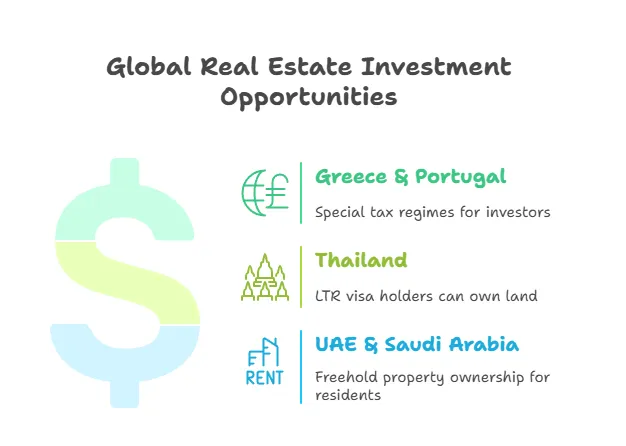
Residency via Investment: Thailand’s new Long-Term Resident (LTR) Visa is designed to attract wealthy individuals, retirees, remote workers, and skilled professionals with a 10-year residency permit. It’s effectively a hybrid between a residence visa and an investment scheme. For investors (“Wealthy Global Citizens” category), the requirements include proof of at least US$1 million in assets, US$80,000 annual income for the past two years, and an investment of US$500,000 in Thai assets. Acceptable investments are Thai government bonds, Thai property (condos) or direct equity in Thai companies. The application is made through the Thailand Board of Investment (BOI) which fast-tracks LTR visas; processing times are advertised as 1–3 months. Other LTR categories (Wealthy Pensioners, Professionals, etc.) have variations of income and lower investment requirements (e.g., retirees can invest $250k and show $40k income). Unlike traditional one-year visas or the Elite visa (which is a paid membership, not an investment), the LTR offers a more formalized long-stay with an option to work (it includes a digital work permit).
Minimum Investment: $500,000 (about 16.5 million Thai Baht) is the key investment threshold for the Wealthy Global Citizen LTR visa. This could be, for example, purchasing a couple of Bangkok condominium units or buying Thai government bonds. Additionally, one must have $1 million in net assets and relatively high income, which sets a high bar but not as exorbitant as Singapore’s. For retirees under LTR, the required investment is halved to $250,000 (with $250k in assets and $40k/year income). The application fee for the LTR visa is 50,000 THB (around $1,400). Investors should be aware that certain assets like land cannot be owned directly (see exclusive opportunities below) – so the $500k is typically in condos or financial assets. The investment must be maintained throughout the visa duration to keep qualifying.
Exclusive Investment Opportunities: Historically, foreigners in Thailand could not own land and faced restrictions in certain investments. The LTR program has introduced a groundbreaking incentive: qualified foreigners under LTR who invest at least THB 40 million (~$1.1M) in specified assets (Thai real estate, securities or funds) are permitted to buy and own up to 1 rai (1,600 m² or ~0.4 acre) of residential land. This is a significant privilege since it marks the first time in modern Thai law that foreign individuals can own land title in their own name for residential use (outside of few exceptions like BOI-approved industrial land). It enables LTR investors to build a house in Thailand, something not possible for others except via complicated structures.
Additionally, LTR visa holders get a fast-track at airports and automatic work authorization, which means they can freely invest and engage in business activities without needing separate permits. They can also access Thailand’s robust capital markets more easily: for instance, opening a Thai brokerage account to trade on the Stock Exchange of Thailand (SET) typically requires a long-term visa or work permit – the LTR satisfies that. This grants exposure to Thai equities (many of which have ownership limits for foreigners) on local terms. As a resident, one could also invest in high-yield Thai corporate bonds or government bonds that are sold to “residents” in Thai baht – opportunities not marketed abroad.
Another angle: Thailand often offers property pre-sales at discounts to locals or residents; being on LTR might give early-bird access to condo launches or provincial real estate projects aimed at domestic buyers. Moreover, LTR holders can participate in state-sponsored investment zones, such as special economic zones or Eastern Economic Corridor (EEC) projects, perhaps getting incentives or ease of doing business. In summary, land ownership is the headline exclusive benefit, alongside generally smoother access to all Thai investment avenues (property, stocks, entrepreneurship) that permanent tourists can’t easily tap into.
Taxation on Investments: Thailand’s tax system is moderate and has some expatriate-friendly features. First, Thailand does not tax foreign-sourced income for individuals unless it is remitted to Thailand in the same year it’s earned. This means an LTR visa holder can keep overseas investment income offshore without Thai tax, similar in concept to remittance bases elsewhere. If they bring it in a later year, it’s not taxed either. Capital gains tax: Thailand doesn’t have a separate capital gains tax for individuals; gains are treated as ordinary income but with important exceptions. Notably, capital gains from the sale of securities on the Thai stock exchange are exempt for both residents and non-residents (Thailand imposes no capital gains tax on stock trades for individuals) – this is attractive for those investing in Thai equities. Real estate gains are taxed as ordinary income, but there are standard deductions based on holding period that reduce effective tax. For example, selling property held 5+ years can halve the taxable gain. No wealth tax: Thailand has no net worth or wealth tax, and inheritance tax only for large estates (>100M THB per heir at 5% for direct heirs).
Rental income from property is taxed as personal income (with a standard deduction of 30% for expenses). Personal income tax rates go up to 35% for income over ~4 million THB ($110k). However, the government has floated special flat tax rates (like 17%) for approved highly-skilled professionals under LTR, which could extend to their income from stock options etc.. It’s unclear if investors purely under the Wealthy category get a tax break, but all LTR visas come with a perk: exemption from the previous annual Thai work permit income reporting and some social fund payments.
Also, LTR holders who do work are taxed like regular residents; but Thailand has tax treaties that often can prevent double taxation. Another benefit: with LTR, if one stays tax-resident in Thailand (>180 days/year), they might use Thailand as a base to benefit from its moderate taxes on regional investments. VAT is 7% in Thailand – quite low, which helps reduce business and living costs (although there is talk of raising it in future). Overall, Thailand offers a fairly low-tax environment on investment income, especially if structured smartly (no tax on offshore income, no capital gains on Thai stocks, low property taxes).
Pathway to Citizenship: Thailand is not known for an easy citizenship process. The LTR visa itself is a long-term residency but not permanent residency (PR). After holding certain visas (which likely will include LTR, though LTR is new), one could apply for permanent residency in Thailand, which historically requires 3–5 years of continuous stay and quotas per nationality. Citizenship requires at least 10 years of residency (with 5 years as a PR) and Thai language proficiency, among other criteria. Dual citizenship is generally not recognized by Thailand, so one must often renounce the prior citizenship upon Thai naturalization.
Therefore, while theoretically an investor could naturalize after a decade, it’s rare and not a primary motivator for most. The LTR is mostly intended to grant the functional benefits of living and investing in Thailand without dealing with short visa runs. Notably, the Thai Elite visa (a different program that’s essentially a paid long-term tourist visa) also doesn’t lead to citizenship. So investors should view LTR as a stable residency for the long haul, rather than a route to a Thai passport. Children born in Thailand to LTR visa holders won’t get Thai citizenship unless one parent is Thai.
Additional Benefits: LTR visa holders enjoy VIP treatment in some cases – the visa was marketed with fast-track airport lanes, a one-stop service center for all immigration needs, and permission to work in Thailand without the usual work permit bureaucracy (the LTR comes with a work permit for those who need it, integrated in the fee). For the investor, Thailand offers an appealing lifestyle: modern cities like Bangkok with high-end condos and healthcare, along with resort areas (Phuket, Chiang Mai) where many expats enjoy retirement. The cost of living is much lower than Western or even other Asian hubs – meaning investment capital can go further (e.g., hiring staff, renting office space). Thailand also has a large expat investor community, given its popularity for remote work and second homes, which can provide networking benefits.
Family members (spouse and children) can accompany the main LTR holder easily (they get LTR dependent visas). Education options include numerous international schools and a growing number of foreign university campuses. One strategic benefit: by residing in Thailand, investors position themselves in the heart of ASEAN, near other markets like Vietnam and Indonesia – but in a country with great infrastructure and connectivity. Also, Thailand’s currency (Thai Baht) has been relatively stable and strong in the region, and residents can hold multi-currency bank accounts if needed. In summary, Thailand’s LTR visa offers a blend of investment access and lifestyle perks, attracting those who want a base in Asia without the high costs or stringent demands of places like Singapore, albeit without offering an easy path to citizenship.
Conclusion
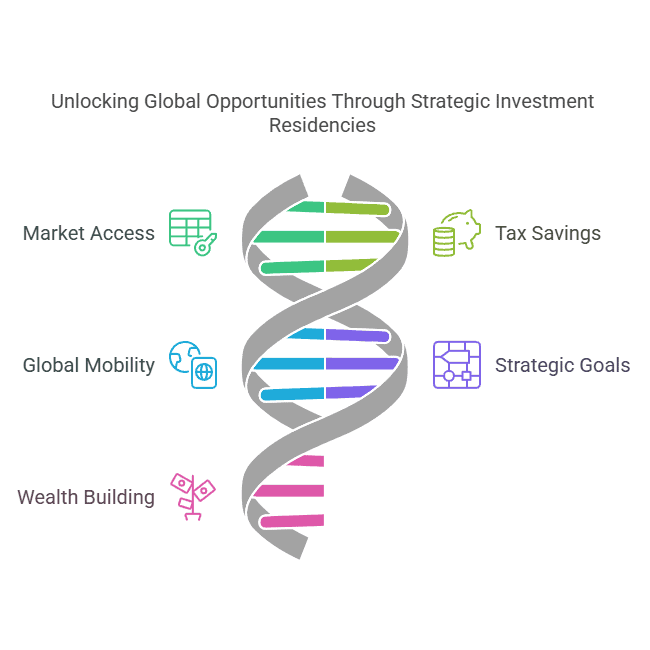
In a world of shifting regulations, these residency-by-investment programs provide strategic platforms for globally-minded investors. Each destination balances a different mix of benefits:
Tax havens and financial hubs like the UAE and Singapore offer unparalleled tax advantages and business infrastructure – ideal for protecting and growing wealth in a stable environment. UAE stands out for zero taxes and ease of living, while Singapore, with no capital gains tax and a top-tier financial market, appeals to those who can meet its high entry bar.
European gateways such as Portugal, Greece, and Malta grant not only investment opportunities but also a coveted path to EU citizenship or permanent residence. Portugal’s Golden Visa remains attractive (despite changes) for its relatively low investment and fast citizenship, whereas Greece provides immediate permanent residency and tax schemes like the €100k flat tax for global income. Malta requires a higher outlay but delivers permanent status from the start and extensive tax planning benefits with no wealth tax.
Emerging markets like Saudi Arabia and Thailand have opened in unprecedented ways. Saudi’s Premium Residency gives investors a foothold in a transformative G20 economy with near-zero taxes, albeit without a passport at the end. Thailand’s LTR visa is a pragmatic option for those seeking a comfortable lifestyle and regional market access, essentially trading a moderate investment for a decade of residency and unique perks like land ownership.
When comparing these options, investors should weigh personal priorities:
Access to markets: For exclusive stock or real estate access, programs like Saudi Arabia’s (local stocks, real estate) or Singapore’s (property with low duties) clearly unlock otherwise closed doors.
Mobility and citizenship: If a second passport is the goal, Portugal or Malta provide clearer paths than the rest.
Tax optimization: UAE and Monaco (not covered above) lead for tax-free living, but Portugal’s NHR or Greece’s non-dom offer targeted tax relief if one plans carefully.
Cost vs. benefit: Greece and Thailand require the lowest financial outlay, whereas Singapore demands the highest but with commensurate prestige and opportunities in Asia’s wealth hub.
Ultimately, the best country for relocation and investment will depend on an investor’s financial capacity, investment interests (property, stocks, business), and long-term plans for citizenship or return on investment. This comparative analysis has provided a data-driven foundation to inform that decision, highlighting that the right residency investment program can be a powerful tool for global investors – opening doors to markets and opportunities that yield both financial and lifestyle dividends.

Lusine Sargsyan
Attorney
