

Introduction
Providing children with access to prestigious universities is a top priority for many expat families. One strategic approach is obtaining residency or citizenship in countries known for renowned universities and world-class education, especially where legacy admissions (preference for alumni children) can give students an edge. This report offers a comparative analysis of the top-ranked countries that combine globally recognized universities with favorable expat immigration pathways. Families can use this information to balance education goals with immigration investment thresholds, from relatively accessible programs to high-end investor visas.
Education & Admissions Comparison
| Country | Top Universities (Global Ranking) | Legacy Admissions? | Tuition (Local vs Intl) | Scholarship Access (Citizens/PR) |
|---|---|---|---|---|
| United States | Dozens of world top-50 universities (e.g. Harvard, MIT, Stanford in top 5) Unrivaled Ivy League prestige, broad subject excellence. | Yes (strong) – ~75% of U.S. research universities consider legacy; alumni children get significant admissions boost Common at Ivies and selective colleges. | High, but locals pay less. Public in-state tuition ~$10K vs out-of-state ~$28K privates ~$50K+ for all. Citizens/PR eligible for in-state rates and federal aid. | Extensive for citizens/PRs. Federal aid (Pell Grants, loans) and need-based scholarships available to U.S. students (not internationals). Many merit scholarships require residency. Dual citizens should apply as U.S. for better aid |
| United Kingdom | 2 of world’s top 5 (Oxford #1, Cambridge #3) and ~11 in top 100 Renowned in humanities, sciences, engineering (Imperial, UCL, etc.). | No (none official) – Admissions merit-based; Oxbridge have no legacy preference (legacy considered “shocking” in UK) Alumni status doesn’t confer formal advantage. | Moderate for locals, high for foreigners. Home fee capped at £9,250/year (~$11.5K) Overseas fees £25–35K ($31–43K) at top schools Only UK/settled residents qualify for home rate. | Good for locals. UK citizens/PRs get tuition loans and grants universities offer bursaries (e.g. Oxford up to £4K) to home students Limited scholarships for non-home students. |
| Canada | 3 in top 100 (Univ. of Toronto #21, UBC, McGill) High quality, especially in medicine, AI, business. Degrees respected globally, though slightly lower profile. | No – Canadian admissions based on grades/test scores; legacy status not used. (Culture of fairness; mostly public unis.) Alumni kids get same treatment as others. | Low–Moderate for locals, moderate for intl. Domestic undergrad avg. C$6–10K/year; International often 2–4× higher (e.g. C$30K+) depending on program. Citizens/PRs qualify as domestic and for lower provincial rates. | Strong for citizens/PRs. Government student loans and grants for domestic students; many university scholarships are open to internationals but provinces often have awards reserved for local residents. Overall lower cost reduces need. |
| Australia | 6 in top 100 (ANU ~#62, Melbourne ~#34, Sydney, UNSW, etc.) Known for research and teaching in English, attractive in Asia-Pacific. | No – Admissions primarily by academic rank (ATAR). No legacy advantage in public universities. Possibly small alumni tuition discounts, but no impact on selection. | Low for locals due to subsidy, high for intl. Domestic students in Commonwealth Supported Places pay A$3K–$11K/year (subsidized) and can defer via HECS International fees typically A$20–40K. PR/citizen get subsidized CSP rates; others pay full. | Available for locals. Merit scholarships (e.g. university awards) mostly for citizens/PRs; government study loans (HECS-HELP) only for citizens (PRs must pay upfront at domestic rate). International students have fewer scholarships (some uni-specific). |
| Singapore | 2 in top 20 (NUS #19, NTU ~#36) Asia’s leading universities, excellent in STEM, business. English instruction in a global finance/tech hub. | No (merit-only) – No formal legacy admissions. Local applicants do get priority; alumni connections mostly matter for networking, not entry. | Tiered: Annual undergraduate tuition ~S$8K (citizen), S$12K (PR), S$17K (intl) for general courses – all subsidized, but intl must sign 3-year work bond Without subsidy, intl fees ~S$30–40K+. Citizens/PR have lower fees and no bond. | Good for locals. Many scholarships (govt and university) for top Singaporean students; PRs eligible for most university scholarships. International students have fewer slots and usually bonded to work in SG if on scholarship. Citizens/PRs also get means-tested bursaries. |
| Switzerland | 3 in top 100 (ETH Zurich #11, EPFL ~#41, Univ. of Zurich) ETH/EPFL are world-leading in STEM (comparable to MIT/Caltech). Small but elite system. | No – Admissions criteria (e.g. Matura, entrance exam) apply equally. No legacy consideration. Aimed at academic excellence only. | Low for all. ETHZ/EPFL tuition about CHF 1,500/year (~$1.7K) for any student. Other publics similarly low (maybe slightly higher for non-residents in some cantons, but generally inexpensive). Living cost is high, but tuition negligible. | Need-based local support. Cantons offer scholarships to resident students (Swiss or long-term residents) to cover living costs. International students not eligible for those, but ETH/EPFL fees are low anyway. A few excellence fellowships open to foreign graduate students. |
United States: Prestigious Universities, Ivy League Prestige and Legacy Advantage
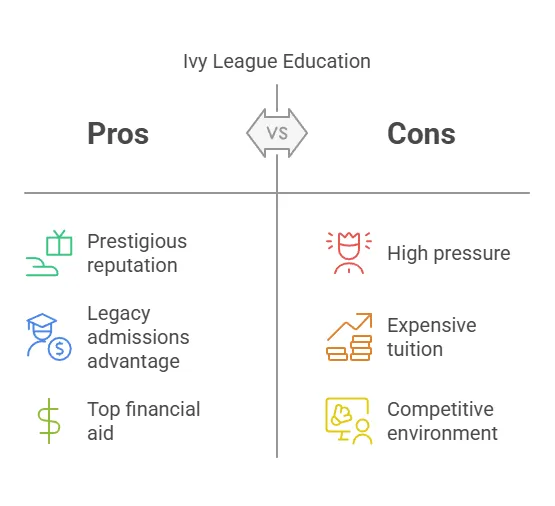
Higher Education Reputation: The United States is home to many of the world’s highest-ranked universities, renowned for their world class education system. The United States attracts a significant number of overseas students due to its world-class education system and prestigious universities. In fact, 36 of the top 100 global universities are in the U.S., more than any other nation. This includes the Ivy League (Harvard, Yale, Princeton, etc.), MIT, Stanford, and other elite schools that consistently top global rankings. American degrees are renowned worldwide, and Ivy League graduates in particular enjoy strong career outcomes. Studies show that 60% of Ivy League and other elite college alumni become among the highest earners in the U.S., reflecting their significant economic and social advantages. Ivy League graduates also dominate leadership roles in business, politics, and science, aided by powerful alumni networks. In short, the U.S. offers unparalleled prestige and networking through its universities, making it a prime destination for families aiming for elite academic opportunities.
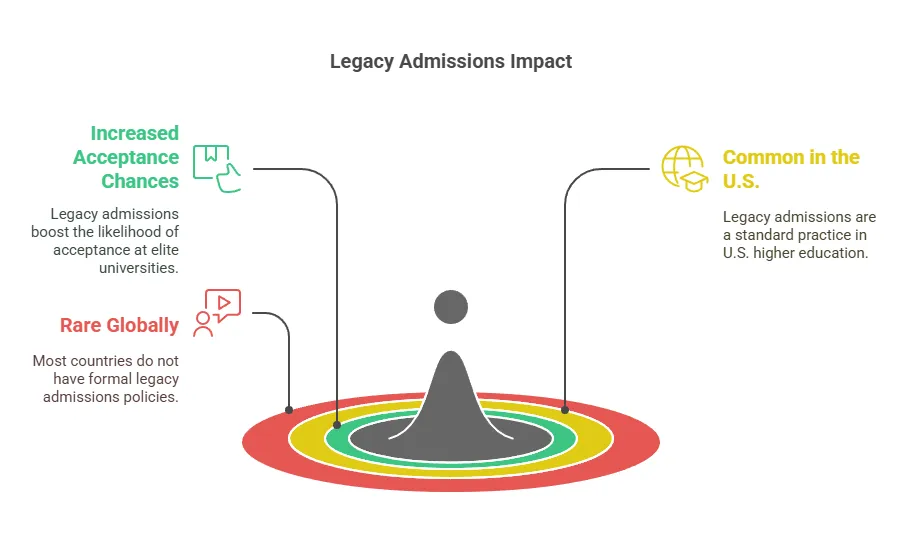
Legacy Admissions Policies: Legacy admissions are both common and influential in U.S. colleges. Nearly three-quarters of U.S. research universities and almost all liberal arts colleges consider legacy status in admissions, giving an edge to children of alumni. For example, Harvard’s acceptance rate for alumni children was 33% – over five times the overall admit rate of ~6%. At many Ivy League schools, 10–15% of students are legacies, and their odds of admission are significantly higher than non-legacies. The intent is to reward alumni loyalty (and often, donations), though this practice is controversial for favoring already advantaged groups. For expat parents, being alumni of a U.S. university can markedly boost their child’s future application. Many top U.S. universities give preference to undergraduate applicants whose parent(s) earned a degree there. This “legacy hook” can make a meaningful difference in competitive admissions. (Notably, a few top U.S. schools like MIT and Caltech do not use legacy preference, and some public universities are barred from it.) Overall, however, legacy ties remain a widely practiced admissions boost in the U.S., far more than in other countries.
Tuition Benefits for Citizens/Residents: Gaining U.S. residency or citizenship can also yield big financial advantages in higher education. Public universities charge significantly lower tuition to in-state residents than to international or out-of-state students. For example, the average annual tuition at a four-year public university is about $9,750 for in-state students versus $28,300 for out-of-state. At elite public campuses (e.g. UC Berkeley or University of Michigan), the difference can be tens of thousands of dollars per year. U.S. citizens and permanent residents are typically eligible for in-state rates after establishing residency in a state. Private universities charge the same tuition for all, but U.S. citizens/PRs have access to need-based financial aid that international students often lack. Many Ivy League and top schools are need-blind and offer generous aid for domestic students; some are need-aware or limited in aid for foreign applicants. Citizens and green-card holders can also apply for federal financial aid and government-backed scholarships, which are unavailable to internationals. In short, a student with U.S. status may pay far less for college. Additionally, dual citizens can choose to apply as a U.S. applicant, avoiding the stricter quotas and lower admit rates for international applicants. (Top U.S. universities have no official quotas for U.S. citizens, whereas international spots are limited.) This means a dual-national student with similar credentials stands the same chance as any American – a significant admissions advantage in itself.
Scholarship Eligibility: Domestic status opens the door to a wide array of scholarships. U.S. citizens and permanent residents can compete for federal programs (like Pell Grants) and thousands of private scholarships that require U.S. residency. They can also benefit from state-specific merit scholarships (e.g. Georgia’s HOPE Scholarship, California’s Cal Grants) if residing in those states. Furthermore, many universities are more generous with need-based aid for domestic students – the Ivy Plus colleges often pledge to meet full demonstrated need for U.S. students, whereas aid for foreign students may be limited. Dual citizenship is particularly useful here: an applicant with U.S. citizenship can often secure both admission and financial aid more easily. Overall, being a U.S. resident greatly improves both the affordability of college and the likelihood of receiving aid or scholarships, compared to being an international student.
Residency and Citizenship Pathways: The U.S. offers various pathways for expats to obtain residency or citizenship, though some require substantial investments. The most direct is the EB-5 Immigrant Investor Program, which grants a family a U.S. green card (permanent residence) in exchange for a qualified business investment. Currently, the minimum investment is typically $800,000 (in a targeted high-unemployment or rural area) or $1,050,000 in other areas. The investment must create at least 10 full-time U.S. jobs. Processing times can range from ~2 to 5+ years for conditional residency due to demand, but once conditions are removed after about two years, the investor and family have permanent green cards. After 5 years of permanent residency, one can apply for U.S. citizenship (naturalization), provided physical presence and other requirements are met. Another route for those with sought-after skills is the H-1B work visa to employment-based green card pipeline, or the EB-2/EB-1 visas for highly skilled or extraordinary ability individuals, which can lead to a green card without the EB-5 investment. However, these employment routes depend on job offers or achievements rather than capital. The EB-5 remains a key option for investors: it essentially “fast-tracks” a green card for those who can invest around $1 million and wait a few years. Importantly, the U.S. allows dual citizenship – it does not require new citizens to renounce prior nationalities. This means expats can obtain American citizenship for their family (gaining all the educational and civic benefits) while retaining their original citizenship, as long as their home country also permits dual nationality. All these factors make the U.S. an attractive, albeit high-investment, choice for long-term educational planning.
United Kingdom: Oxbridge Excellence without Official Legacy Boost

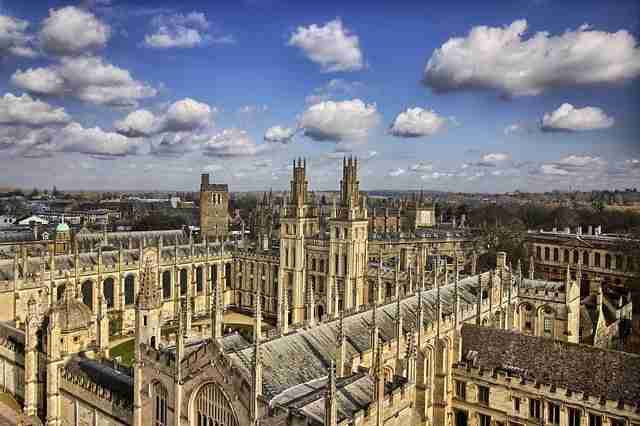
Higher Education Reputation: The United Kingdom is another top destination, boasting 11 of the world’s top 100 universities, second only to the U.S. The UK’s rich cultural heritage, combined with its academic excellence, makes it a highly attractive destination for expat families. The UK’s flagship institutions – notably the University of Oxford and University of Cambridge – are perennially ranked among the global top 5. (Oxford was ranked #1 globally in Times Higher Education 2024.) Other prestigious universities include Imperial College London, University College London (UCL), the London School of Economics (LSE), and more. A British higher education carries international prestige, especially in fields like literature, sciences, engineering, and finance. Oxford and Cambridge (together known as Oxbridge) have educated countless world leaders, Nobel laureates, and industry pioneers. They offer an intellectually rigorous environment and historic college systems that confer a unique alumni status. Graduates of top UK universities benefit from strong name recognition across Europe, the Commonwealth, and beyond. For example, Oxford and Cambridge alumni have extensive networks in global academia and in elite sectors like consulting, banking, and diplomacy. The UK’s global standing in education makes it highly attractive for expats seeking the best opportunities for their children.
Legacy Admissions Policies: UK universities do not practice formal legacy admissions. Unlike many U.S. institutions, British universities – including Oxford and Cambridge – offer no admissions preference to children of alumni. Admissions are based primarily on academic merit (exam scores, interviews, etc.) and contextual factors (e.g. school quality, socioeconomic background) rather than family connections. In fact, British academics often express surprise at U.S.-style legacy preferences, seeing them as contrary to the merit-based ethos of UK higher education. While alumni might support their alma maters in other ways (mentoring, donations), being an alumnus’s child confers no direct advantage in the admissions process.
Tuition Benefits: Tuition costs in the UK vary sharply between local and international students. Domestic undergraduates (UK citizens or permanent residents) pay capped “home” tuition fees, currently up to about £9,250 per year (≈$12,000) for most programs. This cap is set by the government and has kept undergraduate education relatively affordable for locals. In contrast, international students pay higher tuition set by each university, often ranging from roughly £11,000 up to £38,000 per year (≈$14,000–$48,000), depending on the program and institution. For example, a laboratory-based or medical degree at a top university may cost towards the upper end of that range. Notably, EU students no longer qualify for home fees post-Brexit, so they are generally charged the international rate. It’s worth mentioning that Scotland has had different policies: Scottish residents (and previously EU citizens) enjoy free or lower fees for their first degree at Scottish universities, whereas students from other parts of the UK pay tuition in Scotland. Aside from tuition, all students face living expenses; however, UK students can access government-subsidized loans to cover fees and living costs, easing upfront financial burdens. Overall, UK citizens and residents benefit from substantially lower tuition, while non-resident internationals must budget for significantly higher fees.
Scholarship Eligibility: Financial aid in the UK is a mix of government loans and university grants, with limited merit scholarships. For UK domestic students, the primary support is through government-funded student loans (covering tuition and living costs) which are income-contingent to repay. Pure grants are less common than in the past, but need-based bursaries are widely offered by universities to students from lower-income families. For instance, the University of Cambridge provides a non-repayable bursary of up to £3,500 per year (≈$4,500) for eligible low-income undergraduates. Many other institutions have similar bursary schemes or hardship funds to ensure finance isn’t a barrier for talented local students. Merit-based scholarships for domestic undergraduates are relatively rare – admission itself is largely based on academic achievement, and there isn’t a broad culture of large merit awards as in the U.S. However, international students and postgraduates will find a number of scholarship opportunities. The UK government’s Chevening Scholarships, for example, fund outstanding students from around the world for postgraduate study. Universities also offer merit scholarships to attract top international students (sometimes reducing tuition by a fraction) and specialized awards (often funded by philanthropic endowments) for academic or extracurricular excellence. Overall, need-based support (loans and bursaries) is the cornerstone of UK student aid, ensuring home students can afford the home-rate tuition, while merit scholarships play a smaller role and are usually targeted to specific groups (such as international scholars, graduate students, or exceptional achievers in certain fields).
Residency and Citizenship Pathways: The UK offers several pathways for graduates and investors to attain long-term residency and eventually citizenship, though policies have tightened in recent years. International students in the UK can now benefit from the Graduate Route visa, which allows them to remain in the country for up to 2 years (3 years for PhD graduates) after finishing their degree to work or job-hunt. This makes it easier for UK-educated talent to transition into the workforce. To stay longer-term, however, one typically needs to move onto a sponsored work visa or other category. The most common route is employment: securing a job that qualifies for a Skilled Worker visa (previously Tier 2) can put a graduate on the path to permanent residency. After 5 years on a work visa, individuals can usually apply for Indefinite Leave to Remain (ILR), i.e. permanent resident status. ILR requires meeting salary thresholds and an English and “Life in the UK” knowledge test, among other criteria. Once ILR is obtained, one can apply for naturalisation as a British citizen after 12 more months, provided they have lived in the UK for at least 5 years total. In practice, that means many foreign graduates who stay and work in the UK become eligible for citizenship about 6 years after finishing their studies, assuming continuous residency and employment.
For those able to make substantial financial investments, the UK historically had an Investor visa (“Tier 1 Investor”) program. This required a minimum investment of £2 million (≈$2.6 million) in UK assets and granted a path to ILR in 5 years (accelerated to 2 or 3 years with larger investments of £10 million or £5 million). It allowed affluent individuals (and their families) to reside in the UK and ultimately apply for citizenship, without a job offer. However, the Tier 1 Investor route was shut down in February 2022 due to concerns over abuse and security risks. The UK government has indicated it may introduce a reformed investment visa focusing on “innovative” business investment, but as of now no direct replacement has been launched. Apart from pure investment, entrepreneurial visas (such as the Innovator Founder visa) exist for those who start businesses in the UK, albeit with strict endorsement requirements instead of a set capital threshold.
When it comes to citizenship requirements, the UK is relatively generous with dual nationality. Britain allows dual (or multiple) citizenship – one does not have to renounce prior citizenship to become British. This policy makes the UK attractive for foreign nationals who wish to add British citizenship without losing the rights of their birth nationality. The naturalisation process involves passing the “Life in the UK” exam (a civics test) and meeting residency rules (no long absences, good character, etc.), in addition to holding ILR for a year.
Canada: Quality Education and Accessible Immigration for International Students
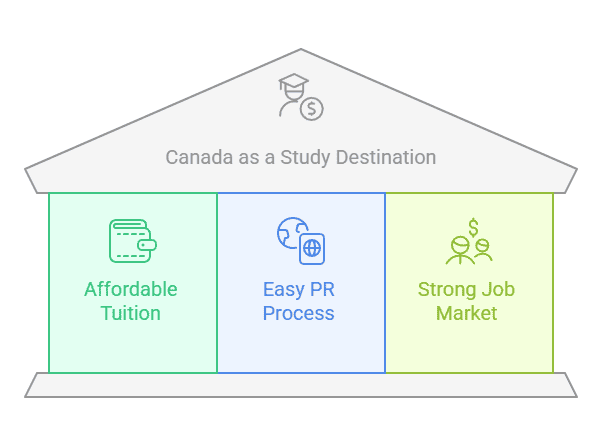
Higher Education Reputation: Canada offers a strong higher education system with several universities of global repute, though generally a step below the U.S./UK in rankings. Canada has 3 universities in the world’s top 100 (University of Toronto at #21, University of British Columbia, and McGill University are typically the highest ranked). Canada is also a popular destination for Indian students, who are drawn to its high-quality education and supportive environment. These schools, and others like McMaster, University of Montreal, and University of Alberta, are well-regarded internationally, known for research output and academic quality. While Canadian universities don’t carry the same prestige as the Ivy League or Oxbridge, they do rank highly in fields such as medicine, AI, environmental science, and business. A Canadian degree is widely recognized and respected, particularly in the U.S. and Commonwealth. For example, University of Toronto is often compared to top U.S. public Ivies, and McGill is famous as one of the top universities in the Americas. Class sizes at flagship Canadian universities can be large, but the education standard is consistently high, with many professors educated or affiliated with top global institutions. Overall, for expat families, Canada provides high-quality education (with several world-class programs) in an English/French-speaking environment that is often more accessible and affordable than the U.S. route. Canada is consistently ranked among the best countries for higher education, offering a supportive environment for international students.
Legacy Admissions Policies: Canadian universities, as public institutions for the most part, do not typically practice legacy admissions in the way U.S. private colleges do. Admission to Canadian undergrad programs is usually based on academic performance (grade 12 averages or IB scores) and sometimes supplemental applications or standardized tests, depending on the program. There is little evidence of legacy preference playing a role in admission decisions at major schools like U of T or McGill – the concept is largely an American phenomenon. A child of an alumnus might have some networking advantages or familiarity with the university culture, but no formal point boost is given. One exception: a few Canadian universities have legacy scholarships or small perks for children of alumni (for instance, University of British Columbia’s alumni association sometimes offers a scholarship exclusively for legacy students), but these do not impact admissions chances. Culturally, Canada emphasizes fairness and diversity in admissions, and universities are publicly funded, making it hard to justify legacy favoritism. Thus, expat parents should not expect an admissions advantage just from being alumni. However, the lack of legacy admissions is offset by generally higher acceptance rates at Canadian schools compared to ultra-selective U.S. colleges. The top Canadian universities are selective (McGill’s acceptance rate for international students can be around 40-50%, U of T’s varies by program) but not nearly as prohibitively competitive as Ivy League single-digit rates. This means that a well-prepared student stands a reasonable chance without needing legacy status.
Tuition Benefits for Citizens/Residents: One of Canada’s biggest draws is the relatively lower tuition and generous policies for permanent residents/citizens. Tuition in Canada is moderate for locals and still somewhat lower for internationals than U.S. levels. For example, at McGill University, annual undergraduate tuition for Quebec residents can be around CAD $2,500–$4,000 (since Quebec heavily subsidizes locals), for other Canadian residents around CAD $8,000, and for international students about CAD $26,500 (arts) to $60,000 (medicine) – these are illustrative figures. Similarly, University of Toronto’s tuition for Ontario residents is roughly CAD $6,000–$14,000 depending on program, while international fees range from CAD $60,000–$70,000 for fields like engineering or commerce. Thus, a Canadian PR or citizen pays dramatically less. Many universities have a two-tier system: domestic vs. international tuition, where domestic includes both citizens and permanent residents. By obtaining Canadian permanent residency, expats can ensure their children pay the local tuition rate. On average, Canadian citizens/residents might pay roughly one-third to one-half of what an international student would pay for the same program. Additionally, certain provinces have extra breaks: Quebec, as noted, has the lowest fees for Quebec residents; other provinces sometimes have small discounts for in-province students vs. out-of-province Canadians. Another aspect is public healthcare and social services – international students must often pay for private health insurance, whereas a PR/citizen student is covered under provincial healthcare (after any waiting period). All things considered, the cost of a degree for a Canadian citizen can be a fraction of the cost in the U.S., making Canada attractive for its high value.
Scholarship Eligibility: Canadian citizens and permanent residents have access to more funding opportunities as well. The Canadian government and provincial governments provide student loans and grants to domestic students based on financial need (through programs like OSAP in Ontario, or Canada Student Loans). These are not available to international students. There are also a variety of merit scholarships at each university earmarked for domestic students. For instance, UBC’s Premier Undergraduate Scholarships or University of Toronto’s President’s Scholars of Excellence are open to all, but some awards (especially those funded by Canadian government agencies or local organizations) may require citizenship/PR. Permanent residents are generally treated the same as citizens for scholarship purposes in Canada. Moreover, if a family immigrates to Canada when the child is young, the child may qualify for provincial tuition support (like Quebec’s nearly free CEGEP and university tuition for residents, or Alberta’s Rutherford Scholarship for Alberta high school graduates attending local universities). As a multicultural country, Canada also has scholarships targeting newcomers or children of immigrants, which an expat family might leverage after settling. While the pool of funding is not as large as in the U.S., the combination of relatively low tuition and available aid can make Canadian higher education quite affordable for locals.

Residency and Citizenship Pathways: Canada is known for its relatively expat-friendly immigration system, offering multiple pathways that are attainable for middle-class families, not just the ultra-wealthy. One route is the Quebec Immigrant Investor Program (QIIP) – historically, an investor could obtain Canadian permanent residence through Quebec by investing CAD $1.2 million (≈USD $870,000) for 5 years (often as a government bond), plus a smaller non-refundable contribution. This program was paused in 2019 but is slated to reopen with updated criteria. The expected new QIIP requires a net worth of CAD $2 million and an investment of CAD $1.2M (with around CAD $200k as a fee). Successful applicants get permanent residency up front, allowing the family to live anywhere in Canada. After 3 years of physical presence out of 5 years, one can apply for Canadian citizenship. Importantly, Canada allows dual citizenship with no issues – a Canadian can keep or acquire another nationality freely. Beyond the investor route, Canada has popular skilled immigration streams: the Express Entry system awards points for age, education, work experience, and language, enabling professionals to become PRs without an outright investment. Many expat families choose this route if the parents have in-demand skills, as it’s far less costly than investor programs. Another option is the Start-up Visa, which encourages entrepreneur families to found a company in Canada with backing from a designated Canadian venture fund or incubator – leading to PR. Investment requirements here can be much lower (e.g. funding a startup with maybe CAD $150k+). Additionally, each province has Provincial Nominee Programs (PNPs) which sometimes cater to investors or entrepreneurs at various investment levels (for example, Ontario’s entrepreneur stream may require around CAD $200,000–$600,000 investment depending on location). In summary, Canada offers a broad spectrum of immigration thresholds – from moderate investment or skill-based programs all the way to passive millionaire investor programs – making it feasible for a range of families. The timeline to citizenship is relatively fast (3 years residency) and the benefits for the child’s education are significant as discussed. These factors combined make Canada a top choice for families seeking a balance of high-quality education, reasonable investment, and eventual dual citizenship in a stable country.
Australia: Strong Academia in an English-Speaking, Multicultural Society
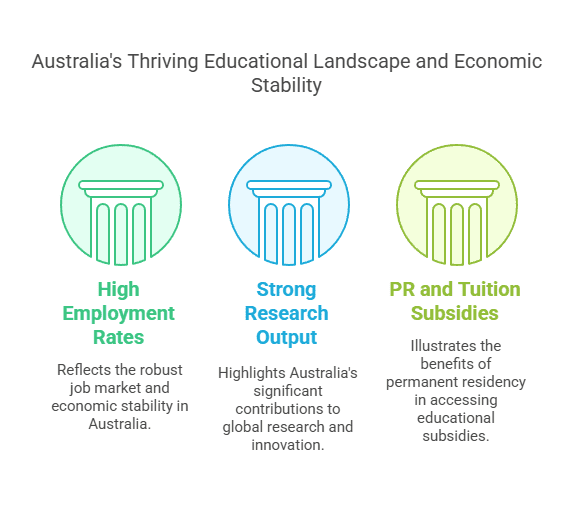
Higher Education Reputation: Australia is a major education destination in the Asia-Pacific, with 6 universities in the world’s top 100. Australia’s vibrant cities, such as Sydney and Melbourne, offer a lively and dynamic environment that enhances the educational experience for students. Its “Group of Eight” universities (led by Australian National University, University of Melbourne, University of Sydney, and University of New South Wales) are highly regarded, typically appearing in global top 50–100 lists. Australian universities excel in areas like medicine, engineering, environmental science, and business, attracting many international students from Asia and beyond. While Australian institutions may not be as globally famous as Harvard or Oxford, ANU and Melbourne, for example, have reputations on par with some top European universities. The academic quality and research output in Australia is strong – Australia produces a significant number of highly cited research papers and has Nobel laureates among its alumni/faculty. For an expat family, the appeal is a Western-style education in English, with robust facilities and often a more relaxed campus culture. Australian degrees are recognized in the UK, US, and elsewhere, and the country’s universities have partnerships worldwide (for instance, University of Melbourne has exchange programs with many Ivy League schools). Australia also shines in global university employability rankings, indicating graduates are well-prepared for jobs. In short, Australia offers prestigious education (though slightly below the U.S./UK tier) and is often considered for its high quality of life and education balance. Australia is frequently listed among the best countries for higher education, attracting students from around the world with its high-quality education and vibrant cities.
Legacy Admissions Policies: Legacy admissions are not a notable factor in Australia. Admissions to Australian universities, especially undergrad, are generally formula-driven based on academic results (such as the ATAR rank from high school or international equivalent scores). Universities in Australia are mostly public and must adhere to fair admission standards; giving preference to alumni children is not an established practice. If anything, some Australian universities encourage multi-generational attendance through alumni scholarships or tuition discounts for family of alumni, but these incentives come after admission and do not affect the selection process. For example, the University of Sydney might have an alumni family bursary taking a percentage off tuition for a student whose parent is an alum. But the student still needs to meet the same ATAR cutoff or entry requirements as others. Thus, expat parents will not gain an admissions edge for their child simply by having studied there. Instead, the benefit of an Australian connection would be familiarity with the system or perhaps networking for postgraduate opportunities. Culturally, Australian higher ed has an egalitarian ethos similar to Canada’s, so legacy preference is virtually absent. The upside is that many programs (except the ultra-competitive like medicine) have clear entry criteria, so a well-qualified student has a transparent path to admission.
Tuition Benefits for Locals: Australia, like other countries, differentiates tuition between domestic and international students. Citizens and permanent residents are eligible for Commonwealth-subsidized places at public universities. Domestic undergraduates typically study in a Commonwealth Supported Place (CSP), where the government subsidizes a large portion of the tuition and the student pays a student contribution amount. For example, an Australian citizen in a humanities course might pay around A$6,000 per year, whereas an international student might pay A$30,000 for the same course. For a high-cost course like medicine, a domestic student might pay A$11,000/year (with government covering the rest) versus an international fee of A$70,000+. Furthermore, Australian citizens (and some qualifying PRs) can use the HECS-HELP loan scheme to defer their student contribution, paying nothing upfront and repaying via the tax system only when income crosses a threshold. Permanent residents and New Zealand citizens are treated as domestic for tuition pricing (they pay the low fees) but currently cannot defer fees through HECS-HELP – they must pay the student contribution upfront. Nonetheless, the cost is far lower than international fees. By securing Australian PR or citizenship, an expat ensures their child is eligible for these subsidized university spots. Another consideration: children of Australian citizens born abroad can typically get citizenship by descent, and PR holders’ children born in Australia usually become citizens at birth, automatically granting them local student status. In summary, domestic status in Australia can save tens of thousands in tuition each year, making a huge difference over a 3-4 year degree.
Scholarship Eligibility: Domestic students in Australia have access to various scholarships and support as well. Each university and state offers scholarships for high-achieving locals (e.g. UNSW Co-op Scholarship, which includes industry placements and is only open to citizens/PRs). The Australian government also has programs to support Indigenous and low-income domestic students that wouldn’t apply to international students. Additionally, only citizens and PRs can receive government student allowances like Youth Allowance or Austudy for living expenses while studying, if they meet criteria. These aren’t scholarships per se, but they reduce financial burden. While Australia doesn’t have as vast an array of scholarships as the U.S., there are still significant awards (the Australian National University Chancellor’s Scholarship, etc.) reserved for domestic or regional students. Permanent residents become eligible for most of these on par with citizens, except a few that explicitly require citizenship (such as some defense-funded programs). For post-graduate study, Australian citizens/PRs have access to Research Training Program scholarships for PhDs, and substantially lower PhD tuition (often free for domestic students). An expat child with Aussie status could benefit from all these opportunities, whereas an international student in Australia is typically paying full fees and relying mostly on self-funding. Thus, obtaining local status in Australia not only slashes tuition but also opens up financial aid, loans, and scholarship avenues that make higher education more accessible.
Residency and Citizenship Pathways: Australia has had investor visa options as well, although the main Significant Investor Visa (SIV) – requiring an investment of AUD $5 million (~USD $3.3M) – was halted in 2023 as the government shifted focus to skilled migration. Under that program, wealthy individuals could get a provisional visa and then permanent residency after maintaining the $5M investment for a few years. With the SIV closed, prospective expats look to alternative pathways. The Business Innovation and Investment (subclass 188) visas still exist in other streams: an Investor stream requires AUD $2.5M investment in state bonds or funds and business experience, and a Business Innovation stream requires owning and operating a business with certain turnover in Australia (investment around AUD $800k+ and meeting business benchmarks). These can lead to permanent residence (subclass 888) after meeting criteria for 3-4 years. More commonly, Australia attracts expats via the Skilled Migration route. The Skilled Independent visa (subclass 189) is a points-tested system for workers in occupations in demand – if the applicant has a decent education, work experience, and English ability and is under age 45, they may secure PR with no job offer needed. There are also state-nominated visas (190, 491) that can be easier if one is willing to live in specific regions, and employer-sponsored visas (482, transitioning to 186 PR) if one has an Australian job offer. Many expat families choose Australia for its straightforward skilled PR process, which can be achieved with professional qualifications rather than a large financial outlay. The timeline for citizenship in Australia is 4 years of residency (with at least 1 year as a permanent resident), after which one can apply for citizenship and typically obtain it in a few months. Australia fully allows dual citizenship – there is no requirement to renounce other nationalities upon naturalizing. This is attractive for families who want to retain their original citizenship. In terms of investment spectrum, Australia’s options range from no investment for skilled PR (just meeting criteria), to moderate investment for entrepreneur visas, up to multi-million for significant investors (though that door is currently shut). After obtaining PR, education benefits for children apply immediately (children of PRs are domestic students). All things considered, Australia offers a balanced path: relatively achievable immigration, a high standard of education and living, and the ability to hold dual citizenship, making it a top contender for expat families.
Singapore: Asian Tiger with Top Universities (Dual Citizenship Not Allowed)
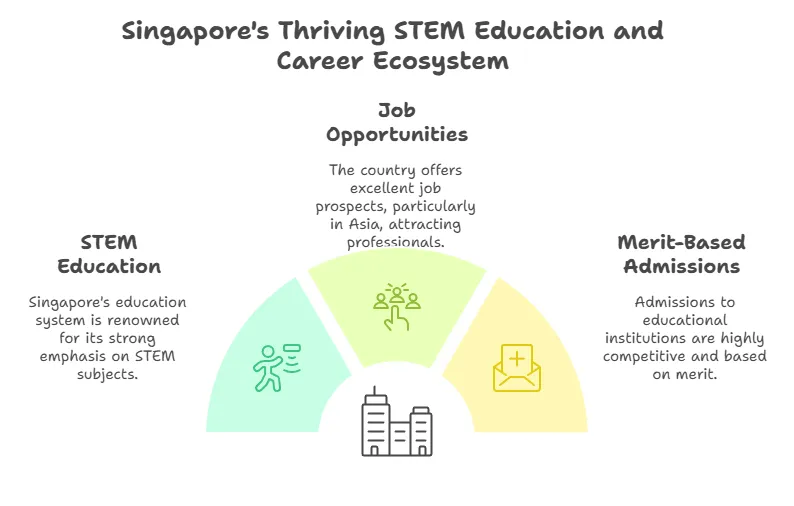
Higher Education Reputation: Singapore, though a small nation, punches above its weight in education with renowned universities like the National University of Singapore (NUS) and Nanyang Technological University (NTU). It has 2 universities in the global top 20 – the National University of Singapore (NUS) and Nanyang Technological University (NTU), which are consistently the highest ranked in Asia (NUS was ranked #19 globally in THE 2024). These universities are known for excellence in engineering, computer science, business, and natural sciences, and they attract faculty and students from around the world. For example, NUS’s engineering and technology programs are often compared to those at top U.S. institutions. Beyond NUS and NTU, Singapore has other prestigious institutions: Singapore Management University (SMU) for business and law, and affiliations like Duke-NUS Medical School and Yale-NUS Liberal Arts College (which recently merged back into NUS). The education system in Singapore is rigorous and English-speaking, blending British and American pedagogical influences with an Asian focus on STEM. Graduates from Singaporean universities are highly sought after in global finance, consulting, and tech, especially within Asia-Pacific. Singapore itself is a major financial and tech hub, so local grads have access to internships and jobs at companies like Google Asia-Pacific, Goldman Sachs, etc. For expat families particularly from Asia, Singapore is seen as offering Ivy League-level education closer to home. In summary, Singapore provides a world-class, English-medium university education, making it an attractive destination for families prioritizing academic excellence. Singapore is recognized as one of the best countries for higher education in Asia, offering world-class universities and a strategic location.
Legacy Admissions Policies: Singapore’s universities do not publicly practice legacy admissions. Admission to NUS, NTU, and others is primarily based on academic achievement (e.g. A-level results, SATs, etc.), standardized tests, and interviews for certain courses. Being the child of an alumnus does not confer a formal advantage in the competitive entry process. However, given Singapore’s small size, networking can play an informal role – for instance, an alumni parent might know professors or have connections that could guide their child’s application or provide reference letters. But there is no official legacy preference policy at NUS/NTU akin to the U.S. system. Each applicant, local or foreign, competes mainly on grades and co-curriculars. That said, one could interpret “legacy” in another way: if a parent studied in Singapore and the family has ties there, the child might be more likely to attend the same university simply due to familiarity or family expectation. Still, the admissions odds are determined by performance (for example, NUS medicine has a strict quota and admits based on exams and interviews only). So, expat families should treat Singapore admissions as meritocratic. One difference: Singapore’s public universities do have a policy favoring citizens and permanent residents in admissions. While not explicitly stated as a quota, in practice a significant majority of seats (especially in high-demand courses like medicine or law) go to Singapore citizens first, then PRs, then international students. This is partly because the government subsidizes education heavily for citizens/PRs, and it wants to educate its own population. Therefore, obtaining Singapore permanent residency can improve a child’s chances of admission indirectly by putting them in the “local” applicant pool, which is given some priority.
Tuition and Subsidies: Singapore’s universities have a dual fee structure. Citizens pay the lowest tuition, PRs pay slightly more, and international students pay highest. For example, an NUS undergraduate degree might cost around S$8,200 per year for a Singapore citizen, S$11,500 for a permanent resident, and S$17,500 for an international student (these figures vary by course) – and courses like medicine or music have higher fees. On top of that, the Singapore government offers a Tuition Grant scheme that heavily subsidizes these amounts for all students (including internationals), but with a catch for foreigners: an international student who takes the tuition grant must sign a bond to work in Singapore for 3 years after graduation. Citizens and PRs don’t have such a bond; it’s simply a subsidy. If an international student opts out of the subsidy, the fees are extremely high (e.g. S$40k+ per year), which few do. The key point: a Singapore citizen not only pays the lowest fees but also has no work obligation, a PR pays slightly more but also no bond, whereas an international pays more and is bonded if subsidized. Therefore, becoming a Singapore PR or citizen substantially reduces tuition costs and conditions. Additionally, citizens (and to a lesser extent PRs) have access to more financial aid. Singapore citizens can get government bursaries and loans that are more generous, while foreign students have more limited aid. It’s worth noting that even the unsubsidized international fee in Singapore is often lower than out-of-state tuition at a top U.S. university, which shows the relative affordability due to government support. But certainly, local status helps. For instance, medical school at NUS for citizens is about S$28k/year, for PR S$38k, for international S$60k (all heavily subsidized rates), and only foreigners have to serve the 3-year bond. Thus, for long-term planning, obtaining PR or citizenship in Singapore can save a family tens of thousands in tuition and give the student more freedom post-graduation.

Scholarship Eligibility: Singapore offers many scholarships, especially merit-based ones, often tied to service obligations. The most prestigious are government scholarships (like the PSC Scholarship) for citizens, which sponsor studies in Singapore or abroad in return for serving in the civil service. Only citizens are eligible for those. Universities themselves offer scholarships to top incoming students: some are open to all nationalities (e.g. NUS Global Merit Scholarship), but again, many more slots are given to locals. Permanent residents are sometimes eligible for “local” scholarships, but certain awards (especially those with government career pipelines) require citizenship. However, PRs can apply to most university-provided scholarships which typically cover tuition and possibly a stipend. In addition, being a PR or citizen allows students to do paid internships or take on part-time jobs more freely under Singapore’s labor rules, which can support their education. The Tuition Grant mentioned earlier is effectively a grant for all, but as noted, it comes with a work requirement only for foreigners. There are also bursaries for lower-income students that citizens and PRs can get easily, whereas international students are not prioritized for those. So, while Singapore’s primary financial benefit is the tuition subsidy, the secondary benefit is access to scholarships and bursaries primarily reserved for its residents.
Residency and Citizenship Pathways: Singapore has a well-known Global Investor Programme (GIP) for obtaining Permanent Residency. Currently, the GIP requires an investment of S$2.5 million (~USD $1.8M) into either a new or existing business in Singapore, or into a government-designated fund. Applicants must also have a successful entrepreneurial track record. Through this investment, one can obtain Singapore PR for the family. PR is the main goal for many, because Singapore citizenship is much harder and requires renouncing other citizenships (Singapore strictly forbids dual citizenship beyond age 21). Typically, one must reside as a PR for several years (2–3+ years) and show integration (e.g. at least one son completing NS, or entire family residing there) before being considered for citizenship, and even then it’s not guaranteed. So most expats aiming for education benefits will be content with PR status. PR in Singapore gives almost all rights of citizens except voting and holding public office; crucially, PRs count as locals for education and jobs. Outside the investor route, one can become PR via the Professional/Technical Personnel route – essentially, by working in Singapore on an Employment Pass and then applying for PR after a couple of years of stable employment. Singapore does not have a direct “golden visa” aside from the GIP; one must either invest or be a valued working professional. The investment threshold at S$2.5M is relatively high, reflecting Singapore’s selectivity. There is also an option for those who found or bring startups via certain incubator schemes, but they usually funnel into the main GIP or work pass system. The timeline for PR can be as short as 6-12 months after applying, if approved. Many factors (education, salary, family ties) weigh into approval. Once the family is PR, the children can attend local schools and later universities as locals (though note: local public school admission can be competitive for PRs). If the family does pursue citizenship eventually, they must relinquish their previous citizenships, since Singapore law states dual nationality is not allowed and one must renounce the other citizenship during the naturalization process. This is a major consideration – some families might keep PR status long-term instead. Another aspect: male PRs who are granted PR at a young age (below 18) and who reside in Singapore are expected to serve national service like citizens (failure to do so can bar future citizenship or even have legal consequences). This is often a deterrent for some; others see it as acceptable. In any event, Singapore ranks highly based on educational opportunities, but it is also among the most restrictive in dual citizenship. The ideal candidate for Singapore would be an expat family already inclined to relocate to Singapore for work or business, who can then secure PR and enjoy the education system. The investment is high, but it comes with the benefit of living in one of the world’s most advanced cities and educating children in top-notch institutions – a trade-off many consider worthwhile for the long-term payoff.
Switzerland: Elite STEM Universities in a High-Quality Setting
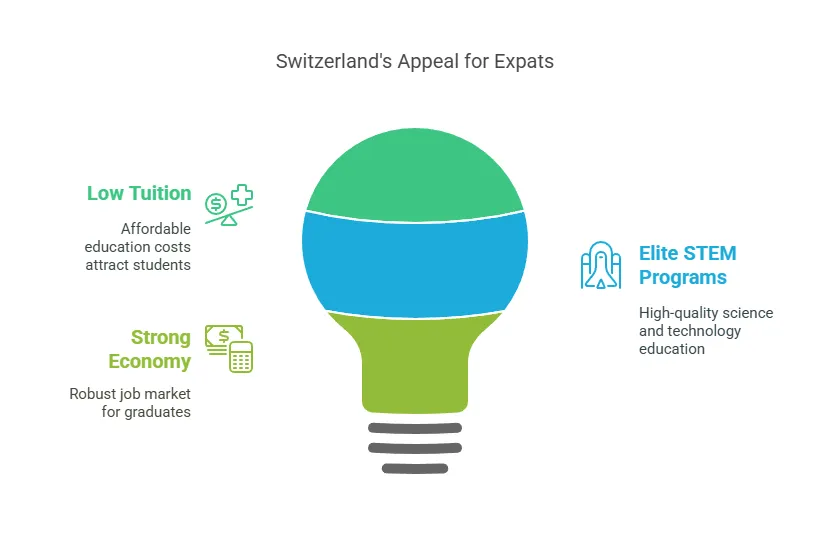
Higher Education Reputation: Switzerland is renowned for its high-quality education and is home to two of Europe’s top universities: ETH Zurich (Swiss Federal Institute of Technology) and EPFL (École Polytechnique Fédérale de Lausanne). ETH Zurich in particular is often ranked the #1 university in continental Europe and sits around 11th globally, putting it on par with the Ivy League in engineering and science. Alumni include Albert Einstein and many Nobel laureates. EPFL is also in the global top 20-30 range and is world-leading in areas like computer science, cyber-security, and life sciences. These schools make Switzerland a global STEM education powerhouse. Besides the federal institutes, Switzerland has other respected universities (University of Zurich, University of Geneva, etc.) which are strong regionally, and famous hospitality/business schools (like EHL and IMD for an MBA) albeit those are private and costly. For an expat family, Switzerland offers arguably the best science and technology education in Europe, with degrees held in very high esteem by employers and academia worldwide. The country also has a multilingual advantage – universities may teach in German, French, or English depending on the region and program, producing graduates comfortable in multiple languages (ETH Zurich predominantly in German at undergrad, EPFL in French; many Master’s and PhD programs in English). Given Switzerland’s small size, its universities have a high concentration of talent and funding; ETH’s research budget and facilities rival those of big U.S. universities, meaning students have access to cutting-edge labs and projects. In summary, although Switzerland has a small number of universities, their global standing is exceptional, making it a top destination for elite academic pursuits, particularly in technical fields. Switzerland is often ranked among the best countries for higher education, particularly in STEM fields, due to its elite universities and high-quality setting.
Other Countries to Consider for Higher Education
In addition to the top countries listed earlier, there are several other countries that international students may want to consider for higher education. Here are a few examples:
Ireland: Known for its vibrant cities, stunning landscapes, and friendly people, Ireland is a popular destination for international students. Trinity College Dublin and University College Dublin are two of the country’s most prestigious universities, offering high-quality education and a rich cultural heritage. Ireland’s welcoming atmosphere and strong academic reputation make it an attractive option for those looking to study abroad.
Sweden: Sweden is known for its innovative approach to education and its commitment to sustainability. The country is home to several world-class universities, including the Technical University of Stockholm. Sweden’s focus on research and development, along with its high quality of life, makes it an appealing destination for international students seeking academic excellence and a progressive environment.
New Zealand: With its stunning natural beauty and outdoor lifestyle, New Zealand is a popular destination for international students. The country is home to several top-ranked universities, including the University of Auckland and the University of Otago. New Zealand offers a unique blend of high-quality education and a relaxed, adventurous lifestyle, making it an ideal choice for students who value both academic and personal growth.
Finland: Finland is known for its high-quality education system and its commitment to innovation. The country is home to several top-ranked universities, including the University of Helsinki and Aalto University. Finland’s focus on student-centered learning and its supportive academic environment make it an attractive destination for those seeking a high-quality education in a progressive and inclusive society.
These countries offer a range of academic programs, cultural experiences, and career opportunities that may appeal to international students. By exploring these additional options, students can find the best fit for their educational and personal goals.
Residency & Citizenship Pathways
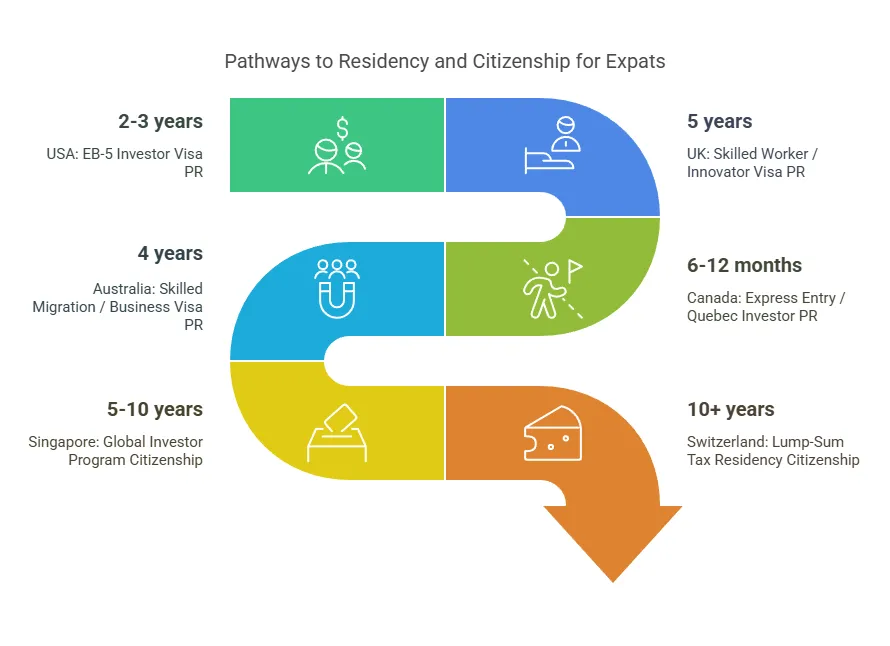
| Country | Main Residency/Citizenship Routes for Expats | Investment/Criteria | Time to PR/Citizenship | Dual Citizenship |
|---|---|---|---|---|
| United States | EB-5 Investor Green Card (direct path to PR for family) Employment-based visas (H-1B then green card); Family sponsorship if applicable. | EB-5: Invest $800K–$1.05M in a new U.S. business creating 10 jobs Other: Job offer in specialty field (no direct investment, but need employer sponsor and often lottery for H-1B). | EB-5: ~2–3 years to conditional green card, then 2 years to full PR eligible for citizenship 5 years after initial PR. Employment: ~1–2 years to PR (after job) + 5 years to citizenship. | Yes – The U.S. imposes no renunciation requirement One can naturalize as American and keep existing citizenship (if other country permits). |
| United Kingdom | Skilled Worker Visa (job-based), Innovator Founder Visa (business startup ~£50K), previously Tier-1 Investor (£2M, now closed) Family visa if spouse is UK citizen. | Skilled: Job offer meeting salary/skill requirements (investment = N/A). Innovator: Endorsed business plan + ~£50,000 funding. (Investor route was £2 million in UK assets, but closed in 2022). | Skilled/Innovator: Typically 5 years residence → apply ILR (permanent status) + 1 year → citizenship (6 years total). Investor (when it existed): ILR in 2–5 years depending on £ investment, citizenship after 5-6 total | Yes – The UK allows multiple nationalities. Naturalized Britons can retain previous citizenship. |
| Canada | Express Entry (Skilled Worker); Quebec Immigrant Investor Program (QIIP) Start-up Visa (entrepreneur with VC support); Provincial entrepreneur programs; Family sponsorship. | EE: Point-based (education, experience, etc.), no fixed investment. QIIP (reopening 2024): ~CAD $1.2M investment (5 years, government-guaranteed) + ~$200k contribution;Net worth ~CAD $2M Start-up: Proof of concept and CAD $200k from a designated investor (or $75k from incubator). | PR timeline: EE could be 6–12 months after application (fast). QIIP: ~2–3 years to PR (investment is passive). Citizenship: 3 years physical presence (out of 5) as PR to be eligible | Yes – Canada fully allows dual citizenship. No requirement to renounce original nationality |
| Australia | Skilled Independent (189) or State-Nominated (190) Visa; Business Innovation & Investment (subclass 188) streams; (Significant Investor Visa of A$5M was halted in 2023) Also family sponsorship. | Skilled: Points-based, need occupation on list, good English (no direct money investment). Business (188A): Investment of ~AUD $300–600K in a new or existing business plus criteria; Investor (188B): AUD $2.5M in state bonds/funds; Significant Investor (188C): AUD $5M in investments (currently on hold) | Skilled: Direct PR or 5-year visa → PR; roughly 4 years to be eligible for citizenship (with 1 year as PR) Business: 5-year provisional, convert to PR after meeting business/investment for ~3 years, then citizenship after total ~5+ years. | Yes – Australia allows dual citizenship. Naturalizing Australians need not give up other passports. |
| Singapore | Global Investor Programme (GIP) (investor PR) Employment Pass to PR (work in SG then apply for PR); family ties (spouse of citizen/PR). | GIP: Invest S$2.5 million (≈USD $1.85M) in a new or existing business, or approved fund in Singapore Must have entrepreneurial track record. Employment Pass: Salary generally ≥ S$5-10K/month job; after ~2 years on EP, can apply for PR (no direct investment, but economic contribution via job). | PR approval: ~6-12 months after application (families often get PR with main applicant). Must usually hold PR 2+ years before eligible to apply for citizenship, but citizenship is not guaranteed and is selective. Total 5-10 years residence common before naturalization. | No (dual not allowed) – Singapore requires renouncing former citizenship to become Singaporean Also, mandatory military service for male citizens and 2nd-gen PR. Many expats remain PR (indefinite status) without taking citizenship due to this. |
| Switzerland | Lump-Sum Tax Residency (for wealthy retirees) Business Investor Permit (cantonal approval required, invest ~CHF 1M+ into business and create jobs); Work Permit (employer-sponsored, limited quotas for non-EU). | Lump-sum tax: Negotiate tax based on cost of living, typically taxed on imputed income ~CHF 400K+ (actual tax ~CHF 150–300K/yr) , varies by canton (higher in popular cantons). Business: Generally expect CHF 1M+ investment and local employment creation (no fixed minimum by law, but must substantially benefit economy). Work: Job offer with proof no Swiss/EU available, salary per Swiss standards. | Residence: Granted immediately upon approval of tax agreement or work permit (B Permit, annual, or L Permit). Permanent Residence (C Permit) after 10 years (can be 5 for select nationalities). Citizenship requires 10 years residency (some cantons require longer local residence), language skills, and passing community interview; process can take ~1-2 years after applying. | Yes – Switzerland permits dual citizenship without restriction since 1992 (Many naturalized Swiss keep their original citizenship.) But integration is key – one must adapt to Swiss life to be naturalized. |
Conclusion

Families prioritizing long-term educational planning for their children should weigh both the academic advantages and the immigration feasibility of the best countries for higher education. The United States and United Kingdom offer unparalleled university prestige and legacy admissions boosts, but come with high costs and significant investment (or effort) to secure status. Canada and Australia provide a balance of high-quality education, lower investment thresholds, and relatively easy immigration processes, making them popular choices for many expats seeking dual citizenship and affordable degrees. Germany and the broader EU present the opportunity of virtually free education and continental mobility – recent reforms allowing dual citizenship in Germany enhance its appeal, though the path to citizenship can be longer. Singapore represents a unique case of top-tier education in Asia with strict citizenship rules; it is ideal for those focused on Asian opportunities and who are prepared for the trade-offs of Singaporean PR/citizenship (such as military service and no dual nationality). Switzerland boasts two of the world’s best universities and a superb training ground for STEM fields; however, it targets either the very affluent or those with niche skills when it comes to residency, given its costly and demanding immigration route.
In making a decision, families should consider not only university rankings and legacy policies but also the overall environment – including language, culture, networking potential, and post-graduation career prospects. For example, a U.S. or UK education might open doors globally, but an EU citizenship could grant a child the flexibility to study and work across dozens of countries with ease. Similarly, a Canadian or Australian passport coupled with a local degree can set the stage for a stable, high-quality life in those countries, with the option to move freely within certain international agreements (Commonwealth ties, USMCA, etc.). It’s also important to factor in family priorities like the ability to retain original citizenship, the time one is willing to wait for naturalization, and any service obligations (as in Singapore or some Gulf states not covered here).
Ultimately, there is no one-size-fits-all answer – each country offers a distinct mix of educational opportunity, financial cost, and legal commitment. This comparative analysis has highlighted that legacy admissions – while a powerful tool – are predominantly a U.S. phenomenon, and elsewhere the value of residency lies more in tuition benefits and local status. Families should align their expat strategy with their children’s academic interests (for instance, if a child aims for engineering, ETH Zurich or MIT might shape the choice; if they value multilingual education, perhaps the EU route). By securing the appropriate residency or second citizenship well in advance, parents can unlock these opportunities and give their children a head start in the increasingly competitive arena of global higher education.
