
Expats seeking to gain citizenship and secure a second citizenship often prioritize places where that citizenship can be inherited by children and grandchildren. This comparative analysis examines the top countries offering intergenerational citizenship benefits, covering citizenship by descent policies, generational inheritance rules, dual citizenship allowances, naturalization timelines, and residency or investment requirements. We also include currency conversions for any financial thresholds (in USD), and provide comparative tables for clarity.
Citizenship by Descent and Generational Inheritance
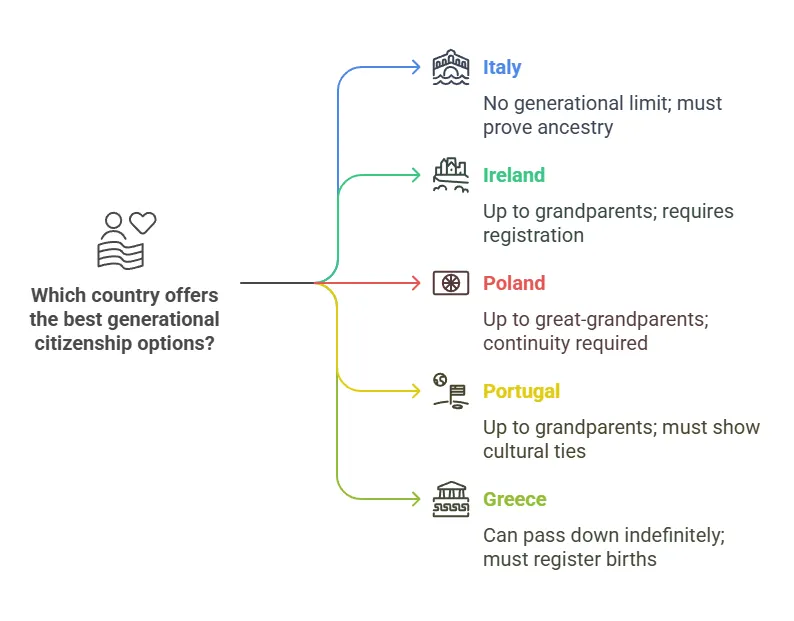
Many countries grant citizenship based on ancestry (jus sanguinis), allowing expats with heritage from those nations to claim citizenship and pass it to their descendants. However, the extent of inheritance varies:
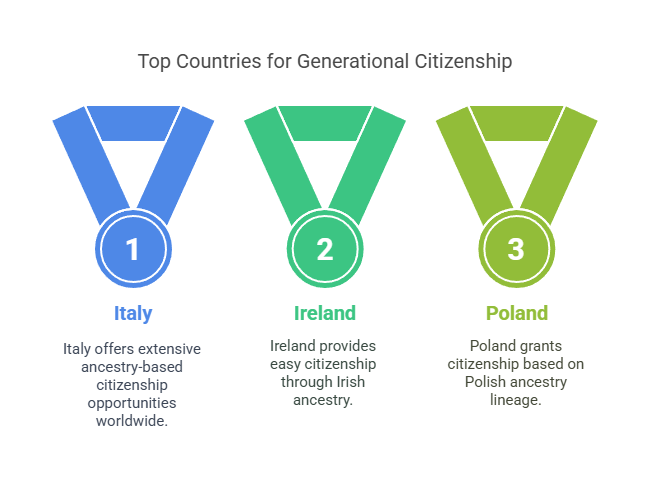
Italy: Renowned for one of the most generous ancestry laws. If you have an Italian ancestor (as far back as great-great-grandparent or more), you can apply for Italian citizenship by descent. There is no generational limit – the bloodline can continue indefinitely, provided none of your ancestors renounced their Italian citizenship before the next in line was born. (One caveat: the Italian ancestor must have been alive on or after 1861, the year of Italy’s unification.) Once obtained, Italian citizenship is automatically passed to your children, and so on. Italy allows dual citizenship, so you don’t have to give up your original nationality.
Ireland: Offers citizenship by descent up to one generation born abroad (parent) automatically, and extends to a second generation (grandchild) if you register in the Foreign Births Register. In practice, if you have an Irish citizen parent or an Irish-born grandparent, you can claim Irish citizenship. Even great-grandchildren of an Irish-born citizen qualify, but the intermediate parent/grandparent must have registered or been an Irish citizen at the time of the next generation’s birth. Essentially, each generation born abroad needs to be registered to keep the citizenship chain unbroken. Ireland permits dual citizenship freely.
Poland: Grants citizenship by descent to those with a Polish parent, grandparent, or even great-grandparent, as long as the ancestor lived in Polish territory after 1920 and did not lose Polish citizenship before the descendant’s birth. This means Polish nationality can be confirmed for multiple generations abroad if documentation proves continuous citizenship. Poland, like Italy and Ireland, recognizes dual citizenship, so retaining your original passport is not an issue.
Portugal: If you have a Portuguese parent, you’re automatically eligible for citizenship. Since 2020, Portugal also allows grandchildren of Portuguese citizens to apply, provided you can demonstrate a basic knowledge of the Portuguese language and ties to Portugal. (Portugal even has a special program for descendants of Sephardic Jews exiled centuries ago.) For those without Portuguese ancestry, Portugal’s naturalization period is a relatively short 5 years of residency – one of the quickest in the EU – and it famously does not require full-time residency during those years for Golden Visa investors (more on that later). Portugal allows dual citizenship with no restrictions.
Spain: Spanish citizenship by descent is typically limited to one generation (a Spanish parent). However, recent laws (e.g. the 2022 “Grandchildren Law”) have offered avenues for grandchildren of Spanish nationals — especially descendants of exiles — to obtain citizenship. Generally, if you have a Spanish parent or grandparent, you may be eligible, but Spain’s rules are more restrictive. Notably, a child born abroad to a Spanish citizen who was also born abroad must actively declare their desire to retain Spanish nationality by age 21, or they lose it. This prevents an indefinite chain of inherited Spanish citizenship if families remain overseas. Spain does permit dual citizenship only in specific cases – usually if the other country is a Latin American or former Spanish territory (we cover this under dual citizenship below). If you naturalize in Spain as a foreigner from outside those favored countries, you are legally required to renounce your previous citizenship (even though enforcement may vary).
Greece: A Greek parent can pass citizenship to their child automatically. In fact, Greek nationality law allows transmission “from generation to generation indefinitely” as long as each descendant has a parent with Greek citizenship. In practice, this means an unbroken line of Greek citizens can continue forever. However, one must register births and maintain the family record in Greece to formalize the status. Greece allows dual citizenship outright.
Germany: German citizenship is by descent if at least one parent is German. But Germany imposes a notable generational restriction for those born abroad: A child born outside Germany to a German parent who was also born abroad (after 1999) does not automatically receive citizenship unless the birth is registered with German authorities within one year. This rule means that while a German expat can pass citizenship to their children, if the family remains abroad, they must actively register each new birth. Failing to do so breaks the chain for subsequent generations. (This rule doesn’t apply if the child would be stateless, in which case Germany grants citizenship by necessity.) As of 2024, Germany is updating its laws to be more permissive with dual citizenship (previously, naturalizing as German often required renouncing the prior nationality) – we detail this below.
United Kingdom: The UK confers citizenship by descent to one generation born abroad. If you’re born outside the UK and one of your parents is British otherwise than by descent (meaning the parent is British by birth or naturalization, not merely by descent), then you are automatically British. However, your own children born abroad will not automatically be British unless other conditions are met. This effectively limits automatic inheritance to the first foreign-born generation. The UK does have some complex provisions for “double descent” in limited cases (e.g. a grandchild of a UK-born citizen might claim British citizenship in specific historical circumstances, especially if born before 1983), but generally an expat cannot skip straight to a UK-born grandparent for citizenship unless they use the UK Ancestry visa route (a 5-year residency path for Commonwealth citizens with a UK grandparent). The UK imposes no restriction on dual citizenship.
Canada: Canada allows citizenship by descent for children born abroad to Canadian citizens (first generation). Until recently, it did not extend to grandchildren born abroad – a rule known as the “first generation limit.” For example, a Canadian citizen born in Canada can pass citizenship to their child born abroad, but that child (Canadian by descent) could not pass it to their foreign-born child. However, this policy is evolving. A 2023 court ruling deemed the second-generation cutoff unconstitutional, and Canada plans to amend the law to allow citizenship to pass to further generations if the Canadian parent has lived in Canada for at least 3 years. This means in the future Canadian expats who spent some formative years in Canada could transmit citizenship to grandchildren born abroad. Canada, like most Western countries, permits dual citizenship.
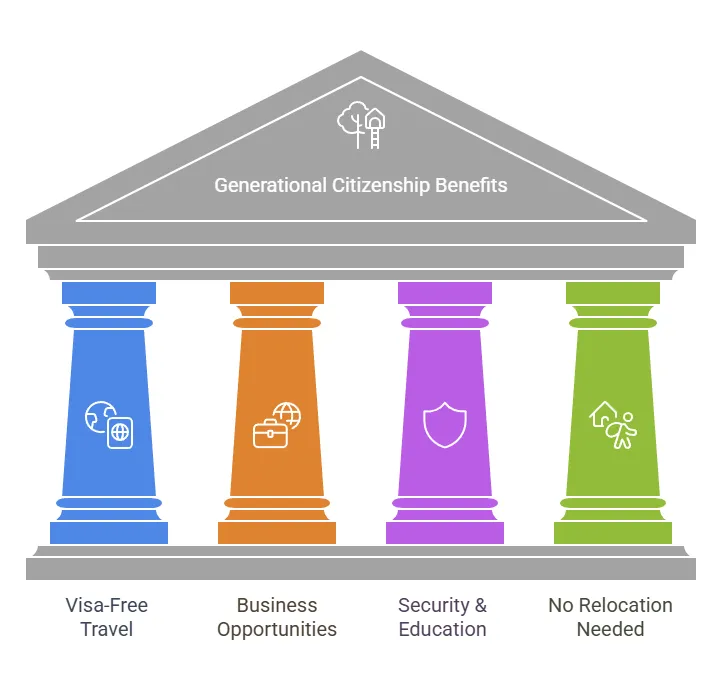
Becoming a legal citizen through descent ensures that your descendants can also benefit from the same privileges.
Note: Other countries with favorable ancestry laws include Hungary (citizenship by descent up to grandparents with a basic language test), Croatia (recently simplified descent for diaspora, removing language requirements for applicants of Croatian heritage), Lithuania (allows grandchildren and great-grandchildren of citizens who fled during WWII to reclaim citizenship), and Israel (offers immediate citizenship to those of Jewish descent under the Law of Return). Each country has unique conditions on how far back you can go and whether you must demonstrate cultural or language ties.
Generational Inheritance Rules at a Glance
Some countries allow citizenship to be passed down indefinitely under jus sanguinis, while others impose limitations to prevent an endless chain of citizens born abroad with no connection to the homeland. Key patterns include:
Indefinite Jus Sanguinis: Italy and Greece are prime examples where, in theory, citizenship can continue ad infinitum down the bloodline. In practice, families need to maintain records (e.g., register births with consulates), but there’s no legal generational cutoff.
One-Generation Rule: Countries like the UK and Australia typically restrict automatic citizenship by descent to children only. For instance, a British or Australian citizen born or naturalized in-country can pass citizenship to their child born abroad, but not to a grandchild born abroad unless the child (parent) returns and settles. (Australia requires a citizen by descent to live in Australia for at least 2 years before they can transmit citizenship to offspring.) This encourages at least one generation to reside in the homeland before the next generation is born, to maintain ties.
Registration Requirements: Germany and Switzerland require administrative action to continue citizenship beyond one generation abroad. Germany’s one-year birth registration rule for second-generation expats is one example. Switzerland similarly mandates that foreign-born children of Swiss citizens be registered with a Swiss consulate by age 22 to retain citizenship. Spain’s requirement that foreign-born grandchildren of Spaniards formally declare their intent to keep citizenship between ages 18–21 is another such measure. In some countries, maintaining a permanent residence permit is crucial for the citizenship application process.
Skipping Generations: Generally, you cannot “skip” a generation – meaning you can’t claim a great-grandparent’s citizenship directly if the intermediate generations did not have or claim that citizenship. One exception is through special programs or if laws change. For example, Ireland doesn’t technically skip, but it allows a grandchild to claim directly via the foreign births registry even if the parent was not an Irish citizen. In effect, the grandchild becomes the first in the family to hold Irish citizenship, re-establishing the chain for future generations. Similarly, Poland’s confirmation process can establish you as a citizen even if your parents didn’t know they were Polish – because legally the citizenship passed (as long as no one lost it). These mechanisms can appear to “skip” generations but really are retroactively recognizing that the lineage conferred citizenship all along.
Dual Citizenship Allowances and Restrictions
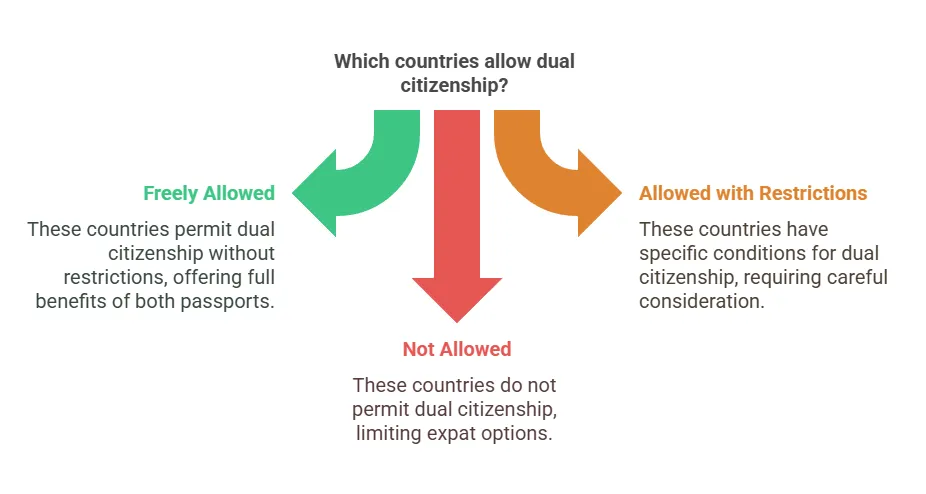
When obtaining a second citizenship, expats usually want to keep their original citizenship for maximum flexibility. Dual citizenship policies therefore are crucial in choosing a country:
Freely Allow Dual Citizenship: United States, Canada, United Kingdom, Ireland, Italy, France, Portugal, Sweden, and most of the Americas (e.g., Argentina, Brazil) permit dual nationality with virtually no restrictions. If you naturalize in or derive citizenship from these countries, you are not required to renounce your existing citizenship. For instance, an American gaining Italian citizenship by descent can hold both passports, and an Italian moving to Canada can become Canadian without losing Italian status. Holding an EU citizenship, such as from Italy or Ireland, allows you to live and work in any EU member state. This is the ideal scenario for expats seeking a second passport.
Allowed with Some Caveats: Some countries formally allow dual citizenship but have quirks. Spain is a prime example – it allows dual citizenship only for Spaniards by origin (birth or descent) and with certain countries. Spaniards who naturalize in a Latin American country (or a select few like Andorra, Philippines, Equatorial Guinea, Portugal) can keep both nationalities. Conversely, foreigners who naturalize as Spanish must renounce their old citizenship (unless they are nationals of those special countries). In practice, this means an expat from Latin America can become Spanish and retain dual status due to reciprocity agreements, while, say, an American or Indian would be asked to renounce (though the U.S. or India might not acknowledge that renunciation). Russia and Turkey also allow dual citizenship but require you to inform the authorities and may impose limitations (e.g., dual citizens in Russia must report foreign citizenship and cannot hold certain government jobs). Australia and New Zealand both allow dual citizenship broadly, but note that until the 2000s Australia did not – it changed in 2002 to let Aussies hold multiple nationalities freely.
Disallow or Strongly Discourage Dual Citizenship: A minority of countries require exclusive allegiance. Austria and Singapore are famously strict – they generally do not allow dual citizenship at all (except in rare cases like birth with dual nationality, which often must be resolved by adulthood, or special merit naturalizations in Austria). Germany historically forbade dual citizenship in naturalization cases (one had to renounce former citizenship unless it was an EU/Swiss citizen or special permission was obtained). However, Germany is in the process of liberalizing its law: starting 2024, it will permit dual citizenship for naturalized Germans without requiring renunciation, aligning with the trend in other EU countries. Netherlands and Norway also had strict rules but have relaxed them recently – Norway since 2020 allows dual citizenship, and the Netherlands tolerates it in some scenarios (e.g. if one naturalizes as a Dutch citizen while married to a Dutch, or cannot renounce former citizenship). Japan, China, India, and many Gulf countries do not allow dual citizenship, which is a deal-breaker for expats wanting to keep their original passport. Those countries either strip the nationality of citizens who naturalize elsewhere (India, for example, cancels Indian citizenship if you voluntarily acquire another, offering an OCI card instead), or they require renunciation of foreign citizenship as a condition of naturalizing (as Japan does, technically by age 22 for dual-born citizens).
In our selection of “best countries” for a second citizenship, we prioritize those that permit dual citizenship, as this is vital for most expats. All the countries highlighted (Italy, Ireland, Portugal, Canada, Australia, etc.) allow dual citizenship outright. For Spain and some others that have partial allowances, we’ve noted the restrictions.
Naturalization Timelines and Residency Requirements
If you don’t have the luck of qualifying by descent, the alternative is to naturalize – i.e. move there, live as a resident, and eventually apply for citizenship. The required residency period and conditions for naturalization vary greatly across countries:
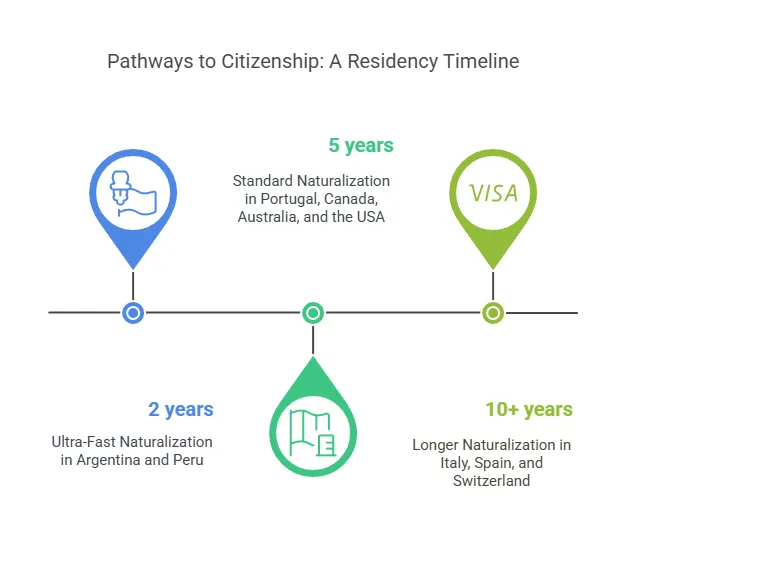
Ultra-Fast Naturalization (2–3 Years): A few countries offer citizenship after a very short period of residence. Argentina is often cited as the quickest: only 2 years of continuous legal residence are required to become eligible for citizenship. In fact, Argentina’s constitution grants any person who has lived in the country for two years the right to apply – no hefty investments or extreme requirements (aside from basic Spanish knowledge and a clean record). Peru also allows naturalization after 2 years of residency(applicants must pass a Spanish language and culture test). Dominican Republic can be as quick as 2 years with an investment or even 6 months if married to a Dominican. Paraguay historically had a 3-year residency rule (though enforcement tightened recently). Ecuador requires 3 years. These short timelines are attractive, but keep in mind the passports, while decent regionally, may not be as powerful globally as U.S. or EU passports. Still, they do grant freedom from one’s original country and can be passed to children.
Standard Naturalization (5 Years): The global norm is around 5 years of residence. Most European Union countries require 5 years of continuous legal residency (some require this as holding permanent resident status) to qualify for citizenship. For example, France is 5 years, Ireland is effectively 5 years out of the last 9 (with at least 1 year immediately prior to application) in practice, Sweden 5 years, Belgium 5 years, Portugal 5 years. Countries like Portugal not only offer a relatively short naturalization period but also provide significant tax benefits for new residents. Canada is also now 3 out of 5 years of physical presence (which is effectively a 5-year window) to naturalize. Australia requires 4 years of residence, of which at least 1 year as a permanent resident (and allows some flexibility for brief trips abroad). New Zealand requires about 5 years (and has a days-in-country requirement each year). United States requires 5 years of permanent residence (a Green Card), or 3 years if married to a U.S. citizen. Germany historically required 8 years, but has announced a reduction to 5 years, or even 3 years for highly integrated individuals (such as those with exceptional language skills or contributions). Brazil requires 4 years normally, but only 1 year if you have a Brazilian spouse or child (Brazil also grants immediate citizenship to children born on its soil, and having a Brazilian child entitles a foreign parent to apply in 1 year).
Lengthy Naturalization (7–10+ Years): Some countries have longer timelines. Italy and Spain both mandate a full 10 years of legal residence for foreigners (without special ties) to apply for citizenship. This is on the higher end in Europe. Switzerland requires 10 years (and its process involves cantonal approval and demonstrating integration, such as language proficiency). Austria is 10 years (and very strict on language and renouncing former citizenship, unless you qualify for a shorter term by marriage or special merit at 6 years). United Arab Emirates, Qatar, and other Gulf states often have 20+ year or no realistic path at all for naturalization of expatriates. Japan requires ~5 years but requires you to renounce other citizenships. China essentially does not offer naturalization to foreigners except in extraordinary cases.
Special Cases – Reduced Residency: Some countries shorten the required residency under certain conditions. Spain, as noted, requires 10 years ordinarily, but only 2 years for citizens of Spanish-speaking countries of Latin America (and a few others historically tied to Spain like Philippines, Equatorial Guinea, and Portugal). Spain also allows 1 year for spouses of Spaniards or those born in Spain to foreign parents. Portugal has a 5-year rule, but interestingly does not require full-time residency during those 5 years if you are on its investor residence permit (Golden Visa) – as long as you maintain your resident status, even with minimal stay (about 7 days/year), you can qualify. UK requires 5 years of residency plus holding Indefinite Leave for 1 year (so effectively 6 years, or it can be 5 total if married to a Brit). USA as mentioned is 5 years (3 with a US spouse). Israel via the Law of Return can grant you immediate permanent residency (Aliyah) and citizenship in under a year of moving there (with no requirement to renounce existing citizenship – Israel allows dual).
The table below summarizes the naturalization timelines for some top countries:
| Country | Residency for Naturalization | Notes on Fast-Track or Special Cases |
|---|---|---|
| Argentina | 2 years | Easiest standard naturalization; basic Spanish required. |
| Peru | 2 years | Must pass a Spanish language and culture test |
| Spain | 10 years | 2 years if from a Latin American or select country 1 year if married to a Spaniard |
| Italy | 10 years | 4 years if an EU citizen; 3 years for foreign-born children of Italian parent (jus sanguinis recognition) or 2 years if married to an Italian. |
| Portugal | 5 years | Does not require full-time residency (Golden Visa: ~35 days total in 5 years). |
| Germany | 8 years (reducing to 5) | Can be 5 now with integration, or even 3 in exceptional cases. |
| United Kingdom | 5 years (plus 1 year ILR) | 5 years to Permanent Residency (ILR), then 1 additional year to apply (immediate if married to a UK citizen). |
| United States | 5 years (as LPR) | 3 years if married to a US citizen; must be a Permanent Resident (Green Card holder) and meet physical presence requirements. |
| Canada | ~3 years (out of 5) | Must spend 1095 days in Canada in a 5-year period time as a student or worker can count half. |
| Australia | 4 years (with at least 1 year PR) | Total 4 years legal residence, final 1 year as permanent resident; must not be absent >1 year total. |
| Brazil | 4 years | 1 year if you have a Brazilian spouse or child; Portuguese language required. |
| Switzerland | 10 years | Requires integration (language, community acceptance); time between ages 8–18 counts double. |
| UAE/Qatar | 20+ years or rare | Highly restrictive; typically not feasible for most expats. |
(ILR = Indefinite Leave to Remain, LPR = Lawful Permanent Resident)
As shown, European countries tend to cluster around 5 years, with notable outliers (Spain, Italy at 10). The Americas are often more lenient (most of Latin America ranges 2–5 years). For an expat planning, this means if you are willing to move and live in a country, you could have a new citizenship in as little as a couple of years (in a country like Argentina or Peru), or typically 5 years in many desirable countries, provided you meet other requirements (language, integration, etc.).
Investment and Other Pathways to Citizenship
Aside from ancestry or lengthy residency, some countries offer expedited or easier routes to citizenship through investment, marriage, or special talents. Here we focus on investment and special residency programs, with costs converted to USD for consistency:
Citizenship by Investment (CBI) Programs: These grant citizenship in exchange for a financial investment or donation, without the normal residency period. They are popular for those who want a second passport quickly. Countries like the UAE attract investors by offering favorable tax policies, including the absence of capital gains tax. In the Caribbean, several small nations have well-known CBI programs:

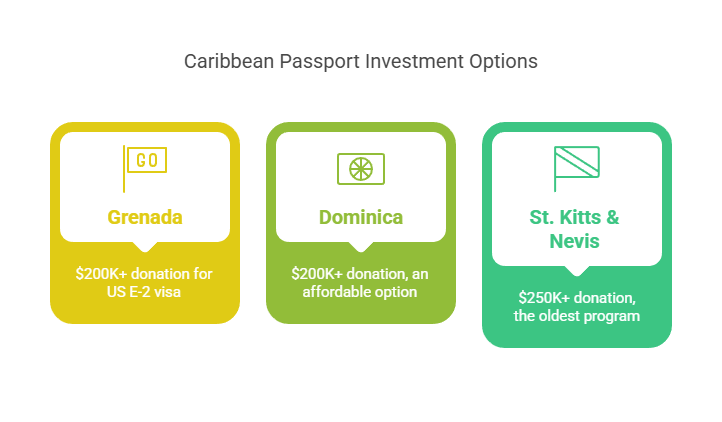
St. Kitts and Nevis: The oldest CBI program, offering citizenship typically within 4–6 months for a minimum donation of $250,000 (single applicant) to a government fund. No residency required at all. It allows dual citizenship and the passport grants visa-free travel to about 150 countries. Citizenship is for life and can be passed to children, though note that most Caribbean CBI laws currently do not automatically extend to grandchildren born outside the country unless the children return to have kids there or apply to add them (except Grenada, discussed next). However, you can include dependents (spouse, children up to a certain age, even parents) in your application for additional fees.
Dominica: Offers a similar scheme at $200,000 donation for a single applicant (plus fees), making it one of the most affordable. Processing ~3-4 months. Dual citizenship allowed. Children can inherit citizenship, but like other Caribbean programs, the third generation (grandchildren) would not automatically be citizens unless the second generation lives in Dominica or takes action.
Grenada: Requires a $235,000 donation (single) or about $270,000 investment in real estate. It’s unique because it not only provides a decent passport (visa-free UK, Schengen, etc.) but also Grenadian citizens are eligible for the U.S. E-2 investor visa. Importantly, Grenada’s citizenship can be passed to future generations more freely – it’s the only Caribbean CIP that allows grandchildren of the original investor to inherit citizenship outright. Grenada also allows dual citizenship.
Antigua & Barbuda, St. Lucia, and Vanuatu have similar programs ranging from $200k–$300k donations. All allow dual citizenship. They typically require a short visit or oath-swearing trip (Antigua asks you to visit for 5 days within the first five years). Vanuatu’s program is around $130k and very fast (as quick as 1–2 months).
“Golden Visa” Residency-by-Investment: These are programs where you invest in a country (often in real estate, government bonds, or businesses) to obtain residency, which can lead to citizenship over time. Examples:
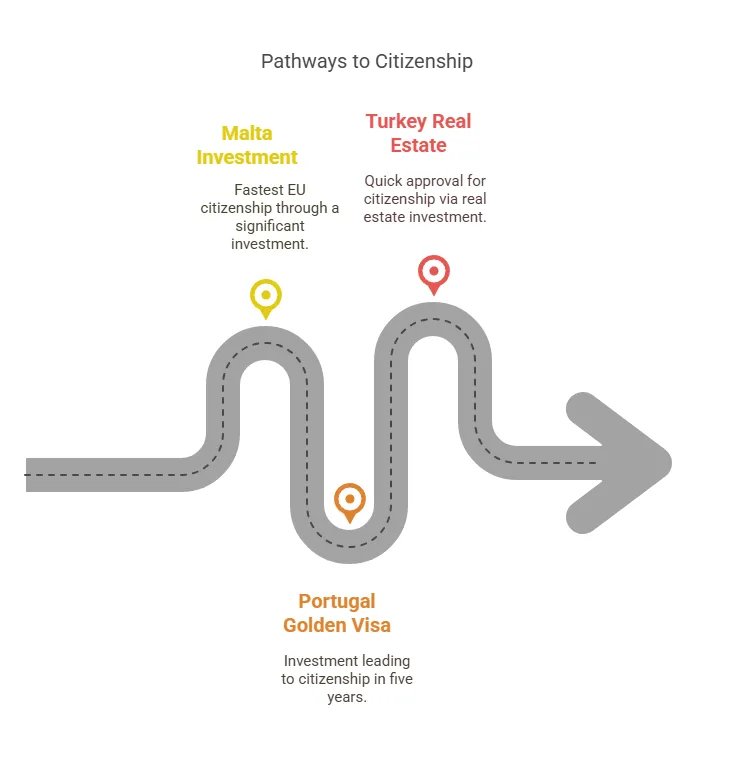
Portugal Golden Visa: Invest as little as €280,000 (~$300,000) in real estate in a low-density area (or €500,000 in regular areas, $540k) or €500,000 in a fund. This grants a residency permit with minimal stay requirements (7 days per year). After 5 years, you can apply for citizenship (with basic language A2 exam). This route has been very popular due to its flexibility and clear citizenship timeline of five years while keeping your primary life elsewhere.
Greece Golden Visa: Invest €250,000 (~$270,000) in property (recently raised to €500k in certain prime areas). It grants residency, but Greece requires 7 years of residence and knowledge of Greek to naturalize, so again the investment mainly helps with residency, not a shortcut to citizenship.
Malta: Malta has both a citizenship by investment (often termed “naturalization by exceptional services”) and a residency investment program. Malta’s Citizenship by Direct Investment requires about €600,000 (~$650,000) contribution for a 3-year route or €750,000 (~$810,000) for a faster 1-year route, plus €700,000 property purchase (or €16,000/year rental) and €10,000 donation. It’s very expensive (total over $1 million for a family), but you can obtain an EU passport in 1–3 years legally. Malta allows dual citizenship and it can be passed to descendants.
Turkey: A popular option outside the West; investing $400,000 in Turkish real estate (or equivalent government bonds or business) can get you citizenship in as little as 6 months. Turkey allows dual citizenship. The Turkish passport isn’t as strong for visa-free travel to Western countries, but Turkey’s program gained attention as it also provides a potential route to the U.S. E-2 visa and is relatively affordable for a G20 country.
Australia and New Zealand have investor visa pathways that can lead to citizenship. For instance, Australia’s Significant Investor Visa (A$5 million investment) or NZ’s Investor visas (NZ$3 million for Investor 1, etc.) can provide residency, but you still wait the standard residency period (and in Australia’s case, it doesn’t shorten the 4-year requirement). Canada had federal investor programs but shut them down; however, Quebec has/had an investor program (currently suspended) and other provincial entrepreneur programs that eventually can lead to citizenship after you become a resident and meet the 3-year physical presence.
Citizenship by Marriage: While not the focus of this analysis, it’s worth noting many countries offer accelerated or immediate citizenship to those who marry their nationals. As an example: Argentina grants citizenship immediately upon request after marrying an Argentine citizen (no minimum residency or wait, just an 8-month processing). Spain allows spouses to apply after just 1 year of marriage and residence. Brazil in 1 year after marriage with residency. For expats, marriage is obviously a personal decision, but it can significantly reduce the time to citizenship.
Comparative Overview of Top Countries
Bringing it all together, here is a side-by-side comparison of some of the best countries for expats aiming for a second citizenship that can benefit future generations:
| Country | Citizenship by Descent | Generational Inheritance | Dual Citizenship | Naturalization Timeline | Investment Options |
|---|---|---|---|---|---|
| Italy | Yes – no generational limit (any Italian ancestor) | Indefinite, as long as each generation doesn’t renounce (maternal line claims require ancestor born after 1948 or court case) | Allowed (no renunciation) | 10 years residency (reduced to 3 years if marrying Italian) | Investor Visa (€250k–€500k investment, but no shortcut to 10-year wait) |
| Ireland | Yes – if parent or grandparent is Irish (great-grandparent possible via parent’s registration) | Can continue across generations if each is registered (Foreign Births Register) | Allowed | 5 years residency (with 1 year continuous before application) | No direct investor citizenship (Immigrant Investor Programme was closed); standard residency routes only |
| Portugal | Yes – parent or grandparent (grandparent requires language A2) | Child of citizen is citizen; grandchild can apply if ties proven | Allowed | 5 years residency | Golden Visa (from ~$280k investment) → citizenship eligible in 5 years |
| Poland | Yes – up to great-grandparent if continuity of citizenship | Indefinite de jure (citizenship passes if not lost); must prove ancestry and that it wasn’t renounced | Allowed | 3 years with permanent residency and language A2 (or 10 years without PR); 1 year if of Polish heritage (via descent recognition) | No investor citizenship (EU Long Term Residency via investment possible, but citizenship still via standard route) |
| United Kingdom | Yes – one generation (parent must be British otherwise than by descent) | Limited to children born abroad (grandchildren born abroad not automatic) | Allowed | 5 years +1 (standard route) | Investor visa route (Tier 1) was closed in 2022; now mainly skilled or business routes to residency |
| Canada | Yes – first generation born abroad (policy changing to allow second generation with conditions) | Historically only first-gen abroad automatic; upcoming law to allow grandkids if parent lived 3 years in Canada | Allowed | ~3 years physical presence (within 5 years) | Startup Visa (business immigration) or provincial investor programs → PR; no direct CBI |
| Australia | Yes – first generation (child born abroad to Australian parent is citizen). If parent was Australian by descent, they must have lived in Australia 2+ years for the child to be citizen | One generation abroad automatic; beyond that requires parent’s 2-year residence in Australia | Allowed (since 2002) | 4 years residency (incl. 1 year PR) | Significant Investor Visa (A$5m) for residency; citizenship after meeting 4-year residency regardless of investment |
| Argentina | No (citizenship only by birth or naturalization, not by descent beyond first generation) | Children of naturalized Argentines are Argentine if born in Argentina (jus soli). If born abroad, would need to reside in Argentina or have other claim. | Allowed | 2 years residency | No investment required; standard residency (e.g. rentista visa or work) leads to citizenship quickly |
| St. Kitts & Nevis | N/A (not by descent unless parent is citizen; program is by investment) | Children included in application are citizens; future children born to the new citizen are citizens by descent. Grandchildren born abroad would need their parent to have lived in or register in SKN (most CBI countries don’t automatically extend to grandkids abroad) | Allowed | N/A (citizenship in ~4-6 months by investment) | $250,000 donation (single) CBI or $300k+ real estate investment. No residency required. |
| Grenada | N/A (CBI program) | Unique among CBI programs: citizenship can be passed to third generation (grandchildren) even if born abroadDependents can be added post-citizenship without new full investment. | Allowed | N/A (~4-6 months by investment) | $235,000 donation or $270k real estate. No residency required. (Only CBI country with U.S. E-2 visa access.) Grenada’s passport also provides visa on arrival access to over 140 countries, enhancing its appeal. |
| United States | Yes – if born to a US citizen parent (with conditions on the parent’s prior US residency). Not by more distant descent. | Child born abroad to one US citizen parent is a US citizen if the parent had ~5 years physical presence in the US (at least 2 after age 14) – thus one foreign-born generation is allowed. Subsequent generations need at least one ancestor who lived in US to transmit. (Any child born on US soil is a citizen by jus soli.) | Allowed (U.S. recognizes dual citizenship, though expects primary loyalty from its citizens) | 5 years as a Green Card holder (3 years if married to a US citizen) | No direct investment citizenship (the EB-5 investor visa gives Green Card for $800k+ investment, leading to citizenship in 5 years). Birth in US (if not children of diplomats) gives immediate citizenship to the child (parents don’t get citizenship but can be sponsored by the child later at age 21). |
Planning for Intergenerational Security and Mobility

When choosing a country for a second citizenship with your family’s future in mind, consider these key takeaways:
Jus Sanguinis Advantage: If you have ancestral ties to countries like Italy, Ireland, Poland, or Hungary, you have a head start. These nations can confer citizenship by descent, often relatively quickly and affordably, and your children will inherit that citizenship automatically. Italy and Ireland in particular stand out for multi-generational continuity.
No Need to Relocate (in some cases): Citizenship by descent and by investment can be obtained without living in the country. This is ideal if you want the passport for mobility or security but cannot uproot your life. An Italian or Irish ancestry claim can be done via consulates from abroad, and Caribbean CBIs require no residency. However, if you have no ancestry or spare funds, then a residency (naturalization) route is the main path.
Dual Citizenship Policies Matter: Always verify that the country will let you keep your original nationality. All the countries discussed (except Spain’s nuanced stance) freely allow dual citizenship, meaning you won’t jeopardize your birth citizenship by gaining the new one. This is crucial for maintaining rights in your home country (e.g., property, inheritance, return rights).
Residency Commitment: If you opt for a residency-based naturalization (like Portugal, Canada, Australia), be prepared to meet physical presence requirements. Portugal is lenient (only ~7 days/year), whereas Canada or Australia require you to live majority of the time there. Maintaining a permanent residence permit is essential for meeting the physical presence requirements in countries like Canada and Australia. Plan accordingly – if your goal is citizenship in 5 years, you must actually spend those years in-country (with some vacation allowance). Failing the physical presence or integration criteria (language tests, etc.) can derail an application.
Costs (and Conversions): A €600,000 Maltese contribution is about $650,000. Ensure you account for additional fees (due diligence, legal, application fees can run tens of thousands). Comparatively, a $150,000 donation to a Caribbean program may sound steep, but it’s a one-time cost for an entire family’s lifelong citizenship, which can be seen as an investment in peace of mind (and often far cheaper than waiting a decade in another country with high living costs).
Generational Strategy: If your aim is true intergenerational security, consider how easy it will be for your children and their children to retain this second citizenship. Countries like Italy are excellent because once you become Italian, your kids (even if born abroad) are Italian by blood and there’s no catch about their kids – the lineage remains as long as no one formally renounces. In contrast, if you naturalize in a country with a one-generation rule (like UK or Canada under old rules), your grandkids might not inherit it unless your kids relocate there. Keep an eye on evolving laws (Canada’s expected update will improve its generational transmission; Germany’s new dual law will simplify matters for German-expat families).
Global Mobility: European Union citizenships (e.g., Italy, Ireland, Portugal, Spain) are extremely valuable for mobility – not only do their passports rank high for visa-free travel, but they also grant the right to live and work in any of the 27 EU countries. This is a huge benefit for your future generations, essentially opening an entire continent’s opportunities. Similarly, a US or Canadian citizenship gives visa-free access to many countries and rights in large economies. Caribbean passports, while not as globally powerful, still give visa-free travel to UK, EU Schengen, etc., which can be a lifesaver if your home country’s passport is restrictive.
In summary, planning for a second citizenship is a worthwhile endeavor for expats focused on intergenerational security. Whether through lineage, laws or investments, the countries highlighted above offer some of the best combinations of ease of acquisition, dual citizenship friendliness, and the ability to pass on nationality to children and beyond. Always consult the latest requirements and consider professional legal advice, as citizenship laws can change. By securing a robust second passport, you are effectively “future-proofing” your family’s freedom – providing options for education, work, and safety across borders for generations to come.
