

Armenia: An Emerging Market for Global Expansion
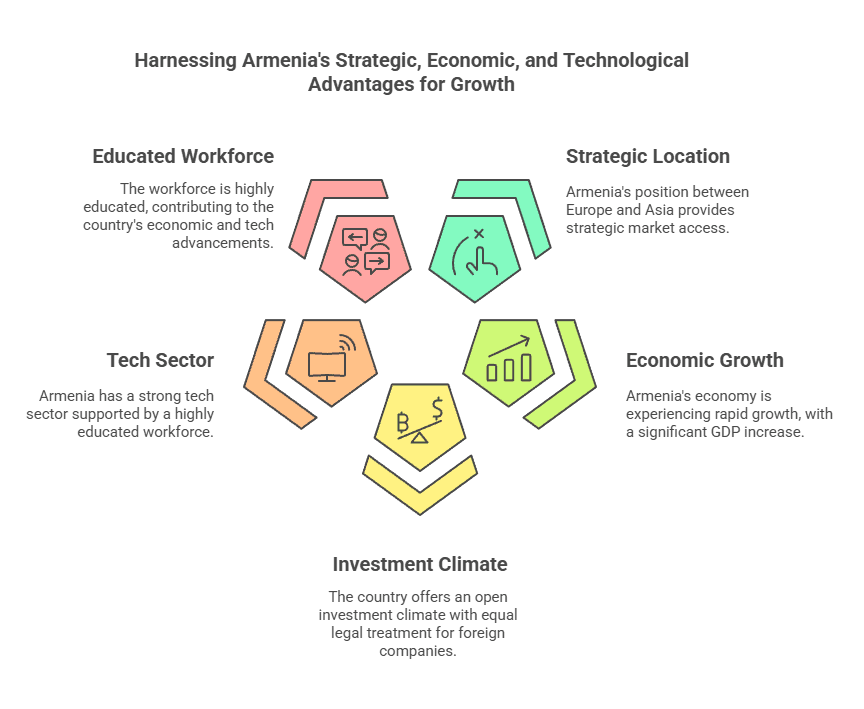
Armenia is strategically located between Europe and Asia. This unique position, combined with a rapidly growing economy, has attracted foreign businesses looking for new markets. Armenia’s GDP saw an impressive average growth of about 10.5% over 2022–2023, reflecting a dynamic post-pandemic recovery. The country’s investment climate is relatively open – foreign companies are legally entitled to the same treatment as local firms, with few restrictions. A well-educated workforce and a burgeoning tech sector further elevate Armenia’s appeal as a global expansion destination. However, entering a new market also means navigating local labor laws, cultural nuances, and administrative procedures, which can be challenging without in-country support.
Yerevan, the capital of Armenia, is a growing hub of business activity and innovation. The city’s modern development and tech-friendly environment have made it a magnet for startups and multinational companies alike. Yet, foreign businesses expanding here must adapt to Armenia’s employment laws and workplace norms – from understanding the Labor Code to handling Armenian-language contracts and payroll. This is where an Employer of Record (EOR) service becomes invaluable. An Armenia employer of record simplifies the hiring process, ensures compliance with local labor laws, and manages payroll and benefits, allowing businesses to focus on their core operations without having to establish a local entity. By partnering with an EOR in Armenia, companies can bridge the gap, gaining local expertise and ensuring operations run smoothly within the Armenian context without having to establish a physical subsidiary of their own.
Understanding Employer of Record (EOR) Services in Armenia
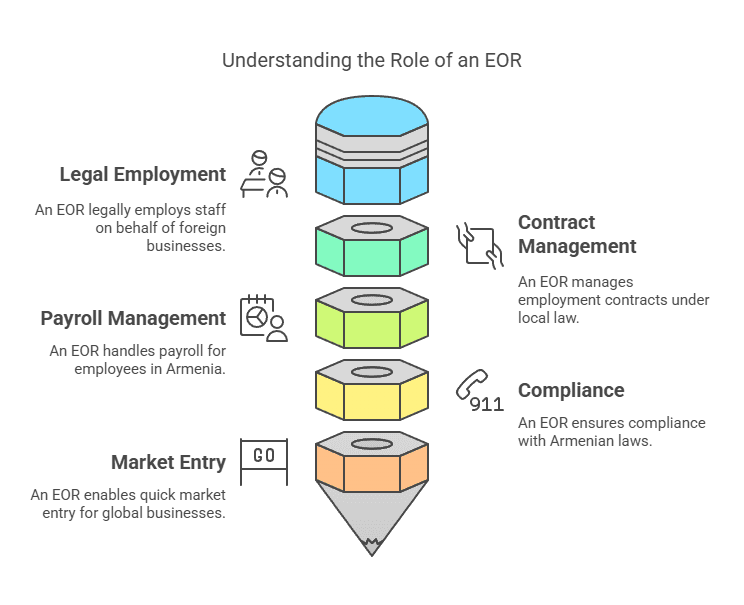
An Employer of Record (EOR) is a third-party organization that formally employs workers on behalf of your company, taking on all the legal employer responsibilities. In practical terms, this means the EOR becomes the legal employer of your staff in Armenia – it signs local employment contracts, registers employees with the authorities, and handles all HR compliance – while your business directs the employees’ day-to-day work. This arrangement allows foreign companies to hire employees in Armenia without first setting up a legal entity or branch office. Often referred to as an international PEO (Professional Employer Organization), an EOR provides a ready-made local infrastructure for HR, so you can onboard talent in Armenia quickly and compliantly.
How EOR works: Suppose your company finds a talented software developer in Yerevan. Instead of navigating incorporation, tax registration, and labor law compliance on your own, you engage an Armenia EOR provider. The EOR signs an employment contract with the developer under Armenian law, effectively “hosting” them under its local entity. They handle payroll, taxes, and benefits for that employee, and ensure all labor code provisions (working hours, leave, social contributions, etc.) are met. You, as the client, manage the developer’s projects and performance as if they were your employee. The EOR takes care of the rest – from work permits (if the hire is a foreign national) to ongoing regulatory filings – and charges you a fee that covers the salary, taxes, and a service margin. In essence, the EOR model lets you outsource HR in Armenia while retaining full control over your team’s actual work output.
Staying compliant: It’s worth noting that Armenia updated its labor laws in 2023–2024 to accommodate modern work practices. For example, employment contracts can now be concluded digitally (via email or electronic signature) with full legal force, and recent Labor Code amendments have expanded remote work opportunities beyond emergency situations. These changes are great for flexibility but add complexity to compliance. A reputable EOR stays on top of Armenia’s latest legal and regulatory updates, ensuring that each hire’s contract terms, work arrangements, and benefits comply with current laws. By using an EOR, foreign businesses tap into local legal expertise by default – every HR action (hiring, probation, termination, payroll taxes) is handled in accordance with Armenian regulations, greatly reducing the risk of penalties or legal disputes for the client company.
Understanding Armenian Labor Laws and Regulations
Overview of Armenian Labor Laws
Armenian labor laws are governed by the Labor Code of the Republic of Armenia, which serves as the cornerstone for regulating the employee-employer relationship and ensuring fair labor practices. The Labor Code outlines the rights and obligations of both parties, covering essential aspects such as working hours, minimum wage, health insurance, and employee benefits. For instance, the standard workweek in Armenia is 40 hours, and the minimum wage is set at AMD 75,000 per month as of 2025. Employers are also required to provide health insurance and other statutory benefits to their employees. Compliance with these regulations is crucial for employers to avoid penalties and ensure a smooth hiring process. By adhering to Armenian labor laws, businesses can foster a fair and productive work environment, which is essential for long-term success.
Employment Contracts in Armenia
In Armenia, employment contracts are a mandatory requirement for every formal employment relationship. These contracts must be drafted in the Armenian language and include essential details such as the job title, duties, salary, and working hours. For fixed-term contracts, the start and end dates must be clearly specified, while indefinite contracts can be terminated following the statutory notice period. It’s also important for employers to screen potential employees for details on their previous jobs before finalizing the hiring process. This ensures that all parties are clear on the terms of employment and helps prevent any misunderstandings or disputes down the line. By having well-drafted employment contracts, businesses can ensure compliance with local labor laws and create a transparent and fair working environment.
Compliance with Labor Laws
Ensuring compliance with Armenian labor laws is crucial for employers to avoid fines and penalties. This involves making sure that employment contracts are in line with the Labor Code, and that employees are paid at least the minimum wage and provided with health insurance. Employers must also adhere to regulations regarding working hours, overtime, and employee benefits. For example, overtime work must be compensated at a higher rate, and employees are entitled to at least 20 days of paid annual leave. An Employer of Record (EOR) in Armenia can be instrumental in helping businesses navigate these complexities. By partnering with an EOR, companies can ensure that all aspects of employment, from contracts to payroll, are handled in compliance with local laws, thereby mitigating risks and focusing on their core operations.
Key Benefits of Using an EOR in Armenia
Rapid Market Entry without a Local Entity
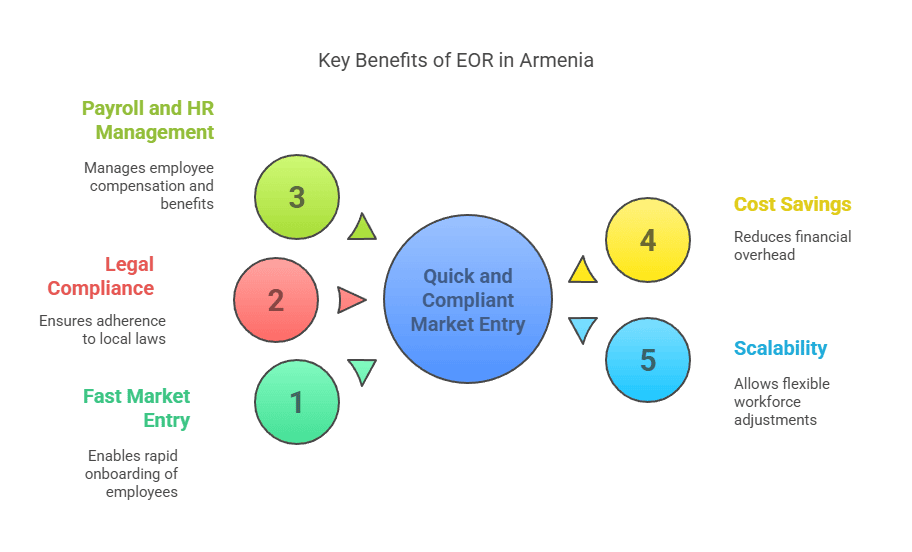
One of the most significant benefits of an EOR in Armenia is the speed and ease of market entry. Setting up a company or subsidiary in a foreign country can take months of paperwork, registrations, and expense. In contrast, engaging an EOR lets you start operations almost immediately because you leverage the EOR’s existing local entity. You can hire and onboard staff in Armenia in a matter of weeks rather than waiting to establish a legal presence. For example, a U.S. tech startup was able to hire its first Armenian developer through an EOR in just a couple of weeks – a process that would likely have taken 3–6 months if they had to incorporate and register a new Armenian company. The developer could begin work right away under a locally compliant contract, while the startup avoided any delay in getting their project off the ground.
This rapid setup is crucial for companies testing a new market or those pursuing a time-sensitive opportunity (such as a project requiring immediate local talent). By using an EOR, you bypass the need to navigate company incorporation, tax ID issuance, opening local bank accounts, and other red tape before making a hire. Instead, you plug into a ready operational platform. As a result, your business can scale into Armenia faster and more efficiently. Whether you need to deploy a sales team to Yerevan or onboard a single remote employee based in Armenia, an EOR makes the process nearly turnkey. This simplified market entry not only saves time but also allows your expansion to stay agile – you can enter Armenia, evaluate the business climate with actual team members on the ground (or remote), and adjust your strategy without the sunk costs of setting up a full entity.
Ensuring Legal Compliance with Local Labor Laws and Risk Mitigation

Navigating Armenian labor law can be complex for outsiders, and non-compliance can lead to fines or reputational damage. An EOR service provides peace of mind by ensuring full legal compliance with all local employment regulations. This includes adhering to the Labor Code requirements on contracts, working hours, minimum wage, overtime, leave, and termination rules. For instance, Armenia mandates a 40-hour workweek, at least 20 days of paid annual leave, and specific rules for overtime compensation and sick leave. When you hire through an EOR, they implement all these rules correctly in the employment agreement and HR policies for your Armenian staff. The EOR’s local HR experts will draft contracts in compliance with Armenian law (in Armenian language as needed), register each employee with the tax and social security authorities, and calculate payroll taxes and contributions accurately. They also handle required notifications – for example, Armenia requires electronic notification to the tax office for any new hire, which the EOR will take care of on your behalf.
The EOR takes care of the rest – from work permits (if the hire is a foreign national) to ongoing regulatory filings – and charges you a fee that covers the salary, taxes, and a service margin. When hiring foreign employees, the EOR will manage the necessary processes and documentation, including work permits and visas, ensuring compliance with local labor laws.
Crucially, the EOR shoulders the legal liability as the employer of record, which significantly mitigates risk for your company. If any issues arise – say a dispute about overtime pay or an allegation of wrongful termination – the EOR, as the legal employer, will manage the situation in line with local law, shielding your company from direct legal conflict. This does not mean you lose control over employment decisions (you still decide who works for you and can request terminations), but the burden of compliance and procedural correctness is on the EOR. For example, if you need to terminate an employee, Armenian law has specific notice periods and severance requirements depending on the reason. The EOR will ensure all such steps are handled properly (and advise you on timing or documentation) so that the termination is legally sound. This prevents scenarios where a company inadvertently violates local labor rights – e.g., Armenia prohibits terminating a contract due to an employee’s retirement age under recent amendments – which an unaware foreign employer might otherwise mishandle. By keeping you compliant with Armenia’s 2025 regulations and any new amendments, EOR services greatly reduce the risk of fines, lawsuits, or penalties. In short, compliance is built into the service. As one industry guide noted, EORs in Armenia are well-versed in local labor laws, ensuring client companies remain compliant with all requirements.
Additionally, using an EOR helps avoid the risk of worker misclassification. Some companies try to hire workers as “contractors” to avoid creating a local entity or dealing with employment law. However, Armenian authorities (like many countries) scrutinize contractor arrangements, and if a contractor is effectively working as an employee (set hours, single client, etc.), there’s a risk they could be reclassified as an employee with backdated benefits. Misclassification can lead to fines (even if relatively small per case) and potential obligations to compensate the worker. By hiring through an EOR, you engage the worker as a proper employee from the start, eliminating misclassification worries. The EOR takes care of offering all statutory benefits and protections to the individual, so you can engage talent confidently without walking a legal tightrope.
Streamlined HR, Payroll, Employment Contracts, and Tax Management
Handling HR and payroll in a foreign country can be extraordinarily complex – every country has its own tax withholdings, social contribution rates, payslip requirements, and reporting schedules. One of the core advantages of an EOR is that it completely manages payroll and tax compliance in Armenia for your employees. This means calculating gross-to-net salary, withholding the correct income taxes, and remitting social security contributions to Armenian authorities, all in line with local deadlines. Armenia currently has a flat personal income tax rate of 20% on salaries (as of 2025, part of a recent reform) and employers also must account for social security (pension) contributions and possibly a small military fund contribution for local employees. An EOR’s payroll team will be intimately familiar with these obligations. They will ensure that each employee’s pay is processed according to Armenian law and that payroll taxes are paid on time – relieving your finance or HR team of having to learn and execute these country-specific processes.
In terms of schedule, salaries in Armenia are commonly paid monthly, often on or around the 15th of the following month. There is no mandatory 13th-month salary in Armenia, but companies may choose to give bonuses. The EOR will align with local pay cycles and make salary deposits to employees’ accounts (often in Armenian dram) through its local banking setup. All statutory benefits such as paid leave, overtime, and sick pay are administered by the EOR in accordance with the law. For example, if an employee takes maternity leave (Armenian law provides 140 days of maternity leave paid by social insurance), the EOR will handle the filings to ensure the employee receives the proper maternity benefits without your company having to navigate the public insurance system. Similarly, if Armenia adjusts its minimum wage (currently AMD 75,000 per month in 2025) or tax rules, the EOR adapts instantly so that your payroll remains correct and compliant.
Beyond payroll, EOR services cover the full spectrum of HR administration: onboarding paperwork, maintaining employee records, managing benefits enrollment, and even visa/work permit processing for foreign expat employees. For instance, if you send a manager from your home office to work in Armenia, the EOR can often facilitate their work permit or advise on the process, as they are legally the employer hosting that individual. They ensure that required documents (like passports, local address registration, or medical certificates) are collected and filed. All this offloads a huge administrative burden from your team. In short, the EOR acts as your outsourced HR department in Armenia. One global payroll guide describes EOR providers as handling everything from recruitment support to onboarding, payroll, benefits, and even terminations – a “single stop” solution for HR needs abroad. This lets you focus on managing your employee’s work and performance, rather than the mechanics of employment. Especially for smaller foreign teams or first hires in Armenia, having a local expert manage HR processes prevents mistakes and saves considerable effort.
Reduced Administrative Overhead and Cost Savings

Using an EOR in Armenia can be cost-effective when compared to the traditional route of establishing and maintaining a foreign entity. Setting up a company comes with significant overhead: legal fees for incorporation, monthly accounting and bookkeeping for local compliance, potentially hiring local staff (HR or admin) to manage payroll and office matters, and ongoing costs of a local office or address. If your goal is to hire only a few employees or to test the market, those fixed costs can far outweigh the direct employment costs. With an EOR, you eliminate the need for local infrastructure – the EOR already has the entity, the accountants, and the legal setup. You typically pay a straightforward fee (often a percentage of payroll or a flat monthly amount per employee) which is transparent and easy to budget. This model converts what would be hefty upfront and fixed costs into a flexible per-employee cost that scales with your actual headcount.
Administrative overhead is also drastically reduced. Your HR and finance departments do not need to become experts in Armenian labor law or tax filing – the EOR’s team does that heavy lifting. Think about the time and resources saved by not having to draft local employment contracts from scratch, not dealing with translations, not running local payroll in-house, and not interacting with tax offices or social security funds in Armenian (which would require local language skills). All those tasks are part of the service you get from an EOR. By outsourcing these functions, companies often find they save money not just in compliance costs but also in opportunity cost – your staff can focus on higher-value activities (like growing the business or managing your core operations) instead of administrative paperwork. As one provider notes, EOR services allow businesses to concentrate on their primary goals in Armenia while the EOR handles the back-office and regulatory intricacies. In a sense, you’re paying for efficiency – the EOR likely has automated processes and local specialists to manage HR tasks far more efficiently than a foreign company could do on its own initially.
Furthermore, because an EOR aggregates many employees for multiple clients, they may achieve economies of scale in procuring benefits or services. For example, an EOR might have a group health insurance policy in Armenia that your employees can join, whereas if you set up a small entity, finding affordable corporate health insurance for just a few employees might be challenging. Similar logic applies to things like meal vouchers or other common benefits – the EOR can streamline access to these. All told, when you factor in the avoidance of setup costs, the prevention of potential non-compliance fines, and the internal time saved, the EOR route can be significantly more cost-effective for many expansion scenarios. This is especially true for SMEs and startups entering Armenia, for whom a lean approach is key. Instead of investing large sums into an unproven market, you keep your Armenia expansion asset-light and agile. If the venture grows, you can later consider establishing a full entity (or continue with EOR indefinitely); if plans change, you can ramp down with minimal sunk costs.
Flexibility and Scalability for Your Workforce
An EOR arrangement offers a high degree of flexibility in managing your international workforce. Because you are not tied into maintaining a local subsidiary, you can scale your team in Armenia up or down as business needs evolve, without the complications that a direct employer would face. Need to hire 10 more people for a new project? The EOR can onboard them quickly under its entity. Conversely, if you need to pause or exit the market, you can terminate or not renew those employment agreements more easily (following local law for each case) without having to go through the process of liquidating a company or dealing with long-term liabilities. Essentially, EOR services allow you to “pilot” an expansion with minimal commitment. Many companies use an EOR to enter a country, build up a team, and once the operation is large or stable enough, they may transition to setting up a subsidiary. Others continue to use the EOR model for years as it continues to meet their needs. This flexibility is a form of risk management – you’re not locked into a permanent establishment, so you can adapt your strategy based on real-time market feedback.
From a hiring perspective, using an EOR in Armenia lets you tap into talent on your terms. You can hire full-time employees, part-timers, or even convert a successful contractor to an employee through the EOR if needed. Armenian labor law allows probation periods up to six months – an EOR can incorporate that into the contract, giving you a trial period to ensure the hire is a good fit, with simplified termination during probation if it doesn’t work out (just three days’ notice required by either party). After probation, if you want to scale the team or expand into a formal local office, you’re starting from an established base of employees already compliant and payroll-ready. If at any point you decide to hire a person directly under your own future subsidiary, an EOR can often assist with that transition as well (many will help transfer the employment from the EOR entity to your new entity seamlessly, as a value-add).
The ability to quickly adjust headcount is particularly useful in project-based industries or uncertain markets. Armenia’s economy, while growing, can be subject to regional volatility; having the flexibility to react is crucial. With an EOR, you could rapidly add customer support reps in Armenia during a seasonal peak, then scale down after, all while remaining compliant with local laws on temporary or fixed-term employment. In summary, the EOR model doesn’t just simplify starting in Armenia – it also simplifies pivoting or expanding later. This agile approach to global hiring is a key benefit that traditional expansion models struggle to match.
Access to Local Expertise and Support
Partnering with an EOR in Armenia gives your company immediate access to local HR expertise and on-the-ground support, which can be invaluable. The EOR’s team are specialists in Armenian employment practices – they understand cultural norms, common workplace expectations, and the intricacies of local bureaucracy. This means they can provide guidance on questions you might not even know to ask. For example, they can advise on customary benefits in Armenia (many employers might offer private health insurance or a supplemental pension plan; an EOR can tell you what is competitive or expected in the local market). They will also be aware of any regional holidays or observances beyond the official national holidays, so you can plan around those in your project timelines. Essentially, you gain a consultative partner who helps you navigate the Armenian work environment effectively.
Local expertise also extends to compliance nuances. Armenia’s laws can change, as seen with the labor reforms in 2023 introducing new rules on remote work and electronic contracts. EOR providers keep track of legislative changes and adjust employment practices accordingly – you won’t need to hire a local lawyer to update your contracts every time the law updates, because the EOR does it automatically. For instance, if the government announces a change in the income tax rate or a new requirement for employers to contribute to a fund, the EOR will implement that and often proactively inform you of the impact. This proactive compliance management is a major benefit of having local experts on your side. According to industry analyses, EOR firms in Armenia often provide valuable insights into local business culture and practices, helping foreign companies navigate the market more effectively. This might even include advice on how to structure bonus incentives in a locally appealing way, or how to handle an employee resignation in line with local custom (in Armenia, it’s common courtesy to provide a letter for resignation with advance notice, etc., which your EOR can facilitate).
Moreover, an EOR in Armenia acts as your support system for any HR issues that arise. If an employee falls ill, the EOR knows the process for sick leave certification and pay (e.g., employers pay the first 5 days of sick leave at 80% wage, and the state social insurance covers from day 6 onward). If an employee becomes a parent, the EOR guides them through the maternity or paternity leave process as per Armenian law. From the employee’s perspective, the EOR is their HR contact for questions about payroll, benefits, or vacation – they can get answers in Armenian, quickly and accurately. This improves the employee experience, which reflects well on your company as the one directing their work. Even routine matters like issuing employment verification letters (for bank loans or visas) can be handled by the EOR’s local office. Essentially, you have a full-service HR department in Armenia without the overhead of building one.
Finally, local support can extend to things like providing office space or employer infrastructure if needed. While not all EORs offer office leasing, some may have coworking arrangements or can recommend local service providers for office rentals, legal advice, or other business services. They are well-connected in the region and can often point you to reliable solutions. All of this soft support helps smooth your entry into Armenia. You’re not operating in an unknown environment alone; you have a partner who “knows the ropes” and can guide you. This level of local insight and hands-on support is a soft benefit that is hard to quantify, but many companies find it crucial for successful expansion. It saves you from potential faux pas (like inadvertently scheduling important meetings on a major Armenian public holiday) and accelerates your learning curve in the new market. In combination, these factors allow you to focus on your core business objectives – developing products, serving customers, and building your team – while the EOR handles the enabling infrastructure in the background.
Hiring Process and Employment in Armenia
Hiring Process in Armenia
The hiring process in Armenia involves several key steps, including recruitment, interviewing, and onboarding. Employers can utilize various channels such as job portals, recruitment agencies, and social media to attract potential candidates. It’s essential to ensure that the hiring process is fair and non-discriminatory, focusing on the qualifications and experience of the candidates. Once suitable candidates are identified, the next steps involve conducting interviews and selecting the best fit for the role. An EOR in Armenia can significantly streamline this process by providing local expertise and ensuring compliance with local employment laws. They can assist with drafting employment contracts, handling onboarding paperwork, and ensuring that all legal requirements are met. This not only simplifies the hiring process but also ensures that businesses can quickly and efficiently bring new employees on board, allowing them to focus on their core activities.
Conclusion and Key Takeaways

Expanding into Armenia via an Employer of Record service can be a strategic masterstroke for companies looking to tap into this emerging market without stumbling over administrative hurdles. As of 2025, Armenia offers growth opportunities and a skilled talent pool, but it also comes with a complex web of laws and procedures. An EOR acts as your trusted partner in Armenia, simplifying every aspect of hiring and employing staff so you can enter with confidence and agility. In summary, the key takeaways for using an EOR in Armenia are:
No Local Entity Needed – Simplified Market Entry: You can hire employees in Armenia quickly without establishing a subsidiary, allowing rapid entry and experimentation in the market. This is ideal for testing growth opportunities or scaling teams on short notice.
Full Legal Compliance and Reduced Risk: The EOR ensures payroll and compliance in Armenia are handled correctly – from employment contracts to tax withholdings – keeping you aligned with Armenian labor laws. This significantly lowers the risk of fines, penalties, or legal disputes, as the EOR’s local expertise ensures everything is done “by the book.”
Outsourced HR & Payroll – Operational Efficiency: All HR tasks (onboarding, payroll, benefits administration, terminations, etc.) are managed by the EOR, outsourcing the HR workload so your team doesn’t have to deal with local paperwork. Employees get paid accurately and on time, and all statutory entitlements are taken care of, improving reliability and trust.
Cost Savings and Less Overhead: Using an EOR can be more cost-effective than setting up a local company and hiring full in-house administrative staff. You save on setup costs, ongoing accounting/legal fees, and avoid potential costly compliance mistakes. The predictable per-employee pricing model of EOR services helps in budgeting and controlling expansion costs.
Flexibility to Scale Up or Down: EOR arrangements are highly flexible – you can easily increase or decrease your Armenian workforce as business needs change, without being tied to maintaining a corporate entity or dealing with complex shutdown procedures. This agility allows you to respond to market conditions and opportunities swiftly, a competitive advantage in fast-moving industries.
Local Expertise and Single Point of Contact: With an EOR, you gain a local partner who understands Armenian business culture, language, and regulations. Any challenges that arise (be it a change in law or an employee issue) can be quickly addressed with local know-how. You essentially have on-demand access to HR and legal experts in Armenia, ensuring smooth operations and advising you on best practices in the local context.
By leveraging an Employer of Record service in Armenia, foreign businesses – whether a startup or a multinational enterprise – can simplify their global expansion efforts. The EOR model removes barriers to entry, safeguards your compliance, and handles the minutiae of HR and payroll, allowing you to focus on your core mission in Armenia. In a country poised for continued growth and innovation, using an EOR unlocks the benefits of Armenia’s market while expertly managing the challenges. This makes expanding into Armenia not only feasible but also efficient and strategically sound for companies aiming to grow their international footprint. With an EOR, you gain the freedom to pursue opportunities in Armenia with confidence, speed, and peace of mind, knowing that all the behind-the-scenes employment details are under control.
