

Armenia’s growing real estate market has attracted many foreign investors in recent years. However, navigating real estate law in Armenia can be challenging for newcomers. Armenia operates within a civil law system, influenced by the Napoleonic Code and the German model for administrative law. From legal due diligence to understanding ownership restrictions, investors must be aware of common pitfalls. This article provides a comprehensive guide to the legal challenges and mistakes often faced by foreign nationals investing in both residential and commercial property in Armenia. We cover up-to-date (2025) information on Armenia’s property laws, including ownership rights, regulatory compliance, property contracts, taxation, and dispute resolution. By learning about these issues – and referencing key Armenian legal sources like the Civil Code, Land Code, and State Cadastre procedures – investors can better protect their investments and avoid costly errors.
Understanding Armenian Real Estate Law
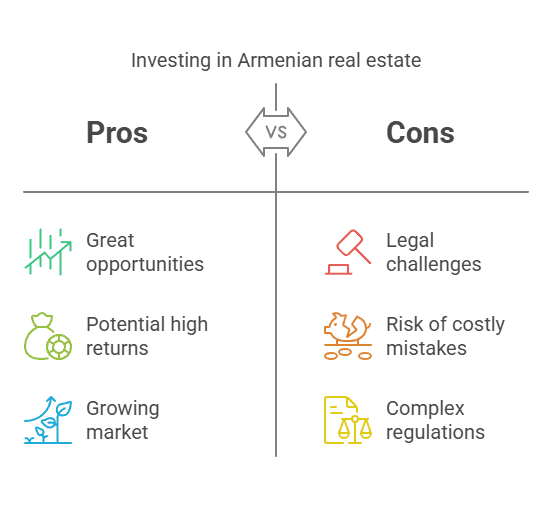
Armenian real estate law is a complex and multifaceted field that governs the acquisition, ownership, and use of real property in the Republic of Armenia. The legal framework is primarily based on the Civil Code of Armenia, which outlines the procedures for real estate transactions, including the sale, purchase, and lease of property. This code also delineates the rights and obligations of property owners, including foreign investors, ensuring their interests are protected under Armenian law.
In addition to the Civil Code, several other laws and regulations play a crucial role in the real estate sector. The Land Code, for instance, provides specific guidelines on land use and ownership, while the Law on State Registration of Rights to Immovable Property ensures that all property rights are duly registered and recognized by the state. Furthermore, the Law on Protection of Consumer Rights safeguards the interests of buyers and tenants in real estate transactions, ensuring fair practices and transparency.
Armenian real estate law is also influenced by international treaties and conventions, such as the European Convention on Human Rights and the International Covenant on Economic, Social and Cultural Rights. These international agreements underscore the protection of property rights and promote economic development, reinforcing the legal framework that governs real estate in Armenia. For foreign investors, understanding these laws and their implications is essential for making informed investment decisions and safeguarding their investments.
Importance of Legal Due Diligence in Armenian Real Estate
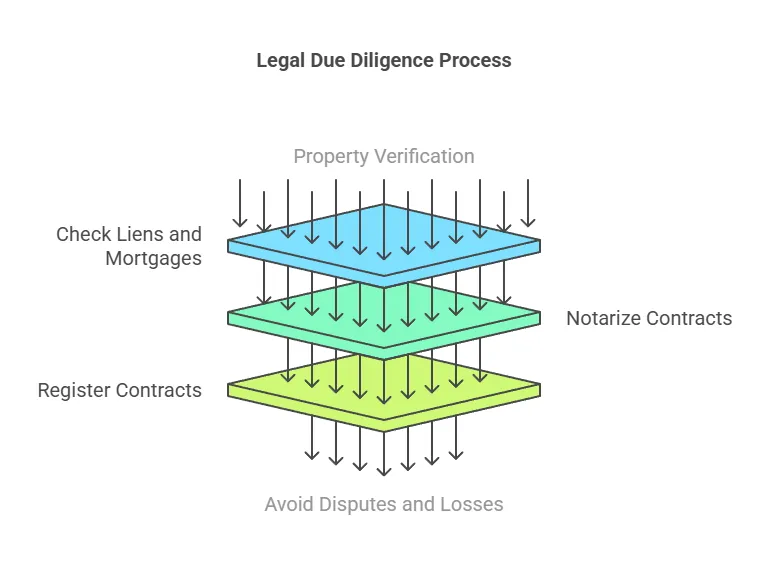
Thorough legal due diligence is the cornerstone of any successful property investment in Armenia. Before signing a purchase agreement, foreign investors should carefully verify the property’s legal status, ownership, and any burdens on title. Skipping due diligence is a common pitfall that can lead to disputes over ownership or unexpected liabilities after the purchase.
Verifying Property Title and Ownership
All immovable property in Armenia is registered with the State Committee of Real Estate Cadastre (commonly just “the Cadastre”). Investors should obtain an official ownership certificate or extract from the Cadastre to confirm the seller’s title and identify any co-owners or claims. The Cadastre’s records are authoritative – ownership rights in Armenia, including those of any economic entity registered, are only legally recognized once registered. According to the Civil Code of Armenia, after signing a sale contract, the transfer of ownership must be registered within a set period (usually 30 working days) for the buyer to be recognized as the new owner. Failing to register the transaction in time can render the contract invalid, a trap that unwary foreign buyers might overlook.
Practical Tip: Before closing the deal, request a fresh Cadastre extract (it’s typically valid for 15 working days). This will show the current owner of record, the exact property description, and any recorded encumbrances. If the extract expires before completion, get an updated one to ensure nothing changed (e.g., a new lien) in the interim. By performing this title due diligence, investors can avoid property title issues in Armenia such as unknowingly buying from someone who isn’t the true owner or purchasing a property that is already pledged to a bank.
Checking for Liens, Encumbrances, and Third-Party Rights
Another critical due diligence step is to investigate any liens, mortgages, or other encumbrances on the property. In Armenia, mortgages and other security interests on real estate must be registered with the Cadastre to be valid. If a property is pledged as collateral or has a court seizure, these should appear on the Cadastre certificate. The Civil Code of Armenia requires that a seller transfer property free of third-party rights unless the buyer explicitly agrees to take it subject to those rights. In practice, this means the seller should clear any mortgage or encumbrance before or at the sale, or the buyer must formally consent to assume it. The legally binding transfer of property rights must be accompanied by an appropriate individual legal act to ensure compliance with Armenian law.
Foreign investors should also ensure there are no unregistered claims. For example, check if the property is occupied by tenants or if others have usage rights. Leases: Long-term leases might be registered on title, but even unregistered tenants can pose problems if they refuse to vacate. Verify if the seller has rental contracts and whether those will continue after the sale. Under Armenian law, a lease may survive a transfer of ownership, especially if it’s registered or for a fixed term. It’s wise to address in the sale contract whether the property will be delivered vacant or subject to existing leases.
Spousal or family rights: Armenia’s family property law can affect title. Property acquired by a married person is considered joint marital property, even if only one spouse is on the title. Thus, a spouse who is not listed as owner may still need to consent to the sale. Notaries in Armenia will ask the seller to declare their marital status and may require a spouse’s signed consent if the property was acquired during marriage. Because Armenia lacked a centralized marriage database before 2014, determining marital status for older acquisitions can be tricky. As a precaution, foreign buyers should have the seller (if an individual) provide either spousal consent or a sworn statement that no marriage existed at acquisition. Failing to do so could result in the spouse later contesting the sale – a legal pitfall that has ensnared some uninformed buyers.
Co-owners and pre-emption: If the property has multiple owners (common in inheritance cases), all owners must agree to sell. Alternatively, one co-owner can sell their share, but the other co-owners have a right of first refusal under Armenian law. This means the selling co-owner must formally notify the others of the offer, and they have 30 days to match it. A foreign investor trying to buy a partial interest or a unit in a jointly owned building should ensure this process is followed; otherwise, a pretermitted co-owner could invalidate the sale by claiming their pre-emption right. Always confirm the ownership structure and get written waivers of pre-emption from any co-owners at closing.
Real-Life Example: Title Dispute from Undisclosed Claims
Imagine a scenario: A foreign investor hastily purchases an apartment in Yerevan without a thorough title check, lured by a great price. Later, when trying to register the property, they discover a court injunction on the apartment – the seller’s brother had filed a claim asserting an inheritance share. Because the buyer’s contract wasn’t registered yet, the court order prevents the transfer. The foreign buyer is now entangled in a family dispute and faces a legal battle to either undo the sale or wait for the relatives to resolve their lawsuit. This situation illustrates why legal due diligence in Armenia real estate transactions is paramount. A simple Cadastre check and asking the right questions could have revealed the risk (e.g., pending litigation or a potential heir) before any money changed hands.
Key Takeaway: Conduct exhaustive due diligence: verify the seller’s ownership via the Cadastre, ensure no mortgages or liens are attached, confirm no hidden stakeholders (spouses, heirs, co-owners), and use a local attorney to double-check all documents. Armenian legal processes are transparent if used correctly – skipping them is an unnecessary gamble.
Ownership Rights and Restrictions for Foreign Investors
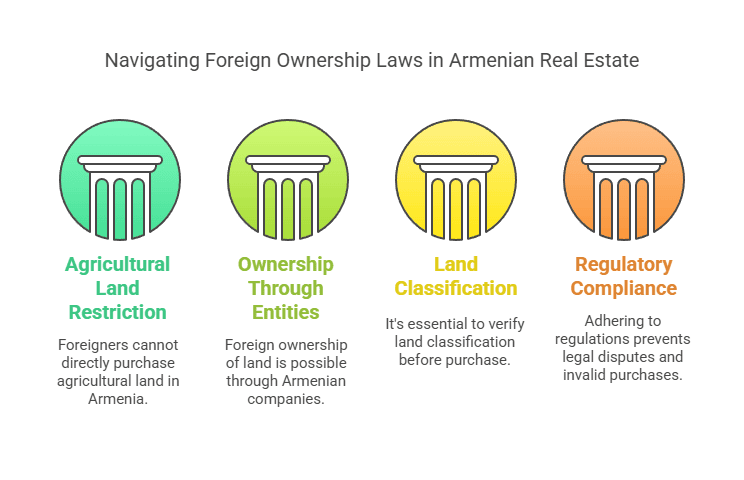
Understanding ownership rights is crucial for foreigners buying property in Armenia. While Armenia’s laws generally allow foreign nationals to own real estate, there are notable restrictions – particularly regarding land. Unaware investors might attempt to buy property they are not legally permitted to own, which can lead to invalid transactions or the loss of investment. Below we examine Armenian real estate regulations on foreign ownership, especially the distinction between owning buildings and owning land.
Restrictions on Land Ownership for Foreigners
One of the most significant legal pitfalls is the restriction on foreign ownership of land in Armenia. The Constitution of Armenia and the Land Code set forth that foreign citizens and stateless persons are prohibited from owning land in Armenia, except in certain cases prescribed by law. In practice, this means that foreign individuals cannot directly register ownership of land plots (such as agricultural fields, development land, or even a house’s land lot) under their own name. They “can be only users of the land” (e.g., leaseholders) by default.
However, the law also carves out important exceptions that foreign investors should know. The Land Code (as amended) specifies that the general ban does not extend to certain categories of land, particularly:
Land plots adjoining private houses or intended for the construction and maintenance of a private residence,
Gardening allotments (garden land),
Land for the construction and maintenance of public or production facilities (e.g., a factory, office, or shop building),
Land for the construction and maintenance of residential multi-unit buildings (apartment blocks).
In other words, foreigners are allowed to own land in Armenia when it is urban or developed land intended for buildings (residential or commercial). The broad restriction mainly targets undeveloped land of certain types (especially agricultural or resource land). The Constitution’s ban applies “except for cases prescribed by law,” and the Land Code has created those cases. As a result, there is no restriction for foreigners to buy apartments or non-agricultural real estate in Armenia. A foreign investor can freely purchase residential apartments, commercial premises, offices, or a house with its adjacent land in most instances. The law explicitly provides that foreign nationals cannot own agricultural land directly – that is the primary limitation remaining.
Agricultural land: For plots classified as agricultural or other restricted categories (e.g., forest land), foreign investors have two main routes to participate: lease the land long-term, or use a locally-registered legal entity to acquire the land. Armenia allows long-term leases of land to foreigners, which is a common workaround for use rights. Alternatively, a foreign investor can establish an Armenian company (for example, a limited liability company) and have that company purchase the land. Armenian companies, even if 100% foreign-owned, are considered domestic legal entities and are not subject to the foreign ownership ban. When forming a legal entity, specific verified documents proving the status of the foreign legal entity must be submitted to the State Register of Legal Entities in Armenia. This method is frequently used for foreign-owned businesses that need land (such as a factory site or, in the case of agriculture, a farm) – the land is held in the company’s name rather than the individual’s name. Keep in mind that maintaining a company has its own costs and administrative burdens, and the company must remain compliant with Armenian corporate and tax laws.
Pitfall scenario: A foreign investor signs a deal to buy a picturesque plot of farmland in an Armenian village to develop a winery, unaware of the ownership restriction. When they apply to register the deed, the Cadastre refuses, citing that a foreign citizen cannot be listed as owner of agricultural land. The investor is left scrambling to fix the situation – ultimately having to create an Armenian LLC and re-route the transaction to the company, incurring additional legal fees and weeks of delay. This could have been avoided by structuring the deal appropriately from the start or obtaining residency. The lesson is to always verify what category of land is involved and ensure compliance with foreign ownership laws before signing any purchase contract.
Owning Apartments, Buildings, and Urban Real Estate
Foreign investors face no legal prohibition on owning apartments, houses, or commercial buildings in Armenia. If the property is a condo/apartment, an office unit, or a standalone building within a town or city, a foreigner can purchase it outright. Even though land itself is restricted, Armenian law treats buildings and the land under them as a unified property in many cases. Since 2012, Armenia has required that when a building is transferred, the right to the land it occupies (or the land use right) should also be transferred or acknowledged at the same time. For example, buying a private house typically includes the land plot around it. How does this square with the foreign ownership ban? Essentially, if the land falls into the allowable categories (like a plot for a private house or within city limits), the foreign buyer can own it along with the house. If not (e.g., a house built on agricultural land), the foreigner might only be able to lease the land. In practice, most urban residential properties are on “settlement land” (not agricultural), so foreigners can own the land for those. The Land Code Article 4(3.1) specifically lists that the restriction doesn’t apply to land for private houses or apartment buildings, which aligns with allowing foreigners to own such properties.
It’s important for foreign investors to clarify the status of the land when buying a standalone property. If you’re buying an apartment in a multi-unit building, you are actually purchasing a unit (premises), and by law you also gain a common-share interest in the building’s common areas and land. This is generally permitted for foreigners, as it falls under residential premises. If you purchase an entire commercial building, ensure the land beneath is either owned (and of a type you can own) or that you secure a transferable long-term lease of the land.
Have your lawyer check the land category (purpose) as recorded in the Cadastre (Armenian land classifications include: agricultural, industrial, residential (settlement) land, etc.). If the land category is “land of settlements” or designated for construction, you’re likely in the clear as a foreign owner. If it’s “agricultural” or “special purpose” (e.g., forest, water fund), then restrictions apply. Misinterpreting this can be a costly mistake, so rely on professional advice and official records.
Utilizing Companies or Residency to Invest in Land
As mentioned, one strategy to avoid foreign ownership restrictions is investing through an Armenian legal entity. Many foreign real estate investors set up a local LLC if they intend to acquire land or engage in property development. For instance, if a foreign developer wants to buy a large tract on city outskirts to build a mixed-use complex, forming a company in Armenia to hold the land can circumvent the personal ownership restriction. The investor then owns the company, and the company holds the land title. This approach is supported by Armenia’s investment laws which treat companies with foreign shareholders as domestic investors (with full property rights) in most respects. Keep in mind that the company will need a registered address (which could be the property itself) and will have annual reporting and tax obligations. The company must remain compliant with Armenian corporate and tax laws. This includes the submission of annual financial statements, which are essential for assessing the company’s financial health and compliance with legal requirements. This approach works best for larger commercial investments or when planning to hold multiple properties, making the administrative overhead worthwhile.
Note: Whichever route chosen, all the usual due diligence and legal processes still apply. Even if using a company, the purchase contract and registration must be done properly. And if holding land via a company, an exit plan is needed (you might end up selling the company shares rather than the land itself, to another investor, to keep the land ownership seamless).
In summary, foreign investors should plan ahead about Armenia’s ownership rules. “Foreigners buying property in Armenia” can do so freely for condos, offices, and constructed real estate. But for land acquisitions, legal structure matters. Use local expertise to determine if you need a special vehicle or status, and do not sign agreements to buy prohibited property under your own name. Armenia’s laws do provide paths for foreigners to invest safely in real estate, but you must navigate the framework correctly to avoid invalid transactions.
Navigating Regulatory Compliance in Property Investments
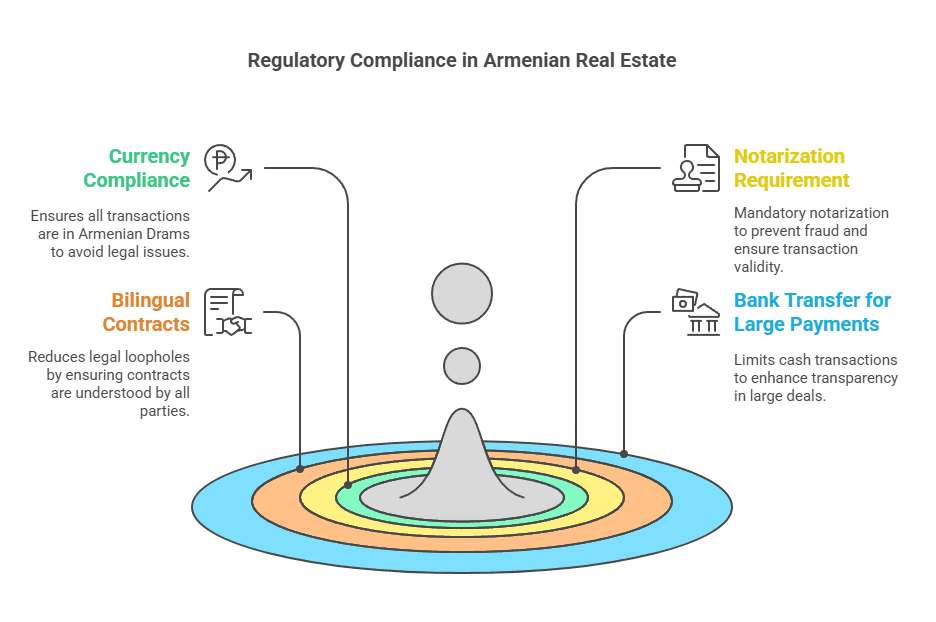
Beyond ownership rules, foreign investors must comply with various regulatory requirements during and after a real estate purchase. Armenia’s real estate sector operates under a clear legal framework, but unfamiliarity with these rules can lead to missteps. Key areas of compliance include the proper execution of contracts (notarization), registration formalities, adherence to currency regulations, and obtaining necessary permits or approvals for property use or development. This section highlights common pitfalls related to regulatory compliance and how to avoid them.
Property Transaction Formalities and Registration Procedures
One of the critical requirements in Armenian real estate transactions is the proper execution and registration of the sale contract. Under Armenian law, a contract for the sale of immovable property must be executed in writing and then registered with the State Cadastre to have legal effect. In fact, the law goes further: as of 2025, all real estate sale-purchase agreements must be notarized before registration.
Previously, Armenia allowed a shortcut for standard form contracts – if buyer and seller signed a standard template agreement at the Cadastre office, a notary certification was not required. This was meant to simplify transactions, but it raised risks (e.g., fraud and tax evasion through under-the-table deals). In late 2023, an amendment to the Civil Code closed that loophole. Now “all transactions, without exception, have to be certified by notaries”, as part of anti-money-laundering and anti-tax-evasion measures. The notary’s role is to verify the identities, legal capacity of parties, and compliance with law (such as required consents), adding a layer of security for the investor.
Implication for foreign investors: Do not attempt to bypass the notary. Engage a reputable notary public in Armenia to formalize the sale contract. The notary will prepare or review the written agreement (often a bilingual contract if one party is foreign), ensure all necessary documents are in place, and then notarize the signatures. Once notarized, the contract must be submitted to the Cadastre for registration of the ownership transfer. The registration usually must occur within 30 working days of signing; otherwise, the contract may lapse in validity. If there is a legitimate reason for delay (e.g., awaiting a document), the parties should document it, but it’s best to register promptly. The State Cadastre Committee will then issue a new ownership certificate to the buyer, officially recording them as the new owner.
Potential Pitfall: A foreign buyer who signs a private agreement abroad or even in Armenia, but fails to notarize or register it properly, will find that legally the property has not changed hands. For example, paying the full purchase price and getting the keys is not enough – if the contract isn’t registered, the seller remains the official owner and could even attempt to resell or mortgage the property. There have been cases in other jurisdictions of such double-dealing; Armenia’s system of requiring registration helps prevent that, but only if you follow through with the formalities. Always work with a notary and ensure the registration filing is completed (usually the notary can handle or guide this step). The registration process in Armenia is relatively fast (several working days by default, or even expedited for an extra fee), so there is little excuse for not completing this crucial step.
Document requirements: Both parties will need valid identification (passports for foreigners, ID cards for locals) for the notary and Cadastre. If you can’t attend in person, a representative with a notarized power of attorney can sign on your behalf – note that a POA from abroad must be notarized and apostilled/legalized to be accepted in Armenia. Ensure any company acting as buyer or seller has its corporate documents in order (and a corporate resolution to buy/sell if required by its charter). The notary will check these.
Finally, budget for the state duties and notary fees. Registration of the transfer involves a state duty (typically around AMD 45,000, roughly $120, depending on property value and location). Notary fees might be a percentage of the deal or a fixed fee schedule. As of the recent changes, notaries are obligated to report suspicious transactions to authorities, so expect to fill out source-of-funds declarations if asked (part of AML compliance).
Currency Regulations and Payment Terms
Another area where foreign investors must be careful is payment and currency compliance. Armenia’s financial regulations require that all local transactions, including real estate sales, be conducted in Armenian Drams (AMD) – the national currency. It is illegal to denominate or settle a property purchase in foreign currency within Armenia, even if both parties privately agree otherwise. Violating this rule can result in hefty fines equal to the amount of the transaction (but not less than 2 million AMD). Therefore, while a seller may quote a price in USD for convenience, the sale contract and the official payment must be in AMD. Foreign investors should be prepared to convert their funds to drams through a bank in Armenia when the purchase is finalized.
Cash vs. bank transfers: Armenia allows both cash and non-cash payments for real estate, but with limits. Any payment above 50 million AMD (approximately $125,000) must be made via bank transfer (non-cash) by law. This threshold is easily exceeded by most property purchases in Yerevan or major deals, meaning practically all foreign investors will be using bank transfers for the bulk of the payment. It’s wise to open an Armenian bank account to facilitate the transaction; foreigners can do so, though having residency can make it easier. If a mortgage loan is involved, it will also go through bank channels. Make sure to plan the logistics of transferring money (consider international transfer times, exchange rates, etc., to have the AMD ready by closing).
Deposit and escrow practices: In some countries, deposits are held in escrow or by attorneys. In Armenia, typically the deposit (earnest money) is paid directly to the seller or via the notary’s account. It’s common for buyer and seller to sign a preliminary earnest money agreement to reserve the property, often with a 5-10% deposit. However, many people sign this on plain paper without notarization, which is actually not compliant with the Civil Code. By law, an earnest money agreement (deposit contract) should be notarized to be legally enforceable. If it’s not, the agreement is technically invalid – which means if either party reneges, the usual penalty (losing the deposit if buyer backs out, or paying double the deposit back if seller backs out) might not be enforceable. The only thing an informal deposit paper proves is that money was paid, so the buyer could reclaim the money, but they can’t force the sale or penalty easily. Pitfall: A foreign buyer might assume a signed deposit receipt guarantees their deal, only to have the seller change mind and simply return the deposit without penalty. To avoid this, either notarize the preliminary deposit agreement or incorporate the deposit terms into the main notarized contract.
Tip: Use bank transfers for traceability. Notaries may ask for proof of the payment of the full purchase price (like bank transfer receipts) at the time of contract, especially if it’s done before registration. Some buyers choose to pay partially before and balance after registration for safety. Discuss with your legal adviser the safest payment method – for large deals, consider using a notary’s escrow account simultaneous payment upon registration mechanism to protect both parties. Armenian notaries sometimes facilitate transactions by holding funds until the title is registered, adding security for foreign investors who might not fully trust a stranger with a direct advance payment.
Construction, Zoning, and Other Regulatory Compliance
If the investment involves not just buying property but also developing or significantly renovating it, additional Armenian regulations come into play. Building permits are required for new construction and major renovations. Local municipalities handle construction permits and enforce zoning regulations and building codes. Developers must also adhere to national health and safety standards to ensure a safe working environment during construction. A foreign developer must ensure that the land they purchase is zoned for the intended use – for example, you cannot legally build an apartment building on a plot zoned as agricultural without first reclassifying it to “land of settlements” or similar through a government process. Changing land use designation can be complex, requiring approvals up the chain (possibly even parliamentary approval for certain reclassifications). Thus, the investor should verify land use permissions in advance or be prepared for a lengthy compliance process.
Armenian construction law requires permits for structural changes and new builds. Working without a permit can lead to fines, work stoppage, or orders to demolish unpermitted additions. All architects and builders should be licensed. Ensure your project obtains an expertise conclusion (an approval from technical experts) and a building permit before breaking ground. After construction, a use permit or occupancy certificate is needed to officially occupy or sell units in the building.
Environmental and heritage considerations: If the property is in a protected area (for instance, near historical monuments or in certain nature preserves), special rules or extra permits may apply. Always check if the site is subject to any environmental restrictions or if the building is classified as a historic/cultural monument. There have been instances where investors bought old buildings in Yerevan’s center planning to redevelop, only to find out the facade was protected by law and couldn’t be altered. Early consultation with local authorities can prevent such surprises.
Utility and infrastructure compliance: To use a property commercially (e.g., open a restaurant or factory), you might need to comply with fire safety regulations, sanitation standards, etc., and obtain specific operational permits or licenses. This goes beyond the scope of a purchase, but it is part of the regulatory landscape a foreign investor must navigate. Not knowing these requirements can stall an investment’s profitability.
Scenario: Compliance Slip-Up
Example: A foreign investor bought a dilapidated building intending to convert it into a boutique hotel. Excited to start, they commenced interior demolition and remodeling immediately after purchase, without securing a renovation permit from the city. Neighbors complained about the construction noise and lack of permits. Municipal inspectors arrived and issued a stop-work order. The project was delayed by several months as the investor now had to apply for a permit after-the-fact, pay penalties, and adjust plans to meet code. This scenario underscores that buying the property is only step one – regulatory compliance continues post-purchase. Always engage local architects, lawyers, or consultants to handle Armenian real estate regulations related to planning and construction.
Key Takeaway: Follow the rules at every stage – have your contracts notarized and registered, obey currency laws (pay in AMD and within banking rules), and obtain all necessary permits for use of the property. Armenia has a fairly streamlined system (e.g., one-stop shops for permits in some cases), but as a foreigner, you’ll want local experts to guide you. Compliance not only keeps your investment safe from legal issues but also ensures the project can operate and generate returns as intended.
Common Contractual Pitfalls in Armenian Real Estate Deals
The contract governing a real estate deal is your primary protection as an investor. In Armenia, real estate contracts are generally straightforward, but there are still pitfalls in the negotiation and drafting phase that foreigners should be mindful of. Misunderstandings due to language, omission of important clauses, or ignorance of local contract law can all lead to trouble down the road. In this section, we outline common contractual mistakes and how to avoid them, ensuring your property contracts in Armenia are solid and enforceable.
Pre-Sale Agreements and Deposit Pitfalls
As mentioned earlier, it’s customary in Armenia to have a preliminary agreement (often called an “earnest money agreement” or deposit agreement) before the final sale contract. This typically happens when a buyer wants to reserve the property and the seller agrees to take it off the market for a period of time. The buyer pays a deposit, and a simple contract notes that the sale will occur by a certain date at a certain price, and outlines the penalty if either party backs out. Under the Armenian Civil Code, if the buyer defaults, the deposit is forfeited; if the seller defaults, they must return double the deposit to the buyer as compensation (this is the standard earnest money penalty arrangement). Just as with employment contracts, real estate contracts must comply with specific legal requirements to be enforceable.
The Pitfall: Many foreigners, unfamiliar with local practice, might either skip the deposit stage (which can offend the seller who expects some good faith money) or do it informally and assume it’s binding. As noted, an informal deposit paper is not legally binding if not notarized. On the other hand, notarizing a deposit agreement means you’re committing to the terms seriously. One way to handle this is to go straight to a notarized final contract when possible. In that scenario, the contract can state that a certain amount is paid as deposit and the remainder will be paid at closing or registration. This final contract is binding and enforceable. If there’s a time gap between signing and completing payment/registration, include clear conditions and use escrow if needed.
If a preliminary agreement is used (say, you need time for due diligence or to transfer funds internationally), try to notarize it. If that’s not feasible, understand that while it may not be enforceable for specific performance, it still evidences a deal. Most sellers in Armenia will honor their word if a deposit is taken (reputation matters), but there’s a risk. Always get a receipt for any deposit paid, and ideally have a clause that if any party changes their mind, how it will be handled.
Clarity in Contract Terms (Avoiding Language Barriers)
Language: The official language for legal documents in Armenia is Armenian. Contracts can be drawn up in Armenian and another language (e.g., English or Russian) in parallel columns. Many foreign investors opt for bilingual contracts. However, it’s crucial to specify which language version prevails in case of discrepancy. Typically, the Armenian version is designated as the controlling text, since it will be used by the Cadastre and courts. Mistake to avoid: Signing a contract in Armenian without a professionally translated equivalent that you fully understand. Never rely on verbal assurances or summaries – insist on a written translation by a qualified translator or bilingual lawyer. It’s also wise to have your own lawyer review the Armenian text, as nuances can be lost in translation. Simple errors in wording can change obligations, so double-check key terms (price, payment schedule, property description, deadlines, etc.) in both languages.
Essential clauses: Ensure the contract covers all important points. Some items to include or verify:
Exact identification of the property: including address, cadastral code/number, and a description of what is included (e.g., land plot size, any storage rooms, parking spaces, etc.). The Cadastre registration will use this description.
Purchase Price and Payment Terms: state the total price in AMD and how/when it will be paid (e.g., X amount as deposit, remainder on a certain date via bank transfer). Clarity here avoids disputes about whether price was fully paid.
Representations and Warranties: The seller should warrant they have good title, that the property is free of undisclosed encumbrances, and that they have obtained any necessary consents (spousal, co-owner, corporate approval if seller is a company). If the property is occupied or leased, the status should be disclosed and the parties’ agreement on that (delivered vacant or tenant stays, etc.) should be stated.
Conditions Precedent (if any): If the sale is conditional (e.g., on the buyer getting a mortgage loan, or on the seller fixing a title issue), those conditions and what happens if they aren’t met should be in the contract.
Closing and Handover: Specify when possession passes to the buyer. In many cases, once the contract is registered, the buyer is the owner and takes possession. If the seller is allowed to stay for a period after, or if keys are handed over earlier (like after signing but before registration), put it in writing.
Default and Remedies: Armenian contracts often do not go into elaborate detail on default (the law provides some default rules), but you can include clauses for what happens if either party fails to fulfill their obligations. Besides the deposit penalty, a buyer might negotiate a right to a full refund plus damages if the seller cannot complete the sale, etc.
Dispute Resolution Clause: See the next section on this, but you may specify the governing law (Armenian law will apply regardless for the transfer of property, but for contractual matters it will anyway be Armenian if it’s in Armenia) and choose a dispute forum (Armenian courts by default, or arbitration if both parties prefer).
For significant investments, having a lawyer draft or at least review the contract is a must. While notaries in Armenia can draft contracts, their templates may be very basic and not tailored to protect a foreign buyer’s interests beyond the minimum. A common mistake is assuming the notary’s standard contract will cover you in all scenarios – it may not address post-sale issues like discovered defects or the specifics of a complex transaction. Don’t hesitate to negotiate terms or add clauses; Armenian sellers are becoming accustomed to more detailed agreements when dealing with international buyers.
Every person or entity signing the contract must have the legal authority to do so. For individuals, this means they either are the owner or have a power of attorney from the owner. If an owner cannot be present (e.g., an Armenian seller living abroad), verify the POA they give to their representative is notarized and, if issued abroad, apostilled or consular legalized. For corporate sellers or buyers, ensure that the person signing is an authorized director or has a corporate resolution and power of attorney to sign. One potential pitfall is when a property is owned by a company, especially if it’s a large asset relative to the company’s value. Under Armenian corporate law, a company might need approval from its shareholders for selling significant assets (commonly if the property’s value exceeds 25% of the company’s assets). If you are buying from a company, ask for a copy of the corporate resolution or shareholder meeting minutes approving the sale. If this formality is skipped, a disgruntled shareholder could later challenge the sale.
Another scenario: if the property owner is deceased and heirs are selling it. In Armenia, heirs need to first register the inheritance (get a certificate of inheritance) then they can sell. Make sure you are dealing with the rightful heirs and that they have completed the inheritance process. Do not finalize a purchase directly from someone who only has a “inheritance right” but not yet the finalized ownership, as extra risks exist. Insist they finalize their title first (it’s usually a straightforward notary process if documents are in order).
Case Example: The Unseen Spouse
Consider this real-life inspired example: A foreign investor agrees to buy a small commercial property in Dilijan from an individual seller. Only the husband is present and listed as the owner on the title. The contract is signed and notarized, but the notary, due to an oversight or perhaps a false statement from the seller, does not obtain the wife’s consent. After the sale, the wife emerges and claims she never agreed and that the property was joint marital property. She files a claim to invalidate the sale. The foreign buyer now faces a court case. Although the buyer acted in good faith, the law tends to protect the property rights of an uninformed spouse. The dispute might end in a settlement or the buyer returning the property for a refund. This nightmare outcome can be prevented by ensuring all required consents are obtained. In practice, a vigilant notary would have demanded the spouse’s presence or a notarized consent form. But ultimately, the buyer’s attorney should also double-check such matters.
Lesson: In Armenia, always confirm that every person who has a legal interest in the property is on board with the sale and properly documented in the contract.
In summary, property contracts in Armenia must be handled with care and attention to detail. Use clear, bilingual agreements and insist on including all necessary details and protections. Don’t rush through signing documents you don’t fully understand. With a robust contract in place, you significantly reduce the risk of misunderstandings and have a solid foundation to enforce your rights if something goes wrong.
Taxation Issues and Financial Obligations
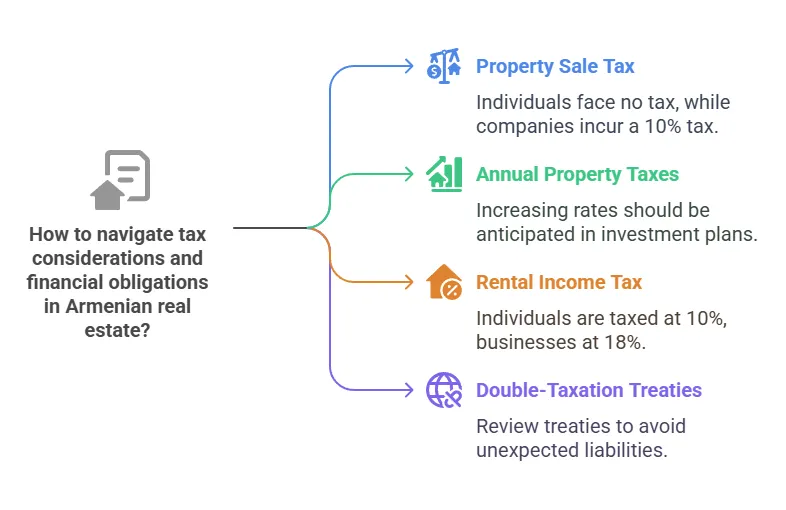
Investing in real estate also carries tax implications that foreign investors must consider. Armenia’s tax system in real estate transactions is relatively straightforward but has some unique points. Failing to account for taxes is a common pitfall – whether it’s surprise costs at purchase, ongoing property taxes, or taxes on rental income and eventual resale. This section will outline the key tax considerations for foreign real estate investors in Armenia and highlight potential mistakes to avoid.
Transaction Costs and Property Transfer Taxes
Good news for investors: Armenia does not impose a hefty transfer tax or stamp duty on real estate transactions as some countries do. The primary costs during a purchase are the state duties for registration (usually minimal, as noted ~AMD 45,000) and the notary fees. There is no separate property transfer tax levied on the buyer or seller by the government just for the act of selling (aside from income tax on the seller’s gain, which we will cover below). In fact, if both buyer and seller are individuals, the sale transaction itself is not subject to VAT or sales tax and is generally not taxable as a transaction.
One exception: if the seller is a developer selling new construction (like a construction company selling new apartments), that sale might attract VAT or a special 20% tax on the developer’s income. But for a typical resale of an apartment or home between two private persons, there’s no VAT.
State duties and fees: To recap, expect roughly the following:
Notary fee: Can vary. Often a percentage of the property value (maybe 0.1-0.3%) or a flat fee depending on notary. It may be negotiable but somewhat standardized.
Cadastre registration duty: Scaled by property type and location, but roughly in the tens of thousands of drams (up to AMD 10,000 for the title certificate and ~AMD 30,000-40,000 for registration service in normal time). Expedited registration (same day or 1-2 days) costs extra if needed.
Agency commission: If you used a real estate agent, the commission is usually 2-4% of the price. This is not a tax but an important cost. Typically the buyer pays their agent and seller pays their own, but sometimes one agent mediates and takes from one side. Clarify this in advance to avoid confusion at closing.
Annual Property Taxes (Immovable Property Tax)
Armenia levies an annual property tax on real estate, which is paid by the owner of the property. Historically, these taxes were very low due to outdated valuations. However, a major reform was passed to gradually increase property taxes to more realistic levels by 2026. The tax is based on the cadastral value of the property (which the government reassessed). The increase is being phased in: for example, only 35% of the new tax was payable in 2023, 50% in 2024, 75% in 2025, reaching 100% of the new rates by 2026. This means that foreigners who purchased property prior to the full implementation might see their property tax bills rise significantly each year until 2026.
For someone buying now (2025), the cadastral values might already be near market levels for new assessments. It’s wise to ask the seller for the latest property tax amount and also consult the Cadastre’s online calculator (the Cadastre Committee has provided tools to estimate the tax). While still modest compared to some countries (even the new rates might equal roughly 0.1-1% of property value, depending on value bands), it’s not negligible if you own high-value real estate. Ensure you budget for this annual property tax and know the payment schedule (property taxes are typically due by October each year, and local municipalities handle the collection).
Pitfall: Forgetting to pay property taxes. While the amounts might seem small, non-payment can eventually lead to penalties or a lien. If you are an absentee owner, be sure to have a way to receive the tax notices (perhaps via email or through a property manager) or check with local authorities annually. If you plan to rent out the property, you might handle the property tax in the lease agreement (some landlords pay it themselves, some incorporate it into rent).
Rental Income Tax and Compliance with Tax Authorities
Many foreign investors purchase property in Armenia with the intent to rent it out for income (be it long-term residential tenants, commercial leases, or short-term rentals like Airbnb). It’s crucial to understand how rental income is taxed in Armenia to avoid issues with the tax authorities.
Under the Armenian tax code:
For individuals (non-entrepreneur landlords): rental income is generally subject to a 10% tax (flat) if the tenant is an organization (which will withhold it), or the individual must self-report it. Specifically, if you rent to a company or an individual entrepreneur, that tenant acts as a tax agent and withholds 10% of the rent and pays it to the tax authority on your behalf. If you rent to a private individual (and you are not a registered entrepreneur yourself), technically you should declare that rental income on an annual tax return and it may be taxed at the general income tax rate (20%). However, many private rentals go undeclared – which is not advised, especially for a foreigner who might want to repatriate the income legally. It’s best to comply: you can register as a sole entrepreneur paying a fixed 10% on rental, or ensure your tenant withholds it. Compliance with financial regulations is crucial, and financial institutions in Armenia play a key role in ensuring that rental income is properly reported and taxed.
For corporate landlords: If you bought property via an Armenian company and that company rents it out, the rental income will be part of the company’s taxable profits (subject to 18% corporate tax). Alternatively, companies can opt for a special regime if applicable (like a small business regime if revenue is under a certain threshold, etc., but that might not apply if rent is high).
Double taxation: As a non-resident, Armenia taxes you on Armenian-source rental income. Your home country might also tax you on that income, unless an agreement exists. Armenia has double taxation avoidance treaties with many countries. For example, if you are from a country that has a treaty with Armenia, it might stipulate that the rental income tax paid in Armenia (10%) is creditable against your home tax, or that the income is only taxable in one of the two states. Check the treaty provisions and consider consulting a tax advisor to optimize how you receive that income.
Compliance tip: If you receive rent in Armenia, you might want to keep that in an Armenian bank and only convert/transfer after paying taxes, to have a clean trail. The Central Bank monitors large transfers abroad, so having proof that you paid due taxes on rental earnings will avoid questions.
Tax on Sale (Capital Gains Tax)
When it comes time to sell the property, what taxes apply to the gain or proceeds? Armenia does not have a separate “capital gains tax” for individuals in the way some countries do, but it treats real estate sale income in certain ways depending on who the buyer and seller are:
Sale by individual to another individual: If you as a foreign individual (or any individual) sell your property to another individual, the income is not taxed in Armenia. Armenia effectively exempts capital gains for individuals in non-business transactions. This is why earlier we noted sales between individuals are not taxed. So if you bought an apartment and later sell it to another person (who is not a company), you as the seller don’t owe Armenian tax on any profit. Do note: if you’re considered a habitual property trader or “constructor,” different rules might apply, but assuming this is an occasional sale, you’re fine.
Sale by individual to a company or entrepreneur: If you sell your property to an Armenian company (or a registered entrepreneur), the buyer must withhold 10% of the purchase price as income tax on your sale. This effectively taxes your capital gain (or entire amount, technically) at 10%. This scenario might occur if, say, a development company is buying out properties, or you sell to a foreign investor’s Armenian company. But it’s less common; most sales are to individuals.
Sale by your Armenian company: If your property is owned by an LLC and that LLC sells the property, the LLC will pay 18% profit tax on the gain (sale price minus the book value and any allowable costs) as part of its corporate income. Alternatively, you could sell the shares of the company to a buyer instead of the property itself – share transfers can sometimes avoid trigger of property sale tax, but that gets into advanced tax planning and is beyond our scope here.
For foreign investors, it’s important to plan the exit strategy tax-wise. If you think you’ll sell to another individual (perhaps another expat or a local buyer), holding the property in your personal name is tax-efficient (no Armenian tax on sale). If you think the likely buyer is a company (maybe a developer assembling land), there will be 10% off the top – you might negotiate the price knowing that. If you hold via a company, you might end up selling the company or paying corporate tax on a sale. Each route has pros and cons, and taxes are just one factor. But the key pitfall is ignorance – you don’t want to find out after selling that you had to pay a tax and didn’t, or that you could have structured differently. Always check the current tax laws at the time of sale (they can evolve). As of 2025, the above rules hold: no tax if sold to individual, 10% if to an entity.
One more angle: If you repatriate the money from the sale abroad, your home country might tax the gain. Here again, double taxation treaties come into play. Many treaties allow the capital gain on real property to be taxed in the country where the property is (Armenia), but since Armenia might not tax it (if sold to individual), your home might then tax it fully. In other cases, if Armenia did tax (10%), you might claim credit. It’s a complex area where professional cross-border tax advice is beneficial for large investments.
Other Taxes and Obligations
A couple of other financial obligations to note:
Land Rent: If instead of owning land (because you couldn’t as a foreigner) you lease it from the state or community, that lease will involve an annual land rent. For example, foreigners can long-term lease agricultural land from the government. The rent is set by valuation. Make sure to factor that rent cost, and note that late payment could jeopardize the lease.
Inheritance/Gift Tax: Armenia currently has no inheritance tax and no tax on gifts of property, except if a property is received as a gift from a developer (which doesn’t apply to normal situations). So if a foreign investor holds a property and later wants to gift it (say to a family member) or if they pass away and leave it to heirs, Armenia will not tax that transfer. The heir or donee would just need to register the new ownership via inheritance procedure or gift notarization. This is friendly compared to many countries.
Investment incentives: Large foreign investors sometimes get tax incentives, but those are usually for big projects and through government negotiation. Real estate by itself doesn’t have special tax holidays, except if you set up in a free economic zone (which is rare for real estate, more for businesses).
Value Added Tax (VAT): Generally, sale of used property by individuals is outside VAT. If you buy a new property from a developer, the price may include VAT (20%) if the developer is VAT-registered. Just be aware when buying from companies. Also, renting out commercial property as a company might require adding VAT to rent if the company is VAT registered. Many small landlords avoid this by staying below thresholds or using the flat 10% regime.
Bottom line: Engage an accountant or tax specialist when you start generating income or plan to sell. Tax compliance in Armenia is not overly burdensome (tax rates are relatively low), but non-compliance can result in fines or legal issues which are easily avoidable. Being proactive about taxes also cements your status as a law-abiding investor, which is helpful if you ever need any government approvals or want to expand your investments in the country.
Handling Disputes and Protecting Your Investment
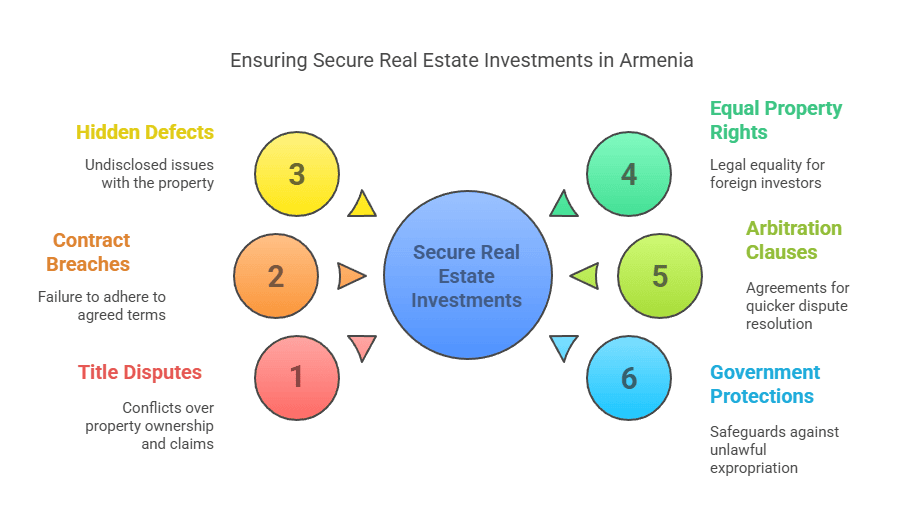
Even with the best preparation, disputes or legal issues may occasionally arise in real estate investments. Foreign investors should be prepared to handle dispute resolution in Armenia and know what legal protections they have. Whether it’s a conflict with a seller, issues with tenants, or (in rare cases) government or third-party actions affecting the property, it’s important to understand the avenues for recourse. This section discusses how real estate disputes are resolved in Armenia and how foreign investors can protect their rights, both under Armenian law and international frameworks.
Dispute Resolution Mechanisms in Armenia
If a dispute arises (for example, a breach of contract by the other party, or a tort issue like fraud), the primary forum will be the Armenian courts. Armenia’s judiciary has jurisdiction over real estate within Armenia – any legal action regarding property title or contracts executed in Armenia would typically be filed in Armenia’s courts of general jurisdiction. Lawsuits are handled in Armenian language, so foreign litigants will need licensed local attorneys to represent them and certified translators for any testimony or documents not in Armenian.
Armenia’s court system for civil cases has first instance courts, appeals courts, and a Court of Cassation. An investor should be aware that while the legal framework is solid, court proceedings can take time. Enforcement of court judgments is generally reliable, but if the losing party is uncooperative, further enforcement steps may be needed (through court executors). It’s better to avoid disputes with robust contracts and by choosing trustworthy partners, but if one ends up in court, know that judicial protection is available – the civil law principles ensure the reinstatement of violated rights and judicial protection thereof. Foreigners have equal standing in court; you won’t be discriminated against as a foreigner in legal proceedings – in fact, foreign investors have the same rights to compensation for damages as locals, guaranteed by the Law on Foreign Investments. This includes protections for intellectual property, ensuring that investors’ rights to patents, trademarks, and industrial designs are upheld.
Arbitration: For large or complex real estate deals, parties may consider an arbitration clause. Arbitration is a private dispute resolution method that can be faster than courts. Armenia is a party to the New York Convention, meaning it will generally enforce foreign arbitral awards. You could specify arbitration (for instance, under ICC or UNCITRAL rules) for any disputes arising from the contract. However, note that certain disputes, like registration of title or eviction, might inherently require court intervention regardless, because they involve public records or enforcement powers. A common approach is to reserve technical or specific performance issues for courts, but allow arbitration for monetary or contractual damage claims. If arbitration is chosen, you’ll need to enforce the award in Armenia, which usually is straightforward if procedure was proper.
In absence of an arbitration clause, any lawsuit would default to court. There are also some arbitration institutions in Armenia (like the Arbitration Court of the Chamber of Commerce) that could be specified if both parties prefer a local arbitration.
Protecting Against Fraud and Misrepresentation
Foreign investors should be on guard against potential fraud or misrepresentation. While Armenia is generally a safe place to invest and outright property scams are not common, no country is immune. Examples of issues that could arise: a seller concealing a defect or encumbrance, a tenant forging documents, or an intermediary misusing funds.
To protect yourself:
Work with licensed professionals (brokers, lawyers, notaries) and do not bypass official channels for a “cheaper” deal.
Ensure all agreements and payments are documented officially. If someone proposes doing part of the deal “informally” (for example, declaring a lower price on the contract to save on some fee), resist – such tactics are illegal and could void your legal protections.
Title insurance is not common in Armenia, but you can conceptually get some guarantees through the contract. In the event of a title defect emerging post-sale that was unknown, you could sue the seller under the contract warranties for losses.
The Civil Code provides that if a seller intentionally misled the buyer or hid known defects, the buyer can rescind the contract or claim damages. Keep evidence of any representations (have important statements written into the contract).
If you suspect fraud, you have the option to involve law enforcement – fraud can be a criminal matter in addition to civil. However, most foreign investors will deal with civil litigation or negotiation. Armenia does have a mediation law and you can also mediate disputes, but that’s voluntary.
Expropriation and Investment Protection
A concern some foreign investors have in emerging markets is expropriation or unfair treatment by the state. In Armenia, the Constitution and laws protect property rights strongly. Expropriation (eminent domain) can only occur for a genuine public need and with fair compensation. For instance, if the government needed to build a road through your land, they must pay market value compensation. Such cases are not common, and as a foreign investor you have the same right to compensation as a local owner. Moreover, Armenia is party to various international treaties that protect foreign investments. The Public Services Regulatory Commission (PSRC) also plays a role in overseeing and regulating investments in sectors such as energy and electronic communications, ensuring compliance with legal requirements. Under the Law on Foreign Investments, foreign investors are guaranteed compensation for damages including lost profits caused by unlawful actions or breaches of state obligations. This means if a government entity acted unfairly or illegally toward your property (for example, revoking a permit arbitrarily or failing to enforce a judgment), you could seek redress and compensation through the courts, and potentially through international arbitration under bilateral investment treaties (BITs) if applicable.
Armenia has bilateral investment treaties with several countries which allow investors to bring claims (often to ICSID arbitration) against the state for expropriation or denial of justice. This is more relevant for very large investors or serious government interference, which is unlikely in ordinary real estate purchases. But it’s comforting to know that the investment climate is backed by such legal frameworks. Indeed, there have been a few ICSID cases involving foreign investors in Armenia (though those are mostly in mining or infrastructure sectors). Real estate investors in city projects have not faced such issues in recent times.
Resolving Common Real Estate Disputes
What are the typical disputes that could occur and how are they resolved?
Contract breaches: e.g., a seller refuses to transfer the property after taking a deposit, or a buyer refuses to pay the remaining amount. Usually resolved by enforcing the contract in court. The court can order specific performance (i.e. the transfer of property against payment) or damages. The deposit clause helps because if clearly notarized, the wronged party can keep or recover the deposit penalty without lengthy litigation in many cases.
Boundary or property description issues: Sometimes after purchase, a boundary dispute with a neighbor might arise (perhaps fences in wrong place, etc.). The Cadastre plans are the reference; a surveyor might be engaged. If a neighbor built something encroaching, you might need a court order to remove the encroachment. The Land Code and Civil Code allow suits to defend one’s property boundaries and to eliminate violations of property rights even absent a contract (a “vindication claim” or “negatory claim” in civil law terms).
Defects in property: If you discover a serious hidden defect in the property that the seller knew about and did not disclose (e.g. severe structural issues, or legal defects like illegal construction part that might be slated for demolition), you could potentially claim misrepresentation. The Civil Code provides for annulment of a sale if there was fraud or fundamental misrepresentation. However, the burden is on the buyer to prove the seller knew and hid it. Often, these issues are settled by negotiation (maybe the seller agrees to compensate some repair) rather than formal court.
Tenant disputes: If you inherited tenants or leased the property out, eviction of non-paying tenants might require a court process. Armenia’s laws do enforce leases, and eviction for breach (like non-payment) is possible through court order if the tenant won’t leave voluntarily. Plan on legal fees and perhaps a couple of months, but generally, the law does not overly favor delinquent tenants, especially in commercial properties. Residential tenant eviction can be a bit sensitive if the tenant has nowhere to go, but if the lease expired or they breached, the owner’s right should prevail.
Neighbor disputes: sometimes issues like noise, or shared facilities in an apartment building (HOA disputes). Armenia has emerging condominium associations for apartment buildings. The condominium’s rules and the law (Law on Management of Condominiums) handle those. As an owner, you have rights and duties (e.g., paying condo fees). Major disagreements could end up in court or municipality for resolution, but these are manageable with local mediation usually.
Final Protective Measures
To protect your investment proactively:
Insurance: Consider getting property insurance. Insurance markets in Armenia cover things like fire, flood, earthquake (important, as Armenia is in a seismic zone), and even title insurance via specialized firms (though title insurance is not widely used, but some international insurers might cover an Armenian property). Insurance won’t prevent disputes but will mitigate financial loss from unforeseen events.
Ongoing legal support: Keep in touch with a local lawyer or a good notary for any legal questions that arise after purchase. For instance, if you get a notice from a government body or a legal summons, consult counsel promptly.
Stay informed: Laws can change. For example, the recent change requiring notary for all deals shows the law can adapt. Tax laws change (as with property tax). Keep an eye on updates or have advisors brief you annually if you continuously invest. This will prevent you from inadvertently falling out of compliance.
In case you do find yourself in a conflict, remember that Armenian law provides mechanisms to resolve it, and as a foreign investor you have full rights to use those mechanisms. The judiciary and legal profession in Armenia are accustomed to foreign participants. The key is to have all your documents in order (contracts, registrations) because a well-documented transaction is much easier to defend or enforce in court.
Conclusion: Mitigating Risks in Armenian Real Estate Investments

Armenia welcomes foreign investment in real estate, and many foreigners have successfully acquired property – be it a home in Yerevan, a commercial venture, or development land via a company. By being aware of the common legal pitfalls for foreign real estate investors in Armenia, you can join their ranks while safeguarding your interests. Let’s recap the crucial steps and points to remember:
Perform thorough legal due diligence before any purchase. Verify titles through the State Cadastre, check for liens or co-owner interests, and ensure the seller has the right and all necessary consents to sell. This prevents costly property title issues later.
Understand foreign ownership restrictions. Know that you generally cannot own agricultural land in your name, but you can own apartments and commercial units freely. If your investment involves land, plan to use a local entity or obtain residency to comply with Armenian law.
Follow all legal formalities in contracts. Use notarized contracts and register them within the required timeframe. Ensure contracts are clear, bilingual if needed, and include all protections (due diligence findings, payment terms, etc.). Avoid side deals or unofficial agreements that are not legally recognized.
Comply with regulatory requirements on payments (use AMD and observe cash limits), and obtain permits for any property development or use changes. Non-compliance can halt your project or void your contract, which is an unnecessary risk.
Anticipate taxes and factor them in. While Armenia’s tax rates are investor-friendly (e.g., 10% flat on many real estate incomes), surprises can arise if you don’t plan (like withholding on certain sales or rising property taxes). Proper tax planning can also maximize your returns and ensure you can repatriate profits smoothly, leveraging treaties to avoid double taxation.
Use professional assistance. Engage reputable local real estate attorneys, notaries, and consultants who understand both Armenian law and the concerns of foreign investors. The cost of good advice is negligible compared to the potential loss from a legal mistake. Armenian professionals can also keep you updated on any legal changes (for instance, a new Land Code amendment or tax law revision).
Consider real-life scenarios and learn from them. Many pitfalls encountered by others – such as contracts invalidated for late registration, or properties bought that couldn’t be registered due to ownership restrictions – are avoidable with knowledge. Weaving those lessons into your investment strategy will save you time and money.
In conclusion, foreigners buying property in Armenia should approach the process with the same rigor as they would in any jurisdiction, keeping in mind the specific local nuances. Armenia’s legal framework is quite solid and, in many aspects, favorable to investors (e.g., equal property rights, straightforward registration, low taxes). The common pitfalls usually stem from lack of information or cutting corners on legal processes. By adhering to the guidance above and leveraging Armenian real estate regulations to your advantage – rather than stumbling over them – you can minimize risk and focus on the rewards of your investment. With proper due diligence, compliance, and expert help, investing in Armenian real estate can be a secure and profitable endeavor, free of legal headaches.
