

Romania, as a member of the European Union, offers its citizens full EU rights and a passport with extensive global mobility, thereby granting them European citizenship. This guide provides a deeply researched, up-to-date overview (as of 2025) of how foreign nationals can obtain Romanian citizenship, thereby gaining EU citizenship. We focus exclusively on Romania’s current nationality laws and EU regulations, covering every pathway to citizenship: by descent (ancestry), by long-term residence and naturalization, by marriage, and by special merits. You’ll find step-by-step processes for each route, required documents, legal timelines, and real-life examples, all presented in a professional, informative tone. High-net-worth individuals, legal professionals, expats, and second citizenship consultants will find this guide especially useful.
Important Note: In mid-2024, the Romanian Parliament passed amendments to the citizenship law, but these changes were under constitutional review and not in force as of early 2025. Therefore, this guide reflects the law currently in effect (Law 21/1991 and subsequent amendments) and the procedures in place at this time.
Benefits of Romanian Citizenship (EU Citizenship Advantages)
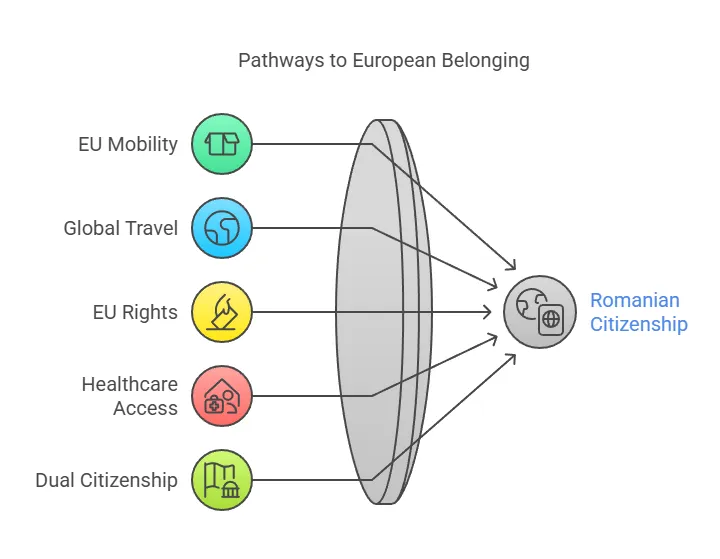
Obtaining Romanian citizenship comes with significant benefits, largely because a Romanian citizen is also a citizen of the European Union. Romanian citizens enjoy full EU citizenship rights, which include the ability to live, work, and travel freely across all member states, access to healthcare and education, and additional rights such as consular protection and voting in European elections. Key advantages include:
EU Freedom of Movement: Romanian citizens enjoy the right to live, work, and study freely in any EU or European Economic Area country, as well as Switzerland. This opens access to the entire European job market and educational opportunities across 30+ countries, from Germany and France to Spain or Sweden.
Powerful Passport: The Romanian passport is a strong travel document. As of 2025, Romanians have visa-free or visa-on-arrival access to 178 countries and territories, ranking the Romanian passport 12th globally in travel freedom (tied with Bulgaria). This includes visa-free travel throughout Europe and to many destinations worldwide.
Right to EU Consular Protection: As EU citizens, Romanians can seek assistance from any EU member state’s embassy when abroad in a country where Romania has no diplomatic presence. They also have the right to vote in European Parliament elections and local elections when residing in other EU states.
Business and Investment Opportunities: With Romanian (EU) citizenship, you can more easily start businesses, purchase property, and invest anywhere in the EU’s single market. There are no restrictions on owning land or companies that might apply to non-EU foreigners. Romania itself has a growing economy (especially in IT, manufacturing, and agriculture) and citizenship allows unhindered access to local and EU-wide markets.
Social Benefits and Education: Romanian citizens can access public healthcare and social security in Romania and are eligible for benefits when residing in other EU countries under EU coordination rules. They also enjoy subsidized higher education opportunities across the EU.
Dual Citizenship Allowed: Importantly, Romania allows dual citizenship. You are not required to renounce your original citizenship when naturalizing as Romanian. This means you can retain your current nationality while enjoying the benefits of a Romanian (EU) passport. Always check your home country’s laws, though, as some countries may revoke citizenship if you voluntarily acquire another. Romania places no such restriction on its side.
By securing Romanian citizenship, a foreign national effectively gains an EU citizenship through Romania, with all the mobility, security, and opportunities that come with it. The following sections detail the pathways to achieve this status.
Romanian Citizenship by Birth and Descent (Jus Sanguinis)
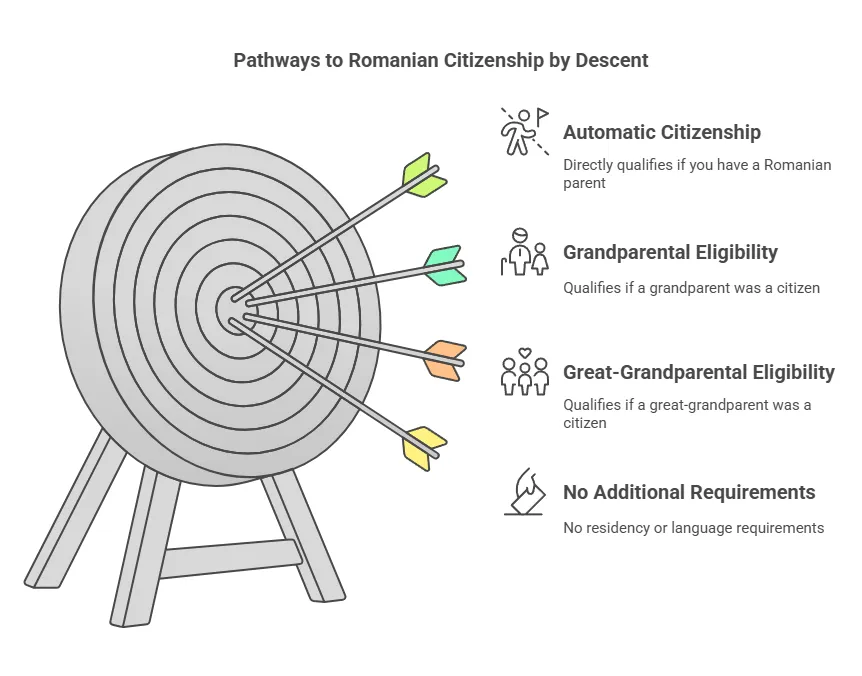
One primary way to obtain Romanian citizenship, and thereby obtain EU citizenship, is through descent – either by being born to Romanian parent(s) or by proving Romanian ancestry. Romania’s nationality law is based on jus sanguinis (right of blood), meaning citizenship is passed down from parents to children. It also has generous provisions for those with Romanian lineage to “repatriate” or reclaim citizenship even generations later.
Citizenship by Birth (Having a Romanian Parent)
If you have at least one Romanian citizen parent, you automatically acquire Romanian citizenship at birth. This applies regardless of where you are born – whether in Romania or abroad – as long as one parent is a Romanian citizen. Only one Romanian parent is required under the law. In practice, this is an automatic transmission of citizenship by blood:
Child Born to a Romanian Citizen: Any child born to a Romanian mother or father is a Romanian citizen from birth, by operation of law. For example, if a foreign national gives birth in New York and the child’s father or mother is Romanian, the child is Romanian.
Registration of Birth: While citizenship is automatic, the child’s birth abroad should be registered with the Romanian authorities (at a consulate or in Romania) to obtain a Romanian birth certificate and passport. This typically involves providing the foreign birth certificate, parents’ IDs, and marriage certificate (if applicable) for registration.
Foundlings: Additionally, any child found abandoned on Romanian territory is presumed to be a Romanian citizen until proven otherwise, if the parents are unknown. This is a protection clause common in nationality laws.
Note: If you are a foreign national who was born to a Romanian parent but never obtained documentation, you are already a Romanian citizen by law. Your pathway is not “naturalization” but simply claiming your existing citizenship. The process involves registering your birth and obtaining a Romanian identity card or passport. It’s advisable to contact the Romanian consulate for guidance on registering a birth after the fact, as you’ll need evidence of your parent’s Romanian citizenship (e.g. their birth certificate or passport) and your link to them.
Citizenship by Descent (Repatriation for Descendants of Romanian Citizens)
Romanian nationality law provides a special route for individuals who have Romanian ancestors (up to certain generations) to obtain citizenship by reacquisition or restoration, even if they themselves were never Romanian. This is often informally called “citizenship by descent” or “Romanian passport by ancestry.” It has been particularly utilized by those whose parents, grandparents, or great-grandparents were Romanian citizens in the past.
Who is Eligible: Broadly, if you have a parent, grandparent, or great-grandparent who was a Romanian citizen and subsequently lost their Romanian citizenship, you may be eligible to apply to “reacquire” Romanian citizenship. The law distinguishes two scenarios:
Descendants of Former Romanian Citizens (General Case): If your ancestor (up to the second degree, i.e. parent or grandparent) was a Romanian citizen but lost that citizenship (for example, by emigrating and naturalizing elsewhere), you can request restoration of Romanian citizenship. This is granted without any residency requirement in Romania, provided you meet certain conditions (discussed below). In other words, children and grandchildren of former Romanians can apply to become citizens of Romania.
Descendants of Those Who Lost Citizenship Involuntarily: If the loss of Romanian citizenship was not voluntary or was for reasons not attributable to the person (for instance, stripped arbitrarily or due to historical border changes), the law extends eligibility to the third degree of descent. This means even great-grandchildren of a former Romanian citizen could qualify in these cases. For example, if your great-grandparent was a Romanian citizen in a territory that later left Romania (such as parts of pre-WWII Greater Romania) and they lost citizenship without choice, you (the great-grandchild) can apply. This provision has been used by many in Moldova, Ukraine (Bukovina, Bessarabia regions), and others whose ancestors were Romanian citizens before 1940.
In practice, Romania’s descent pathway is one of the most inclusive in Europe. Repatriation applications have been extremely popular, especially among the Romanian diaspora and neighbors. For instance, over one million citizens of Moldova have obtained Romanian passports by descent as of 2024, allowing them to live and work across the EU. Many others from Israel, the United States, Canada, and elsewhere have also reclaimed Romanian citizenship through their parents or grandparents who emigrated decades ago.
Legal Basis: Article 10 of Law 21/1991 (Romanian Citizenship Law) states that Romanian nationality can be granted to a person who lost Romanian citizenship, as well as to their descendants up to the second degree, upon request, with the preservation of their current foreign citizenship. Article 11 extends this to third-degree descendants if the former citizen lost citizenship without their will (e.g., due to historical/political events). Notably, applicants under these articles are not required to fulfill the normal residency or language conditions of standard naturalization – the process is considered a restoration of rights. In essence, the Romanian state treats these individuals as returning Romanians.
Key Requirements: Although you need not reside in Romania or speak Romanian to apply by descent, you must satisfy certain documentation and integrity conditions:
Proof of Lineage: You must document your direct lineage to the Romanian ancestor. This typically means providing birth, marriage, and if applicable, death certificates that establish the chain from you to your parent/grandparent/great-grandparent who was Romanian. For example, to use a Romanian-born grandparent, you’d supply your birth certificate, your parent’s birth certificate (showing the grandparent as parent), and the grandparent’s Romanian birth certificate or other proof of their Romanian citizenship.
Proof Ancestor was Romanian and Lost Citizenship: You should provide evidence that your ancestor was indeed a Romanian citizen and later lost that citizenship. Useful documents include old Romanian passports or IDs, a Certificate of Romanian citizenship status, or records of loss of citizenship. Often, applicants obtain an official certificate from Romanian authorities confirming the ancestor’s former citizenship and when it was lost. Additionally, documents from the country your ancestor moved to can help, such as naturalization certificates or foreign citizenship certificates, to show they became citizens elsewhere (hence losing Romanian citizenship).
Clean Criminal Record: Just like any citizenship route, you must have a good record. You will need to submit police clearance certificates (criminal record reports) from your country of current residence (and possibly any other country you’ve lived in) to show you have no serious criminal history. A felony conviction could make you “unworthy of being a Romanian citizen” under the law.
Loyalty and National Security Oath: You will sign affidavits declaring that you have not engaged in actions against the Romanian national order or security, and that you will be loyal to the Romanian state. Essentially, you affirm you mean no harm to Romania.
Retention of Foreign Residence (Optional Declaration): If you intend to keep your domicile abroad after obtaining Romanian citizenship (which is common for diaspora applicants), you typically declare this in your application. It’s absolutely allowable to gain Romanian citizenship while continuing to live outside Romania – many do so, using their new EU citizenship to live in other EU countries.
Apostilles and Translations: All foreign documents (birth certificates, background checks, etc.) must be official and apostilled or legalized, then translated into Romanian by a certified translator. Romania is a party to the Hague Apostille Convention, so documents like vital records and police certificates from other member states need an Apostille stamp. The translations should be notarized as well.
Application Process – Step by Step (Descent Pathway):
Verify Eligibility: Determine your ancestral connection. Identify the ancestor who was a Romanian citizen and gather what you know about their birth in Romania or former territories, and how you are descended (parent, grandparent, great-grandparent). Confirm that this ancestor lost Romanian citizenship (for example, by taking another citizenship). Typically, those who left Romania before 1989 and settled elsewhere lost their Romanian citizenship, so their descendants qualify.
Collect Ancestral Documents: Obtain the Romanian ancestor’s birth certificate or baptismal record from Romania. If available, also get any proof of their Romanian citizenship status (old internal passport, military record, etc.) or a Romanian certificate of citizenship status from authorities. If the ancestor is still alive, their current Romanian passport/ID or a certificate of nationality helps. If they lost citizenship, try to get any documents relating to that loss (e.g., their naturalization certificate in the new country).
Collect Vital Records for Each Generation: Assemble birth and marriage certificates for each link between you and the ancestor. For example, if applying through a grandparent, you need: your birth certificate; your parent’s birth certificate naming that grandparent; and the grandparent’s birth (and marriage, if any) certificate. Name changes should be documented (change certificates or marriage certificates if surnames changed).
Obtain Required Personal Documents: Prepare your own documents, including:
Your passport (valid) – notarized copy.
Your birth certificate (apostilled and translated if not in Romanian).
Marriage certificate (if you are married) or divorce decree, etc., apostilled and translated.
Proof of current residence (e.g. a utility bill or registration) and possibly a copy of your residence permit if you live outside your country of citizenship.
Criminal record certificate from your country of residence (and country of citizenship if different). This must be relatively recent (often issued within 6 months) and apostilled, with translation.
Two recent passport-size photographs (as specified by the consulate/authority).
The completed application form for restoration of citizenship, which includes your personal information and declarations.
Legalize and Translate Documents: Ensure all foreign documents carry a Hague Apostille (or consular legalization if from a country not in the Apostille convention) and get sworn translations into Romanian. This typically means using a certified translator or translation service familiar with Romanian consular requirements.
Submit the Application: You can submit your citizenship dossier in person either in Romania at the Autoritatea Națională pentru Cetățenie (ANC) in Bucharest (the National Authority for Citizenship), or at a Romanian diplomatic mission/consulate in your country. Many applicants apply through the Romanian consulate to avoid travel. The application must be written in Romanian (you can get help from a lawyer or translator for this). When submitting, you’ll present all your documents and the application. The consulate or ANC will register your request.
Processing and Background Checks: Once submitted, the application undergoes verification. Romanian authorities will check the validity of your documents, confirm your ancestor’s records in Romanian archives, and run background/security checks (including consultation with institutions like the Ministry of Interior and intelligence services to ensure no security concerns). This phase can take quite some time given high demand.
Approval and Citizenship Order: If everything is in order and conditions are met, the Citizenship Commission of the ANC will recommend approval. The President of the National Authority for Citizenship will then sign an order granting you Romanian citizenship. Processing times for descent cases can vary widely. Typically it takes about 6 months to 2 years to receive a decision, depending on the backlog and complexity of verifying documents.
Oath of Allegiance: Once approved, you must take an oath of allegiance to Romania in order to become a citizen officially. The oath is a short pledge of loyalty and to respect the Constitution, usually administered in Romanian. You can take the oath at the ANC in Bucharest or at a Romanian consulate. (If you applied abroad, usually you can do it at the consulate once they have your certificate ready.) Minor children included in your file do not need to take an oath; they are granted citizenship alongside you automatically.
Obtain Citizenship Certificate: After taking the oath, you will receive a Certificate of Romanian Citizenship. This document attests that you are a Romanian citizen (with the date of citizenship acquisition being the oath date).
Apply for Romanian Passport and ID: With the citizenship certificate, you can proceed to apply for a Romanian passport and, if you plan to reside in Romania, a CNP (personal numerical code) and Romanian ID card. Passports can be issued at consulates or in Romania. As a new citizen by descent, you now have the same rights as any Romanian-born citizen.
No Language Test Required: Notably, unlike standard naturalization, the descent/repatriation route does not require you to pass a Romanian language or history test. The law waives the language, culture, and constitution knowledge requirements for these applicants, considering their claim to citizenship as a restoration of rights. This is a huge advantage if you do not speak Romanian – though learning the language is encouraged to fully enjoy your citizenship, it’s not a prerequisite for approval in these cases. Dual citizenship is explicitly permitted, so you will keep your original nationality.
Example Scenario (Descent): An American citizen, whose grandmother was born in Romania but became a US citizen in the 1950s, can apply for Romanian citizenship by descent. He gathers his grandmother’s Romanian birth record and U.S. naturalization papers, his mother’s and his own birth certificates, and a FBI background check. After submitting the dossier to the Romanian consulate and waiting 18 months, he is granted Romanian citizenship without ever residing in Romania. He takes the oath at the consulate in Chicago and obtains a Romanian passport by descent, gaining the right to live anywhere in the EU. This example reflects a common scenario – leveraging a grandparent’s Romanian birth to gain an EU passport in a relatively straightforward (if paperwork-heavy) process.
Romanian Citizenship by Naturalization (Long-Term Residency)
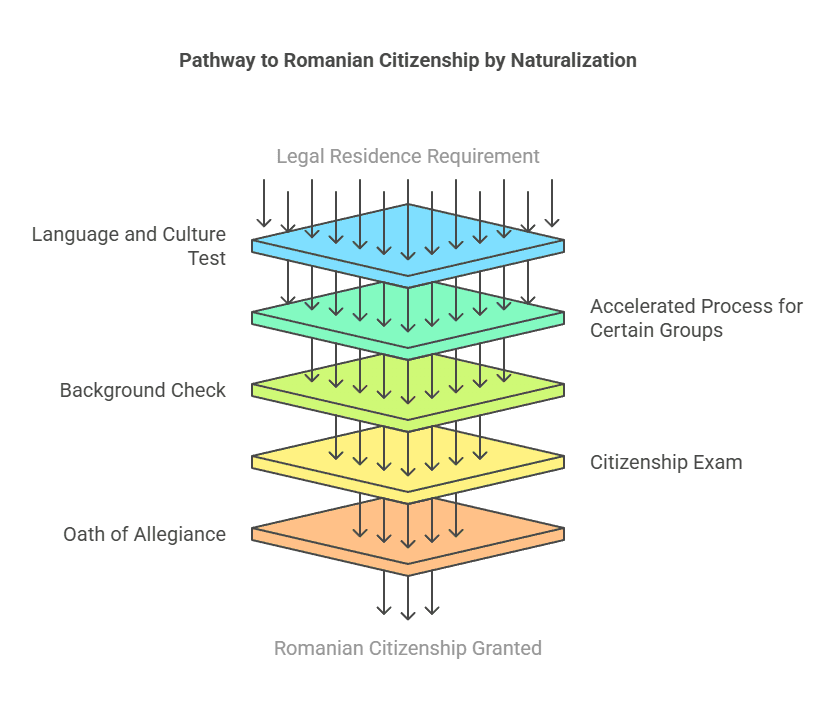
For foreign nationals without Romanian heritage, the main pathway to citizenship is through naturalization, based on lawful and continuous residence in Romania. For many, this ultimately leads to obtaining a European passport, which offers the benefits of EU citizenship, including the ability to live, work, and travel freely across EU member states. This route requires you to live in Romania for a certain number of years and integrate into Romanian society. It is ideal for expats, investors, and other long-term residents who make Romania their home. Here we outline the eligibility criteria, expedited cases, and the step-by-step naturalization process.
Eligibility Criteria for Naturalization: According to Romanian law, a foreign citizen (or stateless person) may be granted Romanian citizenship on request if they meet the following key conditions:
Minimum Residency Period: You must have been living legally in Romania with domicile (permanent residence) or continuous residence for at least 8 years. If you are married to a Romanian citizen, the required period is reduced to 5 years from the date of marriage. These periods are counted up to the date of application. Residency must be lawful (holding the appropriate residence permits) and continuous – lengthy absences can pause the clock. (If you were born in Romania and still live there, the law also treats you as meeting the residency requirement.)
Legal Stay Status: You should have a valid Romanian residence permit throughout those years. Typically, foreigners spend an initial period on temporary residence permits (for work, business, study, etc.), then may obtain a long-term residence permit or EU permanent residence after 5 years. By the time you reach 8 years, you would usually hold a permanent resident status in Romania, though the law doesn’t strictly require you to have permanent residency as long as you’ve been domiciled legally for the time frame. The key is continuous legal domicile in the country.
Good Character: You must demonstrate loyalty to the Romanian state and a good record of behavior. This means you should not have supported any actions against Romania’s rule of law or national security, and you must declare that you have never engaged in such activities. A police clearance (criminal record) from Romania and other countries will be required, and any serious criminal history can disqualify you. Essentially, you should be of clean criminal record and good moral standing.
Age: You must be at least 18 years old at the time of application (Romania will not naturalize minors independently; children can instead be included with a parent’s application).
Financial Means: You need to show that you have means of subsistence and a stable life in Romania – e.g. employment, business income, or assets – such that you are not a burden on the state. Typically, proof of income or employment and possibly housing (like a rental contract or property ownership) is required to satisfy this condition.
Integration: Language & Culture Knowledge: Unlike the descent route, regular naturalization requires assimilation into Romanian society. You must have sufficient knowledge of the Romanian language, and basic understanding of Romanian culture and civilization. In practical terms, you should be able to maintain a simple conversation in Romanian and comprehend written texts at an elementary level. You are also expected to know the Romanian Constitution and national anthem – not line by line, but the fundamental principles and some history. These integration criteria are evaluated in an interview/exam as part of the process.
No Threat to National Security: This ties in with good character – you should not be involved in any activities that could threaten public order or security. Background checks will assess this.
If you meet all the above conditions, you are a candidate for naturalization. The core requirement that filters most applicants is the length of residency. For someone who moves to Romania as a foreigner, you generally need to reside continuously for 8 years (or 5 if married to a Romanian) before you can apply.
Expedited Naturalization (Reduced Residency): Romania provides some shortcuts for certain categories of applicants by reducing the required residency period by up to half:
If you are an “internationally recognized personality” in a particular field (for example, a renowned scientist, artist, athlete, or someone who has made exceptional contributions internationally), you may be allowed to apply after only 4 years of residency instead of 8.
If you are a citizen of another EU member state, the required period is halved. In other words, EU citizens can apply for Romanian citizenship after 4 years of residence (since they already enjoy rights as EU residents).
If you have obtained refugee status in Romania, you can also naturalize after 4 years from the date of recognition of refugee status.
If you have made a significant investment in Romania exceeding €1,000,000, the law allows you to apply after 4 years of residency (investment is seen as a contribution meriting faster integration). Note this is not “citizenship by investment” in the sense of immediate passport, but rather an expedited naturalization for major investors.
These reductions cannot generally be combined below half the normal term. Also, the 5-year term for those married to a Romanian can likewise be halved in these cases (potentially bringing it down to ~2.5 years if, for example, an EU citizen married to a Romanian, or a refugee married to a Romanian). In practice, however, most applicants use either the 8-year or 5-year rule. The expedited provisions are used rarely, except perhaps by EU nationals living in Romania or high-profile individuals.
Regardless of residency duration, all other criteria (language, good conduct, etc.) still apply in expedited cases. The only thing that changes is how many years you must live in Romania before applying.
Step-by-Step Naturalization Process:
If you believe you qualify, here is the typical process to go from resident to Romanian citizen:
Establish Legal Residency in Romania: First, you must move to Romania on a long-stay visa and obtain a residence permit. There are various grounds to get a Romanian residence permit (work permit, business investor, study, family reunification, etc.). High-net-worth individuals often start by opening a company or making an investment to get a residence visa, or by obtaining employment in Romania. Ensure you maintain legal status continuously. After 5 years of continuous temporary residence, you can apply for a permanent residence permit (which is recommended as it eases travel and proves long-term intent), but it’s not mandatory to wait for permanent residency if you hit 8 years on temporaries.
Maintain Continuous Domicile: You need to actually live in Romania for the majority of the time. Avoid long absences. The law stipulates that if you are outside Romania for more than 6 consecutive months in a given year, that year will not count towards the residency requirement. So, plan to be physically present and integrated in Romania for the required years. Keep records of your stays (passport entry/exit stamps) in case needed.
Learn Romanian and Prepare for Integration: During your years in Romania, take the time to learn the Romanian language to at least a basic conversational level. You should also familiarize yourself with Romanian customs, basic history, and the constitution (for example, knowing the colors of the flag, national anthem lyrics, national holidays, and the fundamental rights and duties in the Constitution). There are courses and books available, and even an official citizenship interview guide (developed with UNHCR for refugees) that provides examples of the questions asked. Typical questions might cover Romanian geography, culture, and constitutional principles.
Gather Required Documents: When you’ve met the required residency term (8 or 5 years, or reduced period if applicable), start assembling your application file. The general documents needed include:
Passport (valid) – notarized copy of the identification page.
Romanian residence permit – copy showing your legal status (if you have a permanent resident card, include that; if not, copies of your temporary permits).
Birth certificate (apostilled and translated if not already in Romanian).
Marriage certificate if married (and spouse’s Romanian ID or passport copy to prove the marriage to a Romanian for the 5-year rule).
Proof of residence in Romania – e.g., rental contract, property deed, or a declaration from a host, to show you have accommodation.
Proof of income/means – such as employment contract, salary slips, tax returns from ANAF, proof of business ownership, or bank statements, to demonstrate financial stability.
Criminal record certificates: One issued by the Romanian Police (obtainable in Romania) and police certificates from any other country you lived in recently. All should be clear of serious offenses.
Any diplomas or certificates that might waive the language requirement (for instance, if you have a degree from a Romanian university, it’s obvious you know Romanian). Otherwise, be prepared for an interview to test language, rather than a certificate.
The application form for naturalization, completed in Romanian, which includes your personal info and a statement of why you seek citizenship.
Two photographs (per the specified dimensions).
Receipt of application fee payment (a modest administrative fee, unless exempt).
Submit Application to the ANC: Applications for naturalization are submitted in person to the National Authority for Citizenship in Bucharest. (Since 2020, Romania also allows naturalization applications to be filed at Romanian consulates if the applicant lives abroad at time of application, but this scenario typically applies to those qualifying for special merits or those who left after starting the process. In most cases, you’d file while living in Romania.) You may appoint a lawyer to assist, but personal presence is required at least for the interview step. Your file will be registered and given a number.
Interview & Examination: After an initial verification of your paperwork, the Citizenship Commission will schedule an interview with you. This is a crucial step where a panel assesses your Romanian language ability and knowledge of culture and the constitution. They will ask you to read a short text in Romanian, answer questions about Romanian history/geography (e.g., “Who is the current President of Romania?” or “Name some national symbols” or “What does the Romanian Constitution say about rights of citizens?”). They will also have you sing or at least recite a verse of the national anthem “Deșteaptă-te, române!” and possibly answer a basic question about it. If you’ve prepared and integrated during your years in the country, this is usually manageable. If you fail the language or knowledge portion, they may give you a chance to reappear after some months.
Approval Process: Assuming you pass the interview and meet all criteria, the Commission will issue a proposal to approve your citizenship. The final approval comes in the form of an Order by the President of the National Authority for Citizenship granting you Romanian citizenship. This order is published in the official gazette and a copy will be sent to the local ANC office or consulate.
Oath of Allegiance Ceremony: Just like for descent cases, taking the oath is the last step. As a successful naturalization candidate, you must appear (typically within 3 months of being notified of approval) to take the citizenship oath. This can be done in Bucharest at the ANC headquarters or at the county prefecture if you live outside Bucharest. In some cases, overseas applicants can take it at a consulate. The oath is given in Romanian: you declare loyalty to Romania and to observe the Constitution and laws. After reciting the oath, you sign the oath document.
Citizenship Certificate: Upon completing the oath, you are issued a Certificate of Citizenship. This document, along with your foreign passport, will be used to obtain a Romanian passport and national ID. You are now officially a Romanian citizen from the oath date.
Extend Citizenship to Children: If you have minor children, they can obtain citizenship alongside you. Children under 18 can be included in their parent’s naturalization application or can automatically become citizens when both parents naturalize (or one parent with consent of the other). Included minors are listed on the parent’s citizenship certificate and do not need to fulfill the residency or language requirements, nor do they take an oath. This means if you naturalize, your kids can too, provided you list them and supply their documents.
The total time from application to approval can vary. It’s common for the naturalization process (after submission) to take around 1 to 2 years, due to background checks and scheduling of interviews/oaths. In recent years, Romania has had a significant number of applications, so patience is required.
Example Scenario (Naturalization): A Canadian entrepreneur moves to Romania and establishes a tech startup in Bucharest. After 8 years of continual residence, building his business and integrating (even learning conversational Romanian), he applies for citizenship. Because he invested over €1 million in Romania’s economy, he was actually eligible to apply two years early (after 4 years) but he waited to be sure. He passes the interview (having learned Romanian) and takes the oath to become a Romanian citizen in 2025. He retains his Canadian citizenship while obtaining a Romanian passport, gaining EU mobility for himself and the ability to include his young children as Romanian citizens too. This scenario illustrates the naturalization path for a long-term resident investor.
Romanian Citizenship by Marriage
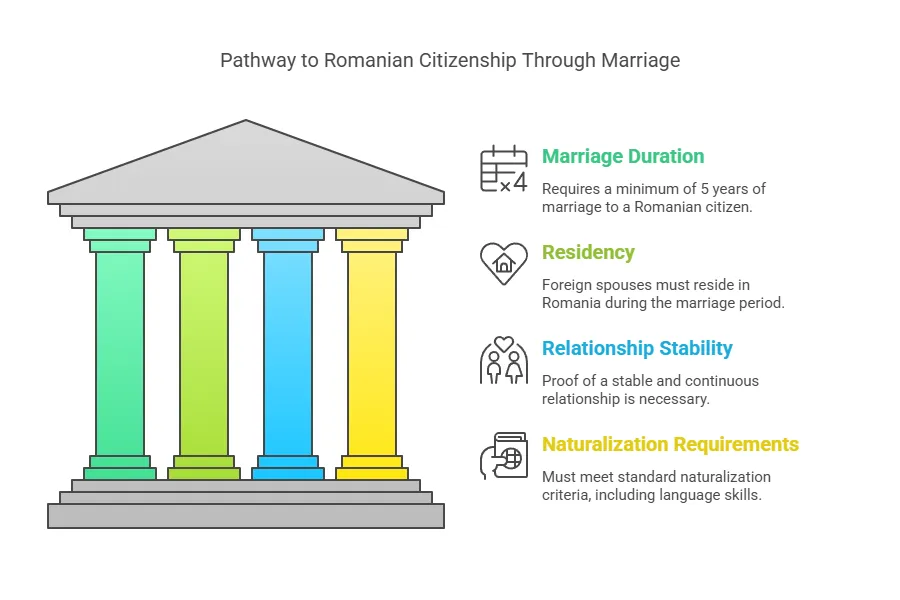
Marriage to a Romanian citizen is a special situation that can put you on a faster track to citizenship, though it is not automatic. Simply marrying a Romanian national does not instantly confer citizenship – but it reduces the residency requirement and qualifies you for naturalization after fewer years. This pathway is essentially a subset of naturalization, with the advantage of a shorter timeline and recognition of the family connection.
Eligibility and Conditions:
Marriage to a Romanian Citizen: You must be legally married to a Romanian citizen. The marriage should be recognized under Romanian law (if the marriage took place abroad, it should be registered or recognized by Romanian authorities).
Minimum Duration of Marriage and Co-habitation: You can apply for citizenship after at least 5 years of marriage, provided you have also lived in Romania during that time. The law specifies being “married and living with” a Romanian spouse for 5 years. This implies co-habitation in Romania; simply being married for 5 years while living abroad likely would not suffice. In practice, you need to hold a residence permit in Romania through your Romanian spouse (a family reunification visa) and reside together for five years.
Other Naturalization Requirements: Aside from the shorter residency period, all other standard naturalization requirements apply. You must still demonstrate good conduct (clean criminal record), basic Romanian language and culture knowledge, loyalty to the state, and have means of subsistence. Age 18+ is required for the applicant.
Continuation of Marriage: Typically, you should still be married (and not legally separated) at the time of application and up through the oath. If the Romanian spouse passes away during the process, or if there’s a divorce, the situation could change the eligibility (you might then have to fulfill the normal 8-year rule unless a discretionary exception is made). There isn’t a specific clause on this scenario in the law, but logically the preferential treatment is predicated on the marriage.
In summary, marriage shortens the timeline from 8 years to 5 years of residency. It doesn’t waive the language or other requirements. Think of it as a fast-track within the naturalization framework for those who have formed a family with a Romanian citizen.
Process for Citizenship by Marriage:
The process is very similar to the naturalization steps described above, with a few differences in documentation:
Residence in Romania as a Spouse: After marriage, the foreign spouse should obtain a family reunification residence permit in Romania (valid initially for one year at a time, then renewable). Maintain continuous residence for 5 years from the marriage date.
Prepare Documentation: In addition to the standard naturalization docs, include the Romanian spouse’s documents: their Romanian ID card or passport, your marriage certificate (transcribed into Romanian records if the wedding was abroad), and proof of continuous cohabitation (like a shared address registration). The application will cite Article 8 of the law, noting eligibility after 5 years of marriage.
Apply and Interview: Submit your application to the ANC, including proof of 5+ years of marriage and residence. Both spouses might need to attend the initial submission to verify the situation (the Romanian spouse’s presence shows support of the application). The interview will test the foreign spouse on language and knowledge, as usual.
Approval and Oath: Once approved, the foreign spouse takes the oath and becomes a citizen. The Romanian spouse’s status is unaffected (they were already a citizen). If they have children together, the children likely are already Romanian from birth (having one Romanian parent). If the children somehow are not Romanian (e.g., step-children from before, or if the Romanian parent hadn’t established filiation), those minors can be included in the application as well.
Retention of Foreign Citizenship: Romania allows the new citizen to keep their original nationality, so a foreign spouse-turned-Romanian will typically become dual national (unless their home country requires a renunciation).
Example Scenario (Marriage): An American woman marries a Romanian man and moves to Romania in 2019. She obtains a residence permit as the spouse of an EU citizen and lives with her husband in Cluj-Napoca. By 2024, after five years of marriage, she speaks intermediate Romanian and has integrated into the community. She applies for citizenship in mid-2024. She provides her marriage certificate, proof of their life in Romania, and passes the language interview. In 2025, she takes the oath and becomes a Romanian citizen – allowing her to live and work anywhere in the EU and enjoy full Romanian citizenship rights, while keeping her U.S. citizenship as well.
This shows that while marriage eases the journey, the individual still must invest time in residency and integration. It’s a fast-tracked naturalization, not an instantaneous right by marriage.
Important: Sham or fraudulent marriages to obtain citizenship are criminal offenses. Authorities do investigate the authenticity of the marital relationship, especially if an application is made as soon as the 5-year mark hits. Genuine couples have nothing to worry about, but the marriage route should not be seen as a loophole – it requires a real, subsisting marriage.
Special Cases: Citizenship by Investment and Merit
Romania does not offer a direct “citizenship by investment” program like some other countries (where one can invest a sum and instantly or after a short time get a passport). However, as discussed, significant investors in Romania benefit from expedited naturalization (half the residency time). For example, Italy offers Italian citizenship through its Golden Visa program, which requires a 10-year residency period before one can apply for naturalization. We’ll outline how investment can help and other special merit cases, including honorary citizenship.
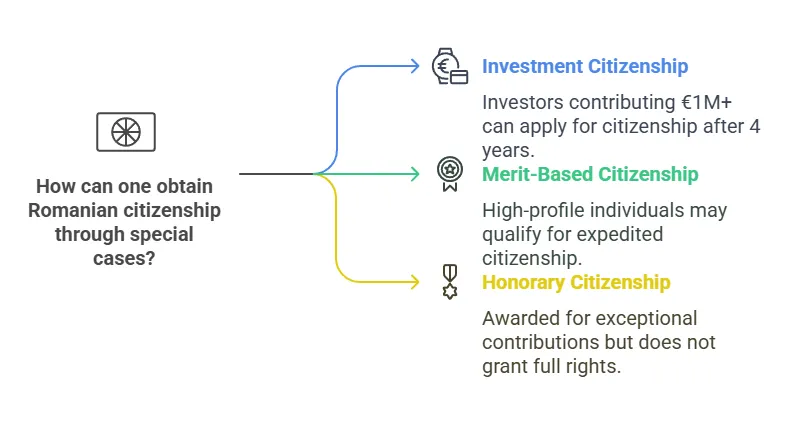
Citizenship by Investment (Expedited Naturalization): If you invest over €1,000,000 in Romania – for example, by funding a business, major real estate development, or government-approved project – the law allows you to apply for citizenship after 4 years of legal residence instead of 8. You must still go through the standard application (steps of naturalization) and meet language and other requirements. Think of it as a reward for contributing substantially to the economy: the wait time is cut in half. However, there is no provision to skip the residency altogether; you cannot just invest money and get citizenship immediately. You’ll first need a residence permit (which you can obtain on the basis of your investment or company director status), then reside those 4 years. After that, follow the naturalization procedure. Many high-net-worth individuals consider Romania for long-term residence since the threshold (€1 million) is relatively reasonable compared to “golden visa” programs elsewhere, leading eventually to an EU passport. But again, it’s not instant – plan for those years of residency.
Notable Contributions (Merit): The law’s provision for “internationally recognized personalities” covers those who have exceptional achievements – whether in science, culture, sports or other fields. Such individuals can be fast-tracked (4-year residency rule). In practice, Romanian authorities might even waive some formalities case-by-case if it’s in the national interest, but formally the person must still apply and be evaluated. There have been instances of famous athletes or academics being granted citizenship a bit faster due to their renown, but Romania is generally strict on the legal procedure.
Honorary Citizenship: Romania has a concept of “Cetățenie de onoare” (honorary citizenship) granted by the Parliament to foreigners for exceptional services to Romania or the Romanian nation. This is quite rare and is more of an honor (often symbolic) than a commonly used path. Honorary citizenship can be given without the normal requirements (“without any other formality”) by a parliamentary decision. Honorary Romanian citizens enjoy many of the same civil rights as regular citizens, except they typically do not have the right to vote, be elected, or hold public office in Romania. For example, a distinguished foreign writer or diplomat who helped Romania might be awarded honorary citizenship. This status does not require giving up original citizenship and is purely discretionary – you cannot apply or follow a process for it; it must be conferred upon you as an honor. It also does not automatically confer EU citizenship status in the way normal citizenship does (due to the limitations on political rights, it’s somewhat a special category).
Special Humanitarian Cases: On occasion, the Romanian President or Government can propose citizenship for someone who has provided special service or in cases of humanitarian need (for instance, a person who saved Romanian lives, etc.). These are extremely uncommon and would be handled via a legislative or executive initiative. Essentially, if Romanian authorities see a strategic benefit or moral obligation, they can make exceptions.
In summary, there is no separate “buy a passport” scheme in Romania. Any investor or talented individual must still become part of the community for a few years. But Romania does reward major contributions by making the path quicker. If you are considering investing in Romania as a route to citizenship, aim to also spend time there and integrate, and your efforts could pay off with an EU passport a few years down the line.
For comparison, many EU countries have clamped down on direct citizenship-by-investment programs due to EU regulations. Romania’s approach aligns with EU norms: offering residency (and eventual citizenship) to investors, but not selling citizenship outright. In fact, investing in Romania can first qualify you for a Permanent Residence Permit if you invest at least €50,000 as share capital in a company, which is a step on the journey to citizenship.
Dual Citizenship in Romania
Romania permits dual citizenship, meaning you can hold Romanian citizenship without losing your original citizenship, and vice versa. This policy has been in place since the 1990s and was crucial in allowing the large Romanian diaspora to reconnect with their homeland.
No Renunciation Required: Unlike some countries that demand new citizens renounce their previous nationality, Romania imposes no such requirement. The Romanian Citizenship Law explicitly states that those who regain or are granted citizenship may keep their foreign citizenship. For example, if a Canadian acquires Romanian citizenship, the Romanian state has no objection to them remaining Canadian as well.
Diaspora Reacquisition: The dual citizenship allowance enabled millions of ethnic Romanians from Moldova, Ukraine, and other countries to obtain Romanian citizenship while retaining their existing citizenship. This has been a cornerstone of Romania’s inclusive approach. As noted, over a million Moldovans have taken advantage of this, becoming dual Moldovan-Romanian nationals. Many Israelis of Romanian origin have similarly gained dual Israeli-Romanian citizenship, and so on.
Obligations: Dual citizens, when in Romania, are treated purely as Romanian citizens. They must use Romanian documents to enter/leave Romania and are subject to the same laws (including any military or civic duties, though Romania has no compulsory military service currently). Dual citizens can vote in both countries (if the other country also allows dual nationals to vote) and enjoy consular help from both.
Impact of Other Countries’ Laws: The only caveat is that your country of origin’s laws might have restrictions. Romania’s law cannot protect you from losing your first citizenship if that country’s law says you lose it upon acquiring a new nationality. For instance, historically, individuals from countries like the Netherlands or Belgium lost their original citizenship when they voluntarily acquired Romanian nationality (before those countries updated their laws). Always check the nationality laws of your home country or any other citizenship you hold. Romania will recognize you as a dual citizen, but another state might not.
EU Considerations: Holding Romanian (EU) citizenship and another citizenship is generally unproblematic in the EU context. Many EU citizens have multiple nationalities. However, note that when exercising EU rights (like moving to another EU country), you typically do so as a Romanian/EU citizen if you’re using that status.
In summary, Romania’s acceptance of dual citizenship offers great flexibility. You can gain the benefits of a Romanian/EU passport without forfeiting the rights and identity linked to your original citizenship. This is a significant factor for many high-net-worth individuals and expats who wish to add a second passport to their portfolio for mobility or security, but do not want to give up their citizenship of birth.
One should also be mindful of tax implications of dual citizenship, although simply having Romanian citizenship does not automatically make you a tax resident in Romania – taxation is based on residence and source of income, not citizenship. Many dual citizens live outside Romania and only pay taxes where they reside.
Case Studies: Real-Life Scenarios

To illustrate how these pathways work in practice, here are a few typical scenarios of foreign nationals obtaining Romanian citizenship:
Case 1: Reclaiming Citizenship by Descent (Grandparent from Romania) – Daniel is a 45-year-old American whose grandmother was born in Bucharest in 1930. His grandmother left Romania in the 1950s and became a U.S. citizen, losing her Romanian citizenship. Daniel decides to obtain a Romanian passport by descent. He collects his grandmother’s Romanian birth certificate, her US naturalization proof, his mother’s and his own birth certificates, and FBI background check. He files an application at the Romanian Consulate in New York, asking for restoration of citizenship under Article 10 of the law (as a descendant up to second degree). After 18 months, he is informed of approval and takes the oath at the Consulate. Daniel is now a Romanian citizen. He gets his Romanian passport, which grants him EU citizenship through Romania, allowing him to work in Europe. He retains his US citizenship as Romania allowed dual citizenship. This scenario is common among those with a Romanian grandparent – many have successfully reclaimed citizenship this way, as evidenced by the large number of reacquisitions in recent decades.
Case 2: Naturalization of a Long-Term Expat Investor – Sophia is a Lebanese entrepreneur who moved to Romania in 2016 to start a winery business. She obtained a residency permit as a business investor. Over the years, she invested well over €1 million and expanded her company, contributing jobs locally. By 2022, she had a Romanian permanent residence card. She speaks intermediate Romanian after years in the country. Instead of waiting 8 years, Sophia qualifies to apply in 2020 (after 4 years) thanks to the investment provision. She submits her application, passes the interview (demonstrating her knowledge of Romanian language and singing a portion of the anthem), and in 2021 she takes the oath of citizenship. Sophia becomes Romanian in five years total. She continues to run her business, now with the benefit of being an EU citizen for any future ventures. She also keeps her Lebanese citizenship. This case shows an investor leveraging the reduced naturalization period.
Case 3: Fast-Track via Marriage – Alex is from Australia and married a Romanian he met in London. In 2018, they moved to Timișoara, Romania. Alex obtained a residence permit as the spouse of a Romanian. He integrates into the community, learns Romanian, and after 5 years of marriage (in 2023) applies for citizenship. His application includes his Romanian marriage certificate and wife’s documents. By 2024, he is approved and takes the oath. Alex becomes a dual Australian-Romanian national. Now he can travel, live, and do business anywhere in the EU. This scenario underscores that while marriage gave him a shortcut, he still had to commit five years to living in Romania and adapting to the culture.
Case 4: Moldovan Citizen Reacquiring Romanian Citizenship – Elena is a young professional from Chișinău, Moldova. Her great-grandparents were Romanian citizens before WWII when Moldova was part of Romania. Under Romania’s law (Article 11), Elena, as a third-generation descendant of former Romanians who lost citizenship not by their will, is eligible for restoration. She applies through the special repatriation program that many Moldovans use. After about a year, she obtains Romanian citizenship. She doesn’t relocate to Romania; instead, she uses her new Romanian passport to work in Germany. Elena’s case is extremely common – in fact, by 2024, over one million Moldovans held Romanian passports this way. It highlights Romania’s role in extending EU citizenship to those with historic ties, and how those individuals leverage the opportunity for broader EU mobility.
Each of these examples reflects a different route, but in all cases the individuals ended up with Romanian (and EU) citizenship, whether through family lineage, long-term residency, marriage, or historical justice.
Conclusion
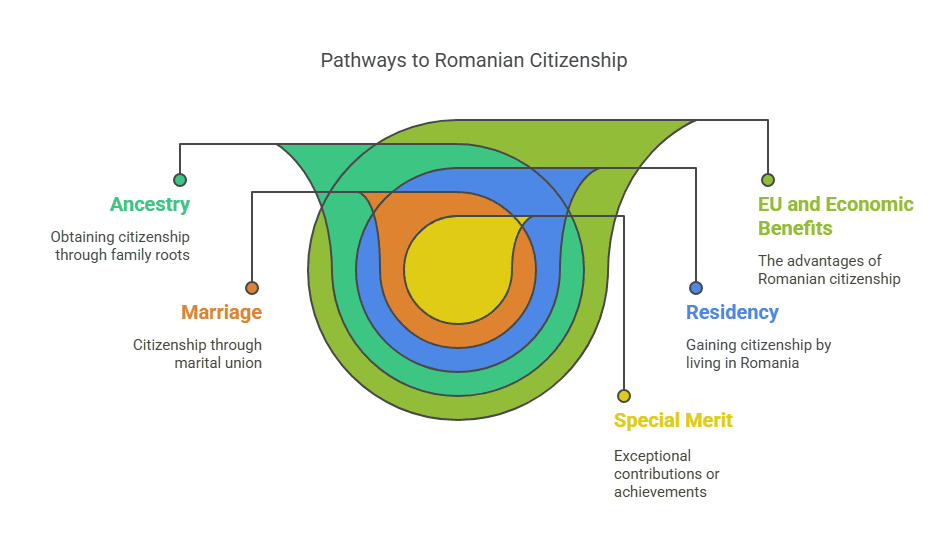
Obtaining Romanian citizenship is a gateway to European Union citizenship, with all its attendant benefits. Whether you qualify through your Romanian ancestry, long-term residence and integration, marriage to a Romanian, or exceptional contributions, Romania provides multiple pathways to become a citizen. As outlined, the processes are detailed but very much achievable — tens of thousands of people successfully become Romanian citizens each year via these routes.
Citizenship by descent is a powerful option if you have Romanian roots, allowing you to reclaim nationality often without even relocating. Naturalization through residency is the path for those committing to life in Romania, rewarding you after years of contribution with a Romanian passport. Marriage to a Romanian expedites this journey for those who build a family in Romania. And while investment or special talent doesn’t grant citizenship outright, it can significantly shorten the timeline.
As of 2025, Romania remains committed to an inclusive citizenship policy – it recognizes dual citizenship, embraces its diaspora’s right to return, and upholds EU freedom of movement values. The benefits of Romanian (EU) citizenship, from extensive travel freedom to economic opportunities, make the effort worthwhile.
Professional Guidance: Given the legal intricacies and documentation involved, it is advisable for high-net-worth individuals or anyone with a complex case to consult a legal professional or specialized consultant when pursuing Romanian citizenship. Official government websites (Ministry of Justice – Citizenship Authority) and reputable law firms’ publications (as referenced throughout this guide) are great resources for up-to-date requirements. Ensure all information you rely on is current, since regulations can evolve.
By following the steps and advice laid out above – and with some patience – you can successfully obtain Romanian citizenship and with it, the rights of a citizen of the European Union. How to get Romanian citizenship is no longer a mystery: it’s a clear process that thousands have navigated, and with careful preparation, you could soon join their ranks, holding a Romanian passport and embracing a new world of possibilities.
Frequently Asked Questions
Q: How long does it take to obtain Romanian citizenship through naturalization? A: The process typically takes about 1 to 2 years after submitting your application, provided you meet all the residency and other requirements. However, the total time from initial residency to citizenship can be 8 years, or 5 years if married to a Romanian citizen.
Q: Can I retain my original citizenship after becoming a Romanian citizen? A: Yes, Romania allows dual citizenship, so you can retain your original nationality while enjoying the benefits of Romanian (EU) citizenship.
Q: What are the benefits of having an EU passport? A: An EU passport allows you to live, work, and travel freely across all EU countries. It also provides access to high-quality healthcare, education, and social benefits, as well as the right to vote in European Parliament elections.
Q: Do I need to speak Romanian to obtain citizenship by descent? A: No, the descent pathway does not require you to pass a Romanian language test. However, learning the language is encouraged to fully enjoy your citizenship.
Q: What documents are required for Romanian citizenship by marriage? A: You will need your marriage certificate, proof of continuous cohabitation, your Romanian spouse’s ID or passport, and other standard naturalization documents such as your birth certificate, proof of income, and a clean criminal record.
Q: Is there a fast-track option for investors? A: Yes, significant investors who contribute over €1,000,000 to the Romanian economy can apply for citizenship after 4 years of legal residence, instead of the usual 8 years.
