

Comprehensive Guide to Employee Dismissal Rules, Notice Periods, and Severance Pay
Terminating an employment contract in Armenia requires navigating specific legal grounds, procedures, and financial obligations under the Armenian Labor Code. Employers, HR professionals, and legal advisors must ensure compliance with current Armenian labor law provisions (as of 2025) to avoid disputes and penalties. This article provides a comprehensive overview of employee dismissal rules in Armenia, including valid termination grounds, the rights of each party, required notice periods, severance pay calculations, documentation steps, and best practices. Real-life scenarios illustrate how these rules apply in practice.
Valid Legal Grounds for Termination in Armenia
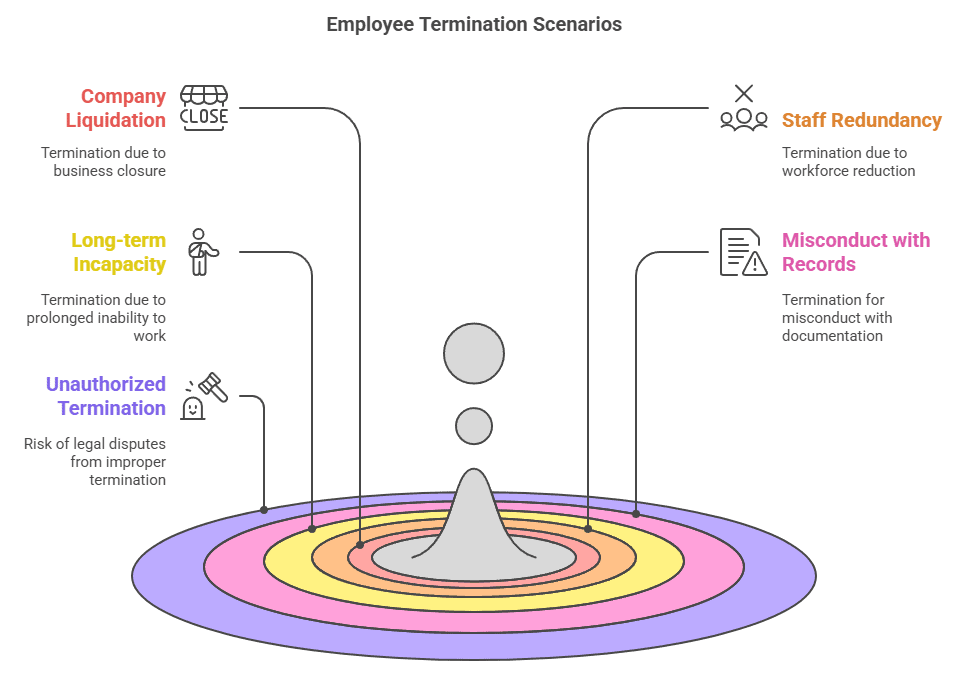
Under the Armenian Labor Code, an employer may legally terminate an indefinite or fixed-term employment contract only on certain prescribed grounds. It is imperative that terminations are based on one of these valid reasons; otherwise, they may be deemed unlawful. The primary grounds for termination initiated by an employer include:
Liquidation of the Company or Cessation of Business
If the organization is liquidated or a sole proprietor employer ceases business operations, all employment contracts may be terminated. Employer bankruptcy is similarly a ground for termination, often leading to mass layoffs.
Staff Reductions / Redundancy
Employers can dismiss employees due to changes in production volume, economic circumstances, technological changes, or reorganization of work that result in a reduction of the workforce. This must be a genuine redundancy situation (e.g. elimination of roles).
Employee's Lack of Suitability or Qualification
If an employee is not suitable for the position or job – for example, due to lack of necessary qualifications or if their state of health makes them unable to fulfill duties – the contract can be terminated on this basis. A deterioration in the employee's health that stably prevents them from working can justify this ground, supported by a medical conclusion (medical-social expertise) confirming the incapacity.
Unsatisfactory Probation Results
If the employee was hired with a probationary period and did not meet the required standards by its end, the employer may dismiss the employee for unsatisfactory result of the trial period. Note: A probationary period in Armenia is generally up to 3 months, and termination during probation requires a minimum 3 days' notice.
Disciplinary Violations / Non-Performance
Regular failure by the employee to perform their duties (or violation of the employer's internal disciplinary rules) without valid reason is a cause for termination. However, Armenian law requires a pattern of misconduct – prior to the given disciplinary violation, the employee who committed the disciplinary violation must have at least two unexpired or unpaid disciplinary penalties (Article 121, Part 1). This ensures termination for poor performance isn't done hastily.
Loss of Trust
The Labor Code allows dismissal based on loss of trust (typically applicable to employees in financially responsible or confidential positions). For instance, if an employee commits an act that causes or could have caused material damage to the employer or leaks confidential information, the employer may justifiably lose trust. Armenian case law emphasizes that even if individual actions aren't explicit rule violations, the overall pattern of an employee's behavior can justify loss of trust.
Long-Term Inability to Work
If an employee is absent for an extended period due to illness or incapacity, the employer may terminate the contract on grounds of long-term inability to work. Under the current law, this means the employee has been temporarily incapacitated for more than six months consecutively or more than 180 days in the last twelve months (excluding days of pregnancy and maternity leave) as per Article 113, Part 1, Clause 7. This ground ensures businesses can eventually fill a role that has been vacant long-term, but it must be applied carefully and in line with medical documentation.
Other Grounds Provided by Law
The Labor Code and other laws specify additional special cases. For example, an employment contract must be terminated if an effective court judgment prevents the employee from working (e.g. imprisonment) or if the employee loses required professional licenses/certifications for the job. Likewise, if a minor aged up to 16 years old is employed, their parent/guardian or a state inspector can demand contract termination for the child's best interest (Article 109, Part 1, Paragraph 8). Another special case: if an employee fails to submit documents required by public health rules and consequently is barred from work for over 10 consecutive workdays (or 20 days in 3 months), the employer may terminate the contract.
Employee-Initiated Termination & Mutual Agreement
In addition to the employer-driven grounds above, Armenian law always allows resignation or mutual separation. An employee may resign by giving at least 30 days' written notice for an indefinite contract (Article 112, Part 1) or 5 days' notice if resigning for urgent reasons like illness or the employer's breach of law. Employers and employees can also mutually agree to terminate at any time; this requires a written agreement stating the termination date and any agreed conditions (such as compensation). A mutual termination is often a pragmatic way to end employment on agreed terms, but it must be truly consensual.
Importantly, termination grounds must be genuine and well-documented. The employer is obligated to state the factual and legal reason for dismissal in the termination order given to the employee. Arbitrary or false reasons (for example, citing "staff reduction" as a pretext to dismiss an underperformer without actually eliminating a position) could render the termination unlawful.
Employer and Employee Rights During Termination
Both employers and employees have specific rights and protections during the termination process. Armenian labor law strikes a balance: it enables employers to end contracts for legitimate reasons, but also shields employees from unfair or opportunistic dismissal. Key rights and obligations include:
Employee Protections and Prohibited Dismissals
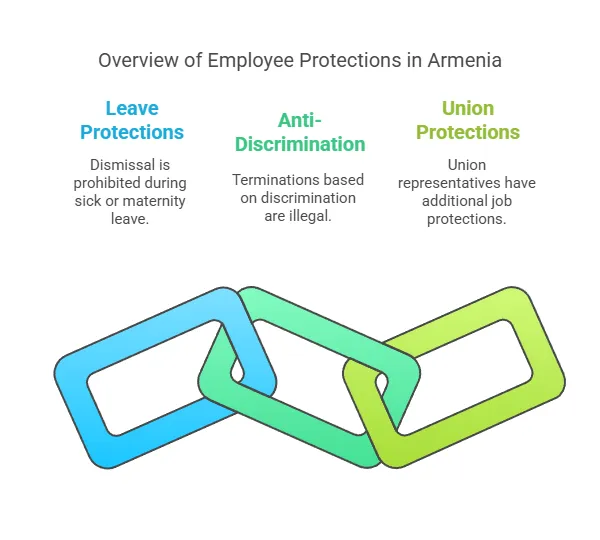
Certain situations bar an employer from dismissing an employee (except in extreme cases like liquidation). These prohibitions safeguard employees who are temporarily vulnerable or engaged in protected activities:
Temporary Disability
An employer cannot terminate an employee while they are on certified sick leave or otherwise temporarily unable to work due to health reasons. For example, firing someone who is hospitalized or recovering at home with a doctor's note is unlawful (until the long-term incapacity threshold is reached).
Leave Periods
Employees cannot be dismissed during any approved leave – this includes annual vacation, maternity or paternity leave, or any other leave of absence. For instance, terminating an employee because they took vacation or while they are on holiday violates the law.
Pregnancy and New Mothers
Special protection is given to pregnant women and recent mothers. From the moment an employer is notified of an employee's pregnancy (via medical certificate) and until one month after the end of her maternity leave, the employer may not terminate her contract. Exceptions: 1) in cases of liquidation (cessation of activity) of the employer, removal from state registration, in the case of a notary employer, dismissal from office; 2) in case of regular failure by the employee to fulfill duties without good reason; 3) in case of loss of confidence in the employee.
Strikes and Public Duties
If an employee is participating in a lawful strike, or is off work fulfilling certain state or civic duties (e.g. military reserve training), the employer generally cannot dismiss them for that reason. Article 124 of the Code specifically covers military service obligations, effectively suspending the employment for the duration of compulsory service rather than ending it.
Discrimination and Retaliation
The law explicitly lists grounds that shall not be considered legitimate reasons for termination. These include an employee's membership in a trade union or participation in union activities, acting as an employee representative, filing complaints or lawsuits against the employer for labor violations, or any personal characteristics such as sex, race, nationality, language, origin, political views, religion, marital status, or social status.
Trade Union Representatives
Employees elected to represent co-workers (e.g. union leaders or works council members) have additional job security. An employer generally cannot terminate a union representative without the prior consent of the state labor inspectorate, except in cases of serious fault (like proven theft or violence) or if the company is liquidating.
Employer Obligations and Due Process in Terminations
Employers have the right to terminate employees for valid reasons, but they must follow proper procedure and honor certain obligations:
Proper Notice and Documentation
Employers are required to give employees advance written notice of termination in many cases. The notice must clearly state the basis and reasons for dismissal, and the effective date of termination.
Opportunity for Explanation (Disciplinary Cases)
For terminations related to employee fault, the law expects the employer to follow a fair process. This means the employer should investigate the issue and request a written explanation from the employee before making a final decision.
No Government Pre-Approval Required
Except for the union representative scenario, Armenian employers do not need to obtain permission from a court or government agency before dismissing an employee. Employment in Armenia is not "at-will" but it doesn't require labor authorities to sign off on individual firings in most cases.
Offer of Alternative Job (in Some Cases)
If the termination is due to the employee's lack of suitability, the employer is obliged to see if there is another appropriate job in the organization that the employee could be transferred to. In the event of a staff reduction, an alternative job may be offered. Only if no such position exists, or if the employee refuses the offer, can the employer proceed to terminate on these grounds.
Respect for Final Pay Rules
On termination, the employer must settle all final payments with the employee (wages, payouts) by the last working day, unless otherwise agreed. Additionally, the employer must complete required paperwork, such as preparing a work record book entry (if applicable).
Employees, for their part, have the right to challenge a termination they believe is unlawful. If an employee feels the dismissal was not on valid grounds or the procedure was flawed, they can file a complaint with the Labor and Social Inspection Body or directly bring a claim to court for wrongful termination. Armenian courts can reinstate employees to their jobs with back pay if the termination is found illegal, which is a substantial risk for employers.
Statutory Notice Periods for Termination
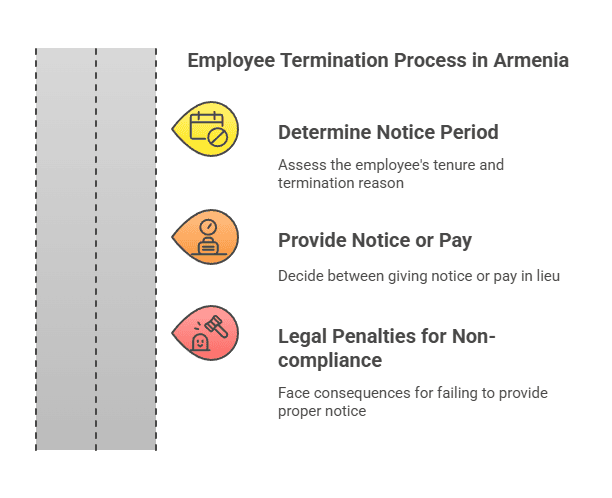
Notice period requirements in Armenia depend on the grounds for termination and sometimes the employee's length of service. The Labor Code specifies when advance notice is required and how long it must be, ensuring employees have some warning or compensation before job loss. Below is a breakdown of notice obligations for employer-initiated terminations:
Two Months' Notice – Redundancy or Liquidation
When terminating employment due to the liquidation of the employer (company closure) or a staff reduction for economic/technological reasons, the employer must give at least two months' written notice to the affected employee. This two-month notice rule also generally applies if the employer is recognized as bankrupt, leading to terminations (though in bankruptcy, actual notice may be shorter as per insolvency procedures).
Notice Based on Length of Service
If the reason for termination is the employee's lack of suitability for the job or the employee's long-term incapacity to work, the required minimum notice period scales with the employee's tenure:
- Up to 1 year: 14 days notice minimum
- 1 to 5 years: 35 days notice
- 5 to 10 years: 42 days notice
- 10 to 15 years: 49 days notice
- More than 15 years: 60 days notice
Three Days' Notice – Special Cases
In specific scenarios, a short three-day notice is sufficient:
- • An employee's work authorization or residence status is revoked
- • The employee has failed to perform work for more than 10 consecutive working days due to not providing required documents
No Notice – Dismissal for Serious Cause
In several serious misconduct or fault-based cases, no advance notice is required at all – termination can be effective immediately. These include:
- • Regular non-fulfillment of duties or gross violation of work discipline
- • Acts leading to loss of trust
- • Coming to work under the influence of alcohol or drugs
- • Absence for a whole workday without valid reason
- • Refusal to undergo a mandatory medical exam required for the job
Employee Resignation Notice
Employees who quit must generally give 30 days notice for indefinite contracts (Article 112, Part 1). Employees can sometimes leave with shorter notice (5 days) for valid reasons like illness or employer wrongdoing. The employer can agree to waive or reduce the notice period for a resigning employee as well.
In all cases, the notice of termination must be in writing and delivered to the employee. By law, the notice letter (or order) must specify the basis and reason for dismissal and the effective date. Providing this clarity in writing is not only legally required but also considered a best practice for transparency.
Pay in Lieu of Notice
Sometimes an employer prefers to terminate the employment immediately or before the full notice period elapses. Armenian law permits employers to terminate without waiting for the notice period as long as the employee is compensated for the notice period they are entitled to. This is essentially pay in lieu of notice. The Labor Code states that if the employer does not give the full required notice, they must pay the employee a penalty (compensation) for each day of notice shortfall, calculated at the employee's average daily wage rate.
Mass Terminations and Collective Dismissals
When an employer plans a large-scale layoff, additional rules ensure that both the authorities and employee representatives are alerted well in advance. Armenian labor law defines a "mass dismissal" as a termination affecting more than 10% of the workforce (but at least 10 employees) within a two-month period. In mass dismissal scenarios:
- • The employer must notify the State Employment Service and the employees' representative body at least two months in advance of the terminations
- • If workers are on fixed-term or seasonal contracts that naturally expire, those endings are not counted as "mass dismissal"
Severance Pay Rules and Calculations
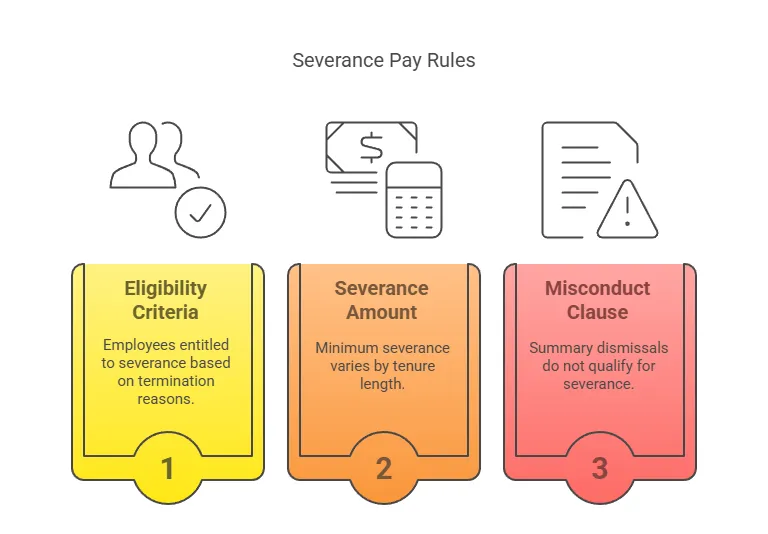
Depending on the reason for termination, Armenian law may require employers to provide a severance payment to the departing employee. Severance is essentially a lump-sum compensation to ease the financial impact of job loss. The Labor Code specifies the scenarios where severance is mandatory, and the amount is typically linked to the employee's wage (average wage) and sometimes their length of service.
When is Severance Pay Required?
Company-Initiated, No-Fault Terminations
If the termination is due to reasons unrelated to the employee's misconduct, such as economic or structural reasons, the law mandates severance. Specifically, when an employment contract is terminated because of the liquidation of the organization or a reduction in workforce (redundancy), the employee must receive severance equal to their average monthly salary (one month's pay).
Employee-Related Reasons (non-disciplinary)
If the termination is due to factors specific to the employee but not misconduct, such as the employee's incapacity or health reasons, the law provides a scaled severance. The statutory minimum severance in these cases is:
- Up to 1 year of service: 10 days' average wages
- 1 to 5 years: 25 days' average wages
- 5 to 10 years: 30 days' average wages
- 10 to 15 years: 35 days' average wages
- Over 15 years: 44 days' average wages
No Severance for Cause or Resignation
If an employee is terminated for serious cause (misconduct) or if they resign voluntarily, the employer is not legally obliged to pay severance. Severance is intended for instances of job loss not the employee's fault, not as a penalty to the employee.
Severance Pay Calculations and Examples
Example 1: Company Liquidation
A company is liquidating and must lay off all staff, including an engineer earning an average of 300,000 AMD per month. That engineer will be entitled to 300,000 AMD as severance (one month's salary).
Example 2: Unsuitability Termination
An employee with 3 years of service is being terminated because despite training, she cannot perform the essential duties of her position. Her average daily wage is 15,000 AMD. According to the scale, she's owed 25 days of pay. That equals 15,000 × 25 = 375,000 AMD as severance.
Example 3: Long-Term Employee
An employee with incapacity issues is let go after 20 years at the company, with an average salary of 500,000 AMD per month (approx. 23,000 AMD daily). Severance = 44 × 23,000 ≈ 1,012,000 AMD (about two months' pay) in line with the >15 years band.
It's important to differentiate severance pay vs. notice pay: Severance is in addition to any notice period or pay in lieu of notice. So if two months' notice is given (or paid out) for a redundancy, the employee still gets the one-month severance at the end of the notice. Severance is meant as an extra cushion, not a substitute for notice.
Required Documentation and Final Steps for Compliance
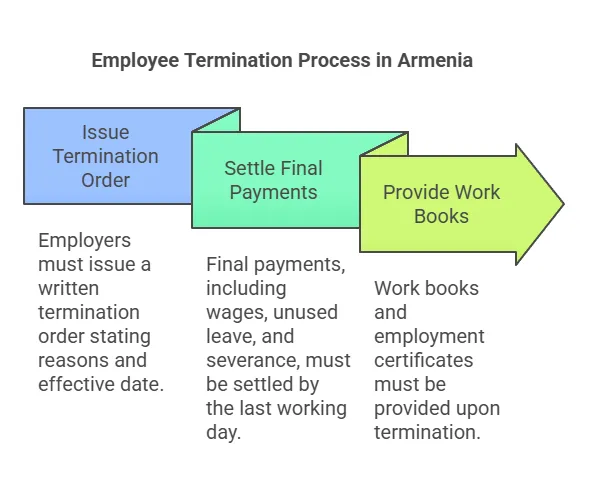
Following the proper procedures and paperwork in a termination is crucial in Armenia. Legal compliance steps ensure the termination is effective and can withstand scrutiny.
Termination Notice and Order Documentation
1. Written Notice of Termination
If a notice period applies, the employer delivers a written termination notice to the employee. This notice should include the reason for termination and the date the employment will end.
2. Employer's Dismissal Order
On the final day of employment, the employer typically issues an official order terminating the employment. This is sometimes called an "HR order" that cites the Labor Code article under which the employee is dismissed.
3. Explanation Letter and Disciplinary Records
If the dismissal was for cause, ensure that the employee's written explanation and any disciplinary memos/warnings are on file. These documents support the employer's decision if later challenged.
4. Employee Acknowledgment
It's good practice to have the employee sign to acknowledge receipt of the notice and the final settlement paperwork. If an employee refuses to sign, a note can be made or a witness can co-sign.
Final Settlement (Wages, Leave, Work Book)
On the employee's last working day, the employer must provide all due payments and documents. Armenian labor law requires the final settlement to be completed by the date of termination, unless otherwise agreed. Key elements include:
Final Paycheck
This encompasses the employee's last salary up to their last day worked, any overtime pay due, and payment for any accrued but unused annual leave.
Severance Pay
Any statutory severance amount owed should be calculated and included in the final payment. This is usually listed separately on the final payslip for clarity.
Payment in Lieu of Notice
If the employer opted to pay wages instead of notice, that amount is added to final pay. This is paid together with other final dues.
Work Book and Records
Armenia traditionally uses a labor book (work record book) for employees. Upon termination, the employer must make an entry in the work book noting the end of employment and hand over the work book to the employee on the last day.
Important: Any delay in final payment can lead to penalties. Failure by an employer to make a complete final payment on time is considered a violation of labor law, and the employee could file a complaint or the labor inspectorate could impose fines.
Scenarios Illustrating Termination in Practice
To better understand how these rules play out, let's consider a few hypothetical scenarios that mirror common situations in Armenia's private sector:
Scenario A: Redundancy due to Restructuring
"Company A" is an IT firm in Yerevan undergoing restructuring. It decides to eliminate the entire QA Testing department of 15 employees due to adoption of automated tools. This is a collective redundancy (more than 10 employees, and 15% of staff). The employer first notifies the State Employment Service and the company's employee council 3 months in advance of the planned layoffs. Each affected QA employee is given an individual notice letter 2 months in advance stating that their position is being abolished due to changes in production/technology (Labor Code Article 113(1)(3)). On the termination date, Company A pays each tester their final salary, plus one month's severance pay as required for redundancies. Because the procedure was correctly followed, the risk of legal challenge is minimal.
Scenario B: Termination for Poor Performance
"Company B" employs Arman as a sales manager. Over the past year, Arman has consistently missed targets and received two written warnings. Despite additional training, his performance hasn't improved. The employer decides to terminate his contract for inadequate performance. First, the company calculates Arman's tenure – 3 years – which means he's entitled to 35 days notice and 25 days' severance under the law. The HR manager meets with Arman to deliver a written notice explaining that due to his not meeting job requirements, his employment will end in 35 days (citing Article 113(1)(3) as the ground). On the last day, Company B provides a termination order and pays Arman: his last month's salary, payment for 5 unused vacation days, and severance equal to 25 days of pay.
Scenario C: Dismissal for Misconduct
"Company C" discovers that Mariam, an accountant, has been coming to work intoxicated and last week was absent an entire day without excuse. The employer immediately documents the incidents and calls Mariam in for an explanation. Company C decides to terminate her for disciplinary reasons. Because these are "for cause" grounds, no advance notice is required – Mariam's employment can be ended effective immediately. The company prepares a termination order citing Article 113(1) points 8 and 9 (being at work under the influence of alcoholic beverages and failing to appear for work during the entire working day for an unjustified reason). Upon termination, Mariam is only paid her final salary and compensation for remaining vacation days. No severance is paid (misconduct terminations do not qualify).
Scenario D: Protected Employee – Pregnancy
"Company D" has a staff member, Nune, who is three months pregnant and has informed her boss with a doctor's note. Her performance has been subpar, and under normal circumstances the company would consider terminating her for poor performance. However, because Nune is pregnant, the employer cannot dismiss her during pregnancy except in drastic situations like liquidation. Company D acknowledges this and instead works with Nune to improve performance, documenting issues. Only after her protected period ends can the company, if performance issues persist, initiate a termination with the usual process. This scenario shows that even if cause exists, certain employees cannot be fired at certain times.
Each scenario highlights compliance: in A and B, the employers followed the rules and provided notice/severance; in C, the employer documented cause and avoided the mistake of giving severance where not required; in D, the employer recognized a legal restriction and adjusted its approach. Real-life cases in Armenia have shown that when employers ignore notice or dismiss a protected worker, courts readily side with employees.
Compliance Risks and Best Practices
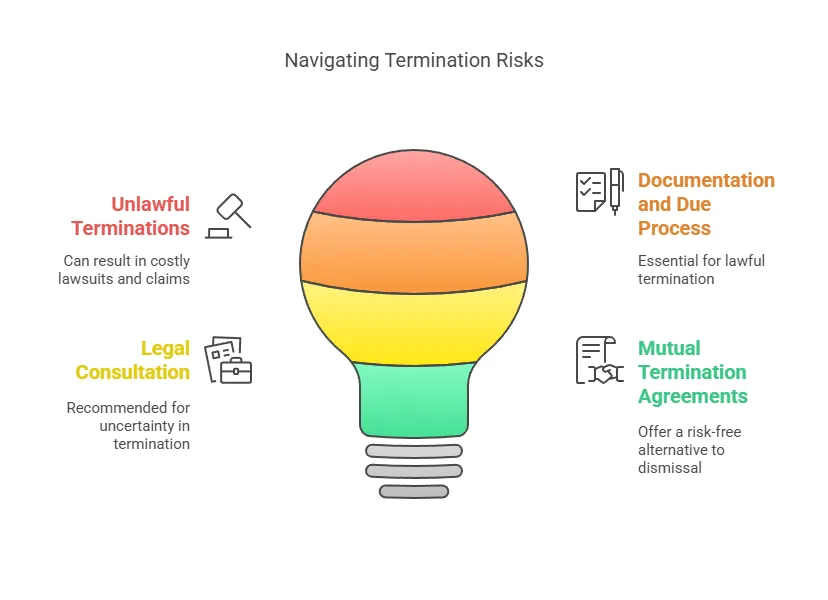
Failure to comply with Armenia's termination laws can lead to significant risks for employers, including legal challenges, financial penalties, and reputational damage. Conversely, following best practices can make the process smoother and defendable.
Compliance Risks
-
Wrongful Dismissal Claims: Courts can restore employees to their jobs and require back-pay for the entire period they were out of work.
-
Administrative Fines: The Labor Inspectorate can levy fines for breach of labor laws.
-
Reputation Damage: Unfair treatment can harm employer brand and make it harder to attract talent.
Best Practices
-
Plan and Consult: Review situations against the Labor Code and consult legal counsel when unsure.
-
Document Everything: Maintain clear records of performance, misconduct, and disciplinary actions.
-
Follow Procedures: Tick all the boxes the law requires - notice, explanations, alternative positions.
Additional Best Practices for Termination Compliance
Use Mutual Agreements When Appropriate
Consider mutual termination agreements with written consent and settlement terms to avoid disputes.
Treat Employees with Dignity
Communicate respectfully and privately. Provide honest reasons and help employees transition when feasible.
Timely Final Payments
Always pay what is owed at once on termination. Double-check calculations for all compensation types.
Stay Updated on Law Changes
Labor legislation can evolve. Stay current with legal updates and maintain legal advisor relationships.
By following these best practices, employers in Armenia can significantly reduce the risk of legal disputes and ensure smooth separations. Termination is never pleasant, but handling it correctly and lawfully is crucial. Remember that the employment relationship in Armenia is governed by the Labor Code and worker protections – compliance isn't optional.
Conclusion
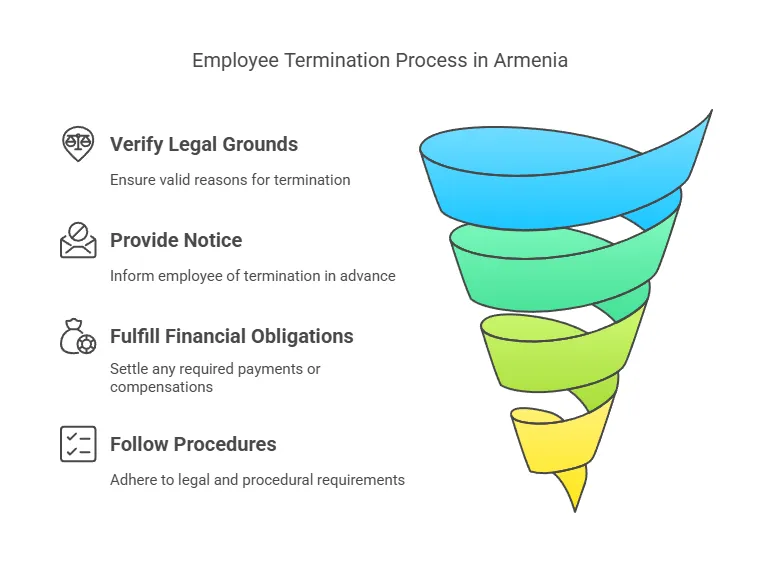
Terminating an employment contract in Armenia's private sector is a process governed by detailed legal provisions aimed at protecting employee rights while allowing businesses flexibility under defined circumstances. As of 2025, the Armenian Labor Code outlines clear grounds on which an employee can be dismissed – ranging from economic redundancies to employee misconduct – and prescribes the procedures to follow for each. Both employers and employees have rights during this process: employees are shielded from arbitrary or ill-timed termination (e.g. during pregnancy or leave), and employers can lawfully end employment provided they adhere to notice requirements, substantiate the reasons, and pay any due severance pay or compensation.
From an HR compliance perspective, key takeaways include the importance of giving the correct notice period (or pay in lieu), calculating and disbursing severance payments where mandated, and completing all final settlement obligations (wages, unused leave, documentation) on time. Real-life scenarios in Armenia underscore that terminations done by the book – with valid grounds, proper documentation, and empathy – stand the test of scrutiny, whereas shortcuts or unlawful motivations can lead to legal reversals and financial liabilities for the employer.
For foreign businesses and investors, understanding these employee dismissal rules in Armenia is vital. Compliance with local labor law not only avoids legal sanctions but also builds trust with the workforce. As Armenia's labor regulations continue to evolve (with recent updates on leave and other benefits), staying informed and seeking local legal counsel when needed is advisable for any employer operating in the Armenian market.
Key Takeaways
Legal Compliance is Essential
Follow structured processes: identify lawful grounds, check employee status, give required notice, provide due severance.
Documentation Matters
Maintain proper records and ensure all termination paperwork is complete and accurate.
Respect Employee Rights
Understand protected situations and prohibited termination grounds to avoid legal challenges.
Seek Professional Guidance
Consult local legal counsel for complex cases and stay updated on evolving regulations.
In summary, termination of employment in Armenia should be handled as a structured process that upholds labor rights in Armenia while managing organizational needs. This balanced approach to termination – fair, transparent, and in line with the 2025 legal framework – is both a legal obligation and a hallmark of good corporate citizenship in Armenia's employment landscape.
