

Relocating abroad can dramatically improve your quality of life – but choosing the right destination is crucial. We’ve analyzed some of the best-ranked countries for expats across key factors like cost of living, healthcare, safety, work-life balance, environmental quality, cultural opportunities, and integration.
Living abroad can be a thrilling experience, offering a unique opportunity to immerse oneself in a new culture, meet new people, and explore new places. However, it can also be a daunting task, especially when it comes to choosing the right country to call home. With so many factors to consider, from quality of life to economic stability, it’s essential to do your research and make an informed decision.
Factors to Consider When Choosing a Country
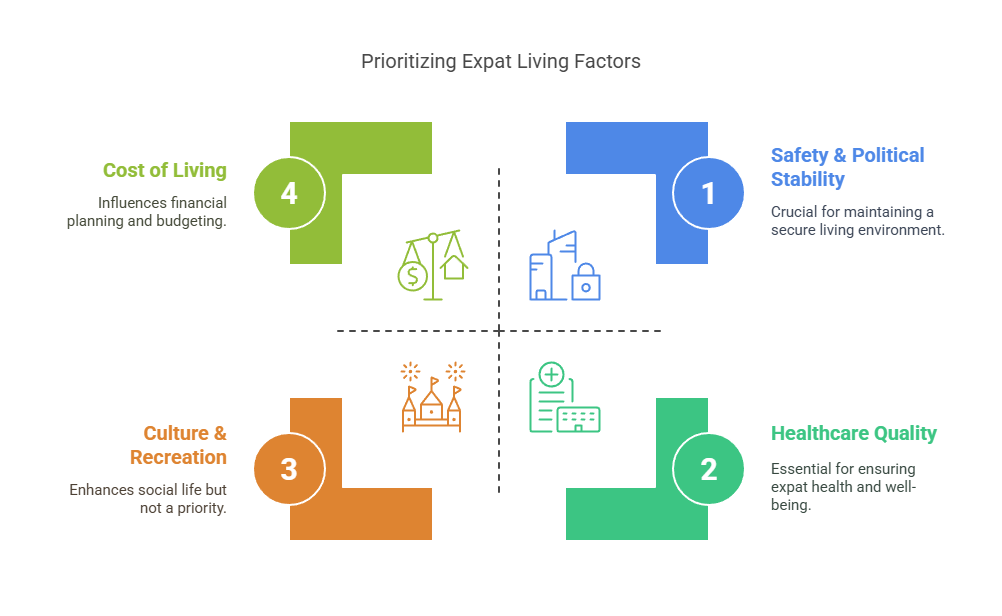
When choosing a country to live in, there are several factors to consider. Here are some of the most important ones:
Quality of Life: What kind of lifestyle do you want to lead? Do you prefer a fast-paced city life or a relaxed rural lifestyle? Consider the overall well-being, happiness, and satisfaction levels of residents.
Economic Stability: Is the country’s economy stable, and are there job opportunities available in your field? A stable economy often translates to better job security and growth prospects.
Living Costs: What are the living costs like in the country, and can you afford to live comfortably? Evaluate expenses such as housing, groceries, transportation, and utilities.
International Schools: If you have children, are there good international schools available? Access to quality primary and secondary education is crucial for families.
Healthcare: What kind of healthcare system does the country have, and is it accessible to expats? Consider whether the country offers universal healthcare or if private health insurance is necessary.
Language: Do you speak the local language, and if not, are there language classes available? Language proficiency can significantly impact your integration and daily life.
Culture: How welcoming is the local culture to expats, and are there opportunities to integrate into the community? A supportive and inclusive environment can make your transition smoother.

| Country | Monthly Cost – Single | Monthly Cost – Family | Healthcare Ranking | Global Peace Index | Dual Citizenship |
|---|---|---|---|---|---|
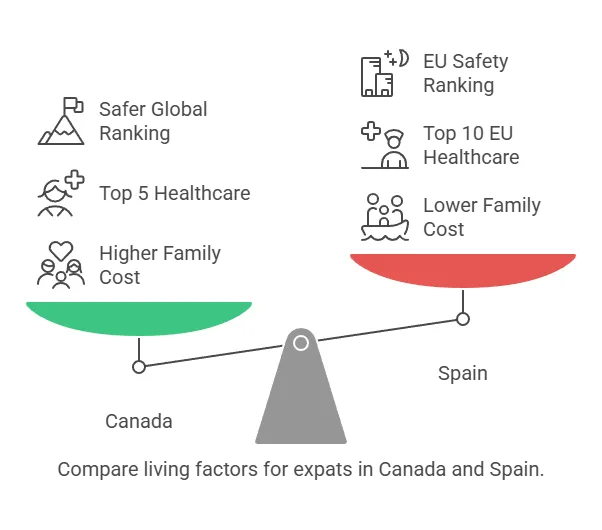
| Canada | C$3,327 (US$2,460) | C$8,228 (US$6,090) | Very High (Top 5) | 11th safest | Allowed |
| Spain | €1,671 (US$1,800) | €4,014 (US$4,300) | High (Top 10 EU) | 31st safest | Restricted (most must renounce) |
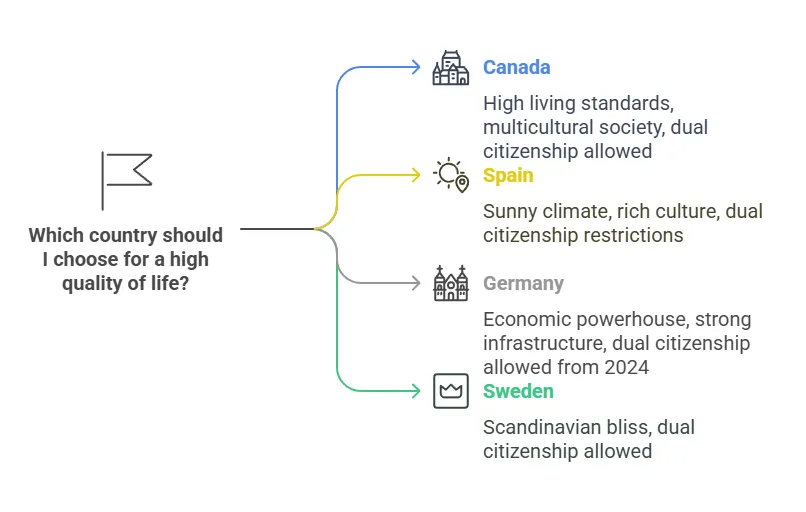
| Germany | €1,880 (US$2,000) | €5,048 (US$5,400) | Very High (Top 10) | 20th safest | Allowed (from 2024) |
| Sweden | €1,780 (US$1,900) | €4,667 (US$5,000) | Excellent (Top 5 EU) | 39th safest | Allowed |
| New Zealand | NZ$3,132 (US$1,850) | ~NZ$7,000 (US$4,300) | High (Top tier OECD) | 2nd safest (2023) | Allowed |
| Singapore | S$5,134 (US$3,800) | S$12,575 (US$9,300) | World-Class (Top 3) | 9th safest | Not allowed (except minors) |
Canada – High Living Standards and Multicultural Society
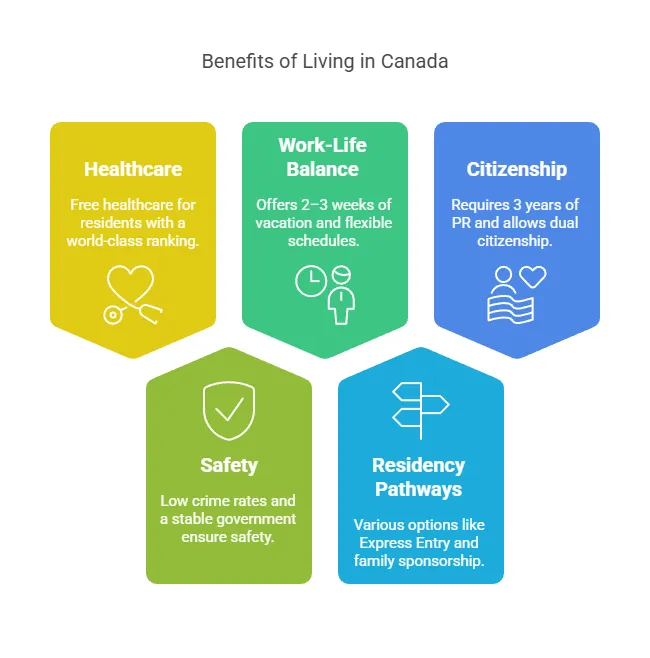
Cost of Living: Canada offers a high standard of living at costs comparable to Western Europe. A single person spends around C$3,327/month (≈US$2,460) including rent, while a family of four averages C$8,228 (≈US$6,090). Major cities like Toronto and Vancouver are pricier – for example, a one-bedroom in Toronto can cost ~C$2,000/month rent – but smaller cities are more affordable. Overall, Canada is the 12th most expensive country on Numbeo’s index, though essentials like healthcare (mostly tax-funded) ease the burden.
Healthcare: Canada’s healthcare system is publicly funded and accessible, known for its quality and universality. Unlike some other countries like Switzerland, which offers free public secondary education, Canada’s education system is also highly regarded but may require private schooling for certain levels. In global rankings, Canada consistently places near the top – e.g. #4 in one international healthcare index. Healthcare is free at point of use for residents (though dental and prescriptions may require insurance). Wait times for specialists can be an issue, but outcomes and coverage are excellent. As a result, life expectancy and health outcomes in Canada are among the best globally.
Safety & Political Stability: Canada is one of the world’s safest and most stable countries. It ranked 11th most peaceful in the 2024 Global Peace Index, with low crime rates (homicide ~1.8 per 100k) and a trusted police force. Politically, it’s a stable democracy with strong institutions and low corruption. Expats enjoy a secure environment; Canadian cities frequently rank among the world’s most livable for safety and quality of life.
Work-Life Balance: Canadians typically enjoy a good work-life balance. The standard work week is ~37.5–40 hours, and laws mandate at least 2 weeks paid vacation (3 in some provinces) for new employees. Many employers offer more. While not as generous as Europe, Canadians benefit from flexible schedules, overtime pay, and parental leave (up to 12–18 months combined for new parents). The culture values outdoor recreation and family time – expect evenings and weekends free for life outside work.
Environmental Quality: With its vast wilderness and low population density, Canada boasts clean air and abundant green space. Air quality is generally good (PM2.5 levels well below global averages except during occasional wildfire season). Canada scores high on environmental performance, around 71/100 on the EPI (Environmental Performance Index). Cities invest in parks, and sustainable policies (like phasing out coal power) continue to improve conditions. Expats can enjoy everything from pristine national parks to bike-friendly city trails.
Cultural & Recreational: Canada’s multiculturalism means rich cultural experiences – from museums and theaters in cities like Toronto and Montreal to music and food festivals celebrating its diversity. Outdoor recreation is exceptional: skiing, hiking, lakes, and campgrounds are easily accessible. Sports like hockey are a national pastime that can help expats mingle with locals. The population is very welcoming – over 21% of Canadians are foreign-born, so expat communities are well-established and integration is smooth through shared activities and community programs.
Long-Term Integration: English (and French in Québec) are the main languages, so English-speaking expats integrate easily. Even for non-English speakers, Canada offers government-funded language classes. Locals are known for politeness and openness to other cultures, helping newcomers feel at home. It’s easy to find international foods, religious centers, and cultural groups. In short, Canada’s inclusive society makes it one of the easiest places for expats to settle in and build a life.
Residency and Citizenship in Canada
Residency Pathways: Canada has numerous visa options. The popular Express Entry system lets skilled workers qualify for permanent residence (PR) based on points (factors include age, education, work experience, English/French ability). Provinces also run Provincial Nominee Programs to attract specific talent. If you have a job offer, an employer can sponsor a work permit, and international students often get a Post-Graduation Work Permit. Other pathways include the Start-Up Visa for entrepreneurs and family sponsorship (Canadian citizens/PRs can sponsor spouses, partners, and children). Canada currently does not have a formal digital nomad visa, but remote workers often stay 6 months visa-free and then pursue work visas or PR if eligible.
Citizenship: Canada makes it relatively easy to become a citizen once you’re a permanent resident. You can apply for citizenship after 3 years of residence (within a 5-year period) as a PR, provided you meet language and knowledge criteria. The process includes a citizenship test on Canadian culture and history and an oath of allegiance. Dual citizenship is allowed – Canada imposes no requirement to renounce your previous nationality. This welcoming policy, plus Canada’s passport benefits (visa-free travel to 180+ countries), makes Canadian citizenship highly attractive to expats.
Spain – Sunny Climate and Rich Culture with Modern Amenities
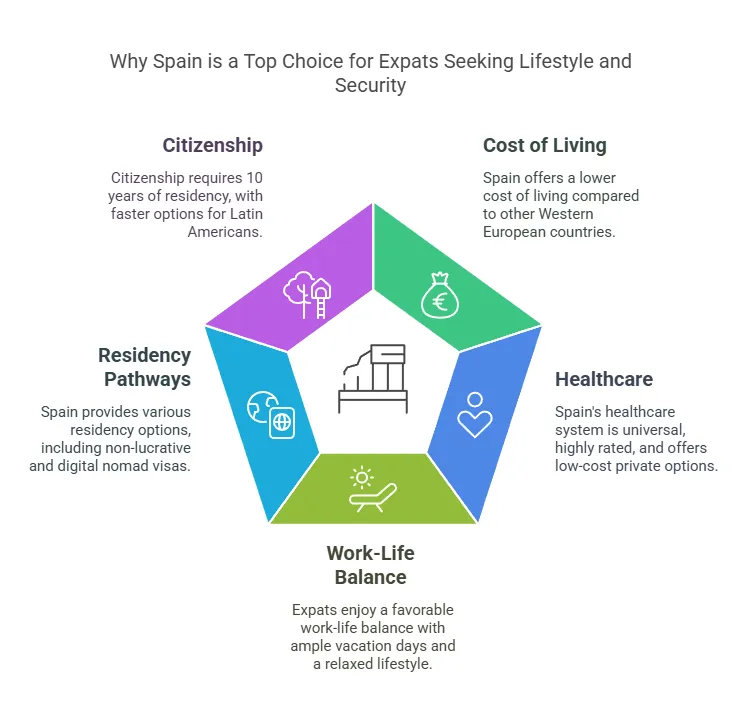
Cost of Living: Spain offers an excellent quality of life at a lower cost than many Western European countries and other European countries. A single expat’s monthly expenses average about €1,671 including rent, while a family of four spends around €4,014. This is markedly cheaper than in neighboring countries – for example, a single’s cost is €1,880 in Germany. Housing is affordable: renting a one-bedroom in Madrid is ~€960 (vs €1,250 in the UK). Groceries, produce, and local wine are inexpensive due to Spain’s agricultural abundance. Overall, Spain ranks 21st on the global Cost of Living index (mid-range), making it a budget-friendly choice without sacrificing comfort.
Healthcare: Spain is renowned for its high-quality healthcare system, which is taxpayer-funded and offers universal coverage. The World Health Organization has ranked Spain among the top healthcare systems globally, and outcomes back this – Spaniards enjoy one of the highest life expectancies. Expats paying into social security can access public healthcare, while private insurance is also available at modest cost. Hospitals in major cities are modern and well-equipped, and many doctors speak English. In a 2024 health index, Spain scored extremely well on health outcomes and care quality. Affordability is a big plus – public healthcare is free or very low-cost, and even private clinics are cheaper than in the US.
Safety & Stability: Spain is a safe, politically stable democracy. Violent crime rates are very low (~0.6 per 100k homicide). Petty theft can occur in tourist areas, but serious crime is uncommon. Spain ranked in the top 25 safest countries on the Global Peace Index. Politically, Spain is stable, though regional movements (e.g. Catalonia) occasionally cause headlines – day-to-day life remains peaceful. Police presence is strong in cities, and emergency services are reliable. Overall, expats feel secure walking cities at night and enjoying Spain’s lively street life without concern.
Work-Life Balance: Spaniards famously value life outside work. The standard work week is 40 hours, but the pace can be more relaxed than in North America. A siesta culture persists in some regions (extended lunch breaks), though big cities have normal business hours. By law, workers get 30 calendar days (about 22 work days) of paid vacation annually, plus around 14 public holidays – among the most generous leave allowances in the world. In addition, the lifestyle prioritizes socializing – long family lunches and late dinners are common. While unemployment has been higher in past years, opportunities exist for expats in sectors like IT, teaching English, and tourism. Those employed in Spain often report a healthy balance, with ample time for the rich Spanish social and family life.
Environmental Quality: Spain’s environment is diverse – from clean mountain air in the Pyrenees to occasional smog in dense urban areas. Generally, air quality is good, especially outside big cities. Spain aggressively expands renewable energy (wind and solar farms are widespread), aligning with EU sustainability goals. Urban areas provide plenty of green spaces; for instance, Madrid and Barcelona have large parks and are increasing bike lanes. Water quality and food safety are high. Spain ranks well on environmental performance indices, benefiting from EU environmental regulations. Plus, expats love the pleasant climate – Mediterranean regions have mild winters and sunny summers, enabling an outdoorsy lifestyle nearly year-round.
Cultural & Recreational: Few countries can rival Spain’s cultural offerings. History and art surround you – from world-class museums in Madrid (Prado, Reina Sofía) to Gaudí’s architecture in Barcelona and the Alhambra palace in Granada. There are endless festivals (think La Tomatina, Las Fallas) and a vibrant nightlife scene. Family life is central to the culture, and children are welcomed everywhere. Expats can enjoy everything from flamenco shows to fútbol matches in La Liga. Recreation is equally rich: Spain’s beaches (Costa del Sol, Canary Islands) and mountains (Sierra Nevada) offer surfing, sailing, skiing, and hiking. With over 40 UNESCO World Heritage sites, weekends can be spent exploring historic towns, vineyards, and nature reserves. It’s easy for expats to immerse themselves and never run out of things to do.
Long-Term Integration: Learning Spanish is key to full integration, but many expats get by with basic phrases as locals often speak some English (especially younger Spaniards and those in tourism). The good news: Spanish is considered one of the easier languages for English speakers to pick up, and immersion in Spain’s social culture provides plenty of practice. Spaniards are generally friendly and family-oriented – it’s common for neighbors to chat and for colleagues to invite you to tapas. There are large expat communities (British, Latin American, etc.) in coastal areas and cities, providing a support network. Spain is quite inclusive, but integrating deeply may require adapting to local customs (like the late meal times and the concept of mañana). Overall, expats who make an effort to learn the language and culture find Spain incredibly welcoming and feel at home in this warm, communal society.
Residency and Citizenship in Spain
Residency Pathways: Spain has multiple visa routes for expats. If you’re employed by a Spanish company, you’ll need a work visa (your employer sponsors it). High-skilled professionals can qualify for the Highly Qualified Professional Visa (PAC), and the EU Blue Card is available for non-EU citizens with a job offer above a certain salary. For those not seeking local employment, Spain offers the Non-Lucrative Visa, ideal for retirees or remote workers with sufficient funds – it lets you reside in Spain long-term (but not work locally). Notably, a new Digital Nomad Visa launched in 2023 allows remote workers to live in Spain while working for foreign employers, provided you meet an income threshold (around €2,334/month). Additionally, if you have family ties, you can apply for family reunification (spouses, children, and dependent parents of Spanish residents are eligible). Most residency visas can be renewed and lead to permanent residency after five years.
Citizenship: Spain’s naturalization timeline is longer than Canada’s. The standard requirement is 10 years of legal residence for foreign nationals. However, Spain offers fast-tracked citizenship (2 years of residence) to nationals of Latin American countries, Andorra, Philippines, Equatorial Guinea, or Portugal due to historical ties. Also, marriage to a Spanish citizen allows you to apply after just 1 year of residency while married. To become Spanish, you must pass language (DELE A2) and culture exams (CCSE). Dual citizenship in Spain is tricky: Spain requires most new citizens to renounce their previous citizenship. Exceptions exist for those from Spanish-speaking countries and a few others – they can retain dual nationality. For example, an American or British expat would be expected to renounce their original citizenship upon naturalizing in Spain. In practice some do keep both (enforcement is lenient), but officially Spain’s policy on dual citizenship is restrictive. Overall, gaining Spanish citizenship is a longer journey, but it grants an EU passport with full rights to live and work across Europe.
Germany – Economic Powerhouse with Excellent Infrastructure
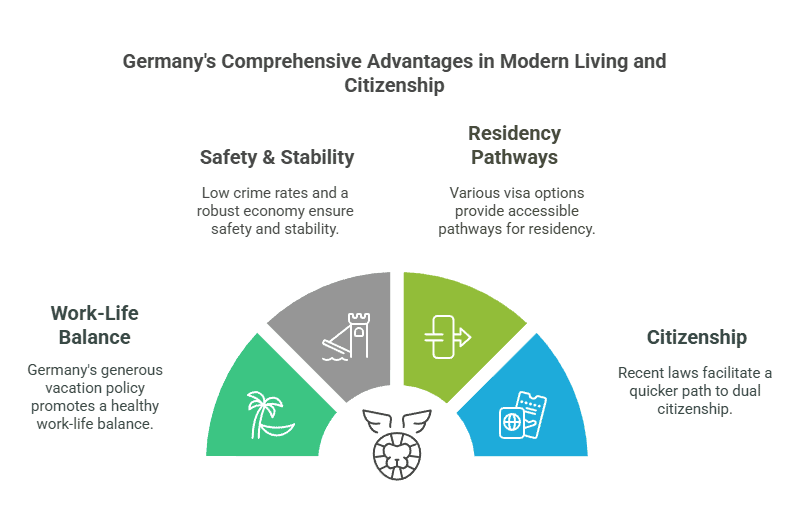
Cost of Living: Germany combines high salaries with a moderate cost of living for Western Europe. Expenses are a bit above Spain but lower than places like Switzerland. A single person’s monthly costs including rent are about €1,880, and a family of four around €5,048. (These averages, from Numbeo, reflect an urban lifestyle.) Day-to-day costs like groceries and public transport are quite affordable thanks to efficient supply chains and government price controls on essentials. Rent can vary – Munich and Frankfurt are expensive, whereas smaller cities in former East Germany are very cheap. For example, a one-bedroom in Berlin might be ~€900, while in Leipzig it could be €600. Germany was recently calculated to have a slightly higher cost-of-living than Canada (by ~2.5% when rent included), but strong purchasing power offsets this. Overall, expats find Germany offers good value: high quality products and services for what you pay.
Healthcare: Germany offers world-class healthcare through a universal multi-payer system. Everyone must have health insurance – either the public statutory plan (gesetzliche Krankenversicherung) or a private plan if your income is above a threshold. The care quality is excellent, with short wait times and a very high doctor-to-patient ratio. In rankings, Germany often scores in the top 10 globally for healthcare (it was #8 in a 2024 global index). For expats, if you’re employed your employer will enroll you in public insurance (premiums are income-based). This covers most medical needs, including specialists, with small copays. Many doctors speak English, especially in cities. Germany is also a leader in medical technology and pharmaceuticals, meaning expats have access to cutting-edge treatments. Simply put, healthcare in Germany is accessible, affordable (especially compared to the U.S.), and high-quality – a major draw for expats with families or medical needs.
Safety & Stability: Germany is a very safe and stable country. It ranks among the world’s most peaceful nations (2024 GPI rank #20 globally). Violent crime is rare; most residents worry more about petty theft or bicycle theft than any serious harm. Police are professional and trusted. Politically, Germany is extremely stable – it’s the EU’s largest economy and a pillar of European democracy. Rule of law is strong, corruption is low, and policies are generally predictable. Recent challenges like an influx of refugees have been handled within the legal framework without destabilization. Expats of all backgrounds typically feel safe in Germany, enjoying freedom of expression and a secure environment. One thing to note: Germany’s strict laws (e.g. quiet hours, jaywalking rules) mean as long as you follow regulations, life is orderly and safe.
Work-Life Balance: Germans are known for efficiency at work – but they also value personal time. The average full-time work week is about 35–40 hours, and many offices empty out by 5pm. By law, employees get a minimum 20 work days off (4 weeks), but in practice 30 days (6 weeks) of vacation is common for full-time workers. Add ~10–13 public holidays (depending on state), and you have ample time off. There is a strong culture of “Feierabend” – once the workday is over, employees disconnect and enjoy their evening. Overtime is usually compensated with extra pay or time in lieu. Parental leave is very generous (up to 12-14 months shared between parents with job protection). In surveys, expats rate Germany highly for work-life balance, thanks to reasonable hours, high productivity (less need for overtime), and secure worker rights. It’s not uncommon to see offices genuinely empty on weekends – leisure time is sacred for Germans, whether it’s spent on hobbies, with family, or traveling (many use those 30 vacation days to explore Europe!).
Environmental Quality: Germany is a green leader, balancing its industrial might with strong environmental protection. Air quality is generally good, though industrial regions (like parts of the Ruhr) can have higher pollution. Germany has been aggressively shifting to renewable energy (Energiewende), and over 40% of its electricity now comes from renewables. The country ranked #13 on the 2022 Environmental Performance Index, reflecting robust efforts in pollution control and sustainability. German cities are very clean and have lots of green spaces – Berlin, for instance, is 40% parks and forests. Recycling is practically a national religion (with an easy deposit system for bottles). Public transit and cycling infrastructure are excellent, reducing car emissions. From the Black Forest to the Baltic coast, Germany’s varied landscapes are well-preserved. Expats sensitive to environmental issues will appreciate strict food safety standards (organic food is widely available) and the general public’s eco-conscious mindset (e.g. solar panels on homes, ubiquitous sorting of trash).
Cultural & Recreational: Germany offers a rich blend of modern and traditional culture. Every city has theaters, opera houses, and museums (Berlin alone has over 170 museums). History buffs can explore everything from medieval castles along the Rhine to World War II sites and memorials. German cultural life includes famous events like Oktoberfest in Munich, Cologne’s Carnival, and Christmas markets nation-wide. There’s also a lively contemporary scene – music festivals, cutting-edge art in Berlin, and Bundesliga football matches that are practically cultural festivals themselves. Recreational opportunities abound: Germany’s central location and infrastructure make it easy to travel (weekend trip to the Alps or Paris, anyone?). Inside Germany, you’ll find extensive bike trails, hiking in the Bavarian Alps or Harz mountains, and swimming in countless lakes each summer. For families, zoos and amusement parks are top-notch. Socially, Germans might seem reserved at first, but they highly value friendship and club life (Vereine – clubs for everything from soccer to singing – are common and a great way for expats to meet people). There is also a significant international community in big cities, providing familiar comforts and social networks.
Long-Term Integration: Integrating into German society takes some effort but can be very rewarding. Language is the biggest hurdle – learning German is important for deeper integration, even though many Germans speak excellent English (especially in business and among younger people). The government provides free or low-cost German language courses for immigrants. Culturally, Germans are very punctual, honest, and direct; expats adapting to these norms will fit in faster. Making German friends can take time (initial friendliness is reserved), but joining local clubs, attending community events, or participating in the workplace social activities (like after-work beers) will help. There are active expat communities in cities like Berlin, Munich, and Frankfurt where you can find support and networking. Germany is quite inclusive and has become more diverse – around 26% of residents have immigrant backgrounds. As a result, most Germans are used to living alongside expats and foreigners. Once you break the ice, you’ll find Germans form deep, long-term friendships. And with integration measures, including citizenship classes and local welcome programs, Germany provides a clear path for expats to become part of the community.
Residency and Citizenship in Germany
Residency Pathways: Germany, as part of the EU, has well-defined immigration routes. If you’re a non-EU national, a common way in is through a work visa or EU Blue Card. The EU Blue Card is aimed at skilled professionals with a university degree and a job offer meeting a salary threshold (around €58,400 as of 2023, or ~€45,500 in shortage occupations). It grants up to 4 years of residence and can lead to permanent residency. Alternatively, a standard Work Residence Permit is available for those with a German job offer (if the employer proves no EU citizen is available, which is easier now given skill shortages). Germany also offers a Job Seeker Visa – a 6-month visa that lets you come to Germany to hunt for a job (you must show funds and qualifications). For freelancers and the self-employed, certain visas exist: e.g. the Freiberufler visa in Berlin for artists and freelancers, or a Self-Employment Visa if you invest and can benefit the economy (common for entrepreneurs/startups, requiring a solid business plan). Family unification is straightforward: if you have a spouse or parent in Germany with residency, you can obtain a Family Reunion visa. Germany currently does not have a dedicated digital nomad visa, but remote workers often use the freelancer visa or simply reside short-term on a Schengen tourist visa (90 days) while exploring longer options. After 5 years of continuous residence, most expats can apply for a Permanent Residence Permit (Niederlassungserlaubnis), which allows indefinite stay and work.
Citizenship: Germany has recently reformed its citizenship laws to become much more expat-friendly. As of June 2024, the residency requirement for naturalization has been reduced to 5 years (down from 8). In cases of “exceptional integration” (speaking German very well, involved in community, etc.), you might qualify in just 3 years. To naturalize, you’ll need to pass a B1 German language exam and a citizenship test on German society. Crucially, Germany now allows dual citizenship for naturalized citizens. Previously, most foreigners had to renounce their old citizenship, but the new law (effective 2024) lets you keep it. This is a game-changer – an American, for instance, can become German without giving up their U.S. passport. Once a German citizen, you gain an EU passport with full rights across EU countries. Between the shorter timeline and dual citizenship policy, Germany has become one of the more accessible EU countries for expats aiming for citizenship. Just note that you must have held a valid residence and integrated during those years (e.g., paid taxes, no serious criminal record). With these changes, many expats in Germany are now fast-tracking their plans to call Germany their permanent home.
Sweden – Scandinavian Bliss with Social Welfare, Work Life Balance, and Nature
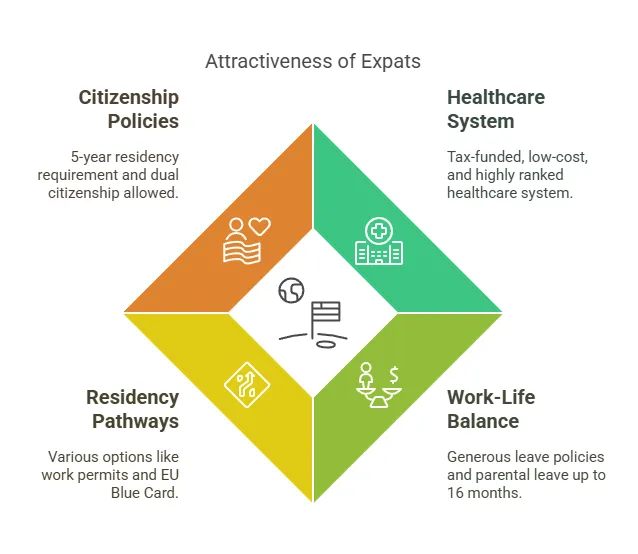
Cost of Living: Sweden’s cost of living is on par with other Nordics – high in absolute terms, but balanced by high salaries and social benefits. A single person in Sweden spends about €1,780 per month including housing, and a family of four around €4,667. Major costs include housing (a one-bedroom in Stockholm ~€1,000). Groceries and services cost more than the European average (due to taxes and high wages for service workers), but healthcare and education are heavily subsidized. In global indices, Sweden’s purchasing power offsets costs – for example, Sweden was rated to have a similar overall cost-of-living to the UK, but with cheaper rent (one-bedroom ~€885 in Sweden vs €1,249 in the UK). Notably, essentials like childcare are very affordable (daycare fees are capped). High taxes fund a lot of public services, so while you pay more at the register, you pay less out-of-pocket for many life expenses. Many expats find that after taxes and benefits, their disposable income in Sweden goes a long way, especially for families.
Healthcare: Sweden’s healthcare system is a hallmark of its welfare state – universal, high-quality, and largely free. Medical care is tax-funded; residents pay only small fees (a doctor visit might be $20) and there’s an annual out-of-pocket cap ($120) after which care is free. Outcomes in Sweden are excellent – it consistently ranks near the top for health metrics and patient satisfaction. In fact, Sweden was #5 in the world in a recent healthcare index. Hospitals are modern and well-equipped, though wait times for non-urgent procedures can be longer than in some countries (a common trade-off in single-payer systems). Expats who register with the Swedish system (you get a personal number) have the same access as citizens. English is widely spoken by medical staff, easing any language barrier. Sweden also emphasizes preventive care and public health (for instance, subsidizing gym memberships, extensive prenatal care, etc.). Overall, for an expat, falling ill in Sweden may be far less stressful financially than back home – the care will be top-notch and it won’t break the bank.
Safety & Stability: Sweden is one of the safest countries on earth. It regularly ranks in the top 20 of the Global Peace Index (it’s actually so peaceful that a recent index drop to rank 39 was notable, due to a rise in reported gang-related incidents – though these rarely affect expats or the average person). Violent crime rates remain very low, and gun violence is extremely rare. Walking alone, even at night, is generally safe across Sweden. The political environment is stable; Sweden is a mature democracy with a high level of trust in government. There are active debates on issues like immigration in politics, but these occur within a stable parliamentary system. Police services are reliable and approachable (and often speak English). Expats from the U.S. or elsewhere often comment on how safe they feel in Sweden, even letting their kids walk to school or play outside without worry. One thing to note: Sweden’s northern climate means some natural safety considerations – e.g., be prepared for snow and ice in winter (cities manage it well), and if you’re driving, watch for moose on rural roads. But in terms of personal and political safety, Sweden is about as secure as it gets.
Work-Life Balance: Sweden is famed for its excellent work-life balance and employee protections. Full-time work is ~40 hours per week, but overtime is discouraged. By law, employees get at least 25 paid vacation days (5 weeks) per year, and many Swedish companies offer more. It’s common for Swedes to take a long summer holiday (several weeks off in July/August when many businesses slow down). There are also ~16 public holidays. Crucially, Sweden offers generous parental leave: parents get 480 days (16 months) per child to share, paid at about 80% of salary for much of that time – one of the most generous policies worldwide. The concept of “fika” – a coffee break often with colleagues – is institutionalized, reflecting a culture that values breaks and socializing during the workday. Many offices have flexible hours, and remote work options are common. Sweden scores very high on OECD work-life indices, with people typically devoting a large portion of the day to leisure and personal care. In short, in Sweden you’re expected to have a life outside work – burning the midnight oil is not seen as virtuous. Expats often find the work culture efficient yet relaxed, and appreciate how family-friendly and life-friendly the system is (e.g. if your child is sick, there’s paid leave to care for them).
Environmental Quality: If you love nature, Sweden is paradise. The country is exceptionally clean and green. Air quality is excellent (cities like Stockholm have average PM2.5 levels well below WHO guidelines). Sweden consistently scores at the top of environmental performance rankings. It was one of the first nations to meet renewable energy targets – about 54% of energy comes from renewables, and Sweden aims for carbon neutrality by 2045. Recycling rates are over 99% for household waste (Sweden actually imports trash to keep its recycling plants running!). Forests and lakes cover much of the country, and even in cities, green spaces are abundant. Everyman’s Right (Allemansrätten) gives everyone the freedom to roam nature – you can hike, forage berries and mushrooms freely, showing how ingrained nature is in the culture. In terms of climate, southern Sweden has mild summers (~23°C) and cold winters, while the north has very long winters (with magical snow and northern lights). The environment is healthy, and public spaces are well-maintained.
Cultural & Recreational: Despite a relatively small population, Sweden has a rich cultural scene. Stockholm, Göteborg (Gothenburg), and Malmö have vibrant arts, music, and nightlife. You’ll find museums (the Vasa Museum with its preserved 17th-century ship, ABBA Museum for pop fans, etc.), art galleries, and historic sites (like Drottningholm Palace). Sweden also has a world-renowned design aesthetic – you might tour the IKEA museum or visit design markets. Music is big: Sweden produces many pop music stars and there are plenty of concerts and music festivals (like Way Out West in Gothenburg). Traditional culture thrives too – midsummer festivals with maypole dancing, Lucia processions in winter, and crayfish parties in August are beloved Swedish traditions that expats can join. Recreation is woven into daily life: public access to thousands of lakes and the sprawling archipelagos means sailing, kayaking, and fishing are common hobbies. In winter, ice skating tracks are cleared on lakes and city canals. Sports like hockey, football, and floorball are popular to play and watch. Socially, Swedes may seem private, but they are very communal in organized activities – joining a local sports team, choir, or hobby group is a great way to partake in Swedish social life. Families with kids will find an abundance of playgrounds, open-air museums (Skansen in Stockholm is both a zoo and heritage park), and free activities. Plus, Sweden’s excellent public transport and its central location in Scandinavia make it easy to take weekend trips to Finland, Norway, or Denmark, broadening your recreational options. In summary, Sweden offers a balanced mix of cosmopolitan culture and outdoor adventure, with a sprinkle of Nordic quirkiness (ever tried a surströmming fermented herring party?).
Long-Term Integration: Integrating into Sweden is generally smooth, thanks to the society’s openness and the widespread English proficiency. In fact, you can live in Sweden speaking only English – 86% of Swedes speak English – but learning Swedish is recommended for deeper integration and job opportunities outside international firms. The government provides free Swedish classes for immigrants (SFI – Swedish for Immigrants). Social integration can be a bit slow; Swedes are polite and helpful to foreigners but can be reserved, so building close friendships takes time. However, once you do make Swedish friends, they tend to be genuine and long-lasting. An advantage in Sweden is the strong expat networks, especially in Stockholm – there are meetups for everything from tech workers to international parents. Society is very progressive and inclusive: LGBTQ+ rights are highly respected, gender equality is among the best in the world, and discrimination is legally and socially condemned. As an expat, you’re given the same parental leave, child benefits, etc., which helps you integrate by participating in society like any Swede.
Residency and Citizenship in Sweden
Residency Pathways: As an EU member, Sweden has free movement for EU/EEA citizens (who only need to register upon arrival). For non-EU expats, the primary route is via a work permit. If you have a job offer from a Swedish employer that meets minimum salary requirements (roughly SEK 13,000/month (EUR 1,174) minimum and terms on par with collective agreements), you can get a Work Permit. Typically, the employer needs to have advertised the job in the EU for a period (to show no suitable EU applicant) – this is often a formality for in-demand roles like IT, engineering, healthcare. High-skilled workers might also be eligible for the EU Blue Card in Sweden (which has similar requirements but a higher salary threshold and can simplify moving within EU later). Sweden does not have an official “digital nomad visa,” but many remote workers use the Self-Employment visa – you must show a business plan and sufficient funds, essentially proving you can run a business that sustains you in Sweden. It’s somewhat strict, but doable for freelancers/entrepreneurs. Another option for those with funds is the Investor/Entrepreneur route – while Sweden doesn’t have a straightforward golden visa, investing in or starting a company that creates jobs can qualify you for a residence permit (you need significant capital and business experience for approval). Family reunification is generous: if you have a spouse or cohabiting partner who is a Swedish resident (or a Swedish citizen), you can get a residence permit for family relatively easily, and you are allowed to work. Students can come on a student visa (for university programs) and later get a job-search permit for 12 months after graduation to find work. After 4 years of continuous work permits (or 5 years of any legal residence), you can apply for permanent residency. One noteworthy aspect: Sweden, like other Nordics, had a refugee/asylum program that many have used, but that’s a different pathway than typical expats would use. In summary, the common expat strategy is to secure a job offer (perhaps while on a tourist visa or via remote interviews) and then apply for a work permit, which usually takes a few months processing.
Citizenship: Sweden offers a relatively straightforward path to citizenship by naturalization. The general requirement is 5 years of continuous residence with a valid permit. This period is shorter if you’re married to a Swedish citizen – in that case, you can apply after 3 years of living together in Sweden. Unlike some countries, Sweden does not mandate any language or culture test (as of 2025 – there have been discussions about introducing a language requirement, but currently it’s not required). You do need to have maintained good conduct (no serious criminal record, paid your taxes, etc.). Sweden has allowed dual citizenship without restriction since 2001, so you can keep your original citizenship. The application process is relatively simple – you submit proof of identity, duration of stay (your personnummer and residence documents), and pay a fee, and the Migration Agency reviews your case. Processing can take around 6–12 months. Once approved, you become a Swedish citizen with the right to vote and an EU passport granting free movement across the EU. It’s worth noting Sweden’s liberal approach: they even allow children born in Sweden to foreign parents to retain multiple nationalities and there’s no requirement to ever renounce Swedish citizenship either. This welcoming policy means many expats settle permanently – for instance, an expat could arrive on a work permit, get permanent residence after 4–5 years, and soon after obtain citizenship in year 5 or 6. With citizenship, you also benefit from the EU’s freedom – you could live or work in Spain, Germany, or any EU country down the line, which is a big plus. In short, Sweden’s citizenship pathway is one of the more generous: five years, no tests, and dual citizenship allowed. It’s the cherry on top of an already sweet expat deal in Sweden.
New Zealand – Scenic Beauty and Relaxed Lifestyle at the Edge of the World
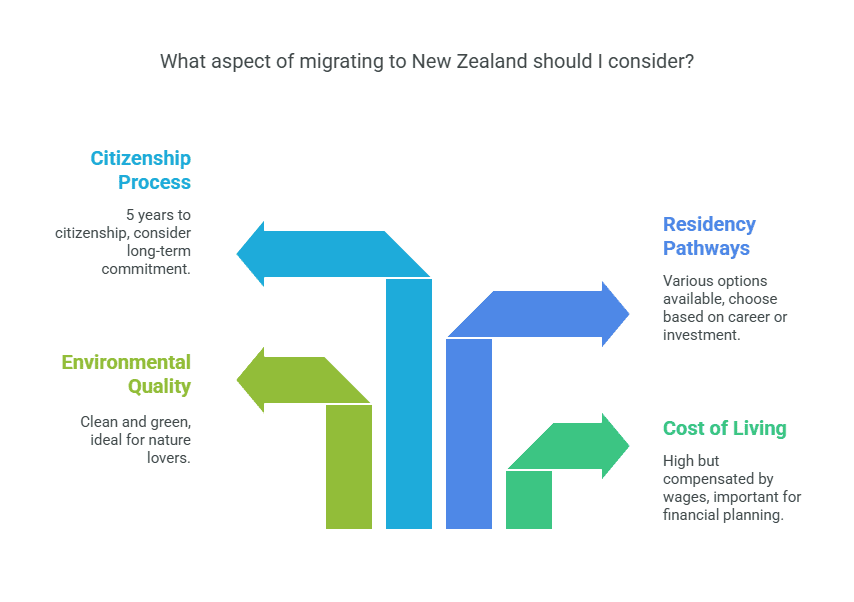
Cost of Living: New Zealand offers a high quality of life, but imported goods and its remote location can make costs relatively high. On average, a single person living in a major NZ city (like Auckland or Wellington) spends about NZ$3,100 per month (≈US$1,850) including rent. A family of four might need roughly NZ$6,500–7,000 (US$4,000–4,300) per month to live comfortably, though frugal lifestyles in smaller towns can be cheaper. Housing is the biggest expense – rents have risen in cities; a one-bedroom in Auckland can cost NZ$1,800–2,500 (US$1,100–1,500) per month. Groceries are moderately pricey (many items are imported, and there’s 15% GST). However, healthcare and schooling (for kids) are low-cost or free, which saves money. By comparison, New Zealand’s cost-of-living is about 15% lower than Australia’s, but higher than the U.S. in some categories. The purchasing power in NZ is decent – wages have grown in recent years, helping offset expenses. Many expats find the cost worth it for New Zealand’s lifestyle, but budgeting for high housing costs is essential. It’s also notable that living in NZ can encourage a simpler, outdoorsy lifestyle, which may reduce discretionary spending.
Healthcare: New Zealand has a robust public healthcare system with coverage for all residents. Most hospital treatments are free or heavily subsidized by the government. GP visits have a co-pay (varying by clinic, often NZ$50–$70, though children’s visits are free). Emergency care and surgeries in the public system are free; however, there can be waiting lists for non-urgent procedures. Many expats (and Kiwis) supplement with private health insurance to get faster access to specialists or elective surgeries. The quality of care is high – New Zealand ranks well in healthcare outcomes, and its system is often cited as efficient. One standout feature: NZ’s Pharmac agency negotiates drug prices, meaning prescription costs are low (often $5 per item). Additionally, New Zealand has the ACC (Accident Compensation Corporation) system which provides coverage for accident-related injuries for everyone, including tourists – any injury from accidents is taken care of with no litigation needed. For expats, if you have a work visa or residency, you’ll generally qualify as a resident for healthcare after a certain period (or immediately if on a pathway to residency). Doctors and nurses are well-trained (many trained or have experience in Australia/UK), and facilities in major cities are modern. One can expect a friendly, personal touch in NZ healthcare, as it’s not a very bureaucratic system. The main downside can be limited specialists in smaller towns – sometimes one may need to travel to a larger city for complex care. Overall, expats find peace of mind with NZ’s healthcare – it’s affordable and reliably there when you need it, a key component of its high quality of life.
Safety & Stability: New Zealand is extremely safe and politically stable – often ranking in the top tiers of global safety indexes. Crime rates are low; violent crime is rare. Most residents feel secure leaving doors unlocked in some areas (though normal precautions are still advised). New Zealand is a peaceful nation (famously, it’s one of the few countries with no native snakes and very low risk of dangerous wildlife, which is a fun safety perk!). Policing is community-oriented; police do not generally carry firearms (only special units do), reflecting the low threat level. On the political front, New Zealand is a stable parliamentary democracy with smooth transitions of power and low corruption (it often ranks #1 or #2 least corrupt country globally). Expats will find the society calm and consensus-driven – big policy changes (like COVID responses, or social policies) usually have broad public discussion and support. One aspect of “safety” unique to NZ is geological safety: NZ sits on the Pacific Ring of Fire, so there are occasional earthquakes (notably in Wellington, Christchurch had major quakes in 2010-2011) and some volcanic regions. The country has strict building codes and emergency preparedness, but it’s something for expats to be aware of – knowing earthquake drills and having emergency kits is routine. That aside, New Zealand has no geopolitical tensions; it’s literally and figuratively far from conflict zones. For families, it’s an idyllic place where kids walk to school safely and people look out for each other.
Work-Life Balance: New Zealanders (or “Kiwis”) are known for a laid-back, “no worries” attitude, and this extends to work-life balance. The work culture prioritizes productivity during work hours but places huge importance on life outside work. A full-time work week is typically 37.5 to 40 hours. It’s generally easy to leave by 5pm and head to the beach, gym, or home – the lifestyle is not defined by overtime. By law, employees get 4 weeks of paid annual leave (20 days) per year, and after 6 months in a job you also accrue 5 days of paid sick leave (which increases with time). There are around 11 public holidays. Many offices also adopt flexible work arrangements; working from home part of the week or adjusting hours for childcare is common and accepted. The concept of “work to live” (rather than live to work) is strong – you’ll see offices empty on sunny Friday afternoons (people might use their annual leave for a long weekend to go camping or fishing). The country’s strong outdoor culture means many people value getting off work to enjoy daylight for sports or hobbies.
Environmental Quality: New Zealand is famed for its pristine environment – from crystal-clear lakes and rivers to clean ocean air. Air pollution is minimal except for occasional urban smog in winter (from home heating) and some vehicle emissions in Auckland. Generally, you’ll enjoy blue skies and stars at night thanks to low light pollution. Water quality is good, though agricultural runoff has impacted some freshwater areas – the government is actively working to improve water standards. The country generates much of its electricity from renewable sources (hydro, geothermal, wind – about 80% renewables), aligning with its clean-green image. Biodiversity is unique (flightless birds like the kiwi, ancient forests), and the Department of Conservation maintains vast national parks comprising 1/3 of NZ’s land area. Recycling and eco-conscious living are big; plastic bags were banned, and there’s a strong culture of conservation. New Zealand does face environmental challenges: invasive species control is ongoing, and climate change brings concerns (strong UV radiation, rising sea levels affecting some coastal areas).
Cultural & Recreational: Despite its remote location, New Zealand has a vibrant culture blending indigenous Māori traditions with European and Pacific influences. Auckland, the largest city, is incredibly multicultural (over 40% of residents are born overseas), with cuisines and cultural festivals from all over the world. Māori culture is a core part of national identity – expats will soon learn greetings in Te Reo Māori, see the haka war dance performed at rugby matches, and can attend events like Matariki (Māori New Year) celebrations. Kiwis are sports-mad: rugby union is akin to a religion (catch an All Blacks game to see national pride at its fullest), and cricket, rugby league, netball, and soccer also have huge followings. Recreationally, New Zealand is an outdoor paradise. You can surf and ski in the same day. Popular activities include hiking the numerous trails (“tramping” in Kiwi lingo) – nine “Great Walks” offer multi-day treks through stunning landscapes like Milford Sound and Abel Tasman.
Long-Term Integration: New Zealand is known as a welcoming society, often topping surveys as one of the friendliest countries for expats. English is the primary language, so most expats have no language barrier (Māori and NZ Sign Language are also official, but English dominates daily life). This makes integration easier – you can communicate and understand cultural references from day one. Kiwis are generally warm, unpretentious, and inclusive. There is a concept of “Kiwi hospitality” – neighbors might invite you over for a cup of tea or to a community BBQ shortly after you arrive. The society is also quite egalitarian; there’s a strong sense of “give everyone a fair go”. New Zealand has welcomed many migrants (from the UK, Asia, the Pacific Islands, South Africa, etc.), and about 1 in 4 people is foreign-born, so diversity is normal. This means expat communities thrive – you’ll find support networks whether you’re from India, China, Britain, or elsewhere. Culturally, to integrate, it helps to show appreciation for Kiwi customs: learn a bit about Māori culture (even simple words like kia ora for hello), follow rugby perhaps, and adopt a relaxed attitude. Workplaces are informal – hierarchy is downplayed, and everyone’s expected to contribute ideas. This helps expats feel included.
Residency and Citizenship in New Zealand
Residency Pathways: New Zealand uses a points-based system for many immigrants, similar to Canada. The main route to live and work is the Skilled Migrant Category (SMC) resident visa. Applicants under 55 years old with in-demand skills, qualifications, and work experience can submit an Expression of Interest; if they have enough points (for factors like a job offer in NZ, work experience, education, age, etc.), they may be invited to apply for residency. Notably, having a skilled job offer in New Zealand weighs heavily in this system. Another route is through Work to Residence visas: for example, the Accredited Employer Work Visa allows accredited NZ employers to sponsor foreign workers, and these workers can often transition to residency after 2 years if earning above certain income thresholds. New Zealand also has Essential Skills Work Visas (tied to a specific job/employer, based on labor market needs) – while temporary, long-term use of these can lead to residency pathways. For entrepreneurs, there is an Entrepreneur Work Visa that can lead to residency if you successfully establish a business (you need a detailed business plan and investment capital). Investors can consider the Investor 1 and Investor 2 Resident visas – Investor 1 requires $5,6 million invested for 3 years, and Investor 2 requires $1,7 million for 4 years (along with a points system for age, experience, etc.). Additionally, New Zealand is friendly to students: international students who graduate with NZ qualifications can often get a Post-Study Work Visa (length depends on level of qualification) to work in NZ, potentially leading to skilled employment and residency. Family sponsorship is another pillar: if you have a NZ citizen or resident spouse, partner, or parent, they can sponsor you for residency (typically after proving the genuine relationship and that they can support you). New Zealand recently introduced a Straight to Residence pathway for certain highly paid or in-demand roles, allowing some skilled workers to apply for residency immediately upon getting a job in NZ (as of 2023, this included roles like engineers, tech specialists, etc., meeting wage thresholds). For remote workers, there isn’t a specific digital nomad visa; however, many can stay short-term on a visitor visa (which is often 3 months for many nationalities, extendable to 6) and explore opportunities. Overall, while New Zealand’s immigration process is competitive (there are quota and policy adjustments periodically), it is well-defined and welcoming to those with skills or investment – particularly if you bring what the Kiwi economy needs, you’ll find a pathway to make it your home.
Citizenship: Becoming a New Zealand citizen typically follows a period as a resident. To be eligible for citizenship by grant, you must have lived in NZ as a resident for at least 5 years – and importantly, NZ’s requirement is phrased as having been physically present for a certain amount of time in each of those 5 years (currently, at least 240 days in NZ each year, and 1,350 days total across 5 years). You should hold Permanent Residence or have Indefinite Returning Resident status during that time. New Zealand also requires you to be of “good character” (they’ll do a background check) and to understand the responsibilities and privileges of citizenship (typically proven via an interview or form, but there’s no formal exam). Language isn’t a barrier – knowing English is not tested, as it’s assumed living 5 years in NZ you have functional English. One of the best parts: New Zealand allows dual citizenship. The law does not require you to renounce your previous citizenship when you become a Kiwi. So as an expat, you can retain your original nationality. The citizenship application process involves submitting documents (proof of residency years, IDs) and attending a citizenship ceremony where you swear allegiance. After that, you receive a certificate of citizenship and can apply for the coveted New Zealand passport, which is one of the strongest in the world (visa-free travel to 180+ countries and, notably, it gives you the right to live and work indefinitely in Australia due to special Trans-Tasman arrangements).
Singapore – Modern Metropolis with Top-notch Infrastructure and Major Cities
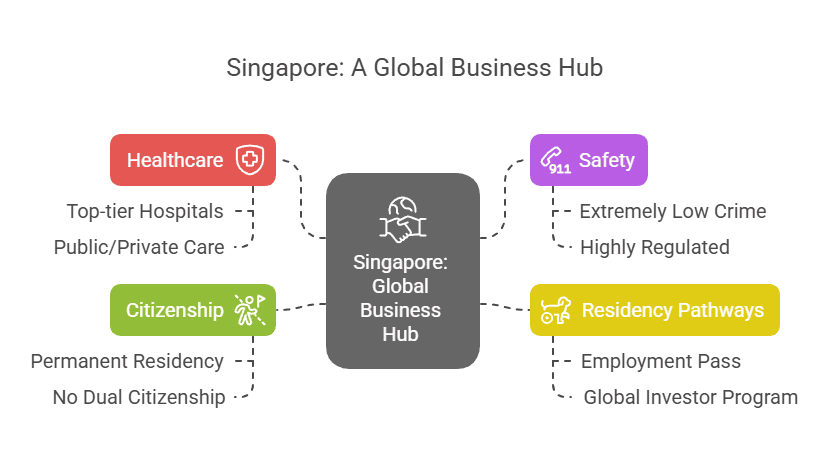
Cost of Living: Singapore frequently ranks among the world’s most expensive cities, especially for housing. An expat single person usually spends around S$5,134 per month (≈US$3,800) including rent, and a family of four about S$12,575 (≈US$9,300). Housing is the biggest factor: renting a condo can easily be S$3,000–$6,000 (US$2.2k–4.4k) per month for a modest 2-3 bedroom. Day-to-day expenses like groceries or eating out range from cheap hawker center meals (S$5 or $4 USD for a hearty dish) to pricey restaurant outings. Transportation is efficient and relatively affordable – the public MRT and bus system keeps commuting costs low (monthly public transport passes ~S$128). Cars, however, are extremely expensive due to the COE system (a permit can cost tens of thousands). On the upside, disposable incomes in Singapore are also high, often offsetting some of the cost-of-living pain. In global comparisons, while Singapore’s total cost for a family (~S$12.6k) is similar to London’s (~S$12.9k), it tends to be cheaper than big US cities like New York. Also, certain items like electronics or designer goods may be cheaper due to low taxes. Expats benefit from zero sales tax on most items (GST is 8% as of 2025, rising to 9% soon, still lower than VAT elsewhere).
Healthcare: Singapore’s healthcare system is world-class, often ranked among the best globally for efficiency and outcomes. The city-state has a mix of public and private care with government oversight known as the “3M” system (MediShield, MediSave, MediFund) that keeps healthcare affordable for citizens. For expats, if you are a permanent resident or on certain work passes, you can access public hospitals at subsidized rates (though subsidies are lower than for citizens). Many expats opt for private health insurance to cover treatments at private hospitals like Gleneagles or Mount Elizabeth, which have luxury-class facilities. In any case, quality of care is uniformly high – Singapore boasts specialist doctors and hospitals that rank in the global top 10 in areas like oncology and cardiology. English is the primary language of care, which is a huge plus. Healthcare is not free, but it’s reasonably priced for the quality – for example, a basic GP visit might be ~S$50, and a specialist consultation ~S$150. The government regulates costs to avoid extremes. Preventive care is emphasized, and you’ll find clinics conveniently in every neighborhood. Pharmacies are well-stocked (many medications available over-the-counter that would require prescription elsewhere). Singapore’s health outcomes (life expectancy ~84 years) rival Japan’s, thanks to the quality of the system. Medical tourism is also big – people from around Asia fly into Singapore for treatment. For expats, the peace of mind is significant: whether you need a quick blood test or major surgery, Singapore’s system will deliver top-notch care promptly and with minimal red tape.
Safety & Political Stability: Singapore is one of the safest countries in the world. Violent crime is extremely rare, and petty crime rates are very low. A significant factor is strict law enforcement and tough penalties which act as deterrents (e.g. zero tolerance for drugs, heavy fines for vandalism). It’s common (though not officially encouraged) to see locals reserve seats in public by leaving laptops or phones unattended – that’s the level of trust in safety. For expat families, it’s reassuring that children can roam public spaces or take transport safely at almost any hour. Singapore consistently ranks at the top in personal security indices; in Gallup’s law and order index, it often scores #1. The rule of law is strong – laws are strictly enforced, but that creates a very orderly society. Politically, Singapore is stable under a long-standing government (the same party has ruled for decades). While it’s not a liberal democracy by Western standards, governance is highly effective, technocratic, and enjoys broad public support due to delivering economic prosperity and safety. Protests are almost nonexistent (they require permits); however, this doesn’t typically concern expats – rather, they benefit from the predictability and stability. One can plan long-term in Singapore without worrying about political upheaval or policy swings.
Work-Life Balance: Work-life balance in Singapore can vary. The culture historically leans towards hard work – it’s not uncommon in certain industries (finance, law, tech startups) to have long hours. The average full-time employee works about 44–45 hours per week by law (that’s the limit before overtime must be paid). Many multinational offices, however, bring their own work-hour culture, and local companies may expect overtime when big projects loom. On the flip side, Singapore recognizes the need for balance more in recent years. There are minimum 7 days of paid annual leave mandated, increasing with tenure to 14 days by year 8 (many companies offer 14-21 days regardless). Public holidays (11 days) often create long weekends. Commuting in Singapore is also generally short and easy (excellent public transit, or a small island if driving), so people aren’t losing hours each day in traffic – this helps balance. Leisure is definitely possible: the city is full of gyms, parks (the Botanic Gardens for morning walks), and a happening dining and nightlife scene that professionals do enjoy after work.
Environmental Quality: Singapore is a very clean and well-kept urban environment, often dubbed a “Garden City.” Despite its dense population, it manages air and water quality effectively. Air quality is usually good, except during periodic haze episodes caused by forest fires in neighboring countries (typically a few weeks some years, when prevailing winds bring smoke – the government distributes masks and advisories then). Most of the time, the air pollution index remains in healthy ranges, aided by greenery and low heavy industry locally. Water is completely safe to drink from tap – Singapore’s water management is cutting-edge (with NEWater recycling tech). The city is lush with trees and parks; from the famous Gardens by the Bay and East Coast Park to pockets of rainforests in nature reserves, green cover is everywhere. Singapore also invests heavily in sustainability – it’s increasing solar panel usage, testing electric buses, and aiming for greener buildings. A challenge is the tropical climate: heat and humidity are high year-round (around 30-34°C days, 80-90% humidity). But that’s mitigated by widespread air conditioning (malls, offices, public transport all air-conditioned). Cleanliness is a point of pride – littering penalties are steep, so streets are virtually spotless. Waste management and recycling are efficient (though there’s room to improve recycling rates, the government is working on it). Noise and light pollution exist in busy areas, but there are quiet residential neighborhoods as well.
Cultural & Recreational: Singapore may be small, but it’s culturally rich and vibrant. As a true melting pot of Chinese, Malay, Indian, and Western influences, it offers an expat a taste of all of Asia (and beyond) in one place. Food is the easiest way to experience this – hawker centers (open-air food courts) serve up Michelin-starred street food from Hainanese chicken rice to Indian curries to Malay satay for just a few dollars. There are also endless restaurants from fine dining celebrity chef spots to hole-in-the-wall eateries for every cuisine. Festivals from different ethnic groups fill the calendar: Chinese New Year’s lion dances and spectacular Chinatown decorations, Hari Raya light-ups in Geylang Serai for the end of Ramadan, Deepavali’s colorful street arches in Little India, and Christmas festivities on Orchard Road – all are celebrated by the entire nation regardless of ethnicity, which is special. For recreation, Singapore has world-class attractions: the Singapore Zoo and Night Safari (often rated best in the world), Sentosa Island’s beaches and Universal Studios theme park, the Marina Bay Sands with its rooftop infinity pool and casino, countless malls (a national pastime is shopping in air-conditioned comfort). Art and music scenes are growing – the National Gallery and ArtScience Museum host international exhibitions, and events like the Singapore Arts Festival and Formula 1 Grand Prix concerts bring global talent.
Long-Term Integration: Singapore is very used to expats – foreigners make up roughly 30% of the population – so integration can be as easy or as limited as one prefers. The good news: English is the lingua franca, spoken by virtually everyone (it’s the main working language and one of four official languages). This eliminates a huge barrier and means you can engage in community life, navigate bureaucracy, and form friendships without a language hurdle. Culturally, Singapore is a mix, so as an expat you’re just another thread in the multicultural fabric. Locals are generally polite, busy with their own lives but helpful if approached. To integrate more deeply, understanding some local customs helps – e.g. the concept of “kiasu” (a sort of competitive, not-wanting-to-miss-out attitude), or how to respectfully haggle with a taxi uncle. Trying and appreciating local food is probably the quickest way to a Singaporean’s heart! Also, learning a few phrases of Singlish (the local English creole, like “lah” and “can or not?”) can break the ice and show you value local quirks. Many expats live somewhat in an “expat bubble” – condos, international schools, and expat pubs – which is comfortable, but those who venture out (attend community events, volunteer, join local sports teams or interest groups) find a rewarding blend of local and international life. The government makes efforts to integrate foreigners, e.g. through the National Integration Council, community centres offering courses in local culture, etc. Social integration is facilitated by the fact that Singaporeans themselves are diverse – there isn’t a single “racial majority” mindset; multiracial harmony is a core value taught from school, so locals are often curious about foreign cultures. An expat family can integrate via school connections: local schools are an option (if the child is young and can adapt, they’ll pick up Mandarin or Malay which is a bonus), while international schools have a mix of expat and local families too. Importantly, Singapore is very inclusive in terms of religious and cultural freedom – you’ll see churches, mosques, temples and all coexisting; as long as one respects others’ beliefs, integration is smooth.
Residency and Citizenship in Singapore
Residency Pathways: Singapore is quite welcoming to foreign talent, but it has a structured visa system. The most common way to live and work in Singapore is to obtain an Employment Pass (EP). The EP is for professionals, managers, and executives earning above a certain salary (at least S$5,000/month (USD 3,700) for new applications, higher for older candidates). It’s employer-sponsored – you need a job offer and the company applies on your behalf. Mid-level skilled workers can get an S Pass (for technicians, etc., salary ≥ $2,000). There are also work permits for lower-skilled jobs (typically not for typical expat jobs). If you are an entrepreneur or startup founder, Singapore offers the EntrePass – a visa for those starting an innovative business, which doesn’t require the usual salary criterion but does need a solid business proposal and funding or incubator support. Another relatively new option is the Tech.Pass, aimed at highly accomplished tech experts (criteria include a high previous salary or tech credentials) allowing them to come and pursue various business or employment activities flexibly. Singapore does not have a specific “digital nomad visa,” but many remote workers stay short-term on a standard tourist visa (Social Visit Pass) which for most nationalities is 30 to 90 days – officially you shouldn’t work for a Singapore entity on that, but if you’re just doing online work for overseas, it’s a grey area that many utilize for a few months. Long-term, people end up either finding an employer to sponsor an EP, or potentially a Dependent Pass (if your spouse has an EP or is a citizen/PR, you can get a pass to live in Singapore; dependents can also apply for a Letter of Consent to work in some cases). For investors, Singapore’s Global Investor Programme (GIP) offers Permanent Residence (PR) directly if you invest S$2.5 million in a Singapore business or approved fund. Many expats aim for Permanent Residence after working a year or two on an EP – PR is not guaranteed but likely if you have a stable job, decent salary, and contribute (Singapore likes to retain talent). PR gives you more security (no need to renew work visas, more equal CPF pension contributions from employer, etc.). Family: if you become PR, your spouse and kids can also become PR.
Citizenship: Gaining Singaporean citizenship is a significant decision and not easy to obtain. Typically, one must be a Permanent Resident for at least 2 years before applying for citizenship (and of course, show integration – e.g. working, maybe married to a local, or having children who are citizens, etc.). Singapore assesses applications holistically; there’s no fixed “year count” beyond the minimum 2, but many expats apply after, say, 5–10 years of PR. Importantly, Singapore does not allow dual citizenship for adults. This means if you are approved for Singapore citizenship, you are required to renounce your previous citizenship(s). (Children born with dual citizenship must decide by age 22 which to keep.) This is often the biggest consideration for expats. The citizenship application involves proving your contribution – stable income, possibly investment in property, any community service, etc., and an interview. Also, for males seeking citizenship (including second-generation PRs), be aware that national service is mandatory – Singaporean male citizens (and PRs) must serve about 2 years in the military or civil defense, usually starting at 18. Singaporean citizenship brings advantages: the right to vote, the ability to buy subsidized public housing (HDB flats), and of course a very powerful passport jointly ranked #1 globally for travel freedom(as of 2024, Singapore passport holders enjoy visa-free access to 194 countries). PR itself is renewable and offers most of the practical benefits (except voting, passport, HDB eligibility, and easier entry to a few countries).
Preparing for a Move Abroad
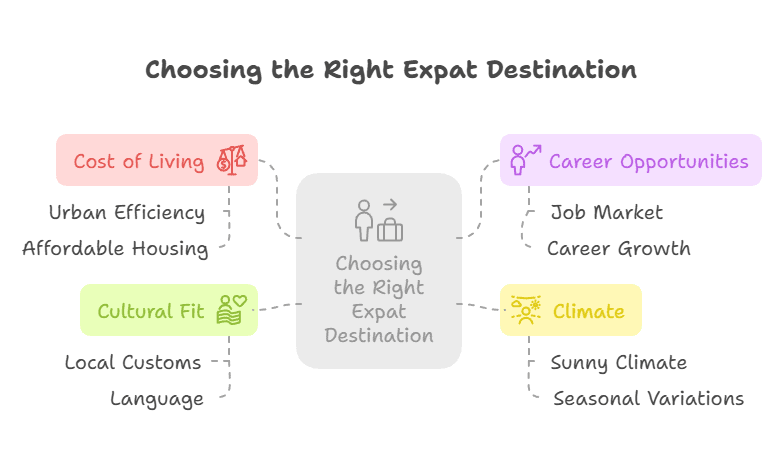
Once you’ve chosen your destination, it’s time to start preparing for your move. Here are some things to consider:
Research, Research, Research: Learn as much as you can about your new home, from the cost of living to the local culture. Understanding the nuances of your destination will help you adapt more quickly.
Plan Your Finances: Make sure you have enough money to cover your living costs, and consider opening a local bank account. Budgeting for higher living costs in some countries is crucial.
Find a Place to Live: Look for accommodation that suits your needs and budget. Whether you prefer city apartments or suburban homes, start your search early.
Get Health Insurance: Consider investing in international health insurance to cover you in case of an emergency. Even in countries with universal healthcare, private insurance can provide additional peace of mind.
Learn the Language: Take language classes to help you integrate into the local community. Basic language skills can significantly enhance your daily interactions and overall experience.
Say Goodbye: Make sure to tie up loose ends at home, including saying goodbye to friends and family. Preparing emotionally for the move is as important as the logistical aspects.
Ultimately, the “best” country depends on your priorities – be it low cost, ease of integration, career opportunities, or climate and culture. All the countries profiled are highly regarded by expats and offer an attractive, if distinct, mix of high quality of life factors. Evaluate what matters most to you and your family, be it the free education and nature of New Zealand, the buzz and safety of Singapore, the cultural richness of Spain, the social model of Sweden, or the opportunities of Canada and Germany. Armed with the information above on living factors and the know-how to secure residency or citizenship, you can make an informed decision and take concrete steps toward your life-changing move abroad. Safe travels on your journey to a higher quality of life!
