

Introduction: Expanding Business Horizons Through Strategic Relocation, Residency, and Citizenship
In an increasingly interconnected economy, securing residency or citizenship in the right country can unlock vast new markets for entrepreneurs. Strategic relocation offers business owners access to entire economic unions, preferential trade agreements, and pro-business environments that would otherwise be out of reach. Understanding diverse markets is crucial, as businesses must adapt their offerings to align with local norms and build strategic alliances that consider cultural nuances and consumer behaviors. For example, establishing a base in an EU member state opens the door to over 500 million consumers in the European single market and preferential trade with about 70 countries worldwide via EU trade agreements. Likewise, a Singapore headquarters plugs a company into Asia-Pacific trade pacts (like ASEAN and the CPTPP), while Canada’s 15 free trade agreements give its residents access to 1.5 billion customers across the G7, EU, and more. When entering a foreign market, careful planning, investment, and understanding local conditions are essential for success. In short, the right residency can dramatically expand a business’s market access, leveraging international economic unions, trade agreements, and business-friendly policies for global growth.
Beyond market size, strategic relocation provides other advantages. Many countries offer corporate tax rates or incentives that reduce business costs (Ireland’s 12.5% corporate tax, UAE’s tax-free zones, etc.), streamlined regulations that rank highly on ease of doing business indices, and special programs to attract foreign investors or talent (from “golden visas” to startup incubator visas). By comparing key factors for each destination – such as regional trade bloc membership, tax environment, ease of incorporation, investment incentives, and residency pathways – business owners can identify the best relocation strategy for their expansion goals.

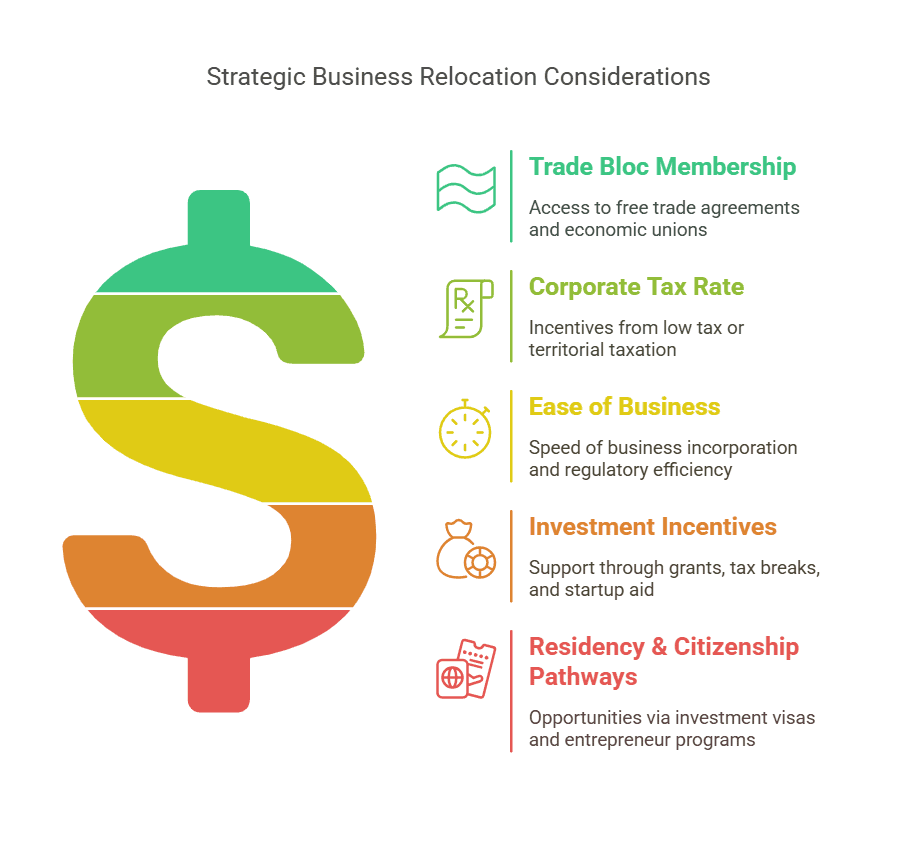
Key factors to consider when choosing a country for residency or citizenship as a business expansion strategy include:
Regional Trade Bloc Membership: Does it grant access to large unified markets (e.g. EU, USMCA, ASEAN) or key free trade agreements that reduce tariffs and barriers?
Corporate Tax Rate: What is the headline corporate tax rate and are there tax advantages (low rates, tax holidays, territorial taxation, etc.) for foreign investors or new businesses?
Ease of Doing Business: How easy is it to start and operate a company there? (Consider World Bank rankings, regulatory simplicity, infrastructure, etc.)
Investment Incentives: Are there government incentives, grants, or special economic zones that encourage foreign investment and entrepreneurship?
Residency/Citizenship Pathways: What programs exist to obtain residency or citizenship (investment visas, entrepreneur visas, etc.), and what are the requirements and benefits?
Understanding Global Market Access
Global market access refers to the ability of businesses to enter and operate in foreign markets, leveraging opportunities for growth, revenue, and expansion. For businesses seeking to expand their operations beyond their domestic borders, understanding global market access is crucial. It involves navigating complex regulatory environments, adapting to local market dynamics, and building strategic alliances with local businesses. Successfully accessing global markets can open up new revenue streams, diversify risk, and enhance a company’s competitive edge. However, it requires a deep understanding of the legal and regulatory environments, consumer behavior, and business practices in the target markets. By strategically positioning themselves in key foreign markets, businesses can tap into new customer bases, optimize their supply chains, and achieve sustainable growth.
Assessing Readiness for Global Expansion
Assessing readiness for global expansion is a critical step for businesses seeking to enter new markets. It involves evaluating a business’s operations, management, and resources to determine its ability to adapt to new market conditions. Businesses must assess their market research capabilities, cultural adaptability, and regulatory compliance to ensure a successful expansion. This includes understanding the target market’s legal and regulatory environments, consumer behavior, and competitive landscape. Additionally, businesses must evaluate their financial resources, management capabilities, and cultural adaptability to ensure a smooth transition into new markets. A thorough readiness assessment helps businesses identify potential challenges and opportunities, allowing them to develop a strategic plan for global expansion that aligns with their business objectives and market conditions.
Below is a comparative table summarizing these factors for several top countries often chosen for strategic relocation. All financial figures are in USD (with EUR given where applicable):
| Country | Regional Market Access | Corporate Tax Rate | Ease of Business | Investment Incentives | Residency Pathway |
|---|---|---|---|---|---|
| Singapore | ASEAN, CPTPP, RCEP (Asia-Pacific trade network) | 17% flat | #2 worldwide (2020) | 3-year tax exemption for new start-ups | Investor PR via ~$1.8M investment (Global Investor Programme) |
| UAE (Dubai) | GCC common market; recently 24 new trade deals (covering 2.5 billion people) | 0% up to AED 375k, then 9% | #16 worldwide (2020) | Free zones (0% tax for qualifying firms) | 10-year Golden Visa (≈$550k in property or business) |
| Ireland | EU Single Market (access to all 27 EU countries) | 12.5% standard | #24 worldwide (2020) | 30% R&D tax credit (effective 42.5% deduction) | Start-up Entrepreneur Programme (innovative business, €50k funding) |
| Canada | USMCA (NAFTA) + CPTPP + CETA (51 country FTA network) | ≈26% (combined federal/provincial) | #23 worldwide (2020) | R&D tax credits; provincial incentives (grants, tax rebates) | Start-Up Visa (innovator residency via incubator/VC support) |
| United States | USMCA (North America); 14 FTAs with 20 countries | 21% federal (+ state taxes) | #6 worldwide (2020) | Various federal and state incentive programs (tax credits, enterprise zones) | EB-5 investor green card ( ~$800k–$1.05M investment ) E-2 treaty investor visas |
| Portugal | EU Single Market (Schengen & Eurozone) | 21% (dropping to 20% in 2025) | #39 worldwide (2020) | Innovation grants; EU structural funds access | Golden Visa residency (via ~€500k investment in funds/business) |
Singapore – Gateway to Asia-Pacific Markets
Singapore consistently ranks as one of the most business-friendly countries in the world. By establishing a presence in Singapore, entrepreneurs tap into the ASEAN Economic Community (a 10-nation free trade area) and benefit from Singapore’s extensive free trade agreements (15 bilateral and 12 regional FTAs) that grant preferential access to major economies. This includes trade pacts with China, India, the EU, the US, and participation in mega-agreements like RCEP and CPTPP, positioning Singapore as a springboard into the entire Asia-Pacific region.
From a tax perspective, Singapore offers a low 17% corporate tax rate on profits. Attractive tax incentives further sweeten the deal – new qualifying startups enjoy a 3-year partial tax exemption, meaning a substantial portion of early profits is tax-free. There are also incentives for innovation: companies can access generous grants and credits for R&D, and there is no capital gains tax nor tax on foreign dividends, making Singapore’s tax regime highly favorable to international business. The result is a tax environment that encourages reinvestment and growth.
In terms of ease of doing business, Singapore is world-class – it was rated #2 globally for ease of doing business. Incorporating a company is straightforward (often completed within a day online), and the regulatory framework is transparent and efficient. The city-state boasts excellent infrastructure, a stable political climate, strong rule of law, and a highly skilled, English-speaking workforce. These factors reduce the friction of operating and allow entrepreneurs to focus on expansion rather than red tape.
For residency pathways, Singapore’s Global Investor Programme (GIP) offers a route to Permanent Residency for those who invest S$2.5 million (approximately $1.8 million USD) in either a new or existing business or an approved fund. This investor PR program is designed to attract high-value business owners and investors, and successful applicants can reside in Singapore long-term with their families. Additionally, Singapore has an EntrePass scheme for entrepreneurs with innovative startups (backed by a government-recognized incubator or venture capital) and a straightforward Employment Pass system for hiring oneself as a managing director when setting up a company. While obtaining Singaporean citizenship is difficult (and typically only considered after several years of residency and business contribution), permanent residency itself grants flexibility to live, work, and expand one’s enterprise in Singapore – the hub of Southeast Asia.
In summary, Singapore is an ideal relocation choice for accessing Asian markets. It combines unparalleled trade connectivity (ASEAN and beyond), a pro-business tax and regulatory environment, and viable investor visa programs, making it a top pick for entrepreneurs aiming to establish an Asian regional headquarters and capture opportunities across fast-growing economies like Indonesia, Vietnam, India, and China.
United Arab Emirates – Middle Eastern Hub with Tax Advantages

United Arab Emirates (UAE), and specifically Dubai, has emerged as a global business hub at the crossroads of Europe, Asia, and Africa. While not a traditional “trade bloc” member like the EU, the UAE leverages several regional agreements and its strategic location to offer superb market access. It is part of the Gulf Cooperation Council (GCC), a regional bloc fostering a common market among Gulf countries, and a member of the wider Greater Arab Free Trade Area (GAFTA). In recent years, the UAE has aggressively pursued bilateral Comprehensive Economic Partnership Agreements (CEPAs) – signing 24 new trade deals in just three years with partners across Asia, Africa, and even Latin America. These agreements (including deals with India, Indonesia, and plans with Mercosur) connect UAE-based businesses to 2.5 billion consumers worldwide with reduced tariffs and improved market access. In effect, a company in the UAE can easily re-export and trade with fast-growing markets in the Middle East, South Asia, and Africa, leveraging the UAE’s status as a logistics and finance hub. Dubai’s world-class ports and airports further enable companies to serve a broad geography efficiently.
A hallmark of the UAE’s attractiveness is its tax environment. The UAE has no personal income tax and traditionally had no federal corporate tax on most businesses. As of 2023, a modest 9% corporate tax was introduced on business profits above AED 375,000 (approximately $102,000), but small businesses under that threshold continue to enjoy a 0% rate, and companies in designated Free Zones remain tax-exempt provided they don’t conduct business in the mainland UAE. This means many international entrepreneurs can still operate tax-free by using UAE free zone entities for foreign trade. Additionally, there is no tax on capital gains or dividends in most cases. Even with the new tax law aligning the UAE with international norms, the UAE’s effective corporate tax for many businesses is among the lowest in the world, especially when using free zones.
The business setup process in the UAE has become increasingly streamlined. Dubai in particular was ranked among the top 20 globally for ease of doing business (16th in 2020). Reforms now allow 100% foreign ownership of companies in most sectors (no local sponsor required in many cases), and online business registration has been simplified. Free zones offer one-stop services to incorporate quickly, with benefits like full foreign ownership, zero taxes for 50 years, no import duties, and simplified customs. Infrastructure in the UAE is ultramodern – from offices to telecom to logistics – which enables efficient operations. One thing to note is that costs (office rent, licensing fees) can be higher than some other countries, but the UAE often compensates with connectivity and a prestige factor that can boost business credibility.
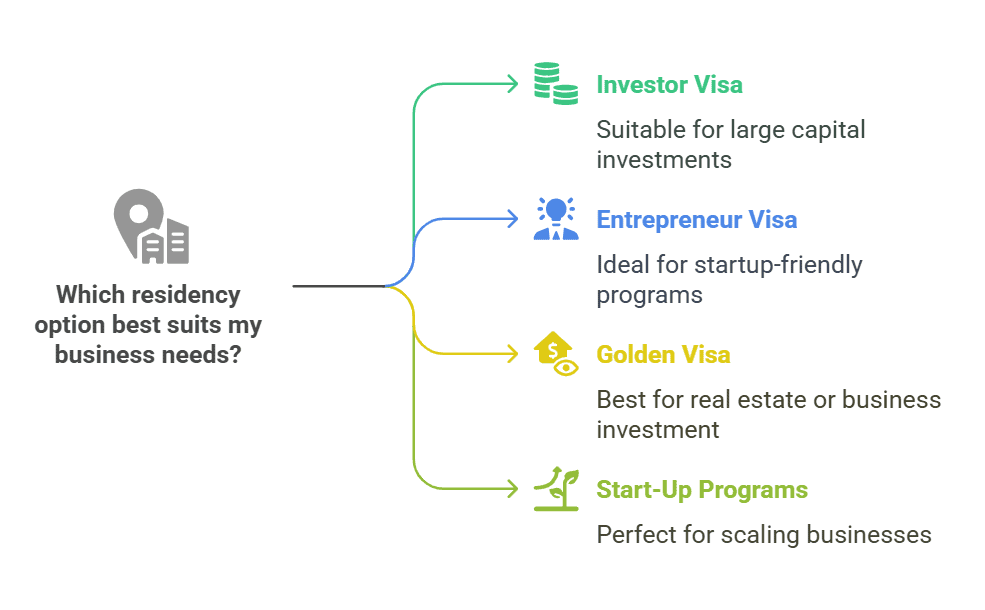
To attract global talent and investors, the UAE rolled out a Gold Card and Golden Visa system. The 10-year Golden Visa is available to investors who deploy at least AED 2 million (≈ $550,000 USD) in UAE real estate or business ventures, as well as to entrepreneurs and individuals with exceptional talents. This long-term residency is a self-sponsored visa that doesn’t tie one to an employer. It gives business owners stability to live and work in the country long-term, with the ability to sponsor family members. Apart from the Golden Visa, entrepreneurs can also obtain residence visas by setting up a company (free zone companies typically come with residence visas for owners and employees). While citizenship in the UAE has traditionally been very rare for foreigners, a 2021 law now allows select investors and talents to be nominated for UAE citizenship. However, for most entrepreneurs, the Golden Visa or company residency is the practical route, offering many of the benefits of citizenship (exclusive benefits like local discounts, etc.) except voting rights.
In essence, the UAE (Dubai) offers a unique mix of zero-tax (or low-tax) business environment, a central location bridging East and West, and increasingly easy residency terms for investors. Companies that relocate to Dubai gain a prestigious address and a convenient base to expand into the Middle East, India, and Africa. With its pro-business policies and visionary initiatives (from smart city tech to world expos), the UAE continues to attract entrepreneurs seeking to capitalize on a dynamic, international market hub.
Ireland – Low-Tax Gateway to the European Union
Ireland has earned a reputation as a prime location for international business in Europe, often dubbed the “Silicon Valley of Europe” due to the concentration of tech multinationals in Dublin. Understanding local consumer behavior is crucial for positioning a brand effectively within the market. For entrepreneurs and investors, Ireland’s appeal lies in its full access to the EU single market combined with an extremely favorable tax regime and English-speaking workforce. As a member of the European Union, Ireland provides companies with tariff-free access to all 27 EU countries (a combined GDP among the world’s largest) and by extension to the EU’s trade agreements with around 70 countries. This means an Irish-incorporated business can easily passport its goods or services across Europe and beyond, taking advantage of EU-wide standards and agreements like the EU–Japan EPA, EU–Canada CETA, etc., without facing additional trade barriers.
Ireland’s corporate tax rate is famously low at 12.5% on trading (active business) income – one of the lowest effective corporate rates in the developed world. This has been a cornerstone of Ireland’s strategy to attract investment. In addition to the low headline rate, Ireland offers robust tax incentives: companies can claim a 30% tax credit on qualifying R&D expenditures (effectively reducing the cost of innovation, with a total deduction equivalent to 42.5% when combined with the normal deduction). There are also favorable intellectual property (IP) regimes allowing income from patents or IP to be taxed at lower rates, and generous capital allowances for investments in renewable energy and other targeted sectors. For holding companies, Ireland has no withholding tax on outbound EU dividends and extensive tax treaty networks. This tax environment has made Ireland a magnet for Fortune 500 companies, and smaller firms benefit from the same rules. Notably, Ireland has agreed to the OECD global tax reform (15% minimum for large multinationals), but for the vast majority of businesses under that threshold, the 12.5% rate remains in place and highly competitive.
In terms of business climate, Ireland is very conducive despite being a smaller economy. It ranks in the top 25 globally for ease of doing business. Setting up a private limited company (Ltd.) is straightforward and can be done within 1–2 weeks. Ireland’s legal system is based on common law (similar to the UK/US), and it has a strong rule of law and robust protection for investors. English is the primary language, which removes barriers for international entrepreneurs. Ireland also scores high in metrics like investor protection and ease of paying taxes (its bureaucracy is relatively efficient). One reason global tech giants from Google and Apple to countless startups choose Ireland is the access to a highly educated talent pool (a result of strong universities and the youngest population in the EU). Moreover, as part of the EU, an Ireland-based business can hire freely from the entire EU/EEA workforce – a significant advantage for scaling with skilled labor.
For those looking at residency and citizenship options, Ireland until recently operated the Immigrant Investor Programme (IIP) which required a €1 million investment in an Irish enterprise or fund for a 2–5 year period. This program was quite successful in attracting global investors but was closed to new applications in early 2023 as the government reassesses its immigration strategies. However, entrepreneurs can still move to Ireland through the Start-up Entrepreneur Programme (STEP), which allows non-EEA founders with an “innovative” business proposal to obtain residency if they have at least €50,000 in funding. The business idea must be scalable and create jobs in Ireland. Successful applicants (and their immediate family) get a residency stamp with the ability to renew and eventually can work toward long-term residency or citizenship. Apart from that, standard routes like employment permits are available (for example, establishing your company and obtaining a Critical Skills Employment Permit for yourself). Ireland also permits dual citizenship and has a relatively straightforward citizenship timeline (5 years of residency, or 3 years if married to an Irish citizen). Gaining Irish (and thus EU) citizenship is a coveted prize, granting full rights across the EU.
Overall, Ireland offers a compelling package: unrestricted EU market access, a very low corporate tax, a stable pro-business environment, and talent availability – all in an English-speaking, high quality-of-life country. It is particularly attractive for tech and finance entrepreneurs aiming for the European market. While its specific investor visa has paused, Ireland’s business environment continues to draw companies that use it as their gateway to Europe. For many, the combination of EU access and low taxes is hard to beat.
Canada – Access to North America and Global Free Trade Networks
Canada is often the top choice for entrepreneurs looking to establish a foothold in North America. Its appeal goes beyond the sizable domestic market – Canada serves as a launchpad into the United States and Mexico through the United States–Mexico–Canada Agreement (USMCA), while also connecting to Europe and the Asia-Pacific via its ambitious free trade network. Understanding and catering to local preferences in various local markets can significantly enhance a company’s global presence. In fact, Canada is the only G7 country with free trade agreements covering the entire G7 and EU. With 15 trade agreements in force covering 51 countries (including CETA with Europe, CPTPP with Asia-Pacific nations, and many bilateral deals), a Canadian-based business enjoys preferential access to about 61% of the world’s GDP. Practically, this means manufacturers in Canada can export tariff-free not only to the US and Mexico (a ~$25 trillion regional market) but also into the EU’s 450 million consumer market and to fast-growing Asian markets like Japan and Vietnam via the CPTPP. This extensive trade linkages amplify the global reach of companies operating from Canada.
Canada’s domestic market is significant in its own right: it’s a G7 economy with a high per-capita income and stable growth. By relocating to Canada, entrepreneurs also effectively gain easier access to the U.S. market – often cited as a key reason, since Canadian companies can often expand south under favorable terms (and Canada’s proximity and similar business culture to the U.S. helps). Moreover, Canada has mutual recognition agreements and closely aligned standards with the U.S., simplifying cross-border business.
On the tax front, Canada’s corporate tax rates are moderate but come with various incentives. The federal base corporate tax is 15%, and when combined with provincial corporate taxes, the overall rate averages around 26% (slightly above the OECD average). While not a tax haven, Canada offers competitive rates compared to the U.S. and many other G7 countries. Additionally, Canada encourages investment and R&D through tax credits. Notably, the Scientific Research & Experimental Development (SR&ED) program provides generous R&D tax credits (up to 35% refundable credit for small Canadian-controlled companies on qualifying R&D expenditures, and 15% for larger firms). Many provinces add their own R&D credits on top. There are also targeted incentives by industry: for example, tax holidays and grants for green energy projects (the 2023 budget included $61 billion in clean technology tax credits over 10 years), incentives for videogame and digital media production in provinces like Ontario and Quebec, and various government grant programs to support startups (such as the Industrial Research Assistance Program). Canada’s taxation system also enables planning opportunities – for instance, small businesses benefit from a lower small-business tax rate on the first CAD 500k of active income (9% federal). And dividends from Canadian companies to resident individuals get a favorable tax treatment, which can help an entrepreneur’s personal tax situation.
Canada’s business environment is very welcoming. It was ranked 23rd globally for ease of doing business, and scores particularly high in categories like starting a business and protecting minority investors. Incorporating a company (whether federal or provincial) is straightforward; there is no minimum capital requirement, and one can complete registration in a matter of days. The country boasts strong legal protections, an independent judiciary, and low corruption. Being bilingual (English and French) and multicultural, Canada also offers a diverse talent pool. Cities like Toronto, Vancouver, and Montreal have thriving startup scenes and deep labor markets in tech, creative industries, natural resources, and more. The cost of doing business (wages, utilities) can be lower than in the U.S., and companies often cite Canada’s high quality of life as a factor that helps attract and retain talent. Furthermore, Canada’s banking system is stable and the country scores highly on political stability and rule of law – factors that add certainty for investors.
Regarding residency opportunities, Canada is known for its immigrant-friendly policies. The flagship program for entrepreneurs is the Start-Up Visa (SUV). Under the SUV program, if you have an innovative business idea that is endorsed by a designated Canadian venture capital fund, angel investor group, or startup incubator, you and up to four co-founders can directly receive permanent residence. Uniquely, Canada’s Start-Up Visa does not require a minimum personal investment (the key requirement is securing a letter of support from an investor or incubator), although in practice your business needs funding to be viable. This program has attracted entrepreneurs globally as it offers immediate PR (not just a temporary visa), allowing you to live anywhere in Canada and build your business. Aside from the SUV, investors can use Provincial Nominee Programs (PNPs) – many provinces run entrepreneur streams where, for example, investing CAD $150,000–$300,000 in a local business and creating jobs can lead to a provincial nomination for permanent residence. Each province has its own criteria (e.g. Ontario and British Columbia have popular entrepreneur programs). Another avenue is the Intra-Company Transfer work permit if you already have a business abroad and want to open a Canadian branch – this can later transition to PR. Once a permanent resident, an entrepreneur in Canada has a path to citizenship typically in about 3 years (1095 days of physical presence within a 5-year span). Canadian citizenship grants visa-free access to numerous countries and is highly respected, plus one can hold dual citizenship.
In conclusion, Canada offers broad market access – notably the lucrative U.S. market and a web of global trade partners – combined with a supportive business climate and relatively easy immigration pathways for business owners. While its tax rates are higher than zero-tax jurisdictions, Canada balances this with stability, infrastructure, and incentives, as well as the intangible benefit of being in a country known for its livability and openness. For many entrepreneurs, the ability to operate in North America without the hurdles of U.S. immigration, while still engaging freely with the U.S., makes Canada an optimal choice for international expansion.
United States – The World’s Largest Consumer Market
The United States offers an unsurpassed market opportunity – a domestic economy exceeding $21 trillion in GDP and a consumer base of 330 million people with high spending power. For many businesses, accessing the U.S. market is a key milestone for growth. By obtaining residency in the U.S. (or even by leveraging certain treaty visas via another country’s citizenship), entrepreneurs can position themselves to expand within the USA and benefit from its trade influence. The U.S. itself has somewhat fewer free trade agreements than some countries (14 FTAs covering 20 countries, including agreements with Canada, Mexico, South Korea, Australia, and others), but the sheer size of the American market and its network of bilateral investment treaties make it enormously attractive. Moreover, through the USMCA trade bloc, a U.S.-based business can trade freely with Canada and Mexico, effectively reaching the whole North American market (nearly 500 million people) with no tariffs. The U.S. also has many sector-specific agreements and is a member of the WTO, ensuring generally low tariffs with most major economies.
Being in the United States puts a company at the center of global finance, technology, and innovation networks. It becomes easier to attract American venture capital (the U.S. accounts for roughly half of global venture funding by value), form partnerships, and service lucrative corporate clients. The U.S. regulatory environment, while complex, also offers advantages like strong intellectual property protection, a huge network of research institutions, and deep capital markets (e.g. the ability to list on NASDAQ or NYSE eventually).
The tax environment in the U.S. is a mixed bag. The federal corporate tax rate is 21% (since the Tax Cuts and Jobs Act of 2017), which brought the U.S. closer to international norms (down from a previous 35%). On top of this, most states levy their own corporate taxes ranging roughly from 0% (in places like Wyoming or South Dakota) up to 8–12% in states like California or New Jersey. The combined average corporate tax is around 25–27%, though these state taxes are deductible at the federal level. While U.S. corporate taxes are higher than zero-tax jurisdictions, the U.S. offers other tax advantages: a wide array of deductions and credits (for R&D, renewable energy investments, etc.), and the ability to choose tax-efficient entity types (for instance, LLCs or S-corps can confer pass-through taxation, meaning profits are taxed only at the owner level, avoiding the corporate tax). Certain states and localities offer generous tax incentives to attract businesses – for example, states may grant multi-year corporate tax exemptions, property tax abatements, or even cash grants for companies that create jobs (as seen in high-profile deals like Amazon’s HQ2 bids). The U.S. also has opportunity zones (which offer capital gains tax deferral for investments in designated economically distressed areas) and various industry-specific incentives (like film production credits in Georgia, or no state corporate tax for tech companies in parts of Texas). Overall, while the U.S. is not a low-tax haven, smart tax planning can significantly reduce the burden, and profit potential in the huge U.S. market can outweigh the costs.
The ease of doing business in the U.S. is generally high – the World Bank ranked the U.S. 6th in the world for ease of doing business. Starting a business in many states can be done in a day or two online, with minimal fees. There is a strong culture of entrepreneurship, with vast resources available: incubators, accelerators, startup grants (especially at city and state levels), and a mature ecosystem for virtually any industry. The labor market is flexible (employment-at-will, easier to hire and fire relative to many countries), and there’s a deep talent pool, though competition for skilled workers like software engineers is intense. The legal system can be complex (50 state jurisdictions plus federal regulations), but U.S. contract law and courts are well-developed for handling business issues. One consideration is healthcare and insurance costs for employees, which are higher than in countries with national healthcare, but many foreign entrepreneurs find the dynamism and scale of the U.S. market to be worth it.
When it comes to visa and residency pathways, the U.S. has specific programs for investors and entrepreneurs, though they can be more demanding than other countries’. The most direct is the EB-5 Immigrant Investor Program, which grants a green card (permanent residence) in exchange for investing $1,050,000 (or $800,000 in a Targeted Employment Area) into a new U.S. business that creates at least 10 full-time jobs. The investment can be direct or through an approved regional center project. EB-5 is a clear route to a green card for those with substantial capital – it’s essentially a “invest your way in” program, with the lower $800k threshold applicable to rural or high-unemployment areas. Processing can take a couple of years, but it results in conditional residency, and later full permanent residency, for the investor and immediate family. Another avenue is the E-2 Treaty Investor Visa. While the E-2 is a non-immigrant (temporary) visa, it is highly useful: it allows an entrepreneur from an E-2 treaty country (there are over 80 eligible nationalities) to invest a substantial amount in a U.S. business and move to the U.S. to direct that business. There’s no fixed minimum investment by law (it must be proportional to the business, but typically $100k+ is expected). The catch is one must hold a passport of a treaty country – for example, nationals of countries like Canada, UK, Germany, Mexico, Japan, Turkey, Grenada, and many others qualify, but nationals of China, India, Russia, among others do not (which leads some entrepreneurs to first obtain a citizenship-by-investment from a country like Grenada or Turkey in order to become E-2 eligible). The E-2 visa can be renewed indefinitely as long as the business operates, but it does not directly lead to a green card. Other pathways include the L-1 visa for intracompany transfers (if you have an established foreign company and want to transfer an executive to a new U.S. office) – this can later progress to a green card. The O-1 visa is for individuals with extraordinary ability (could be an entrepreneur with notable achievements), and the newer International Entrepreneur Parole (IEP) program functions like a startup visa (parole status for founders who raise at least $250k from U.S. investors, among other criteria).
It’s worth noting that U.S. immigration for entrepreneurs, while attainable, often requires navigating bureaucracy and sometimes creative structuring; hence many use Canada or other countries as a stepping stone to enter the U.S. market more easily. That said, once an entrepreneur obtains U.S. permanent residence or citizenship, they gain unrestricted access to one of the most prosperous markets on the planet and the ability to live and operate in a country known for innovation and business growth.
In summary, the United States is unrivaled in market size and influence. Achieving a foothold there – whether via direct investment or treaty-based visas – can propel a business to new heights. The combination of a massive consumer base, robust legal protections, deep capital markets, and cultural cachet makes the U.S. a strategic target for global expansion. Entrepreneurs should be mindful of the higher costs and complex immigration processes, but the potential payoff of being in the U.S. market is enormous. Many successful global companies at some point relocate or expand to the U.S. to fully realize their growth potential.
Portugal – Strategic Entry to Europe with Business-Friendly Residency
Portugal has become increasingly popular among entrepreneurs and investors seeking a base in Europe, thanks to its attractive lifestyle, relatively low costs, and innovative residency programs. As a member of the EU and Schengen Area, Portugal gives businesses and individuals full access to the EU single market and the ability to travel freely across 26 European countries. Goods and services can move from Portugal to the rest of Europe without tariffs or customs, and a company in Portugal can easily service clients EU-wide under common regulations. Portugal uses the euro currency, eliminating exchange risk across the Eurozone. Additionally, Portugal has ties to Lusophone markets (Brazil, Angola, Mozambique, etc.) and a strategic Atlantic location that historically bridges Europe with the Americas and Africa.
One of Portugal’s main draws for business owners has been its “Golden Visa” residency by investment program, which, since 2012, attracted thousands of investors. Through this program, non-EU nationals who invest a certain amount in Portugal can obtain a residence permit and, after five years, become eligible for citizenship. Investment options included real estate, capital investment, or business creation. Notably, in October 2023, Portugal implemented changes to refocus the Golden Visa: it ended the qualifying option of buying residential real estate (due in part to housing market pressures) and eliminated simple capital transfers as a route. However, the program remains open via other routes – specifically by investing in venture capital funds, scientific research, existing Portuguese businesses, or cultural projects. For example, an investment of €500,000 in a Portuguese venture capital or private equity fund (that meets certain criteria) still qualifies for the Golden Visa, as does creating 10 jobs in a new company, or a €250,000 donation to national heritage projects. These adjustments aim to channel foreign investment into productive areas of the economy. The key benefit of the Golden Visa is that it requires minimal stay (an average of just 7 days per year in Portugal), yet after five years of holding the residence (and fulfilling the stay requirement), one can apply for permanent residence or citizenship. Many investors have used this to obtain a coveted EU passport via Portugal while enjoying an optional relatively low physical presence.
Beyond the Golden Visa, Portugal also offers a D7 “Passive Income” visa and a Digital Nomad visa, which have become popular among remote entrepreneurs and freelancers. The D7 is for those with stable income (like from rentals, businesses, or remote work) and allows residency without a big investment, but requires spending most of the year in Portugal. Recently, Portugal introduced a one-year Digital Nomad Visa for remote workers earning above a certain threshold (around €2,800 per month) to reside in Portugal. These options underscore Portugal’s openness to foreign professionals and businesspeople.
When it comes to the corporate environment, Portugal has a standard corporate tax rate of 21% (which will reduce to 20% in 2025 as part of a tax reform). Additionally, there’s a small municipal surtax up to 1.5%, and a progressive state surtax for large profits (for example, an extra 3% on profits over €1.5 million). For small and new businesses, Portugal offers some relief: a reduced rate of 17% on the first €50,000 of taxable profit (16% from 2025) for qualifying SMEs. Portugal also provides R&D incentives (like the SIFIDE tax credit which can cover up to 32.5% of R&D expenses) and has free trade zones in Madeira and the Azores with reduced taxes for certain international businesses. In terms of personal tax, Portugal became famous for its Non-Habitual Resident (NHR) tax regime, which for the last decade allowed new residents to receive many foreign income types (e.g. dividends, interest, pensions) tax-free for 10 years, and taxed local employment at a flat 20%. However, the Portuguese government has announced plans to end the NHR regime from 2024, so this benefit may not be available moving forward. Even without NHR, Portugal’s personal tax on business dividends can be planned (there are exemptions for EU dividends or holding company structures). The overall tax burden in Portugal is moderate by EU standards, and the government often signals pro-business reforms to attract foreign investment.
Portugal’s ease of doing business ranking has room for improvement (it was #39 in 2020) – bureaucratic processes (like getting licenses or local approvals) can be slower compared to, say, Ireland or Estonia. That said, the country has been simplifying procedures: you can incorporate a company in a few days through the “Empresa na Hora” (Company in an Hour) scheme, and there are online one-stop portals for many services. The workforce in Portugal is known for being skilled (especially in engineering and IT, with many English speakers) yet labor costs are lower than in Western European peers. Tech startups have been booming in Lisbon and Porto, aided by government initiatives like Startup Portugal and incubators. The country’s infrastructure is solid (good highways, ports, and improving broadband), and it ranks very high in quality of life – an asset in attracting talent. Costs for office space, wages, and living are among the lowest in Western Europe, meaning entrepreneurs can stretch their capital further.
Quality of life is indeed one of Portugal’s trump cards: it offers a mild climate, safety, and rich culture, which is why many entrepreneurs choose to base themselves there while targeting the broader EU market. The ability to easily travel throughout Europe from Portugal is ensured by its Schengen membership. Also, for those eventually obtaining a Portuguese passport, it is one of the strongest in the world for travel freedom (visa-free access to the US, UK, EU, etc.) and the right to live and work anywhere in the EU.
Overall, Portugal provides a compelling gateway into Europe with a relatively friendly residency regime for investors, a reasonable corporate tax structure, and a lifestyle that can be a magnet for international talent. It may not offer the ultra-low taxes of some competitors, but it balances taxation with incentives and a low-cost base. For entrepreneurs who value a high quality of life for themselves and their employees, as well as a strategic location within the European time zone (convenient for working with both Americas and Asia), Portugal stands out. Its recent adjustments to the Golden Visa indicate a focus on channeling investment into productive ventures – aligning well with business owners who genuinely plan to operate and contribute to the local economy. With Portugal, one can enjoy the full benefits of EU market access while building a venture in a country known for its innovation-friendly attitude and international outlook.
Conclusion
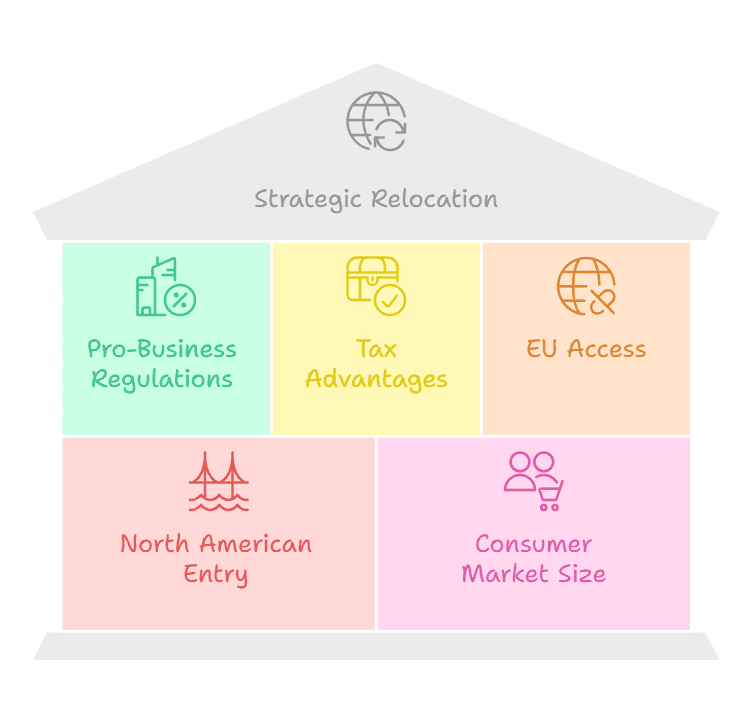
Choosing the right country for residency or citizenship can dramatically extend a company’s global reach. By leveraging the market access provided by economic unions and trade agreements – whether it’s selling services across all EU countries tariff-free, manufacturing in North America under USMCA, or entering emerging Asian markets via ASEAN and CPTPP – astute entrepreneurs can break through growth plateaus and enter new arenas. Equally important are the business-friendly policies that come with these jurisdictions: lower taxes can free up capital for reinvestment, and pro-investor regulations and incentives can accelerate business development. Programs like golden visas and startup residency permits are not just immigration options; they are strategic tools that allow business owners to relocate where opportunity is greatest. A founder can establish themselves in a country that acts as a launchpad to an entire region of the world.
Ultimately, the optimal choice depends on the entrepreneur’s target markets and business needs. For tech startups eyeing European customers, an EU base like Ireland or Portugal might offer the perfect mix of market access and innovation ecosystem. For trading companies or consultancies seeking low taxes and a global hub, Singapore or the UAE could be ideal. North America-focused businesses might leverage Canada’s easy entry and U.S. links, or go directly for the U.S. if they can navigate the visa process. It’s clear, however, that strategic relocation is about more than just a visa – it’s about positioning your business in an environment where it can thrive internationally. By carefully comparing the factors outlined above and aligning them with one’s expansion strategy, business owners and investors can make informed decisions to secure new market access and drive growth through global citizenship and residency options. The world’s key markets are within reach – and the right residency can be the bridge that connects your business to these opportunities.
