

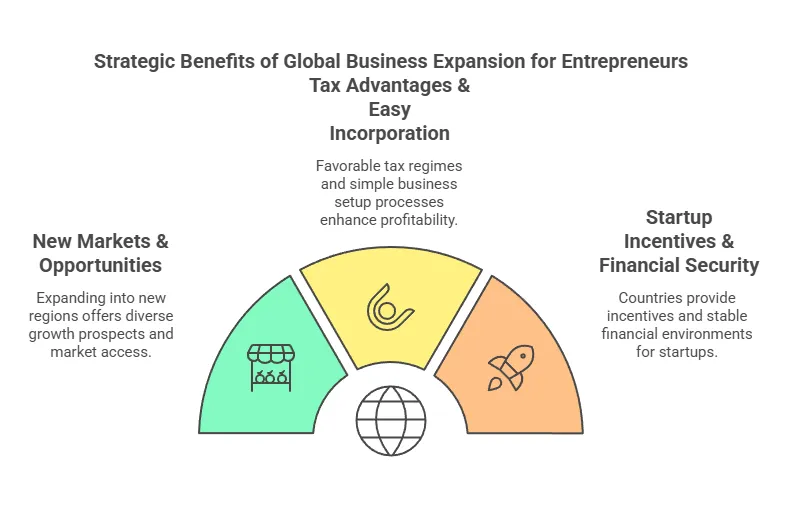
Expanding your business internationally can unlock new markets, tax advantages, and growth opportunities, especially in some of the best countries for business. For expat entrepreneurs, choosing the right jurisdiction is crucial. Below we compare some of the top-ranked countries offering advantageous regulatory, tax, and trade conditions for foreign business owners. We’ll examine corporate tax rates, ease of incorporation, regulatory environment, trade agreements, global market access, startup incentives, and visa or residency options – with side-by-side tables for clarity.
Business Climate, Foreign Investment, and Market Access
| Country | Corporate Tax Rate | Time to Start Business | Major Trade Access | Key Incentives |
|---|---|---|---|---|
| Singapore | 17% (partial exemptions ↓ effective 5-10% for SMEs) | ~1-2 days (online one-stop registration) | ASEAN, RCEP, CPTPP, FTA with EU (goods/services) | Tax exemptions for startups; 300% R&D deduction no dividend/cap gains tax |
| UAE | 0% (free zones) to 9% federal | ~5 days (free zone license) | GCC common market; new FTAs (India, etc.) in 2022+; global hub (no import/export tax) | 0% import/export duties in free zones; no personal income tax; govt incubators (Hub71); numerous incentives for foreign investment |
| Hong Kong | 8.25% up to HK$2M; 16.5% beyond | ~1-3 days (e-Registry online) | Closer Economic Partnership (China) tariff-free; zero tariffs generally; WTO member | 0% tax on foreign-sourced income generous profit deductions (e.g. 300% R&D) |
| Ireland | 12.5% trading income | ~3-5 days (online CRO filing) | EU single market (27 countries) UK access via bilateral ties EU FTAs worldwide | 25% R&D tax credit; 0% tax first 3 years (conditions) grants via Enterprise Ireland |
| Estonia | 0% on reinvested profits (20/22% when distributed) | ~0.5-1 day (online, e-Residency) | EU single market & Eurozone; WTO, EU FTAs (global) | Tax deferral until distribution easy online administration; Startup Estonia support |
| UK | 19% (small) to 25% (standard) | ~1 day (online, £12 fee) | Post-Brexit FTAs (36 deals) including EU (TCA), AUS/NZ, joining CPTPP | 230% SME R&D credit (or cash rebate ~14%); SEIS/EIS investor tax relief; Patent Box 10% rate |
| Switzerland | ~11% – 21% (varies by canton; ~15% avg) | ~10 days (notarization required) | Bilateral EU free trade (industrial goods); EFTA; many bilateral FTAs (e.g. China) | Potential tax holidays deals canton-wise; Innosuisse R&D grants; low VAT (7.7%) and no EU VAT obligations |
| Canada | 15% federal + ~0-11% provincial (prov. incentives) | ~2 days (provincial incorporation online) | USMCA (duty-free US & Mexico); CPTPP (Asia-Pacific); CETA (EU provisional) | 35% refundable R&D credit (SR&ED) for small firms; some provinces 0% tax for exports govt loans/grants for innovation |
Visa and Residency Options
| Country | Entrepreneur Visa | Investment Residency | Permanent Residency & Citizenship |
|---|---|---|---|
| Singapore | EntrePass (no min investment, need innovation/VC criteria)valid 1-2 years, renewable | Global Investor Programme – invest S$10M (≈US$7.5M) for PR | PR usually after investment or employment; Citizenship after ~10+ years (case-by-case, dual citizenship not allowed) |
| UAE | Investor Visa (2-3 year visa via company formation or property) | Golden Visa – 5 or 10-year residency for ≥~AED 2M property or AED 10M business investmentGreen Visa (5-year) for entrepreneurs | No routine citizenship (possible by exception only); long-term renewable residencies common. Golden Visa requires minimal stay (if any) |
| Hong Kong | Entrepreneur Visa (Investment Visa) – requires business plan, local sponsor, no set minimum but must show financial resources and job creation | No direct investor visa (past Capital Investment Scheme suspended). New Top Talent Pass for high earners (not investment-based). | PR (Right of Abode) after 7 years continuous residence. Eligible for Chinese nationality (HKSAR passport) after PR, but must renounce other citizenship. Many remain HK PR indefinitely. |
| Ireland | Start-Up Entrepreneur Programme (STEP) – invest €50k in innovative startup for 2-year residency (Stamp 4) | Immigrant Investor Programme – paused 2023, previously €1M investment for residency | Long-Term Residency after 5 years. Citizenship by naturalization possible after 5 years (with 1 year continuous prior to application). Dual citizenship allowed. |
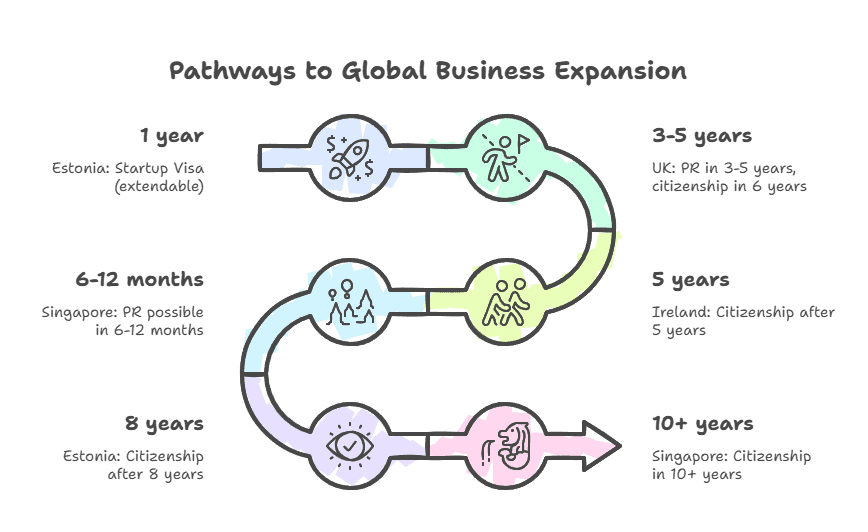
| Estonia | Startup Visa – 1 year (extendable) if approved by Startup Committee (no min investment)Business Owner TRP – invest €65k capital for temporary residence | No formal golden visa, standard business investment route as left | Long-Term EU residence permit after 5 years. Citizenship after 8 years (requires basic Estonian language and usually renouncing previous citizenship). |
| UK | Innovator Founder Visa – needs endorsed innovative business (no min £, 3-year visa) | No direct golden visa (Investor visa closed). Innovator visa essentially covers investment via business creation. | Indefinite Leave to Remain (PR) after 3 years (fast-track if business grows) or 5 years. Citizenship after 5 years +1 year ILR (usually at year 6)Dual citizenship accepted. |
| Switzerland | No dedicated startup visa. Non-EU can get self-employment permit if business benefits economy (case-by-case)EU/EFTA have free movement to start business. | Residence by Investment (Lump-Sum Taxation) – negotiate annual tax (~CHF 250k+) for residence (no work allowed)Alternatively, invest in business and create jobs to get canton-approved residence. | C Permit (permanent residence) after 10 years (5 for U.S./EU nationals in some cases). Citizenship after 10 years residency (plus integration criteria); dual citizenship allowed. |
| Canada | Start-Up Visa Program – requires support from a designated investor/incubator (no minimum personal investment); grants direct Permanent Residence to foundersProcessing ~12-18 months. | Provincial Entrepreneur Programs – invest ~CAD 150-300k in a local business, get a work permit and then PR nomination (varies by province). | Immediate PR from Start-Up Visa confers settlement rights; Citizenship after 3 years physical presence (within 5 years). Canada allows dual citizenship. |
Singapore – Pro-Business Hub of Southeast Asia
Business Environment: Singapore is consistently ranked among the world’s most business-friendly countries. It boasts streamlined regulations and low bureaucracy, making it easy and fast to incorporate – often within 1-2 days online. The corporate income tax is a flat 17%, the lowest in ASEAN, and new startups enjoy generous tax exemptions (75% tax-free on the first S$100K, 50% on the next S$100K) to reduce the effective rate in early years. There are no capital gains or dividend taxes, and the legal system (modeled on English common law) offers strong investor protections and contract enforcement.
Trade & Market Access: Singapore’s strategic location and trade networks give companies unparalleled global reach. The nation sits at a major crossroads of global shipping and aviation routes, with world-class port and airport facilities. It has extensive free trade agreements (FTAs) – including with the U.S., China, India, and the EU – as well as membership in regional blocs like ASEAN, RCEP, and CPTPP. These FTAs enable Singapore-based businesses to tap into vast international markets with minimal tariffs. Singapore also maintains a highly open economy (virtually no import/export duties), facilitating smooth supply chain integration.
Startup Support: The government actively supports innovation through grants and incentives. Programs like Startup SG offer equity co-investment and mentorship, while agencies provide R&D grants, productivity subsidies, and incubator programs. For example, Singapore’s R&D tax deductions can reach 250-300% for qualifying expenditures, substantially lowering the cost of innovation. A robust ecosystem of VCs, accelerators, and government-linked investors makes fundraising more accessible. Additionally, the workforce is highly skilled and multilingual (English is an official language), and pro-business policies simplify compliance and licensing.
Visa & Residency: Singapore welcomes foreign entrepreneurs via the EntrePass visa, which allows you to live in Singapore while starting a venture. Eligibility is based on innovation or funding (e.g. having VC backing or an incubator). Permanent residency is attainable through the Global Investor Programme for those who invest ~S$10 million (≈US$7.5 million) in a local business or fund. While PR can be obtained in as little as 6-12 months for approved investors, citizenship is granted selectively after several years of residency (and Singapore disallows dual citizenship). Even without citizenship, Singapore PR offers long-term security, tax resident status, and access to local benefits.
United Arab Emirates (UAE) – Tax-Free Zones, Corporate Tax Rates, and Global Connectivity
Business Environment: The UAE (especially Dubai and Abu Dhabi) has transformed into a global business hub known for its ultra-low taxes and modern infrastructure. As of 2023, the UAE introduced a federal corporate tax of 9%, one of the lowest rates worldwide. However, companies in designated Free Trade Zones enjoy 0% corporate tax (tax-free) provided they meet the zone’s requirements. Moreover, the UAE levies no personal income tax, no capital gains tax, and no withholding taxes, creating a very attractive environment for profit retention. Incorporating a company is relatively quick – in many free zones it takes ~5 days to obtain a license. The regulatory environment has become increasingly business-friendly, with one-stop online portals (like “Invest in Dubai”) simplifying licensing and visa processes. The UAE’s legal system provides options for dispute resolution in English (e.g. the Dubai International Financial Centre courts), which is reassuring for foreign investors.
Trade & Market Access: Situated at the crossroads of Europe, Asia, and Africa, the UAE offers superb global market access. Its free zones not only eliminate import/export taxes but also streamline customs, allowing duty-free import, trade, and re-export of goods. The UAE has leveraged its location as a “midpoint between East and West” – Emirates and Etihad airlines connect businesses to nearly every major city, and Jebel Ali Port is one of the busiest in the world. The country is also signing new comprehensive economic partnership agreements (CEPAs) (e.g. with India, Indonesia, Israel) to secure preferential trade terms. While not in a formal common market, the UAE is part of the GCC, which facilitates regional trade and labor movement. All these factors mean a company based in the UAE can easily serve customers across EMEA and Asia with efficient logistics.
Startup Support: The UAE has launched numerous initiatives to attract startups and tech talent. Free zones offer incentives like zero tax guarantees for 15-50 years, 100% foreign ownership, and subsidized office space. Dubai’s Innovation Hub and Abu Dhabi’s Hub71 provide mentorship, networking, and even funding – in some cases, selected startups receive grants, equity funding, or free housing and office space for a period. Government funds such as the Dubai Future District Fund and Abu Dhabi’s Mubadala Ventures invest in growing enterprises. While direct grants are less common than in some countries, the UAE’s business-friendly policies (e.g. easy bank account opening, no currency controls, and strong IP protection via updated laws) create a supportive ecosystem for entrepreneurs. There is also a large expat community of professionals to tap into for talent or partnerships.
Visa & Residency: The UAE has greatly expanded its residency options for business owners. A 2–3 year investor visa is available for those who start a company (the visa is tied to the business license and can be renewed). More prominently, the UAE Golden Visa program grants 5 or 10-year residency for sizable investments: for instance, investing ~AED 2 million (≈US$545K) in real estate can secure a 5-year visa, and higher investments or public recognition (like founding a high-growth startup) can qualify for 10 years. Entrepreneurs can also obtain a Green Visa (5-year) without requiring a local sponsor, given they meet criteria such as having an existing business with ~$136K annual revenue. Notably, citizenship in the UAE is exceptionally rare – there is no routine naturalization process for expats, though in 2021 the law was amended to allow select investors and talents to be nominated for UAE citizenship in special cases. In practice, most expats reside long-term on renewable visas. The upside is that UAE residency is straightforward to maintain (no minimum stay required for Golden Visa), allowing entrepreneurs to enjoy a tax-free lifestyle in a globally connected locale.
Hong Kong – Gateway to China with Low Taxes
Business Environment: Hong Kong has long been a top choice for expat businesses due to its simple taxation and efficient bureaucracy. Corporate profits up to HK$2 million are taxed at only 8.25%, and profits above that at 16.5%. These rates are far below global averages, and there’s no tax on foreign-sourced income if certain conditions are met – making Hong Kong ideal for companies with overseas earnings. There is also no VAT/GST, no capital gains tax, and no withholding tax on dividends, minimizing the overall tax burden. Business incorporation is fast (often 1–3 days through Hong Kong’s e-Registry) and inexpensive. The World Bank had consistently ranked Hong Kong among the top 3 economies for ease of doing business before the index’s retirement. Only a few simple steps (online application for company registration and business registration certificate) are needed to get started. Regulations are transparent, and Hong Kong’s common law legal system (separate from mainland China) provides robust protection for property and contractual rights.
Trade & Market Access: True to its history as a trading port, Hong Kong imposes zero tariffs on most imports and has minimal trade barriers. It serves as a gateway to Mainland China – under the Closer Economic Partnership Arrangement (CEPA), Hong Kong companies get preferential access to the mainland market in many service sectors and tariff-free entry of Hong Kong–made goods. Hong Kong’s free port status and prime location in Asia allow companies to efficiently reach suppliers and customers across East Asia. The city is a major logistics hub, with one of the world’s busiest container ports and air cargo terminals. While Hong Kong itself is a single city-market (~7.5 million people), its integration with the Guangdong–Hong Kong–Macau Greater Bay Area initiative opens opportunities to reach over 70 million consumers in the region. In addition, Hong Kong maintains trade agreements or dialogues with economies like ASEAN and EFTA, and being part of China (a WTO member) means Hong Kong benefits from WTO trade rules globally.
Startup Support: Hong Kong offers a vibrant startup scene with significant government and private support. The government’s Innovation and Technology Fund and schemes like the Cyberport Incubation Programme provide equity-free grants (e.g. ~HK$500k or more) to tech startups. Hong Kong Science Park’s incubation programs similarly offer funding up to ~HK$860k, lab facilities, and business development support. StartmeupHK, an initiative by InvestHK, runs competitions and provides resources to attract global entrepreneurs. Beyond grants, Hong Kong’s tax incentives encourage business growth – companies can deduct 300% of the first HK$2M in R&D expenses (and 200% thereafter), and enjoy 100% profit tax deductions on capital expenditure for IP acquisition. The city’s mature financial industry also means ample venture capital is available, and it’s relatively easy to access IPO markets as a longer-term exit strategy. English is an official language of business, which simplifies operations for expats.
Visa & Residency: Foreign entrepreneurs can relocate to Hong Kong under the Entrepreneur Visa scheme (a subcategory of employment visas). To qualify, you must present a strong business plan and prove your startup will bring economic benefits (investment, local jobs, or new technology) to Hong Kong. There is no fixed minimum investment, but having a well-capitalized business and hiring local staff greatly improves approval chances. For high-quality talent, Hong Kong also launched the Top Talent Pass providing 2-year visas to individuals meeting certain income or education criteria. Once in Hong Kong, permanent residence (Right of Abode) can be obtained after 7 years of continuous residence. Many expats take this route – after gaining permanent resident status, you no longer need a visa to live or work in Hong Kong. Citizenship (i.e. a Hong Kong SAR passport) is optional and requires Chinese naturalization (which typically necessitates renouncing other citizenships). Most entrepreneurs simply maintain PR, which already grants full business rights and freedom of movement. Notably, Hong Kong permits dependent visas for spouses and children of entrepreneur visa holders, making it accommodating for family relocation.
Ireland – Low Tax Gateway to Europe
Business Environment: Ireland offers a compelling mix of low taxes, English-speaking talent, and EU market access. The standard corporate tax rate is 12.5% on active trading income, one of the lowest rates in Europe. (Passive income like rents is taxed at 25%.) Ireland has steadfastly kept 12.5% since 2003, though under new global tax rules it now applies a 15% effective rate to very large multinationals. For most businesses, the 12.5% rate holds, and there are attractive incentives: R&D tax credits of 25-30%, a Knowledge Development Box taxing qualifying IP income at only 6.25-10%, and full tax exemptions for the first 3 years of a new startup’s profits (up to €40k per year). Incorporating in Ireland is straightforward – it typically takes about 3-5 days to register a company (electronic filing through the Companies Registration Office). The regulatory environment is known for being pro-business and transparent. Ireland strongly protects intellectual property and has a stable legal system (common law) familiar to international investors. Numerous Fortune 500 companies have chosen Ireland for their European headquarters due to its friendly policies and legal protections.
Trade & Market Access: As a member of the European Union, Ireland provides businesses frictionless access to the entire EU single market of 450+ million consumers. Companies based in Ireland can sell goods and services across all EU/EEA countries with no tariffs and minimal customs formalities. This is a huge advantage for expats looking to scale in Europe. Uniquely, post-Brexit Ireland also retains access to the UK market via the Common Travel Area and specific arrangements – effectively offering a bridge to both the EU and UK. Ireland participates in all of the EU’s free trade agreements (with partners like Canada, Japan, etc.), benefiting Irish-registered firms. Logistically, Ireland is well-connected: Dublin’s port and airport link to global supply chains, and there are efficient ferry routes to mainland Europe. While geographically on Europe’s periphery, Ireland’s time zone and language make it ideal for coordinating with both the Americas and Europe. Many international firms use Irish entities to centralize their European operations, leveraging EU “passporting” rights in finance, digital services, and more.
Startup Support: The Irish government actively encourages entrepreneurship through agencies like Enterprise Ireland. If you establish an innovative startup, Enterprise Ireland can offer equity investment, grants for R&D, business development funding, and mentoring. For example, Irish startups may receive feasibility study grants or commercialization grants running into tens of thousands of euros. There are also regional development funds and supports for hiring employees (e.g. grant aid for new jobs created in certain sectors). Ireland’s tax code further encourages innovation – aside from R&D credits, the Knowledge Development Box regime, unique in the EU, allows a 50% lower tax on profits arising from patented inventions or copyrighted software. New companies also enjoy relief from certain corporate taxes for up to 5 years. Ireland’s startup ecosystem has grown, with incubators and accelerators (often in partnership with universities) available in cities like Dublin, Cork, and Galway. The presence of tech giants (Google, Meta, etc.) has spun off skilled talent and potential acquisition opportunities for startups. Additionally, government-backed seed funds help match private venture capital, ensuring startups have access to funding.
Visa & Residency: Ireland offers a unique Start-up Entrepreneur Programme (STEP) for non-EU founders. If you have an innovative business plan and at least €50,000 in funding, you can be granted a 2-year residence visa (renewable) to develop your startup in Ireland. This comes with Stamp 4 permission, allowing you to work in your own business without needing an employment permit. After 5 years of residence (on STEP or other work visas), you become eligible for long-term residency or citizenship. In fact, Irish citizenship can be obtained after 5 years of legal residency (you must be physically present 4 years + 1 continuous year immediately before application) – one of the faster naturalization timelines in the EU. Aside from STEP, Ireland until recently ran an Immigrant Investor Programme (IIP) requiring €1 million investment or €400k donation; it has been paused as of 2023. Nonetheless, expat entrepreneurs with capital can still start businesses and use general employment permit routes or the investor visa in Northern Ireland (UK) for the UK market. Ireland is known for its welcoming culture, and spouses of critical skills employment permit holders can work without separate permits, making it easier for expat families to settle.
Estonia – E-Residency and Innovator’s Paradise
Business Environment: Estonia is acclaimed for its digital-first government and unique tax system. All undistributed corporate profits are tax-exempt – companies pay 0% corporate tax on reinvested or retained earnings. A flat 20% corporate tax (rising to 22% in 2025) is only due when profits are distributed as dividends. This effectively allows startups to plow back earnings tax-free, fueling faster growth. The World Tax Competitiveness Index has ranked Estonia #1 for over a decade. Coupled with online everything, starting a business is extremely easy – an e-Resident can register a new Estonian company 100% online, often in a single day. There’s no paid-in minimum capital requirement if deferred, and state fees are low (~€265). Estonia’s governance is highly transparent; digital services (e.g. e-Tax, e-Banking) cut down on red tape. Regulations comply with EU standards but are notably startup-friendly – e.g. cap table management, electronic signatures, and even virtual annual meetings are all legally recognized. The judiciary and rule of law are strong (based on continental civil law), and Estonia has one of the lowest corruption levels in Central/Eastern Europe.
Trade & Market Access: As part of the European Union and Eurozone, Estonia offers full access to EU markets for goods, services, capital, and labor. An Estonian company can seamlessly trade across all EU member states. Estonia is also in the Schengen Area, easing cross-border business travel and logistics. Regionally, Estonia positions itself as a gateway between Western Europe, Scandinavia, and Russia/Eastern Europe (though trade with Russia is currently sanctioned). The country has modern transport links: ice-free ports on the Baltic connecting to Finland and Sweden, and EU-wide road/rail corridors. Additionally, Estonia’s e-residency program means you can run a global online business from Estonia without being physically present – ideal for digital goods or services that need a legal home in the EU. Free trade agreements via the EU (with Canada, Japan, etc.) apply, giving Estonian businesses favorable terms internationally. While the domestic market is small (1.3 million people), Estonia’s focus on digital trade and cross-border services enables even micro-companies to operate globally. For example, many e-resident entrepreneurs use Estonia to service clients across the EU and beyond without needing multiple local entities.
Startup Support: Estonia punches above its weight with a vibrant startup ecosystem (in fact, it has one of the highest startups per capita and several unicorns like Skype, Bolt, Wise originated here). The government’s Startup Estonia initiative streamlines resources – including a Startup Visa program, networking, and regulatory advocacy. Various grants are available: the Prototron competition offers equity-free funding for prototypes, and Enterprise Estonia (EAS) provides innovation and export grants to SMEs. Being an EU member, Estonian startups can also access EU-wide funding such as Horizon Europe R&D grants. The tax system itself is a major incentive – by deferring tax on profits, startups have more runway to invest in product development and hiring. Estonia also has simplified hiring of foreign specialists (via a Startup Visa for employees) to help companies scale talent. The ecosystem is tightly knit; there are numerous tech hubs and accelerators in Tallinn and Tartu, and events like Latitude59 foster investor connections. Notably, the e-Residency program (the first of its kind in the world) is an innovation attracting tens of thousands of entrepreneurs to establish their companies in Estonia remotely, further enriching the network of service providers and partners available to startups.
Visa & Residency: Estonia’s Startup Visa scheme is a big draw for expat founders. Non-EU entrepreneurs with an innovative, scalable business idea can apply for a 1-year startup visa (extendable), or a temporary residence permit for entrepreneurship for up to 5 years. The program does not mandate a hefty investment; instead, a Startup Committee evaluates the business idea on its merits (no minimum capital, only ~€180 per month per family member in required funds). If approved, founders can relocate and launch operations quickly. Separately, Estonia issues a Business Owner residence permit for those investing at least €65,000 in an Estonian company (this can be an alternative if your business isn’t a tech startup). After 5 years of legal residency, one can obtain a long-term residence permit (EU Permanent Residence), and after 8 years, you may naturalize as an Estonian citizen (subject to language and civics tests, and renouncing previous citizenship, as Estonia generally disallows dual citizenship). Many entrepreneurs choose to maintain permanent residency instead of citizenship. With an Estonian residence permit, you enjoy visa-free travel across Schengen and the right to live in a safe, digitally advanced society. Moreover, Estonia’s e-residency (while not a travel visa) complements these pathways by enabling entrepreneurs to incorporate and manage an EU-based company from anywhere, even before moving.
United Kingdom (UK) – Global Financial Center with Highly Skilled Workforce, Talent, and Traditions
Business Environment: The UK remains one of the world’s largest and most dynamic economies, attracting entrepreneurs for its stable legal system and thriving markets. Despite Brexit uncertainties, the UK still offers an easy setup process – it topped a 2021 ranking of best European countries to start a business, thanks to cheap and quick company incorporation. Registering a new private limited company (Ltd) with Companies House can be done in 24 hours online for as little as £12. The UK’s corporate tax rate is currently 25% (effective April 2023) on profits over £250k, with a lower 19% rate for small profits (under £50k). This tiered system keeps taxes low for startups and small businesses. Moreover, the UK offers generous incentives: R&D tax credits can refund up to 33% of eligible innovation spend to SMEs, and the Patent Box regime taxes IP-derived profits at 10%. The regulatory environment is generally business-friendly – requirements like VAT registration and payroll (PAYE) are well-understood and supported by online systems. The UK’s common law framework provides strong protection for investors and property rights, and its courts are highly respected. One can also benefit from extensive professional services (lawyers, accountants) readily available in a mature market like London.
Trade & Market Access: The UK is no longer in the EU, but it has negotiated replacements for most EU trade agreements and forged new ones. British companies have tariff-free access to the EU market for goods under the EU-UK Trade and Cooperation Agreement (though with some customs formalities). In addition, the UK swiftly rolled over ~36 trade agreements covering 70+ countries to ensure continuity post-Brexit. Completely new FTAs were signed with Australia and New Zealand, and the UK is set to join the Comprehensive and Progressive Trans-Pacific Partnership (CPTPP), enhancing access to markets across the Asia-Pacific. Businesses in the UK also benefit from the USMCA-like deal (UK-Canada continuity agreement) and bilateral agreements with countries like Japan, Singapore, and others. For entrepreneurs, this network means the UK still enjoys a broad reach in global trade. Domestically, the UK is a large market in itself (68 million people with high spending power). London stands out as a global financial and commercial hub – if your business needs financing or partners, the City offers unparalleled resources. The UK’s location (time zone overlapping Asian and American business hours) makes it ideal for international operations. Additionally, being in the Commonwealth network can open doors to markets in Asia and Africa via historical ties.
Startup Support: The UK government and private sector provide substantial support to startups and SMEs. One flagship incentive is the Seed Enterprise Investment Scheme (SEIS) and EIS, which grant angel investors significant personal tax relief for investing in startups – this encourages more funding to flow to new ventures. Public bodies like Innovate UK issue grants for cutting-edge projects (e.g. £100k+ Smart Grants for R&D). There are also regional funds (Northern Powerhouse, etc.) and accelerator programs (some funded by local governments or universities) that offer cash and mentorship. The UK’s world-class universities fuel innovation clusters in sectors like biotech (Oxford/Cambridge), fintech (London), gaming (Manchester, Dundee), and energy tech (Scotland). Many of these clusters have incubators where startups get subsidized office space and access to advisors. The tax system also assists new businesses: you can carry forward losses indefinitely to offset future profits, and there are relatively low business rates (property tax) exemptions for small premises. The Enterprise Zones in certain areas offer business rate relief and other perks to companies that set up there. Overall, the UK combines a developed financing ecosystem (with many venture capital firms and crowdfunding platforms) and government incentives to give startups a strong start.
Visa & Residency: For expat entrepreneurs, the UK has revamped its visa options. The primary route is the Innovator Founder Visa, launched in 2023 to replace the old Innovator visa. This visa does not require a fixed minimum investment (previously £50k) but does require endorsement from an approved body that evaluates your business idea for innovation, viability, and scalability. As an Innovator Founder, you get a 3-year visa and can work on developing your startup full-time (you are also allowed to do other work for your business). Notably, this can lead to permanent residency (Indefinite Leave to Remain) in as little as 3 years if your business meets certain performance milestones (such as high revenues or job creation); otherwise, you can extend the visa and qualify for ILR in 5 years. The UK also offers a Start-up Visa (for early-stage entrepreneurs with endorsement, 2-year visa but non-extendable, meant as a springboard to Innovator). For those with substantial funds, the UK Investor visa was discontinued in 2022, but the Innovator route covers investment via active business creation rather than passive investment. Once you obtain ILR (permanent residence), you can apply for British citizenship after 12 months (and 5+ years of total residence). The UK allows dual citizenship, which is convenient for many. Family members (spouse and children) can accompany under dependent visas and have the right to work or study. Apart from these, there are other pathways like the Global Talent Visa for highly accomplished individuals in fields like tech or science, which some entrepreneur-founders might qualify for and which also has accelerated settlement. In sum, the UK provides a clear, if challenging, pathway for committed entrepreneurs to make Britain their long-term home.
Switzerland – Stability and Sophistication in the Heart of Europe
Business Environment: Switzerland is renowned for its political stability, strong rule of law, and business-friendly regulations. Though not a member of the EU, it maintains bilateral agreements that keep trade and business friction low. Swiss corporate tax rates vary by canton, but can be as low as ~11% and up to ~21%, with ~15–19% being the effective range in many cantons after recent reforms. The federal corporate tax is 8.5%, and many cantons offer special tax rulings or holidays to attract new businesses. As a result, Switzerland’s tax regime is considered very favorable. Setting up a company (often an AG or GmbH) typically takes a couple of weeks, mainly because of notarization and capital deposit requirements (minimum CHF 20k for a GmbH). However, the process is straightforward and can be done with guidance from Switzerland’s extensive network of corporate service firms. Compliance is high-standard but predictable – Swiss regulations emphasize quality (e.g. strict product standards) but are not capricious. The country consistently ranks high in global competitiveness thanks to efficient bureaucracy, low corruption, and strong protection for intellectual property.
Trade & Market Access: Strategically located in central Europe, Switzerland offers excellent access to EU markets despite not being in the EU. Through a series of bilateral treaties, Swiss companies enjoy free trade in goods with the EU and participation in the Schengen area for seamless travel. Swiss-based businesses often operate across Europe with ease; the country is part of EFTA and has its own network of FTAs (including with major economies like China and Japan). Additionally, Switzerland’s financial openness and stable currency (Swiss franc) make it a safe base for international operations. It’s important to note that while goods move freely, exporting services (like financial services) from Switzerland to the EU may require meeting equivalence standards. Internally, connectivity is top-notch: world-class road, rail, and air transport link Swiss cities to the rest of Europe (e.g. one can reach Milan or Frankfurt in a few hours). The workforce is multilingual (many speak English, German, French, or Italian), allowing companies to serve multiple markets. Switzerland’s participation in WTO and other international bodies ensures its traders enjoy most favored nation tariffs globally. For manufacturers and high-tech producers, the high-quality Swiss brand itself adds value and opens doors in luxury markets worldwide.
Startup Support: Although Switzerland is known for large multinational companies, it actively fosters startups and innovation, especially in sectors like pharmaceuticals, medtech, fintech, and advanced engineering. The government’s Innosuisse agency provides coaching and R&D project grants (often by co-funding collaborations between startups and research institutions). Some cantonal governments offer tax incentives or even grants for new businesses, particularly if they create jobs in high-value industries. For instance, certain cantons might negotiate a reduced tax rate for a period or help with finding subsidized office space for promising ventures. The country has numerous science parks and accelerators (for example, around ETH Zurich or EPFL Lausanne) where startups can access labs, mentorship, and investor networks. Swiss universities are highly ranked and spin out lots of intellectual property – startups can license tech and get support through university-linked incubators. There’s also plenty of venture capital available in Switzerland, often focused on later-stage or highly technical companies. Culturally, processes can be formal (detailed business plans, etc.), but the outcome is a very supportive environment with patient capital and experienced advisors. Additionally, Switzerland’s workforce is extremely skilled; while labor costs are high, productivity and innovation are as well – yielding good value for a startup aiming to do R&D or precision manufacturing.
Visa & Residency: Gaining Swiss residency as a non-EU entrepreneur is possible but requires meeting stringent criteria. Switzerland does not have a straightforward “startup visa.” Instead, a non-EU national who wants to found a company must usually obtain a Swiss residence permit through investment or self-employment. This typically involves showing that your business will create local jobs or serve an economic interest for a particular canton. Essentially, you need cantonal approval: a solid business plan, proof of sufficient capital, and credentials can convince authorities to grant a residence permit (often an initial short-term L permit, then a B permit). Another route is the Swiss Residence by Investment (lump-sum taxation) program, where affluent individuals who agree to pay a minimum annual tax (e.g. CHF 250,000) can get a residency permit without engaging in local employment. This option is aimed at retirees or financially independent persons, but some entrepreneurs use it to base themselves in Switzerland while managing businesses abroad. EU/EFTA nationals have a much easier process – they can freely move to Switzerland and start a business under freedom of movement agreements. Once you have a residence permit (B permit), you need 10 years of residency to be eligible for a Swiss passport (citizenship), among other requirements like language proficiency. However, Switzerland does allow dual citizenship, and a Swiss passport is extremely valuable for global mobility. Many expat business owners do not aim for citizenship but rather for the C permit (permanent residency) which can be obtained after 5-10 years (5 for EU nationals, 10 for most others, or sometimes 5 for non-EU if approved early). A C permit gives you near-equal rights as citizens (except voting), including the ability to live anywhere in Switzerland and operate businesses freely. In sum, Switzerland’s residency pathways exist but are more demanding than in other countries – often requiring substantial investment or economic contribution. Those who succeed, however, get to reside in one of the world’s most stable and prosperous countries, with all the lifestyle benefits that entails.
Choosing the Best Country for Business Abroad

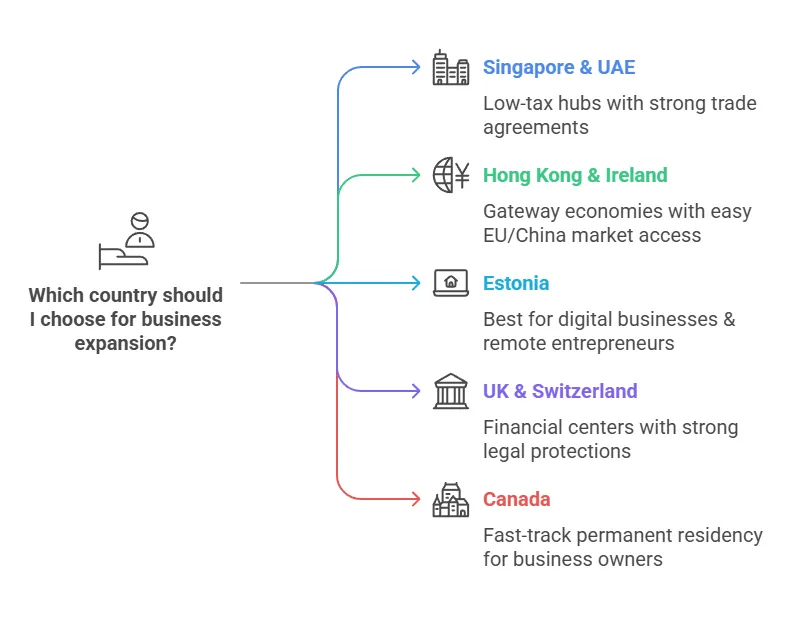
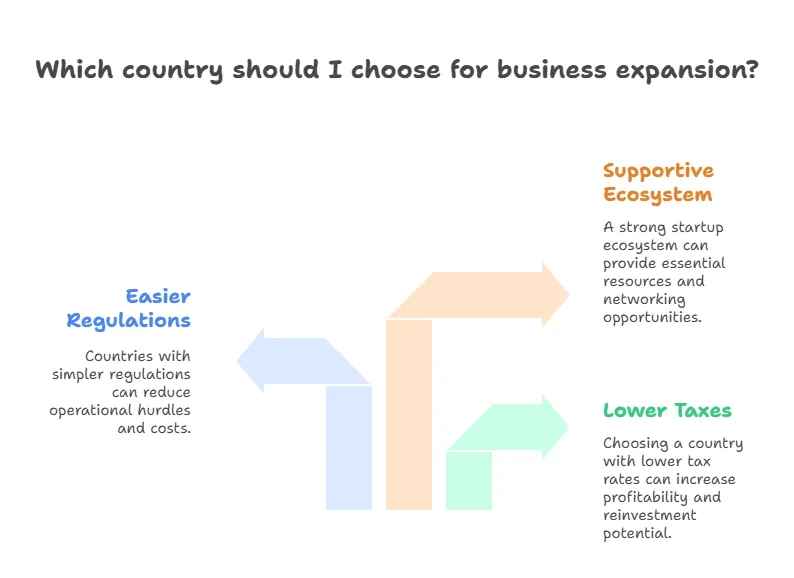
Choosing the best country for business abroad can be a daunting task, especially for entrepreneurs who are new to international business. With so many factors to consider, it’s essential to have a clear understanding of what makes a country an attractive destination for foreign businesses. The right choice can significantly impact your business’s success, offering benefits like lower taxes, easier market access, and supportive regulatory frameworks.
Each of these countries provides distinct advantages for expat business owners – from Singapore’s ultra-efficient bureaucracy and hub location, to the UAE’s tax-free zones, to Ireland’s EU market gateway and tech talent. Singapore, Hong Kong, UAE, Ireland, Estonia, the UK, Switzerland, and Canada all rank among the most favorable jurisdictions depending on your strategic priorities (be it lowest taxes, easiest compliance, market reach, or lifestyle). When choosing a destination for relocation or overseas expansion, consider how each factor aligns with your business plan and personal goals. With the right host country, expat entrepreneurs can enjoy lower taxes, smoother trade, supportive regulatory frameworks, and clear pathways to residency – empowering you to focus on innovation and growth in a truly global context.
Factors to Consider
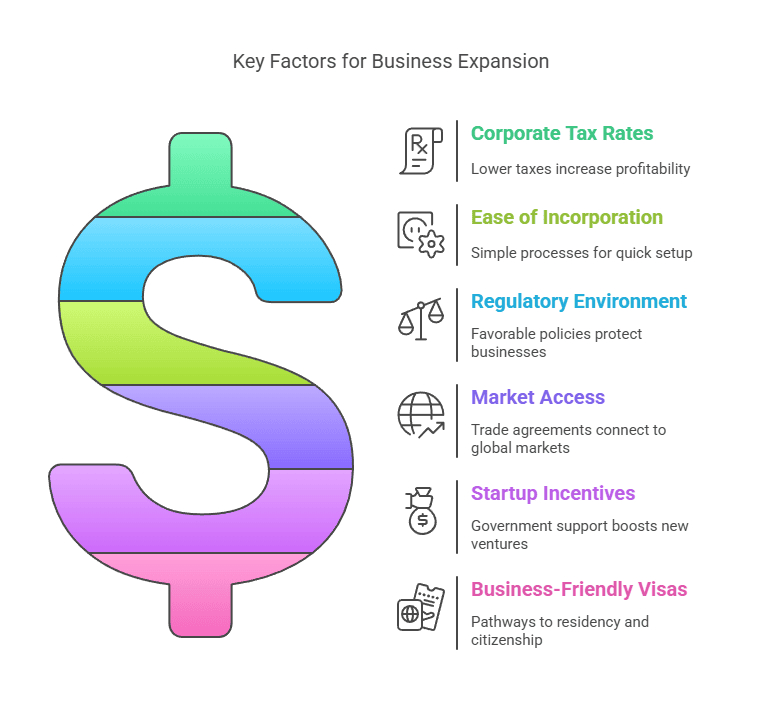
When evaluating countries for business abroad, there are several key factors to consider:
Business Environment: A country’s business environment is critical to the success of foreign businesses. Look for countries with a stable and supportive business environment, including a favorable regulatory framework, low bureaucracy, and a highly skilled workforce. A conducive business environment ensures smoother operations and fewer regulatory hurdles.
Taxation: Taxation is a crucial factor to consider when choosing a country for business abroad. Look for countries with competitive corporate tax rates, tax incentives, and a simple tax system. Favorable tax laws can significantly reduce your overall tax burden, allowing more resources to be reinvested into your business.
Market Access: Market access is essential for businesses looking to expand internationally. Look for countries with a large and growing market, as well as access to key markets in the region. Countries with free trade agreements and strategic locations can provide easier entry into regional and global markets.
Government Support: Government support is critical for foreign businesses. Look for countries with a supportive government that offers incentives, subsidies, and other forms of support to foreign investors. This can include grants, tax breaks, and other financial incentives that can help your business grow.
Infrastructure: Infrastructure is essential for businesses to operate efficiently. Look for countries with a well-developed infrastructure, including transportation, communication, and energy systems. Good infrastructure ensures that your business can operate smoothly and reach its customers and suppliers without unnecessary delays.
