

At a glance: Romanian citizenship pathways in 2026
8 years of legal residence (5 years if married to a Romanian citizen)
Art. 10: up to 2nd degree • Art. 11: up to 3rd degree (involuntary loss) • No residency required
11th globally • 177 visa-free destinations • Full EU & Schengen rights
Law 14/2025 (effective March 15, 2025): B1 Romanian language for descent applicants • Investment fast-track abolished
Romania, as a member of the European Union and a full Schengen Area member since January 2025, offers its citizens complete EU rights and a passport with extensive global mobility. This guide provides a thoroughly researched overview of comment les ressortissants étrangers peuvent obtenir la nationalité roumaine in 2026, thereby gaining EU citizenship. We cover every pathway: by descent (ancestry), by long-term residence and naturalization, by marriage, and by special merits.
High-net-worth individuals, legal professionals, expats, and second citizenship consultants will find this guide especially useful. All information reflects the current legal framework following Loi 14/2025, which introduced significant amendments effective March 15, 2025, including a B1 Romanian language requirement for descent-based applicants and the abolition of the investor fast-track pathway.
Benefits of Romanian citizenship
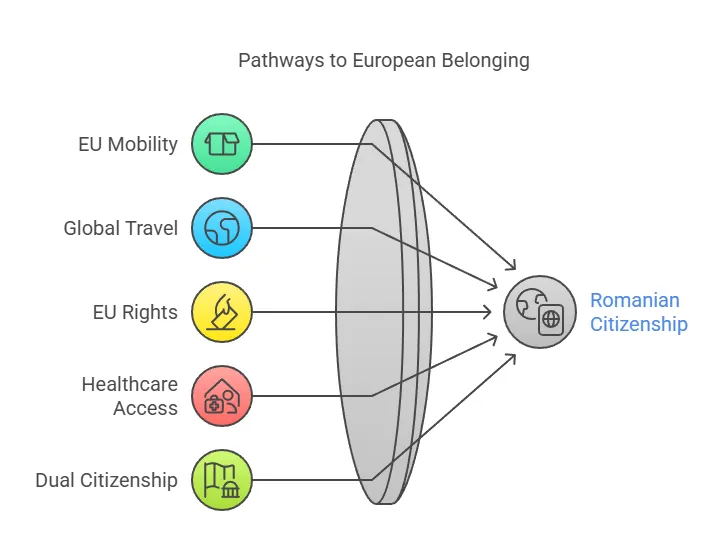
Obtaining Romanian citizenship comes with significant benefits, largely because a Romanian citizen is also a citizen of the European Union. Key advantages include:
- EU freedom of movement: Romanian citizens enjoy the right to live, work, and study freely in any EU or European Economic Area country, as well as Switzerland. This opens access to the entire European job market and educational opportunities across 30+ countries.
- Powerful passport: As of 2026, Romanians have visa-free or visa-on-arrival access to 177 pays et territoires, ranking the Romanian passport 11e au monde in travel freedom. This includes visa-free travel throughout Europe and to many destinations worldwide.
- Full Schengen membership: Romania became a full Schengen Area member on January 1, 2025 (air and sea borders joined on March 31, 2024). This means Romanian citizens and residents benefit from seamless travel across all Schengen states with no internal border controls.
- EU consular protection: En tant que citoyens de l'UE, les Roumains peuvent solliciter l'assistance de l'ambassade de tout État membre de l'UE lorsqu'ils se trouvent à l'étranger, dans un pays où la Roumanie n'a pas de représentation diplomatique. Ils ont également le droit de voter aux élections au Parlement européen et aux élections locales lorsqu'ils résident dans d'autres États membres de l'UE.
- Business and investment opportunities: With Romanian (EU) citizenship, you can start businesses, purchase property, and invest anywhere in the EU’s single market without restrictions that might apply to non-EU foreigners. Romania itself has a growing economy, especially in IT, manufacturing, and agriculture.
- Social benefits and education: Les citoyens roumains ont accès aux soins de santé publics et à la sécurité sociale en Roumanie et peuvent bénéficier de prestations lorsqu'ils résident dans d'autres pays de l'UE, conformément aux règles de coordination de l'UE. Ils bénéficient également de possibilités d'enseignement supérieur subventionnées dans toute l'UE.
- Double nationalité autorisée : Roumanie permet la double nationalité. You are not required to renounce your original citizenship when naturalizing as Romanian. This means you can retain your current nationality while enjoying the benefits of a Romanian (EU) passport. Always check your home country’s laws, though, as some countries may revoke citizenship if you voluntarily acquire another.
En obtenant la nationalité roumaine, un ressortissant étranger obtient effectivement une Citoyenneté de l'UE via la Roumanie, with all the mobility, security, and opportunities that come with it.
Adhésion de la Roumanie à l'espace Schengen
Romania achieved full Schengen Area membership in two stages. Air and sea borders were lifted on March 31, 2024, and full land border integration followed on January 1, 2025, after the EU Council’s decision on December 12, 2024. This completed a process Romania had pursued for over a decade.
Pour Citoyens roumains, this means seamless travel at all internal Schengen borders — no passport checks when crossing into Hungary, Bulgaria, or any other Schengen state. For non-EU residents holding a Romanian residence permit, travel within the Schengen Area is still subject to the standard 90/180-day rule for short stays, and external Schengen border controls apply as usual.
Schengen membership reinforces the value of Romanian citizenship and residency, particularly for those seeking ease of movement across Europe.
Romanian citizenship by birth and descent
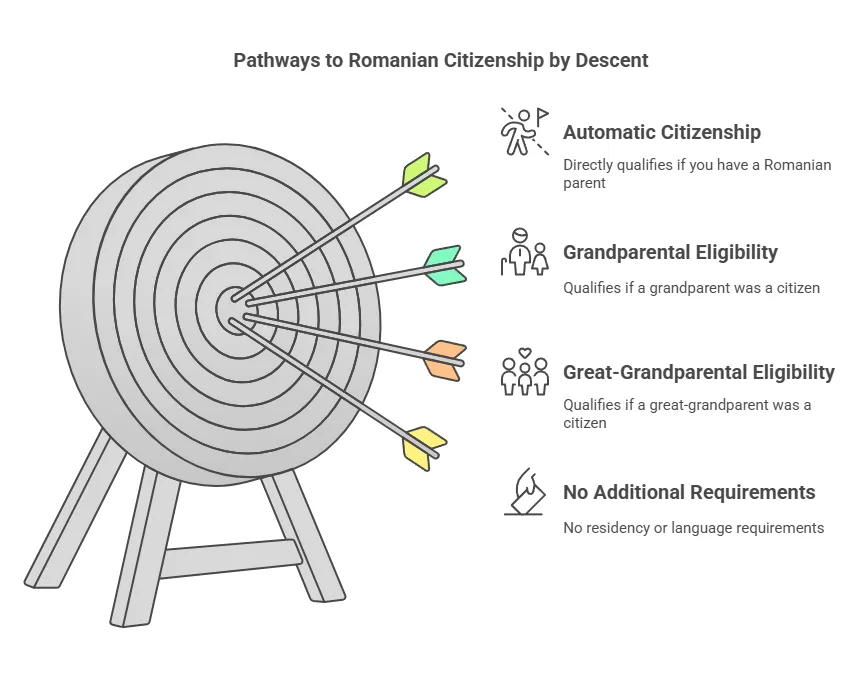
One primary way to obtain Romanian citizenship is through descent — either by being born to Romanian parent(s) or by proving Romanian ancestry. Romania’s nationality law is based on jus sanguinis (right of blood), meaning citizenship is passed down from parents to children. It also has generous provisions for those with Romanian lineage to reclaim citizenship even generations later.
Citizenship by birth (having a Romanian parent)
Si vous avez au moins un parent citoyen roumain, vous acquérir automatiquement la nationalité roumaine à la naissance. This applies regardless of where you are born — whether in Romania or abroad — as long as one parent is a Romanian citizen.
- Child born to a Romanian citizen: Any child born to a Romanian mother or father is a Romanian citizen from birth, by operation of law.
- Registration of birth: While citizenship is automatic, the child’s birth abroad should be registered with the Romanian authorities (at a consulate or in Romania) to obtain a Romanian birth certificate and passport.
- Enfants trouvés : Any child found on Romanian territory is presumed to be a Romanian citizen until proven otherwise, if the parents are unknown.
À noter: Si vous êtes un ressortissant étranger né d'un parent roumain mais n'ayant jamais obtenu de documents, vous êtes déjà citoyen roumain de droit. Your pathway is not “naturalization” but simply claiming your existing citizenship. Contact the consulat de Roumanie for guidance on registering a birth after the fact.
Citizenship by descent (repatriation for descendants)
Romanian nationality law provides a special route for individuals who have Romanian ancestors to obtain citizenship by réacquisition ou restauration, even if they themselves were never Romanian. This has been particularly utilized by those whose parents, grandparents, or great-grandparents were Romanian citizens.
Qui est éligible: If you have a parent, grandparent, or great-grandparent who was a Romanian citizen and subsequently lost their Romanian citizenship, you may be eligible. The law distinguishes two scenarios:
- Article 10 — descendants up to 2nd degree: If your ancestor (parent or grandparent) was a Romanian citizen but lost that citizenship, you can request restoration of Romanian citizenship. This is granted sans aucune condition de résidence en Roumanie, provided you meet certain conditions.
- Article 11 — descendants up to 3rd degree (involuntary loss): If the loss of Romanian citizenship was not voluntary or was for reasons not attributable to the person (for instance, stripped arbitrarily or due to historical border changes), the law extends eligibility to the troisième degré de descendance. Even great-grandchildren of a former Romanian citizen could qualify. This provision has been widely used by many in Moldova, Ukraine (Bukovina, Bessarabia regions), and others whose ancestors were Romanian citizens before 1940.
Dans la pratique, le parcours de descente roumain est l’un des plus inclusifs d’Europe. Rapatriement applications have been extremely popular — over one million citizens of Moldova have obtained Romanian passports by descent, allowing them to live and work across the EU.
Important: B1 language requirement under Law 14/2025
Under amendments effective March 15, 2025, applicants under Articles 10 et 11 (descent/reacquisition) must now demonstrate B1-level Romanian language proficiency. Proof may be submitted within 2 ans of filing (extended by OUG 16/2026 from the original 1-year window). Exemptions apply for former Romanian citizens, applicants aged 65 and older, and those with 3+ years of secondary or higher education in Romanian. This requirement does pas apply to standard Art. 8 naturalization applicants, who continue to be assessed through the existing interview process.
Key requirements for descent applications: Although you need not reside in Romania, you must satisfy documentation and integrity conditions:
- Proof of lineage: Birth, marriage, and death certificates establishing the chain from you to your Romanian ancestor.
- Proof ancestor was Romanian and lost citizenship: Old Romanian passports or IDs, a Certificate of Romanian citizenship status, or naturalization certificates in another country showing loss of Romanian citizenship.
- Casier judiciaire vierge : Police clearance certificates from your country of residence and any other country you have lived in.
- B1 Romanian language certificate: Required under Law 14/2025 for Art. 10 and Art. 11 applicants (with exemptions noted above). Can be submitted within 2 years of filing.
- Loyalty and security declarations: Affidavits declaring no actions against the Romanian state.
- Apostilles and translations: All foreign documents must be apostilled and translated into Romanian by a certified translator.
Application process — step by step (descent pathway):
- Vérifiez l'éligibilité : Identify the ancestor who was a Romanian citizen, confirm they lost Romanian citizenship, and determine whether you qualify under Art. 10 (2nd degree) or Art. 11 (3rd degree, involuntary loss).
- Collect ancestral documents: Obtain the Romanian ancestor’s birth certificate or baptismal record, proof of their Romanian citizenship status, and documentation of how they lost citizenship.
- Collect vital records for each generation: Assemble birth and marriage certificates for every link between you and the ancestor.
- Obtain personal documents: Passport, birth certificate, marriage certificate (if applicable), proof of residence, criminal record certificate, and two passport-size photographs.
- Legalize and translate: Ensure all foreign documents carry a Hague Apostille and sworn Romanian translations.
- Présenter une demande: File your dossier at the Autoritatea Națională pentru Cetățenie (ANC) in Bucharest or at a Romanian consulate. Starting June 30, 2026, electronic filing will also be available under Law 14/2025.
- Processing and background checks: Romanian authorities verify documents, check archives, and run security checks.
- Approval and citizenship order: The Citizenship Commission recommends approval and the President of the ANC signs an order granting citizenship. According to official ANC processing averages, Art. 10 applications take approximately 2 ans et 10 mois, and Art. 11 applications take approximately 3 ans et 10 mois.
- Serment d'allégeance: You must take an oath of allegiance to Romania, administered in Romanian, at the ANC or a Romanian consulate. Minor children do not need to take an oath.
- Obtain citizenship certificate: After the oath, you receive a Certificate of Romanian Citizenship.
- Apply for Romanian passport and ID: With the citizenship certificate, apply for a Romanian passport at a consulate or in Romania.
Dual citizenship is explicitly permitted, so you will conserver votre nationalité d'origine.
Romanian citizenship by naturalization
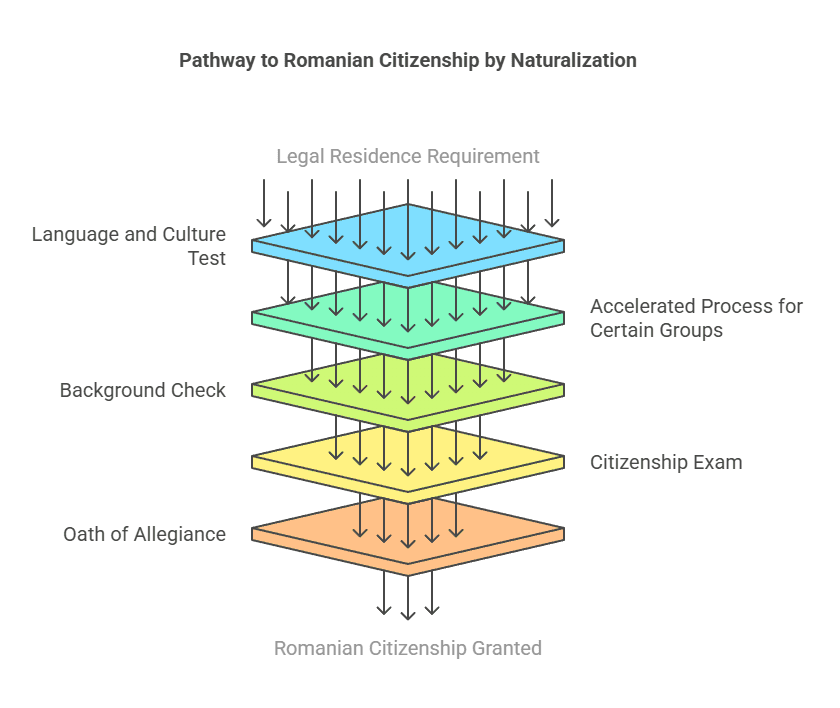
Pour les ressortissants étrangers sans origine roumaine, la principale voie d’accès à la citoyenneté passe par naturalisation, based on lawful and continuous residence in Romania. This route requires you to live in Romania for a certain number of years and integrate into Romanian society. It is ideal for expats, investors, and other long-term residents who make Romania their home.
Eligibility criteria for naturalization: According to Romanian law, a foreign citizen may be granted Romanian citizenship if they meet the following conditions:
- Minimum residency period: Au moins 8 ans of legal domicile or continuous residence. If married to a Romanian citizen, the required period is reduced to 5 ans.
- Legal stay status: Valid Romanian residence permits throughout the entire period. By the time you reach 8 years, you would typically hold permanent resident status.
- Bon caractère : A clean criminal record and no actions against Romania’s rule of law or national security.
- Âge: Au moins 18 ans minimum valide au moment de l'application.
- Moyens financiers : Proof of employment, business income, or assets demonstrating financial stability.
- Language and culture knowledge: Sufficient knowledge of the Romanian language, basic understanding of Romanian culture and civilization, and familiarity with the Romanian Constitution and national anthem. These are evaluated in an interview as part of the process. Note: the B1 language certificate requirement introduced by Law 14/2025 applies specifically to Art. 10-11 descent applicants, not to standard Art. 8 naturalization applicants.
- No threat to national security: Background checks will assess this.
Reduced residency for certain categories: Romania provides some shortcuts for certain applicants:
- Si vous êtes citoyen d’un autre pays État membre de l'UE, the required period is halved — EU citizens can apply after 4 ans de résidence.
- Si tu étais born in Romania and still reside there, residence requirements are considered met.
- Si vous avez obtenu statut de réfugié in Romania, you can naturalize after 4 years from the date of recognition.
- Si vous êtes un « personnalité reconnue internationalement » with exceptional achievements, you may apply after 4 years.
- Si vous avez fait Contributions significatives to Romania and meet other qualifying criteria, reduced timelines may apply.
Important: Investment fast-track abolished
Under Law 14/2025 (effective March 15, 2025), the previous provision allowing investors who contributed over €1,000,000 to apply for citizenship after 4 years of residence has been enlevé. Investment alone no longer qualifies for an expedited naturalization timeline. Investors must now follow the standard 8-year residency track (or 5 years if married to a Romanian citizen). Reduced timelines now apply only to EU/EEA/Swiss citizens, Romania-born individuals with significant contributions, and recognized refugees.
Step-by-step naturalization process:
- Establish legal residency in Romania: Move to Romania on a long-stay visa and obtain a residence permit (work, business, study, family reunification, etc.). After 5 years of continuous temporary residence, you can apply for a permanent residence permit.
- Maintain continuous domicile: Live in Romania for the majority of the time. Absences exceeding 6 consecutive months in a given year may not count toward the residency requirement. Digital nomad permit holders should note that this time generally counts toward the 8-year requirement, as digital nomad permits are not listed among the excluded residence categories.
- Learn Romanian and prepare for integration: Achieve at least basic conversational proficiency and familiarize yourself with Romanian history, culture, the Constitution, and the national anthem.
- Rassemblez les documents requis : Passport, Romanian residence permit, birth certificate, marriage certificate (if applicable), proof of residence and income, criminal record certificates, completed application form, and two photographs.
- Submit application to the ANC: Applications for naturalization are submitted in person to the National Authority for Citizenship in Bucharest. A lawyer may assist, but personal presence is required for the interview.
- Interview and examination: The Citizenship Commission assesses your Romanian language ability and knowledge of culture and the Constitution.
- Processus d'approbation: If you pass, the Commission recommends approval and the President of the ANC signs a citizenship order.
- Serment d'allégeance: Appear within 3 months of notification to take the citizenship oath in Romanian.
- Certificat de citoyenneté : You receive a Certificate of Citizenship and can proceed to apply for a Romanian passport and national ID.
According to official ANC processing averages, standard Art. 8 naturalization applications take approximately 2 ans et 7 mois from submission to decision. Minor children can be included in the parent’s application and do not need to fulfill residency or language requirements.
Romanian citizenship by marriage
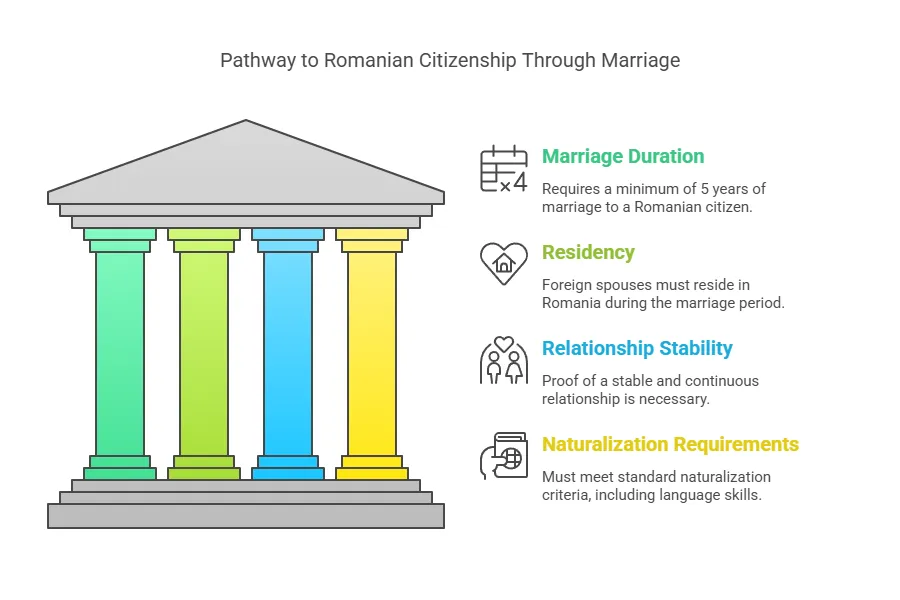
Le mariage avec un citoyen roumain est une situation particulière qui peut vous mettre sur la voie plus rapide vers la citoyenneté, même si elle est pas automatique. Simply marrying a Romanian national does not instantly confer citizenship — but it reduces the residency requirement and qualifies you for naturalization after fewer years.
Eligibility and conditions:
- Marriage to a Romanian citizen: You must be legally married to a Romanian citizen. The marriage should be recognized under Romanian law.
- Durée minimale : Vous pouvez demander la citoyenneté après au moins 5 ans de mariage, provided you have also lived in Romania during that time. This implies co-habitation in Romania on a family reunification visa.
- Autres exigences: All standard naturalization requirements apply — good conduct, basic Romanian language and culture knowledge, loyalty to the state, and means of subsistence.
- Continuation of marriage: You should still be married at the time of application and through the oath.
En résumé, les le mariage raccourcit la durée de 8 à 5 ans of residency. It does not waive language or other requirements.
Process for citizenship by marriage:
- Residence in Romania as a spouse: Obtain a family reunification residence permit and maintain continuous residence for 5 years from the marriage date.
- Préparer la documentation : Include the Romanian spouse’s documents, your marriage certificate (transcribed into Romanian records), and proof of continuous cohabitation.
- Apply and interview: Submit your application to the ANC with proof of 5+ years of marriage and residence. The interview tests language and culture knowledge.
- Approval and oath: Once approved, take the oath and become a citizen. Minor children can be included.
Important: Sham or fraudulent marriages to obtain citizenship are criminal offenses. Authorities investigate the authenticity of the marital relationship.
Special cases: citizenship by merit
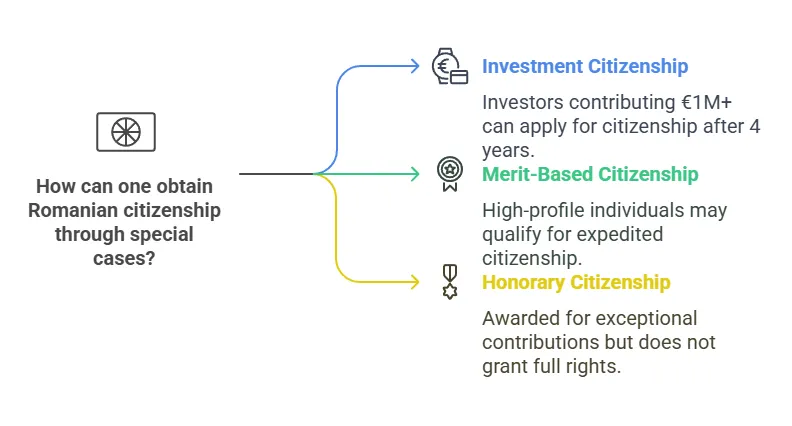
La Roumanie fait pas offer a direct “citizenship by investment” program where one can invest a sum and receive a passport. Following Law 14/2025, the previous expedited naturalization provision for investors contributing over €1,000,000 has been abolished. However, several special categories still exist:
- Notable contributions (merit): The law’s provision for “internationally recognized personalities” covers those who have exceptional achievements in science, culture, sports, or other fields. Such individuals can be fast-tracked to apply after 4 years of residence. Romania is generally strict on following the legal procedure.
- Honorary citizenship: Romania has a concept of “Cetățenie de onoare” granted by Parliament to foreigners for exceptional services to Romania. This is rare and largely symbolic — honorary citizens typically do not have the right to vote, be elected, or hold public office. It cannot be applied for; it must be conferred as an honor.
- Special humanitarian cases: On rare occasions, the Romanian President or Government can propose citizenship for someone who has provided special service or in cases of humanitarian need.
En résumé, les there is no “buy a passport” scheme in Romania. Investors who move to Romania can still obtain residency permits (a permanent residence permit is available for those investing at least €50,000 as share capital), but citizenship now requires the standard 8-year naturalization track. Romania’s approach aligns with EU norms: offering residency to investors but not selling citizenship outright.
Dual citizenship in Romania
La Roumanie autorise la double nationalité, ce qui signifie que vous pouvez détenir la nationalité roumaine sans perdre votre citoyenneté d'origine, and vice versa. This policy has been in place since the 1990s and was crucial in allowing the large Romanian diaspora to reconnect with their homeland.
- No renunciation required: The Romanian Citizenship Law explicitly states that those who regain or are granted citizenship may keep their foreign citizenship.
- Diaspora reacquisition: Dual citizenship enabled millions of ethnic Romanians from Moldova, Ukraine, and other countries to obtain Romanian citizenship while retaining their existing citizenship. Over a million Moldovans have become dual Moldovan-Romanian nationals.
- Obligations : Dual citizens, when in Romania, are treated purely as Romanian citizens. They must use Romanian documents to enter and leave Romania and are subject to Romanian law.
- Impact of other countries’ laws: Your country of origin’s laws may have restrictions. Always check whether your home country permits dual nationality. Romania places no restrictions on its side.
- Considérations fiscales : Simply having Romanian citizenship does not make you a tax resident in Romania. Taxation is based on residence and source of income, not citizenship.
Case studies: real-life scenarios

To illustrate how these pathways work in practice, here are a few typical scenarios:
Case 1: Reclaiming citizenship by descent (grandparent from Romania) — An American citizen whose grandmother was born in Bucharest in 1930 decides to apply for Romanian citizenship. His grandmother left Romania in the 1950s and became a U.S. citizen, losing her Romanian citizenship. He collects ancestral documents, obtains the required B1 Romanian language certificate (as now required under Law 14/2025 for Art. 10 applicants), and files at the Romanian Consulate. After approximately 34 months (the current ANC average for Art. 10 applications), he is granted citizenship and takes the oath. He retains his US citizenship while gaining EU mobility.
Case 2: Naturalization of a long-term expat — A Lebanese entrepreneur moves to Romania and establishes a tech startup. After 8 years of continuous residence, learning Romanian, and integrating into the community, she applies for citizenship. She passes the interview and takes the oath. Note: under the pre-2025 law, she would have qualified after 4 years with her €1M+ investment, but Law 14/2025 abolished this fast-track. Under current law, all investors follow the standard 8-year timeline.
Case 3: Fast-track via marriage — An Australian marries a Romanian and moves to Romania. He obtains a family reunification residence permit, integrates into the community, learns Romanian, and after 5 years of marriage applies for citizenship. After approximately 31 months of processing (current ANC average for Art. 8 applications), he is approved, takes the oath, and becomes a dual Australian-Romanian national with full EU rights.
Case 4: Moldovan citizen reacquiring Romanian citizenship — A young professional from Chișinău whose great-grandparents were Romanian citizens before WWII applies under Article 11 (third-degree descent, involuntary loss). She provides the B1 language certificate and supporting documents. After approximately 46 months of processing, she obtains Romanian citizenship without relocating to Romania, using her new Romanian passport to work in Germany. This path has been taken by over one million Moldovans.
Conclusion
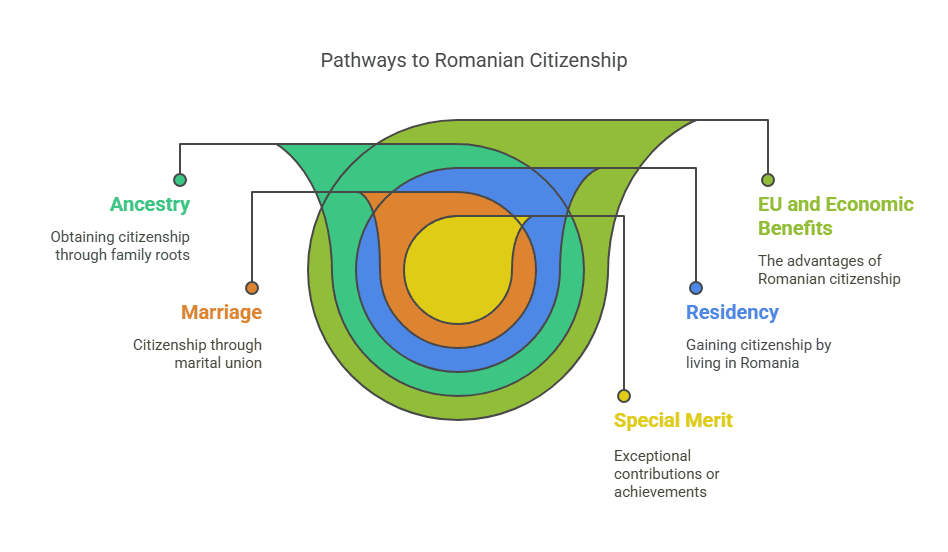
L’obtention de la nationalité roumaine est une passerelle vers la citoyenneté de l'Union européenne, with all its attendant benefits. Whether you qualify through your Romanian ancestry, long-term residence and integration, marriage to a Romanian, or exceptional contributions, Romania provides multiple pathways to become a citizen.
Citoyenneté par descendance is a powerful option if you have Romanian roots, now requiring a B1 language certificate under Law 14/2025 but still without a residency requirement. Naturalisation par résidence is the path for those committing to life in Romania, with the standard 8-year timeline following the abolition of the investor fast-track. Mariage avec une Roumaine expedites this journey to 5 years. And while special talent or contributions can shorten the timeline for certain categories, Romania does not offer citizenship by investment in any direct form.
As of 2026, Romania remains committed to an inclusive citizenship policy. It recognizes dual citizenship, embraces its diaspora’s right to return, and — as a full Schengen Area member — offers its citizens seamless travel across Europe. The benefits of Romanian (EU) citizenship, from visa-free access to 177 countries to economic opportunities across the single market, make the effort worthwhile.
Orientation professionnelle : Given the legal complexities — especially the recent Law 14/2025 amendments — it is advisable for anyone with a complex case to consult a legal professional when pursuing Romanian citizenship. At Vardanyan et partenaires, we assist clients with permis de séjour, demandes de citoyenneté et enregistrement de l'entreprise across multiple jurisdictions. Contact us to discuss your situation.
