

International investors comparing Румыния против Болгарии for corporate expansion in 2026 face a significantly changed landscape. Bulgaria’s adoption of the euro, Romania’s restructured micro-enterprise regime, and the EU Global Minimum Tax now reshape the calculus for choosing between these two low-tax EU jurisdictions. This guide provides a comprehensive, up-to-date comparison of corporate income tax, withholding tax, VAT, social contributions, R&D incentives, and regulatory factors to help corporate planners determine which jurisdiction best fits their strategy.
Both Romania and Bulgaria joined the EU in 2007 and have since attracted international investment through competitive tax rates and developing markets. Bulgaria is known for its ultra-low 10% flat taxes and — as of January 2026 — membership in the eurozone. Romania offers a larger domestic market of 19 million people and targeted incentives for innovation and technology. Each system has distinct advantages depending on your industry, profit margins, and growth plans.
Ставки и структуры налога на прибыль корпораций
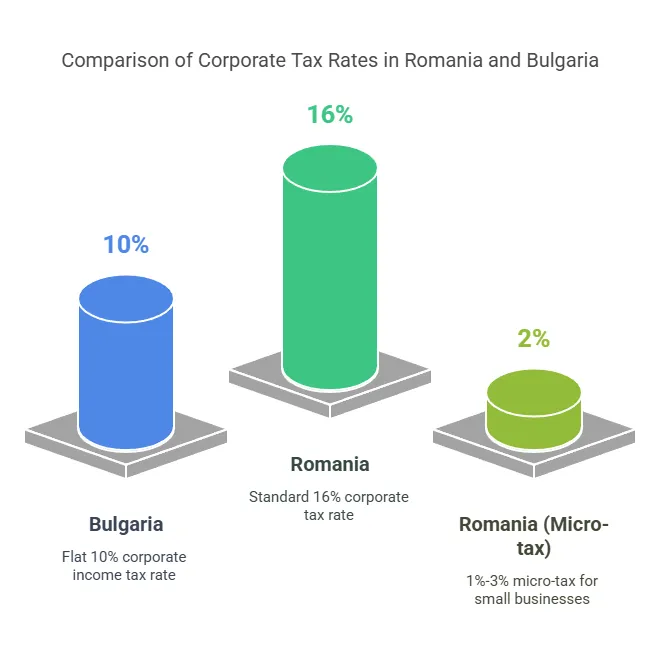
The corporate income tax (CIT) rate is typically the first consideration. Both countries levy flat corporate tax rates, but Bulgaria’s is significantly lower:
Ставка налога на прибыль в Болгарии: 10% квартира on taxable profits — one of the lowest in the EU. This rate applies uniformly to resident and non-resident companies on Bulgaria-source profits. The low 10% CIT remains a major draw for holding companies and cost-sensitive businesses, though the EU Global Minimum Tax now limits its benefit for very large multinational groups (see Pillar Two section below).
Ставка налога на прибыль предприятий в Румынии: 16% квартира on taxable profits. Romania’s standard CIT is higher than Bulgaria’s but still below the EU average (~21%). Romania also offers an alternative micro-company tax regime for small businesses, substantially reducing the effective tax burden for qualifying firms.
Micro-Enterprise Regime in Romania (2026 Rules)
Romania’s micro-enterprise income tax regime underwent a major restructuring effective January 2026:
Ставка: A single flat rate of 1% от оборота. The previous 3% tier has been abolished entirely.
Revenue cap: Уменьшено до €100,000 in annual revenues (including revenues from related parties). The previous €500,000 ceiling is no longer in force.
Требование к сотруднику: At least one full-time employee is required, with a 90-day grace period for newly established companies.
Threshold crossing: Exceeding the €100,000 threshold triggers a switch to the standard 16% CIT from January 1 of that fiscal year.
Влияние: The regime is now far more narrowly targeted. A small consulting firm with €80,000 in revenues would owe only €800 in tax (1% of turnover) rather than potentially thousands under the 16% profit tax. However, businesses approaching the €100,000 cap must plan carefully to avoid an abrupt shift to the standard regime.
Bulgaria does not have a separate micro-company tax — all companies face the 10% profit tax regardless of size. This simplicity is an advantage for predictability, though it means small firms in Bulgaria do not get a further reduced rate beyond the already-low 10%.
Comparative Corporate Tax Overview (2026)
The table below highlights the key tax parameters in each country as of 2026:
| Налоговый аспект | Румыния | Болгария |
|---|---|---|
| Корпоративный подоходный налог (КПН) | 16% standard on profits. Микропредприятия: 1% of revenue if turnover ≤ €100k | 10% flat on profits (all companies) |
| Налог на дивиденды, удерживаемый у источника выплаты | 16% standard (from Jan 2026). 0% intra-EU (≥10% holding for ≥1 year) | 5% standard. 0% intra-EU (≥10% holding for ≥1 year) |
| НДС (стандартная ставка) | 19% standard (reduced rates 9% and 5% on specific items) | 20% standard (reduced rate 9% for some goods/services) |
| Порог регистрации по НДС | RON 395,000 (~€79,500) annual turnover | ~€51,130 (formerly BGN 100,000) annual turnover |
| Социальные взносы работодателя | ~2.25% of gross salary (standard conditions); +4% or 8% for hazardous conditions | ~на 18.9–19.6% of gross salary (varies by accident risk category) |
| Социальные взносы сотрудников | 35% of gross salary (25% pension + 10% health) | ~13.8% of gross salary (10.58% pension + 3.2% health) |
| НДФЛ (НДФЛ) | Плоский (XNUMXD) 10% on most income (no sector exemptions since 2025) | Плоский (XNUMXD) 10% on income (no sector exemptions) |
As shown, Bulgaria’s headline rates (10% CIT, 5% dividend tax, 20% VAT) remain lower across the board than Romania’s (16% CIT, 16% dividend tax, 19% VAT). However, Romania’s micro-tax regime and R&D incentives can narrow the gap for certain businesses. The following sections examine each category in detail.
Налог на дивиденды, удерживаемый у источника выплаты
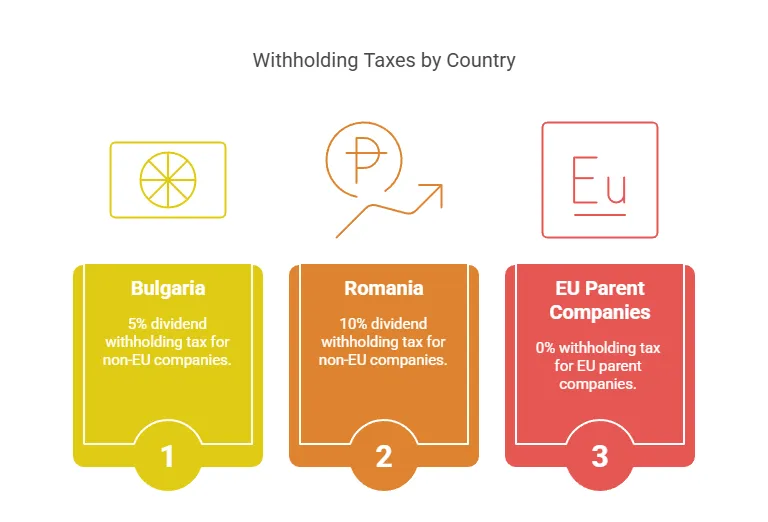
When a company distributes profits as dividends, the withholding tax (WHT) is a critical consideration for investors planning to repatriate profits.
Болгария – Налог на дивиденды: Bulgaria maintains a 5% withholding tax on dividends paid to individuals or foreign corporate shareholders. A proposed increase to 10% in the 2025 budget was not enacted, so the 5% rate continues into 2026. There is no dividend WHT for EU/EEA parent companies meeting the Parent-Subsidiary Directive conditions (at least 10% ownership for one year or more). Many of Bulgaria’s tax treaties can also reduce the 5% rate for other jurisdictions.
Румыния – Налог на дивиденды: Romania’s dividend tax has increased substantially. It was 5% through 2022, rose to 8% in 2023, then to 10% in 2025, and as of January 1, 2026, it is now 16% (enacted via Law No. 141 of July 25, 2025). The 10% rate applies only to distributions from 2025-year profits. Like Bulgaria, Romania implements the EU Parent-Subsidiary Directive, so dividends paid to a qualifying EU parent company (10% or greater share for one year or more) are exempt from withholding. Domestic dividends between Romanian companies are also tax-exempt.
Влияние: Bulgaria now has a dramatically larger edge with its 5% dividend tax versus Romania’s 16%. For investors planning regular profit repatriation to a non-EU parent, Bulgaria’s lower rate means significantly more post-tax dividends. For EU-based investors, this difference may be less relevant since both countries allow 0% withholding on qualifying EU dividends. In practice, many international groups structure investments via EU holding companies to use the 0% rate — in those cases, neither country levies dividend tax on the exit.
Реальный сценарий: A U.S. investor owns a company in each jurisdiction. On a $1 million dividend, Bulgarian tax would be $50,000 (5%), while Romanian tax would be $160,000 (16%) — more than three times as much. By routing the investment through an EU jurisdiction with appropriate tax treaties, investors can often reduce or eliminate these withholding taxes entirely.
Системы НДС и регистрация
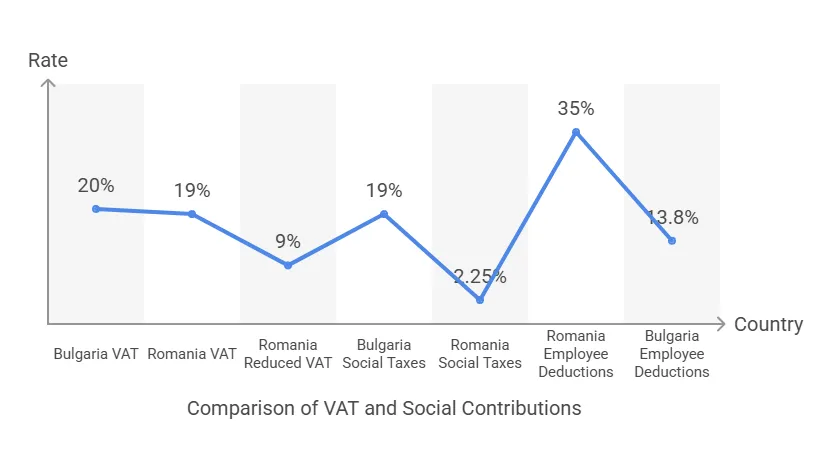
Value-Added Tax (VAT) affects companies’ cash flow and pricing, especially those selling goods or services locally or across the EU. Both countries use the EU VAT framework but with different rates and thresholds:
Ставки НДС: Стандартная ставка НДС в Румынии составляет 19%, немного ниже, чем в Болгарии 20%. Both have reduced VAT rates of 9% on items like books, pharmaceuticals, and hotel accommodations. Romania also has a super-reduced 5% VAT on certain goods. The one-percentage-point difference in standard VAT is minor but could influence large consumer-oriented businesses.
Порог регистрации НДС: In Romania, mandatory VAT registration is required once annual turnover exceeds RON 395,000 (примерно €79,500), increased from RON 300,000 via GEO 22/2025 effective September 2025. In Bulgaria, the threshold was historically BGN 100,000; following Bulgaria’s euro adoption on January 1, 2026, this is now approximately €51,130. Romania therefore allows significantly higher sales volume before mandatory VAT than Bulgaria.
Соответствие НДС: Both countries require periodic VAT returns (monthly or quarterly depending on turnover). As EU members, companies in both jurisdictions obtain EU VAT numbers and trade across the EU using the reverse-charge mechanism and One-Stop-Shop (OSS) systems. Romania has introduced SAF-T digital reporting for VAT, initially for large taxpayers. VAT administration is broadly comparable between the two.
For international investors, the main VAT consideration is often cash-flow impact and registration hassle. If an investor plans only to export services or goods (zero-rated for VAT) and remains under the threshold, they may initially avoid VAT registration. Romania’s higher threshold (~€79,500 vs ~€51,130) gives more room before registration becomes mandatory.
Социальные взносы работодателей и работников
Beyond corporate taxes, labor taxation — social security and payroll costs — affects the total cost of doing business, especially for companies with significant staffing. Both countries have flat income tax of 10% on individuals, but social contributions differ substantially in structure:
Румыния – Социальные взносы: In a 2018 reform, Romania shifted most social security burden onto employees. Employees pay 25% for pension and 10% на медицинское страхование на общую сумму 35% employee contribution withheld from gross wages. Employers pay only a 2.25% work insurance contribution on gross payroll under normal conditions. If employees work under special or hazardous conditions, the employer must contribute an additional 4% or 8% for pensions. The construction sector currently has reduced contributions and zero income tax for employees up to a certain wage, as a workforce incentive lasting through 2028.
Болгария – Социальные взносы: Bulgaria splits the social security burden between employer and employee at roughly a 60:40 ratio. For typical office employees, the employer pays around на 18.9–19.6% заработной платы (включая социальное страхование, медицинское страхование и фонд от несчастных случаев), а работник платит около 13.8% (10.58% for pension and 3.2% for health). Bulgaria caps the maximum income subject to social security at approximately € 1,738 в месяц (formerly BGN 3,400 before euro adoption), which reduces the relative burden for higher salaries — income above the cap is not charged social contributions.
Сравнение: For an employer, Romania’s formal labor cost is lower due to the employee-side tax shift — employers pay only ~2.25% on top of gross salary, versus ~19% in Bulgaria. However, employees in Romania see a much larger chunk taken from gross pay. For budgeting, total labor costs often depend more on base salary levels than on contribution rate differences, and Bulgaria’s average wages remain lower than Romania’s for comparable roles.
Note on IT sector exemptions: Romania previously exempted IT employees from the 10% income tax, a policy that made hiring tech talent more cost-effective. As of January 2025, this sector-specific exemption was fully abolished. It has been replaced by a generic RON 300 per month exemption for minimum-wage workers across all sectors. Bulgaria never offered an equivalent IT sector tax break. Both countries now tax IT salaries identically to other sectors.
Налоговые льготы на НИОКР и инновации
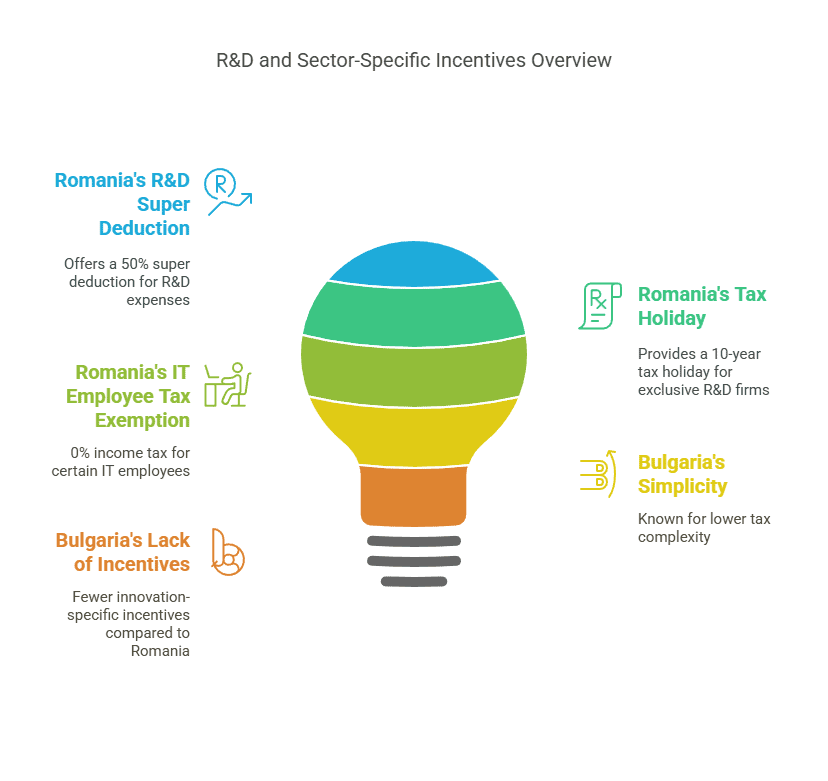
For companies focused on research, development, or innovation, tax incentives can tip the scales. Romania maintains a clear advantage with multiple R&D incentives, while Bulgaria relies mostly on its low base rate and EU grants.
Налоговые льготы на НИОКР в Румынии:
50% Super Deduction: Companies engaging in qualifying R&D can deduct an additional 50% of eligible R&D expenses from taxable profit, on top of the normal deduction. This means €100 of R&D spend yields a €150 deduction.
New 10% Refundable R&D Tax Credit (2026): Introduced via Emergency Ordinance 8/2026, companies can alternatively claim a 10% refundable tax credit on qualifying R&D expenditure. Unused amounts become tax receivables that can be offset or refunded over up to four fiscal years. This is available as an alternative to the 50% super-deduction — companies choose whichever is more beneficial.
Ускоренная амортизация: Equipment used in R&D can be depreciated faster for tax purposes, allowing companies to defer taxes.
Освобождение от налога на реинвестированную прибыль: Romania offers CIT exemption on profits reinvested in certain technological equipment (machinery, computers), benefiting growing tech and manufacturing firms.
10-летние налоговые каникулы для компаний, занимающихся НИОКР: Companies whose exclusive activity is R&D and innovation can qualify for a 10-year corporate tax exemption. This incentive remains active in 2026 alongside the new R&D tax credit.
Налоговые льготы Болгарии: Bulgaria does not have specific R&D credits or super-deductions at the national level. Instead, Bulgaria offers regional investment incentives — investors in high-unemployment areas can receive a refund or reduction of up to 100% of CIT for a period, contingent on reinvesting the saved tax and meeting job creation targets. Bulgaria’s government also offers EU-funded grants and innovation fund programs for R&D projects. The strategy is “low taxes for all” rather than targeted R&D breaks.
For R&D-heavy businesses, Romania’s regime is clearly more favorable. A company spending heavily on research can combine the 50% super-deduction (or the new 10% tax credit), accelerated depreciation, and the reinvested profit exemption to achieve effective tax rates well below Bulgaria’s 10%. The 10-year tax holiday for dedicated R&D firms is especially powerful for startups and research centers establishing operations in Romania.
Глобальный минимальный налог (второй столп)
A major development since 2024 is the EU’s implementation of the Global Minimum Tax under Pillar Two of the OECD/G20 framework. This directly affects the comparative attractiveness of Bulgaria’s low 10% CIT rate for large multinational groups.
Объем: The rules apply to multinational enterprise (MNE) groups and large domestic groups with consolidated revenues of 750 миллиона евро или более in at least two of the last four fiscal years. Smaller businesses are unaffected.
Румыния: Implemented via Law 431/2023, effective from fiscal year 2024. Romania has a Qualified Domestic Minimum Top-up Tax (QDMTT) in place. The first filing deadline (for FY2024) is June 30, 2026.
Болгария: Also effective from January 1, 2024. Bulgaria has implemented all three mechanisms: QDMTT, the Income Inclusion Rule (IIR), and the Undertaxed Profits Rule (UTPR, effective from January 1, 2025). Further amendments were published in the State Gazette on March 27, 2025, with additional Ministry of Finance guidance issued in April 2026.
Impact on Bulgaria’s 10% CIT: For in-scope MNE groups, Bulgaria’s 10% CIT rate no longer provides a sub-15% tax advantage. The QDMTT bridges the gap to the 15% minimum effective rate, meaning large groups effectively pay 15% in Bulgaria rather than 10%. Bulgaria’s 10% rate remains fully attractive for groups below the €750 million revenue threshold — the vast majority of businesses.
Romania’s Position: Since Romania’s standard CIT is already 16% (above the 15% minimum), Pillar Two has minimal practical impact on most Romanian entities. The micro-enterprise regime (1% on turnover) is almost certainly outside scope given the €750 million threshold.
Transitional Safe Harbors: Bulgaria offers three transitional safe harbors: a de minimis test (under €10 million turnover and under €1 million profit), a simplified ETR test using Country-by-Country Reporting data, and a routine profit test based on substance carve-outs. These can simplify compliance for qualifying groups.
For most small and mid-sized investors, Pillar Two changes nothing — Bulgaria’s 10% rate remains a genuine advantage. But for large multinational groups considering a Bulgarian entity primarily for tax reasons, the effective rate is now 15%, narrowing the gap with Romania’s 16%. Structuring decisions for in-scope groups should account for this new reality.
Налоговые льготы для отдельных секторов (ИТ, производство, стартапы)
Beyond R&D, certain industries enjoy tailored tax or fiscal benefits in each country:
Информационные технологии: Romania’s IT sector previously benefited from a personal income tax exemption for software developers, but this was abolished from January 2025. IT professionals in Romania are now taxed at the same 10% flat rate as all other employees. Bulgaria never offered an equivalent IT-specific break. Both countries remain attractive for tech operations due to their skilled workforces and competitive salary levels, but Romania no longer has a tax-driven edge for IT hiring. Romania’s talent pool (~150,000 IT professionals) is larger than Bulgaria’s (~70,000), which may be more relevant than tax differentials going forward.
Производство и промышленность: Both countries compete for manufacturing FDI. Bulgaria’s key advantage is lower wage costs and the potential for CIT refunds in high-unemployment regions — effectively eliminating corporate tax for a period if profits are reinvested. Romania does not offer regional CIT holidays, but its reinvested profit exemption allows manufacturing firms to upgrade machinery tax-free, and its proximity to major auto assembly plants (Renault’s Dacia, Ford) creates valuable cluster effects.
Стартапы и МСП: Romania’s restructured micro-company regime (1% on turnover up to €100,000) remains a meaningful perk for very small businesses. Bulgaria’s 10% flat CIT is simple and predictable at all scales. For pre-profit startups, neither country taxes them, but Romania’s micro regime can offer lower effective taxation once small profits emerge in early-stage service businesses.
In sum, sector-based tax benefits are more pronounced in Romania for R&D and innovation, while Bulgaria’s strategy remains broadly low taxes with targeted regional investment incentives. The abolition of Romania’s IT exemption has leveled one significant differentiator between the two jurisdictions.
Нормативная среда и простота ведения бизнеса
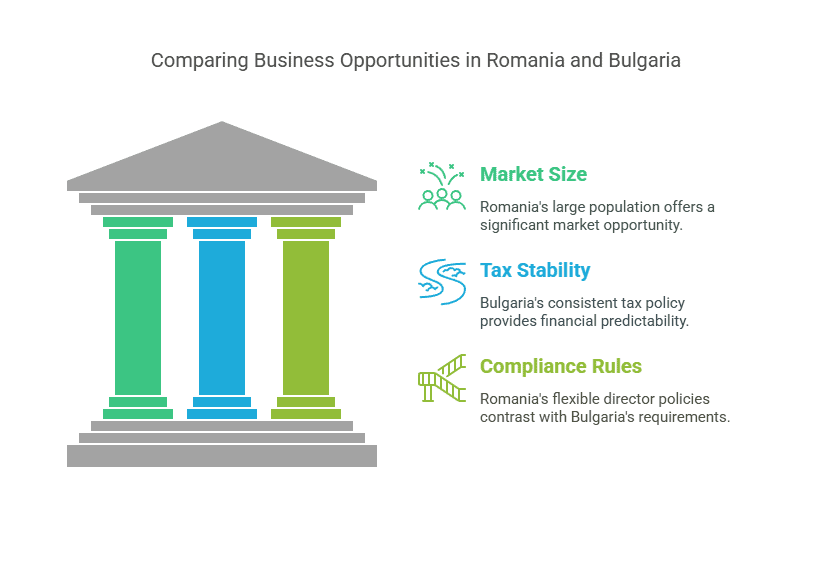
Tax advantages alone do not determine a favorable jurisdiction — the regulatory environment, ease of incorporation, and ongoing compliance burden are equally important:
Простота регистрации: Both countries allow 100% foreign ownership with no restrictions on profit repatriation. Romania uses the “SRL” and Bulgaria the “OOD” as common limited liability forms. Romania has essentially eliminated minimum share capital requirements. Bulgaria’s minimum capital for an LLC is approximately €1. One notable difference: Bulgaria requires non-EU foreign directors to obtain a residence permit to register a company, adding time and complexity. Romania imposes no residency requirement for directors or shareholders, making it more straightforward for non-EU entrepreneurs.
Incorporation Timeline: Setting up a company in Romania can be completed in about 3–5 days with documents in order. Bulgaria may take 1–2 weeks including any director residency paperwork for non-EU nationals. Both have low setup costs (a few hundred euros for registration and notary fees).
Бюрократия и управление: Romania has made strides in reducing red tape through online filing systems and a one-stop-shop Trade Registry. However, investors sometimes encounter frequent legislative changes and inconsistent enforcement. Bulgaria offers more regulatory stability in tax policy — its 10% flat CIT has been unchanged since 2007 — but faces its own challenges with perceived corruption in public procurement and lower judicial efficiency. Transparency International’s corruption index rates both countries in a similar range, generally toward the lower end among EU members.
Административное соответствие: Both countries require annual financial statements and tax returns. Romania mandates an audit once companies exceed certain size criteria, as does Bulgaria. EU compliance obligations (GDPR, competition law, environmental regulations) apply equally in both jurisdictions.
Neither country poses prohibitive regulatory obstacles. Romania might edge out for those who want quick setup without residency requirements and a larger domestic market, while Bulgaria appeals to those who value stable tax laws and simpler tax administration.
Членство в ЕС, доступ на рынок и соответствие требованиям
Both Romania and Bulgaria are EU members (joined in 2007), providing investors with full EU market access and regulatory protections:
Доступ к единому рынку: A company in either country can freely trade goods and services throughout the EU without customs duties. Both participate in EU free trade agreements, enabling exports under preferential terms to global markets.
Налоговые директивы ЕС: Both implement the Parent-Subsidiary Directive (0% WHT on qualifying intra-EU dividends), the Interest and Royalties Directive (0% WHT on cross-border interest and royalties between associated EU companies), and follow EU VAT rules including the reverse-charge mechanism. They also comply with the Anti-Tax Avoidance Directive (ATAD), meaning substance requirements and transfer pricing rules are in force.
Валюта и еврозона: A major change in 2026: Bulgaria adopted the euro on January 1, 2026, becoming the 21st eurozone member state. The conversion rate was fixed at EUR 1 = BGN 1.95583. Dual circulation of the lev and euro runs through June 30, 2026, after which the euro becomes the sole legal tender. This eliminates currency risk for euro-denominated investors operating in Bulgaria. Romania’s leu (RON) continues to float (approximately 4.95 RON/EUR) and Romania has no confirmed euro adoption date. For investors, Bulgaria’s eurozone membership is now a significant advantage — no foreign exchange risk, lower transaction costs, and full integration with eurozone financial infrastructure.
Шенгенская зона: Both Romania and Bulgaria have joined the Schengen area, with air and sea border controls lifted in March 2024 and land border controls removed from January 2025. This streamlines cross-border logistics and the movement of personnel for businesses operating across EU borders.
Финансирование ЕС: Both countries receive substantial EU development funds. Investors can benefit through improved infrastructure and direct grants for investments in sectors like manufacturing, R&D, and green energy. Romania’s larger size means a bigger absolute envelope of EU funds.
For market proximity, Romania’s population of 19 million offers a larger domestic customer base, while many Bulgarian companies produce primarily for export. If pure EU access at the lowest cost is the priority, Bulgaria — now with the added advantage of eurozone membership — is an efficient gateway.
Реальные примеры и сценарии
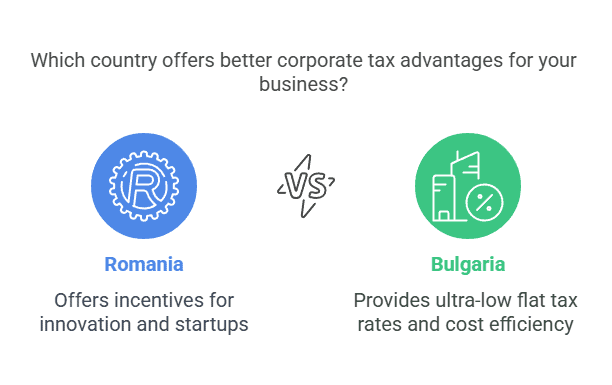
To illustrate how these differences play out in practice:
Tech Development Center: A U.S. software firm choosing between Sofia and Cluj-Napoca for a 100-person team. With Romania’s IT salary exemption now abolished, both countries tax tech salaries at 10% flat PIT. Romania still offers the 10-year R&D tax holiday for dedicated R&D entities and the new 10% refundable tax credit on R&D spending. Bulgaria offers a flat 10% CIT with no additional incentives. If the operation qualifies as pure R&D, Romania’s 0% CIT for 10 years is a decisive advantage. For a cost center or support operation, Bulgaria’s lower base salaries and newly euro-denominated economy may be more practical.
Автомобильное производство: A car parts manufacturer expecting €5 million in annual profits. In Bulgaria, CIT would be €500,000 at 10% (or potentially €0 using regional CIT relief in a high-unemployment area). In Romania, CIT would be €800,000 at 16%, partially offset by the reinvested profit exemption if the company invests in new equipment. Bulgaria’s lower ongoing tax cost and lower labor costs make it attractive for capital-intensive manufacturing in designated regions, while Romania’s established automotive clusters (Renault, Ford, Continental, Bosch) offer supply-chain advantages.
Holding Company / E-Commerce: An international entrepreneur wanting an EU base for an e-commerce business. Bulgaria’s 10% CIT on retained earnings and 5% on dividends — now denominated in euros — make it a straightforward, low-cost option. Romania’s 16% CIT and 16% dividend WHT are considerably higher for a holding or trading vehicle. For pure tax optimization with minimal local operations, Bulgaria is typically favored. Romania may be chosen if the investor plans to leverage its larger consumer market or access EU-funded programs.
Green Tech Startup: A startup developing new clean technology. In Romania, qualifying as an R&D-focused company could unlock the 10-year CIT exemption and the new 10% refundable tax credit on R&D spending. In Bulgaria, the startup would pay 10% on any profit (likely minimal in early years). Once the startup becomes profitable, Romania’s incentives become significantly more valuable — 0% CIT for up to 10 years versus Bulgaria’s 10%. Romania’s larger startup ecosystem (particularly in Bucharest and Cluj) also provides stronger networking and financing opportunities.
Companies often strategically use both countries — for instance, incorporating a Romanian entity for R&D incentives and a Bulgarian entity for low-tax holding or trading activities. Both countries are geographically close and in the EU, making a dual-presence feasible for larger investors. For guidance on structuring cross-border operations that may also include Armenia, see our Регистрация бизнеса и налоговый консалтинг сервисов.
Conclusion: Which Jurisdiction is Better in 2026?
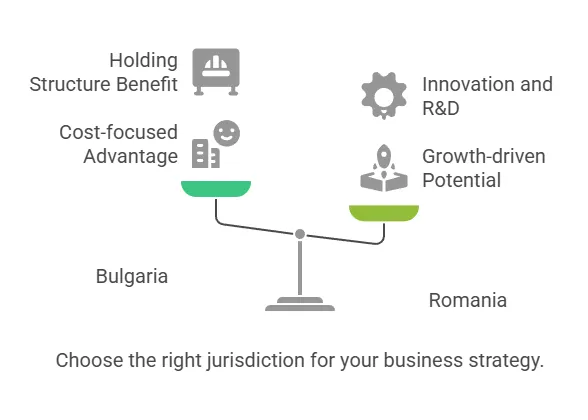
The answer depends on your priorities and business model:
Choose Bulgaria for lowest taxes, eurozone access, and cost minimization. Bulgaria’s 10% CIT, 5% dividend tax, and new eurozone membership create a compelling package for profit-generating companies, holding structures, and businesses serving EU-wide markets. Currency risk is now eliminated for euro-based investors. The main caveat: for multinational groups with €750 million or more in consolidated revenue, Pillar Two effectively raises the rate to 15%.
Choose Romania for R&D incentives, a larger domestic market, and targeted tax breaks. Romania’s 10-year R&D tax holiday, new refundable R&D tax credit, 50% super-deduction, and restructured micro-enterprise regime (1% for firms under €100,000) offer pathways to effective tax rates well below the headline 16%. Companies focused on technology, innovation, or high value-add manufacturing benefit most. The simpler incorporation process (no director residency requirement) and deeper talent pool are additional advantages.
For labor-intensive operations, Bulgaria’s lower base wages may outweigh Romania’s lower employer social contribution rate (2.25% vs ~19%). With Romania’s IT exemption now abolished, there is no longer a tax-driven hiring advantage for tech talent in either direction — the choice depends on talent availability, salary expectations, and operational needs.
For tax stability, Bulgaria’s track record is stronger — its 10% flat CIT has been unchanged since 2007. Romania has made frequent adjustments (dividend WHT from 5% to 8% to 10% to 16%, micro-regime restructuring, IT exemption abolition). Investors who value predictability in long-term tax planning may prefer Bulgaria’s consistency.
Both Romania and Bulgaria are low-tax, investment-friendly EU jurisdictions offering competitive platforms for European and global expansion. The optimal choice — or a combination of both — depends on your specific industry, profit margins, growth trajectory, and structuring needs. Working with advisors experienced in cross-border tax planning ensures you capture the full benefit of whichever jurisdiction you choose. For investors also considering Armenia as part of a multi-jurisdiction strategy, our team can advise on how to integrate резидентство по инвестициям or Armenian tax advantages into your overall structure.
