

En un coup d'oeil
- Congés annuels minimum : 20 working days (5-day week) or 24 working days (6-day week)
- Vacances publiques: 13 official non-working days per year
- Vacation pay: Must be paid at least 3 days before leave begins
- Leave notice: 3 days advance notice required for leave requests
- Unused leave on termination: Compensation covers all leave types under Armenian labor law, not just annual leave
- Reporter: Unused leave may carry over with employee consent; employer can force leave after 2.5 years
Employers operating in Armenia — especially those managing international teams or subsidiaries — must navigate local labor laws to remain compliant. Two key areas are congé annuel payé et vacances publiques, which are governed by the Armenian Labor Code. This guide explains the rules and entitlements for annual leave and official public holidays in Armenia as of 2026, with practical examples and legal references. It is designed for HR professionals, employers, and consultants to ensure company policies meet local requirements.
Annual leave entitlements under Armenian labor law
La loi arménienne prévoit un congé annuel payé généreux pour employésLe Code du travail garantit un nombre minimum de congés annuels pour tous les salariés et précise les modalités d'accumulation, de prise et de paiement des congés. La compréhension de ces règles est essentielle pour s'y conformer.
Minimum annual leave duration and eligibility
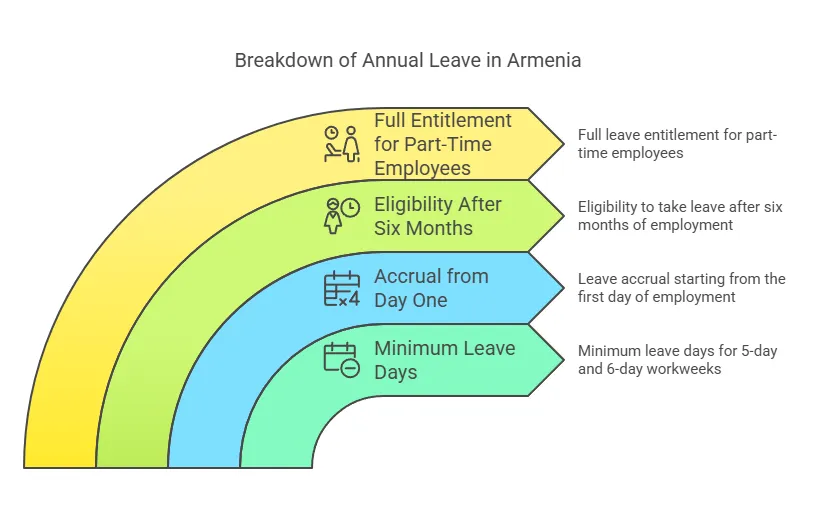
Tous les employés en Arménie ont droit à un congé annuel payé — this is a fundamental right under the Labor Code. The durée minimale du congé annuel pour un employé à temps plein est 20 jours ouvrables pour une semaine de travail de cinq jours ou 24 jours ouvrables pour une semaine de travail de six jours. In practice, this equates to four calendar weeks of vacation per year. Part-time employees are also entitled to the minimum annual leave, non réparti au prorata — the law explicitly states that part-time status does not reduce leave entitlement.
Employers cannot offer less than this minimum. Many international employers are surprised by how high this statutory minimum is — comparable to European standards — and must adjust their company policies accordingly. For instance, a company accustomed to giving 10 business days of vacation would be non-compliant in Armenia, where the legal minimum is roughly double that.
Eligibilité: Les employés commencent à accumuler des congés dès le début de l'emploi, mais le Code stipule que le congé annuel pour la première année est généralement accordé après six mois d'emploi continu with the company. However, this six-month waiting rule can be waived by agreement. The law allows employers and new employees to agree to take leave earlier within the first six months if desired — a provision especially useful for international hires or transfers who might need time off sooner. Starting from the second year of employment, les congés annuels peuvent être pris à tout moment de l'année de travail as per the agreed leave schedule.
Leave notice: Under Armenian labor law, employees are required to give at least 3 days advance notice when requesting annual leave. Employers should incorporate this requirement into their internal leave request procedures.
Example — First-year eligibility: Supposons qu'un employé rejoigne une entreprise en Arménie on February 1, 2026. By August 1, 2026 (after six months of uninterrupted work), they become eligible to take their annual leave for the first working year. If the employer and employee agree, the employee could even take some leave before August (e.g., a short vacation in June 2026), because the law permits early annual leave by mutual consent. In the second year (2027), the employee could schedule their annual leave at any time during the year according to the company’s leave plan.
Accrual of leave: Although Armenian law does not require a monthly accrual system (it grants the full annual entitlement for each working year), many employers calculate accrual for administrative purposes. Over a 12-month period, 20 jours ouvrables de congés équivalent à environ 1.67 jour par mois of service. If an employee leaves the company before using all their leave, they are typically entitled to payment for any congés accumulés mais non utilisésDe même, si un employé n’a travaillé qu’une partie de l’année, ses congés payés au moment du départ sont calculés au prorata de la durée de service au cours de cette année.
Extended and additional annual leave (special cases)
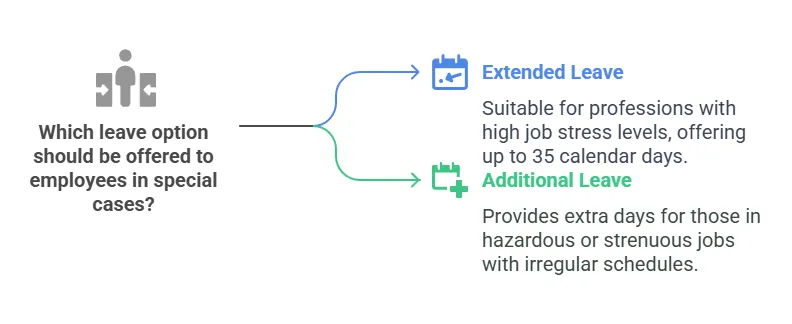
While 20 working days is the minimum for most employees, Armenian law provides prolongé et supplémentaire annual leave for certain categories of workers due to the nature of their work.
Congés annuels prolongés : Employees in jobs that involve great nervous, emotional and intellectual strain or professional risk are entitled to an extended vacation of up to 25 working days for a five-day workweek (30 for six-day), and in exceptional cases up to 35 working days for a five-day workweek (42 for six-day). The Government of Armenia defines which positions qualify. This typically covers teachers, high-stress technical roles, or other roles explicitly listed by government decree.
Congés annuels supplémentaires : Certaines conditions de travail justifient jours de congé supplémentaires en plus du minimum. Under Armenian labor law, additional annual leave may be granted to les employés travaillant dans des conditions nocives ou dangereuses, ceux dont les horaires de travail sont non réglementés (irréguliers) ou ceux qui effectuent des travaux de nature particulière. The government defines the specific categories and the minimum extra days for each. This additional leave is ajouté au congé de base de 20 jours.
If a worker qualifies for both extended and additional leave, they choose either the extended leave or the minimum plus additional days — they do not double-count both. In practice, most office-based or standard jobs will stick to the minimum 20 jours ouvrables. HR should check if any roles in their organization fall under government lists for extended or additional leave and reflect entitlements in employment contracts.
Scheduling annual leave and company policies
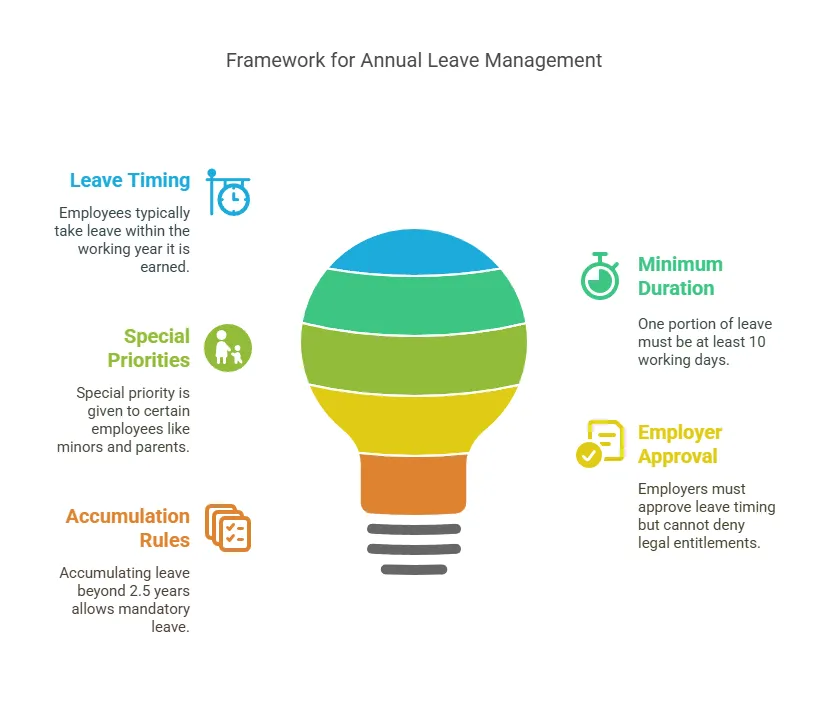
Timing of leave: Les congés annuels sont généralement pris pendant la année de travail au cours de laquelle il est gagné. The “working year” for each employee is defined as the 12-month period starting from their hire date. Employers commonly use a calendrier des congés to plan when employees will take vacations. If there is a collective agreement it may set out the scheduling procedure; otherwise, the schedule is set by mutual agreement between employer and employee.
Splitting leave: La loi arménienne autorise les congés annuels pris en plusieurs parties, but with an important restriction: one portion must be a continuous period of at least 10 jours ouvrables (two calendar weeks) for a five-day workweek employee, or 12 jours ouvrables for a six-day workweek. The employee is legally entitled to au moins deux semaines de vacances ininterrompues. Splitting into smaller pieces is possible only if the employee agrees.
Préférences des employés : Après six mois d’emploi, certains salariés ont une droit légal de choisir leur période de vacances. Priority is given to les employés de moins de 18 ans, les employées enceintes ou celles élevant un enfant de moins de 14 ans, and husbands during their wife’s maternity leave. Similarly, employees pursuing education can align vacations with exam periods, and teachers can take leave during school holidays in their first year of work.
Approbation de l'entreprise : Employers have the right to approve the timing of leave based on business needs, as long as the employee gets their full entitlement within the year. It is best practice to have a clear politique de congé: requiring leave requests to be submitted in writing at least 3 days in advance, and handling overlapping requests fairly.
Employer’s obligation to ensure leave is taken
Les congés annuels sont destinés à être utilisés pour se reposer et ne peuvent être reportés indéfiniment. Le droit du travail arménien n’encourage pas la thésaurisation des congés. An amendment effective 1 décembre 2023 introduced a mechanism for employers to ensure employees take their vacation.
Forcing leave after 2.5 years: Si un employé évite ou refuse continuellement de prendre ses congés annuels pendant deux ans et demi, l'employeur a désormais le droit de planifier unilatéralement les congés du salarié in the next period. The employer must also pay a penalty fee: 0.15% of the employee’s average monthly salary for each day of leave postponed beyond the 2.5-year window, up to a maximum of one month’s salary. This amendment is not retroactive for leave accumulated before December 1, 2023.
Carry-over of leave: En règle générale, les congés annuels doivent être utilisés l'année même où ils ont été acquis. Cependant, le Code du travail arménien autorise le report des congés non utilisés sur l'année suivante. si l'employé est d'accord. No special justification is required — the employee’s consent or request is sufficient to defer unused leave. Employers cannot unilaterally postpone an employee’s leave into the next year without such consent.
Payment during annual leave (vacation pay)
Wages during leave: Pendant les congés annuels payés, un employé doit recevoir son salaire moyen so that going on holiday does not financially disadvantage them. Armenian law calculates indemnité de vacances based on the employee’s average earnings over the preceding 12 months. The employer computes an average daily wage and multiplies by the number of leave days.
Timing of payment: Les indemnités de vacances doivent être payées avant le départ - au moins trois jours avant le début du congé du salarié. If the employer fails to pay on time (through no fault of the employee), the employee’s leave is extended by the number of days of delay in payment, and those extra days are also paid as leave. This is a strong incentive for employers to pay promptly.
No work during leave: Annual leave is a rest period — the employee is not to perform work. The employment position is held for them. Rappel de congé n'est autorisé qu'avec le consentement de l'employé. An employee cannot be forced to cut short their vacation, and if they agree to return early, any unused days must be rescheduled.
Unused leave and compensation
La loi arménienne encourage fortement les employés prendre leur congé annuel minimum en nature, rather than employers paying out vacation days. The Labor Code explicitly states that the minimum annual leave ne peut être remplacé par une compensation monétaire during employment. Employers cannot skip giving time off by paying extra salary — such “vacation buy-out” practices would violate Armenian labor law.
Payment in lieu of leave is allowed when an employee is mettre fin à l'emploi. In these cases, any les jours de congés non utilisés doivent être compensés en espèces. Importantly, under Armenian labor law, the term “unused leave” encompasses all types of leave — not only annual leave. This means that upon termination, the payout obligation extends to any accrued but unused leave of any type the employee was entitled to.
Maintain clear records of each employee’s accrued and used leave. Upon termination, calculate exactly how many days were earned versus taken. For instance, if an employee worked half the year and is leaving, they earned half of their annual leave entitlement (about 10 working days out of 20) — pay those out if not taken.
Overlapping public holidays and annual leave
Quand un jour férié occurs during an employee’s vacation period, that day is not charged as a vacation day. Under Armenian law, public holidays are jours chômés payés séparés et should not be counted against annual leave entitlement.
Exemple : An employee takes two weeks of annual leave from April 20 to May 3, 2026. Within this interval, April 24 (Genocide Remembrance Day) and May 1 (Labor Day) are public holidays. The employer should not count these as vacation days. The employee uses 8 of their annual leave days for the other workdays, and the holidays are paid separately — effectively extending uninterrupted time off without reducing the vacation balance.
HR should configure leave tracking systems so public holidays do not deduct from PTO. Armenia’s 13 public holidays are en plus des vacances annuelles. Always double-check each leave request period for any holiday overlap.
Public holidays in Armenia: employer obligations
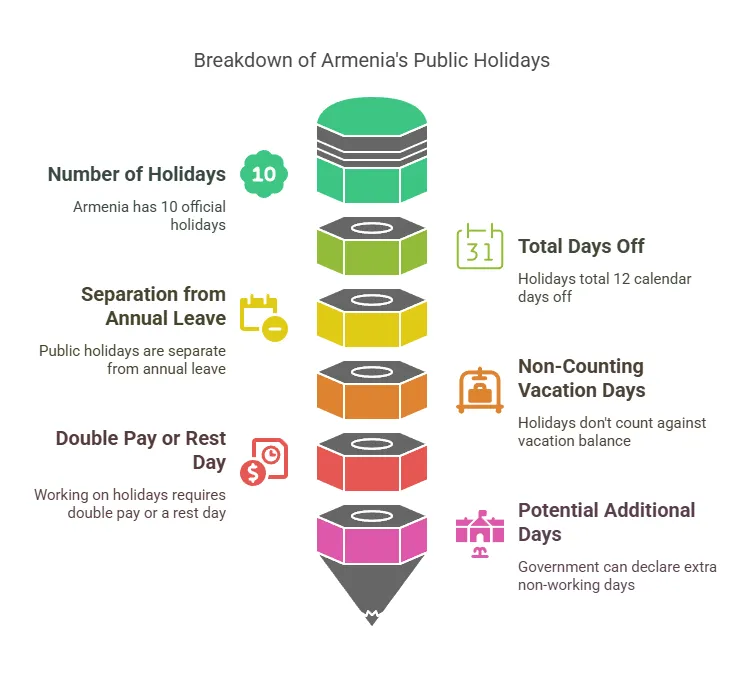
En plus des congés annuels, l’Arménie dispose d’un ensemble de jours fériés officiels chaque année, les employés ont droit à des congés. Ces congés sont fixés par la loi et doivent être accordés sous forme de jours chômés payés. Both local and international employers need to be aware of these dates to plan work schedules, office closures, and payroll.
Legal status of public holidays
The Armenian Labor Code treats public holidays as jours non ouvrés avec salaire complet. No work should be performed except for jobs that cannot be stopped (continuous operations, emergency services, etc.).
Si un employé fonctionne un jour férié, labor law requires premium compensation — typically at least double pay. Alternatively, the employer can arrange a substitute rest day. Companies should document any holiday work and compensation.
Public holidays are distinct from weekends. Armenia generally has a five-day workweek with Saturday and Sunday as rest days. Public holidays may fall on any day of the week and are observed on their calendar date. Unlike some countries, Armenia does not automatically move a holiday to Monday if it falls on a weekend. However, the government sometimes issues decrees to create long weekends by swapping workdays — these are ad hoc decisions and not guaranteed.
Official public holidays in Armenia
As of 2026, Armenia recognizes 13 jours fériés officiels par an:
- décembre 31 — New Year’s Eve
- le 1 janvier — New Year’s Day
- le 2 janvier — New Year’s Day (Day 2)
- le 6 janvier — Christmas Day (Armenian Christmas and Epiphany)
- le 27 janvier — Memorial Day (honoring those who fell in defense of the homeland)
- le 28 janvier — Army Day
- Mars 8 — International Women’s Day
- Avril 24 — Armenian Genocide Remembrance Day
- Mai 1 — Labor Day
- Mai 9 — Victory and Peace Day
- Mai 28 — Republic Day (First Republic Day)
- Juillet 2023 — Constitution Day
- Septembre 21 — Independence Day
Employers should treat these days as paid non-working days. It is advisable to circulate an calendrier des vacances annuelles to all employees at the beginning of the year so everyone is aware of office closures or special pay arrangements.
Note on religious holidays: Armenia has other observances such as Easter and Vardavar. However, only the 13 holidays listed above are official non-working days under labor law. Easter Sunday and Easter Monday are not public holidays by law, so they are regular working days unless an employer voluntarily grants a day off. Companies should not confuse cultural observances with legal holidays.
Managing public holidays in the workplace
HR and payroll considerations: Les jours fériés, employés salariés à temps plein receive their normal salary with no deductions. Travailleurs horaires or those on shift work who are given the day off should also be paid for their scheduled hours. Employers should configure payroll systems so holidays are not counted as leave or absence. When a holiday falls on Saturday, employees on a Monday–Friday schedule do not receive additional compensation — there is no legal requirement for a “day in lieu,” though an employer may offer one as a perk.
For businesses that operate on weekends, a Saturday or Sunday holiday means those scheduled to work must either be given the day off or paid the overtime rate. Planifiez le personnel bien à l'avance pour les vacances: determine whether you will close operations entirely or keep minimal staff, and inform employees of any extra pay or alternative days off.
International companies: If you follow U.S. or European holidays, ensure you also incorporate the Armenian holidays for your Armenian staff. Even if HQ does not close on January 28 (Army Day), the Armenian office or employees should not be asked to work unless properly compensated. Many multinational companies maintain a calendrier de vacances spécifique au pays for each office.
Bridging holidays: The Armenian government often creates long weekends by declaring a Friday off and making a nearby Saturday a working day. These decisions are usually announced in advance. Although these one-time bridge days are not in the Labor Code, honoring them can simplify operations since many employees may take off anyway.
Compliance tips for employers and HR professionals
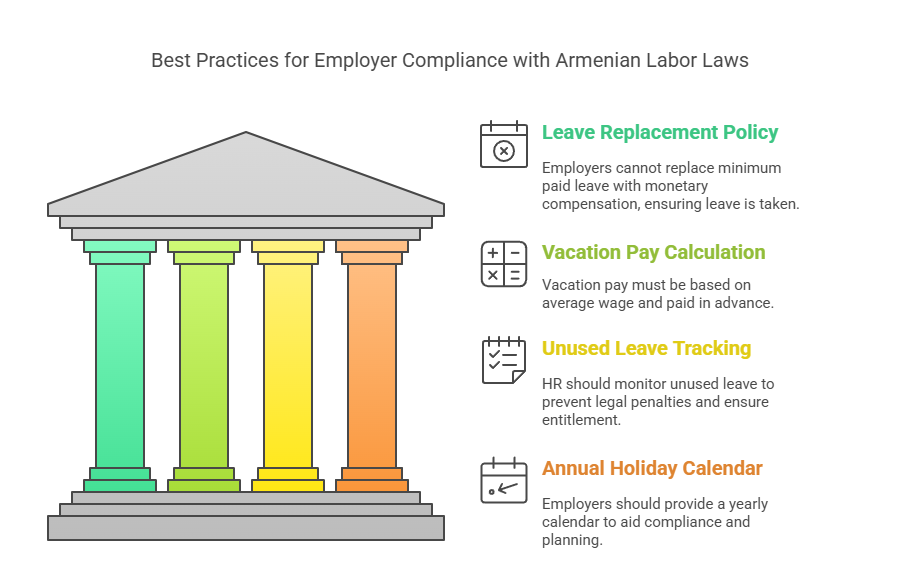
Managing annual leave and public holidays in Armenia requires balancing legal requirements with practical workforce management. Here are key compliance tips for international companies and HR teams.
Align company policy with local law. Review your employment contracts and internal HR policies to ensure the politique de congé annuel meets the Armenian minimum (20 working days for 5-day week) and that all 13 official holidays are recognized. If your global policy offers more generous leave, that is acceptable — but you cannot go below the local minimum.
Leave scheduling system. Implement a transparent system for requesting and approving leave. Given the rule that one portion must be at least 10 working days, encourage employees to take at least a two-week block. Ensure the system enforces the 3-day advance notice requirement.
Track unused leave. Keep track of leave balances and watch for employees not taking leave. The 2.5-year rule means HR should flag anyone who has not taken vacation in about 2 years and encourage them to schedule time off. It is far better to have them take a break than to reach the point of forcing leave and paying a penalty.
Public holiday staffing. Plan ahead for each public holiday. If your operation must run, arrange a rota and inform employees of their rights (like double pay) for holiday work. Communicate holiday closures early — many businesses issue a memo in December for the next year’s holidays.
Educate foreign managers. If you have expatriate managers, make sure they understand Armenian leave norms. A manager in another country might not expect that Armenian employees have a legal right to nearly a month of vacation and 13 holidays. Denying leave or pressuring employees not to take time off would be illegal and counterproductive.
Restez à jour. Labor law updates can occur — such as the 2023 amendments on leave accumulation and the 2026 addition of Memorial Day. Stay informed of any changes and consult local legal advisors when needed.
